About the Project
Inspiration
The inspiration for Unblocked Intelligence Agent came from a problem every software team quietly struggles with: Jira issues don’t fail loudly — they stall silently.
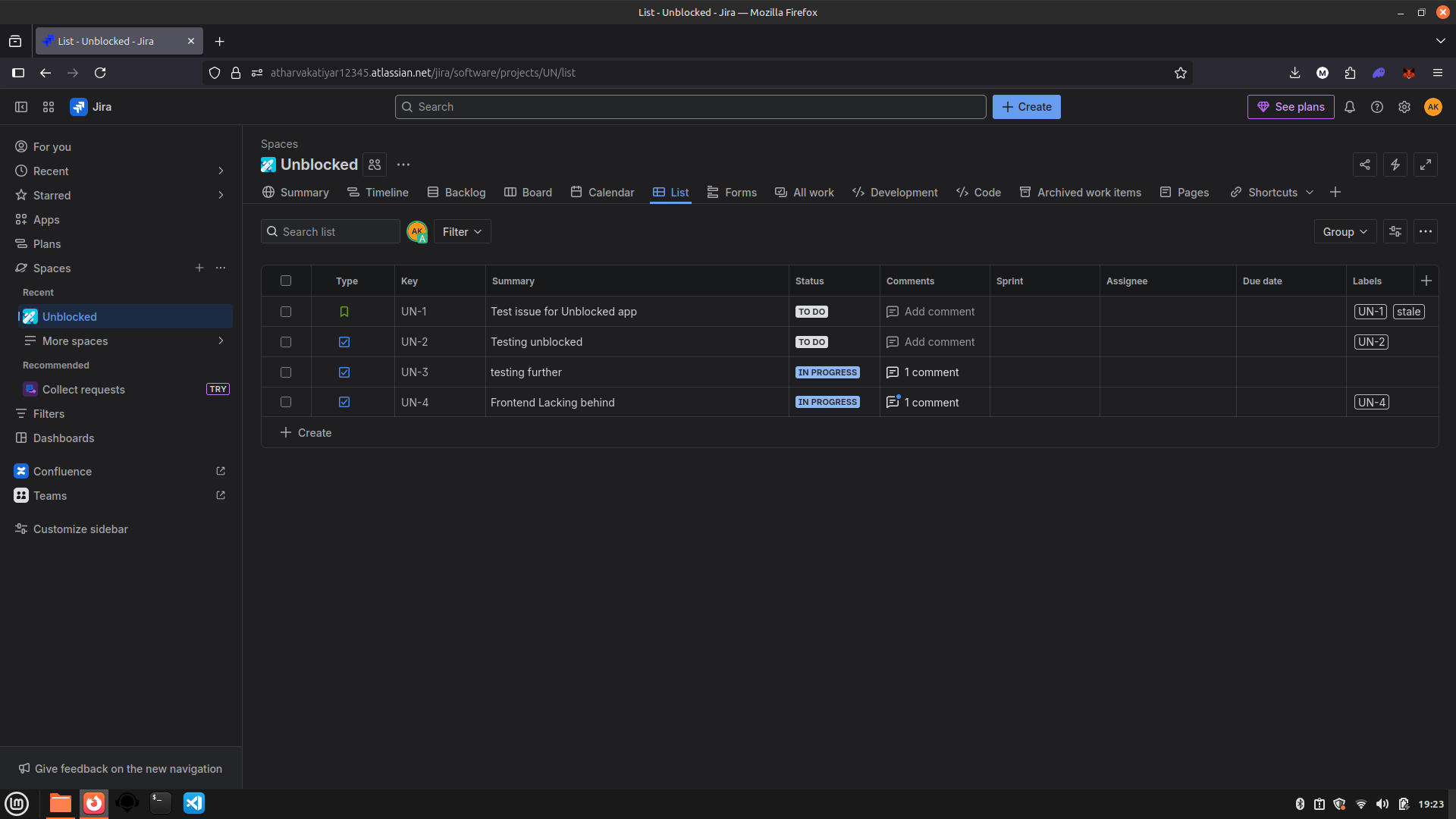
In real teams, issues often sit in “In Progress” for days without updates. No comments. No status changes. No visible blockers. By the time someone notices, the sprint is already at risk, context is lost, and teams spend valuable time reconstructing why work stopped.
Standups, retrospectives, and manual Jira reviews all try to solve this — but they’re reactive and inconsistent. We wanted a system that proactively explains why work is stuck, not just that it is stuck.
That led to a simple guiding question:
“What if Jira itself could tell you why an issue isn’t moving — before it becomes a problem?”
What it does
Unblocked Intelligence Agent is an AI-powered Jira app that automatically detects stalled issues, explains why they’re blocked, and helps teams take action.
For every Jira issue, the app:
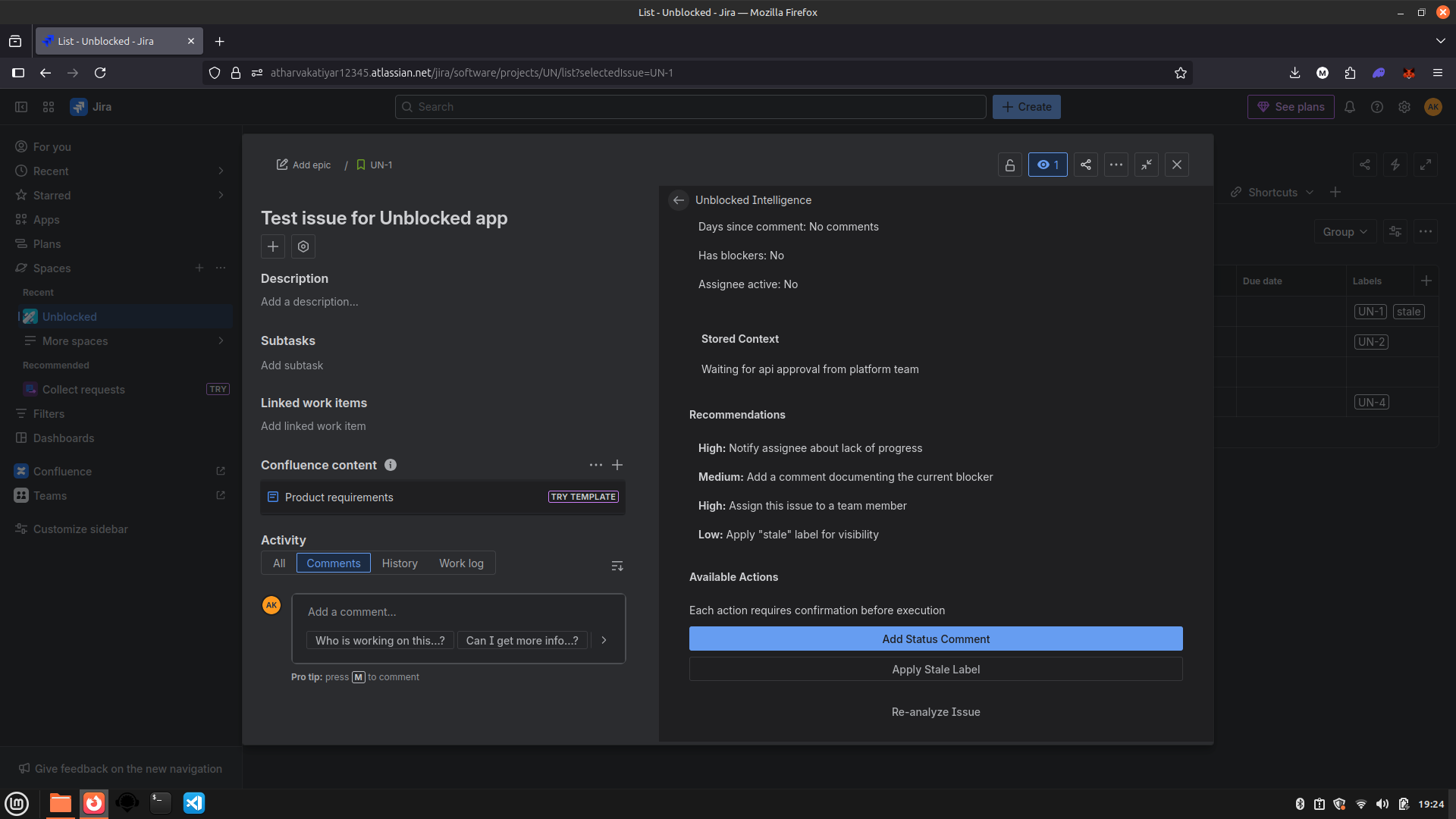
Monitors objective signals like:
- Days since last update
- Days since last comment
- Assignee activity
- Unresolved blocker links
Uses deterministic rules to identify staleness (no black-box guessing)
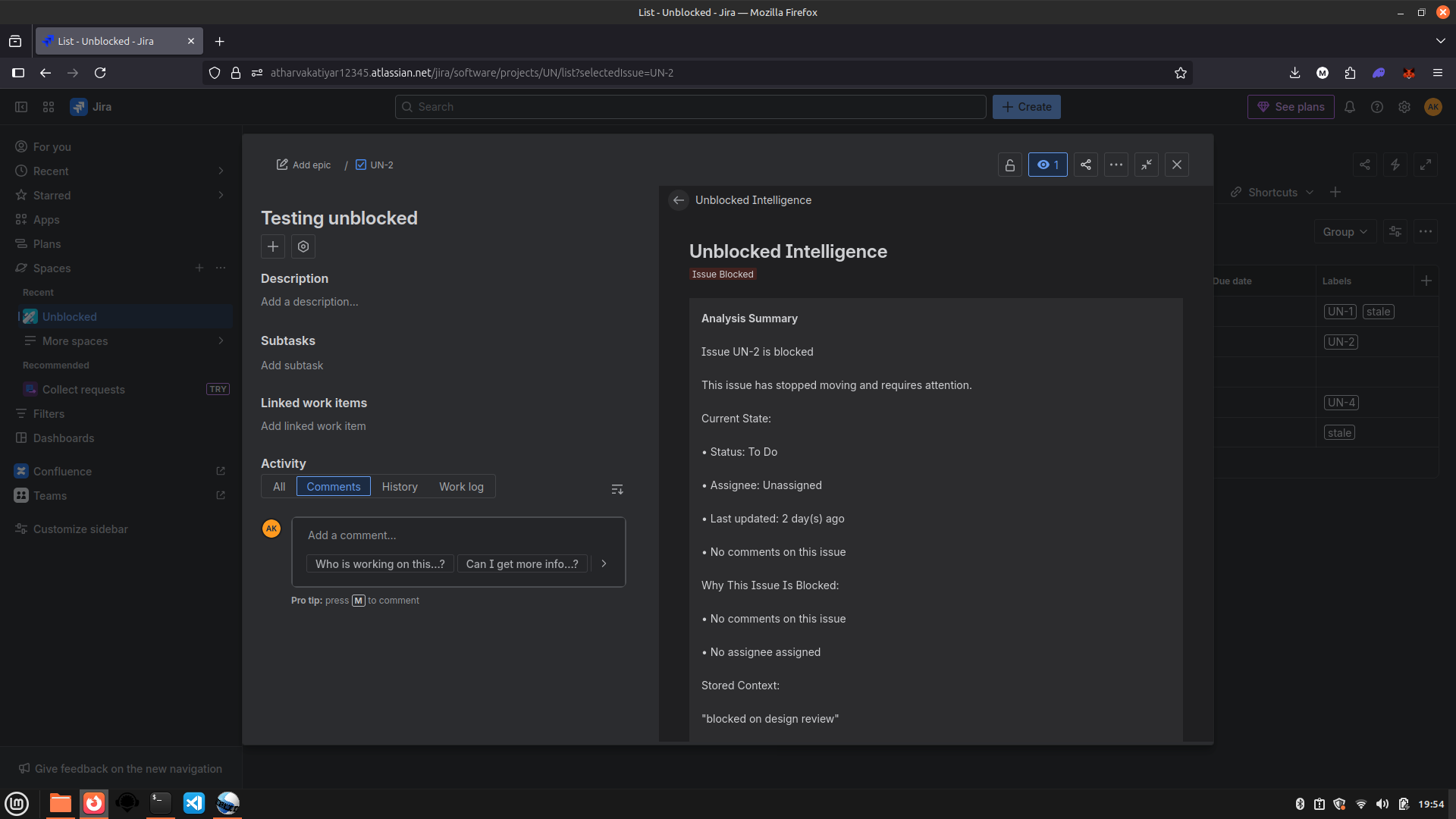
Applies AI reasoning to generate a human-readable explanation
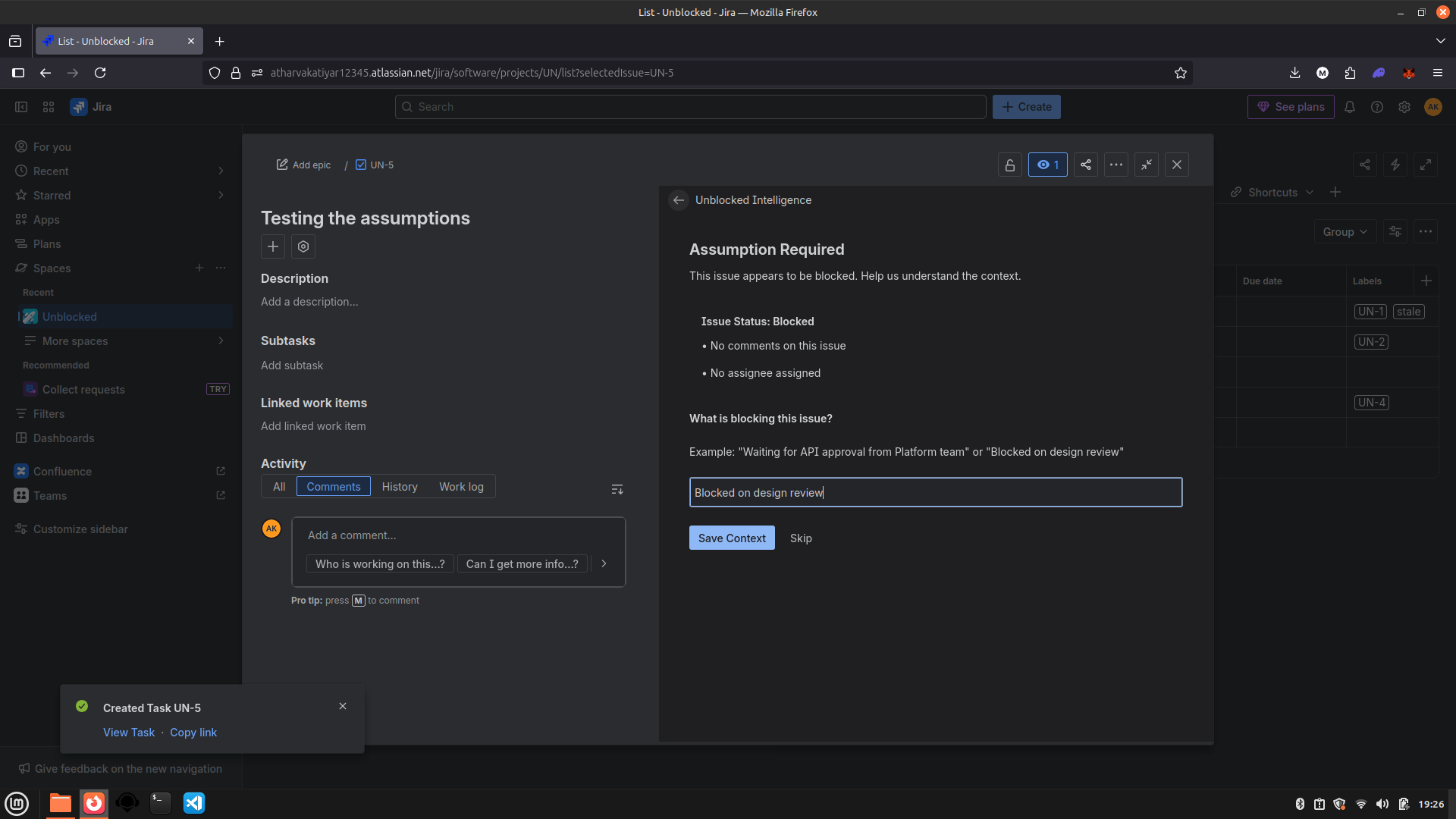
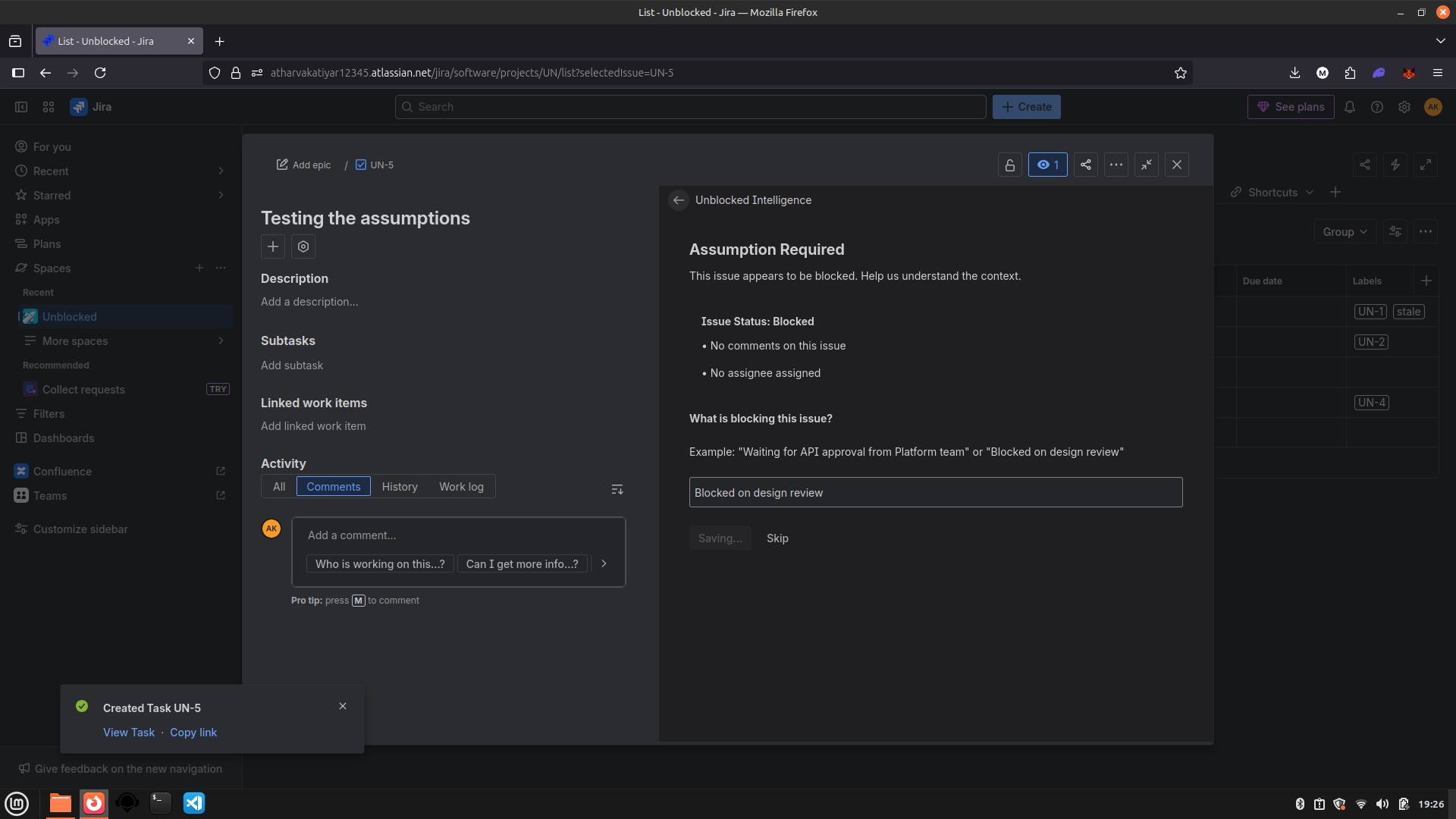
Preserves critical context by storing team assumptions
Suggests safe, confirmed actions like:
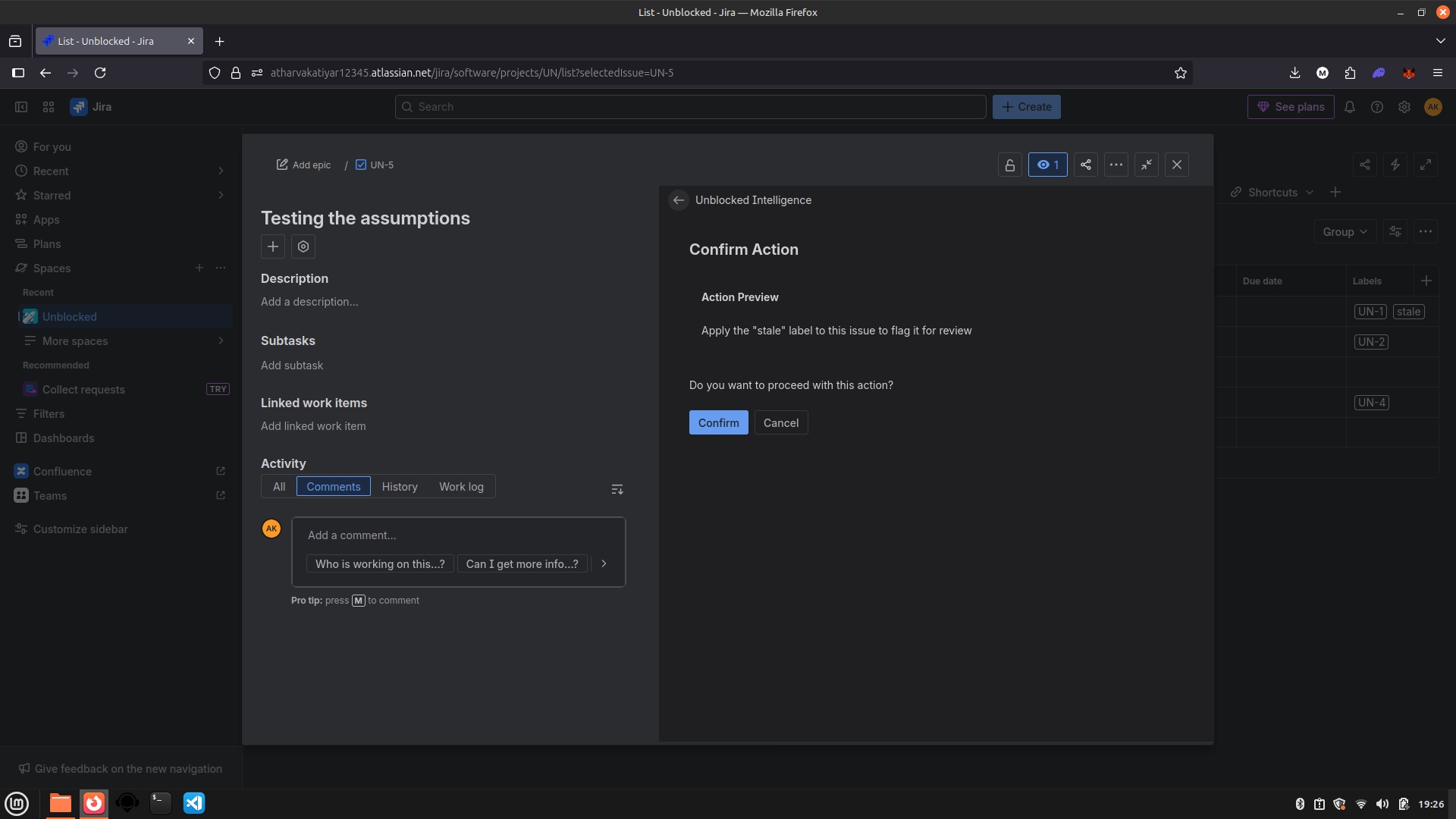
- Adding a stale comment
- Applying a “stale” label
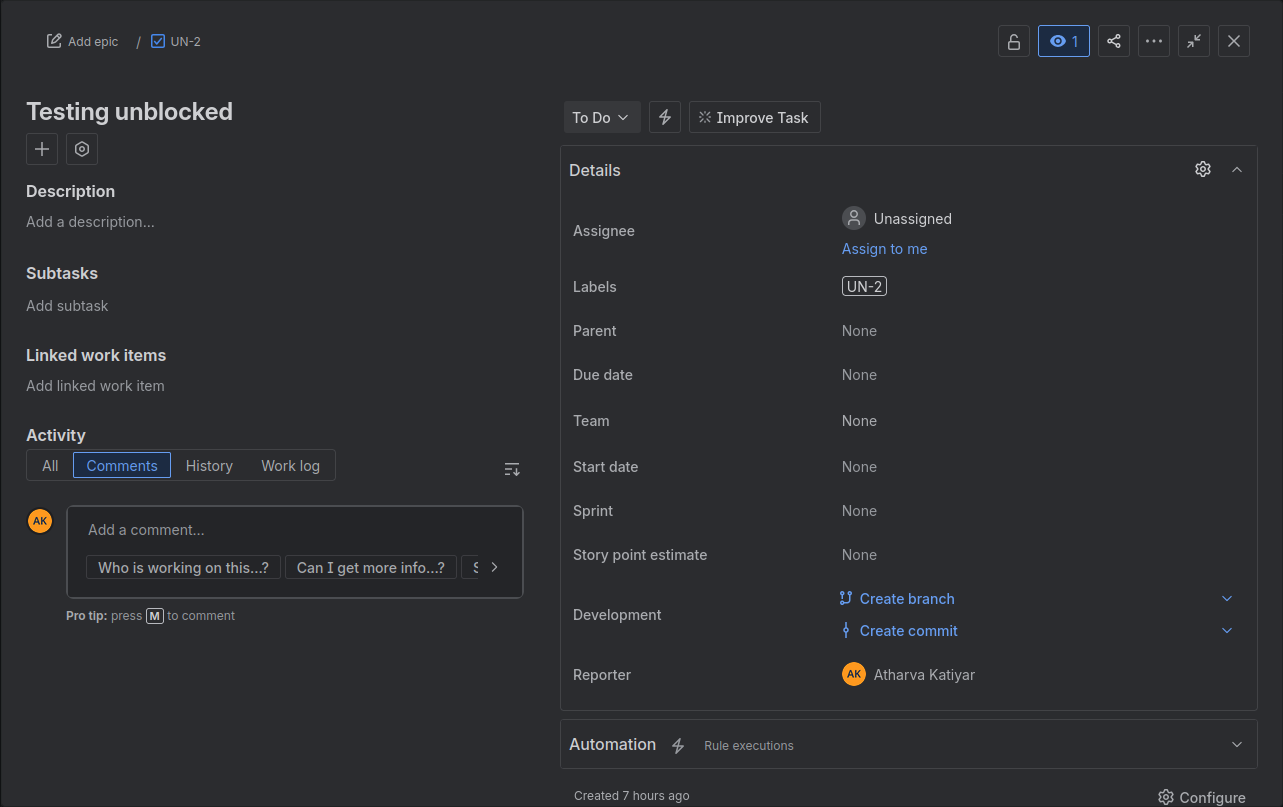
All of this happens directly inside the Jira issue panel, without changing existing workflows.
The result: Teams immediately understand what’s blocking work and what to do next — without manual investigation.
How we built it
The app is built entirely on Atlassian Forge, using a serverless, secure architecture.
Core technologies:
- Forge Runtime (
nodejs22.x) - Forge UI Kit 2 (
@forge/react) - Forge Resolver & Storage APIs
- Jira REST APIs
- Rovo Agent–style contextual reasoning
Architecture overview:
- Frontend (UI Kit 2 + React)
- Renders inside a Jira Issue Glance
- Displays issue health, analysis, assumptions, and actions
- Uses
@forge/bridgeto communicate with the backend
- Backend (Forge Resolvers)
- Fetches issue data from Jira
- Runs deterministic staleness detection
- Generates AI-powered explanations
- Stores and retrieves assumptions
- Executes user-confirmed actions (comments, labels)
- Staleness Detection Engine
Multi-factor algorithm using transparent rules:
- 2+ staleness indicators OR
- 6+ days since last update
Designed to avoid false positives on new issues
- AI Explanation Layer
- Converts raw signals into clear reasoning
- Incorporates stored assumptions
- Produces concise, professional explanations
- Ranks recommended actions by priority
The entire app runs on Atlassian infrastructure, with no external servers, databases, or AI APIs.
Challenges we ran into
Forge UI constraints Forge has strict security and rendering rules. We had to carefully adapt UI patterns and avoid unsupported behaviors (like inline event handlers and external scripts).
Balancing automation with trust Fully automated actions risk surprising users. We intentionally designed a human-in-the-loop flow where the agent recommends actions but never executes them without confirmation.
Avoiding false positives Not every quiet issue is blocked. Designing staleness rules that were strict enough to be useful but flexible enough to be accurate required iteration and real-world thinking.
Explaining, not just detecting Many tools can flag “stale” work. The harder problem was generating explanations that actually make sense to humans — concise, contextual, and actionable.
Accomplishments that we’re proud of
- Built a production-ready Forge app that runs entirely on Atlassian infrastructure
- Created a clear, explainable staleness detection algorithm
- Designed an AI agent that focuses on one real question instead of generic chat
- Preserved human context through assumption tracking
- Delivered real value without changing existing Jira workflows
- Successfully deployed and tested on a live Jira Cloud instance
What we learned
- AI is most useful when paired with deterministic signals, not used alone
- Developers trust systems that can explain their reasoning
- Small, focused agents are more powerful than broad chatbots
- Forge’s constraints encourage better security and architecture decisions
- Real productivity gains come from removing investigation time, not adding dashboards
What’s next for Unblocked
Future enhancements could include:
- Project-level dashboards for blocked work
- Notifications when issues newly become stale
- Team-level analytics and trends
- Configurable staleness thresholds
- Slack or email integrations
- Historical analysis of recurring blockers
The long-term vision is for Unblocked Intelligence to become a quiet but reliable teammate — continuously watching issue flow and stepping in only when human attention is truly needed.

Log in or sign up for Devpost to join the conversation.