-
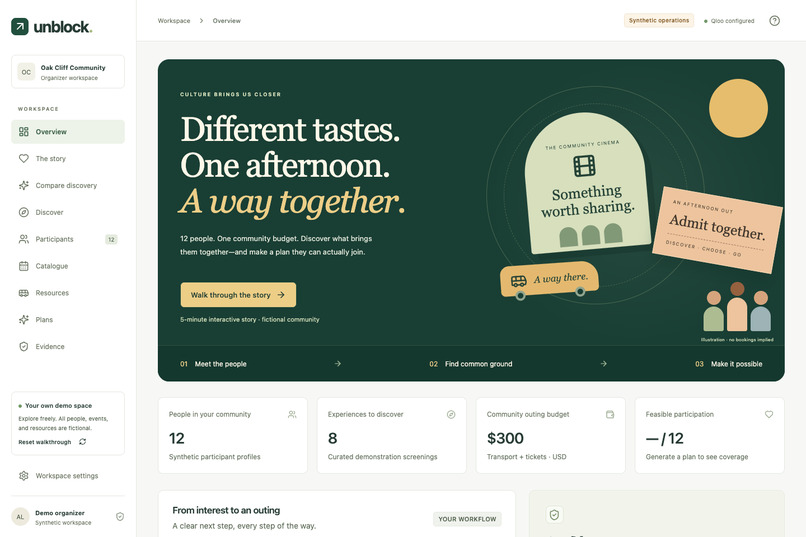
Cultural interests into accessible community outings.
-
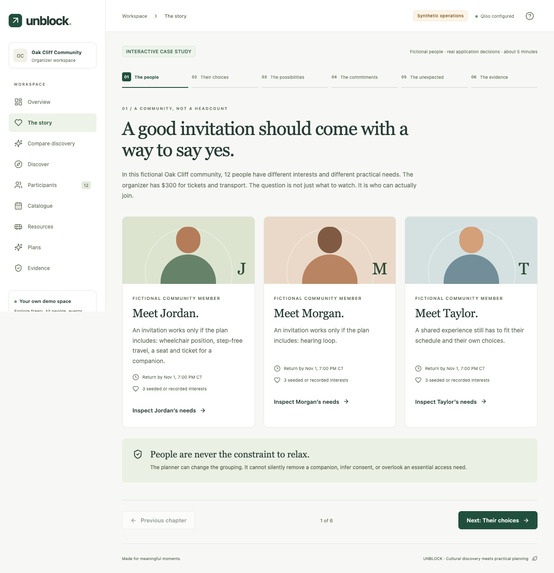
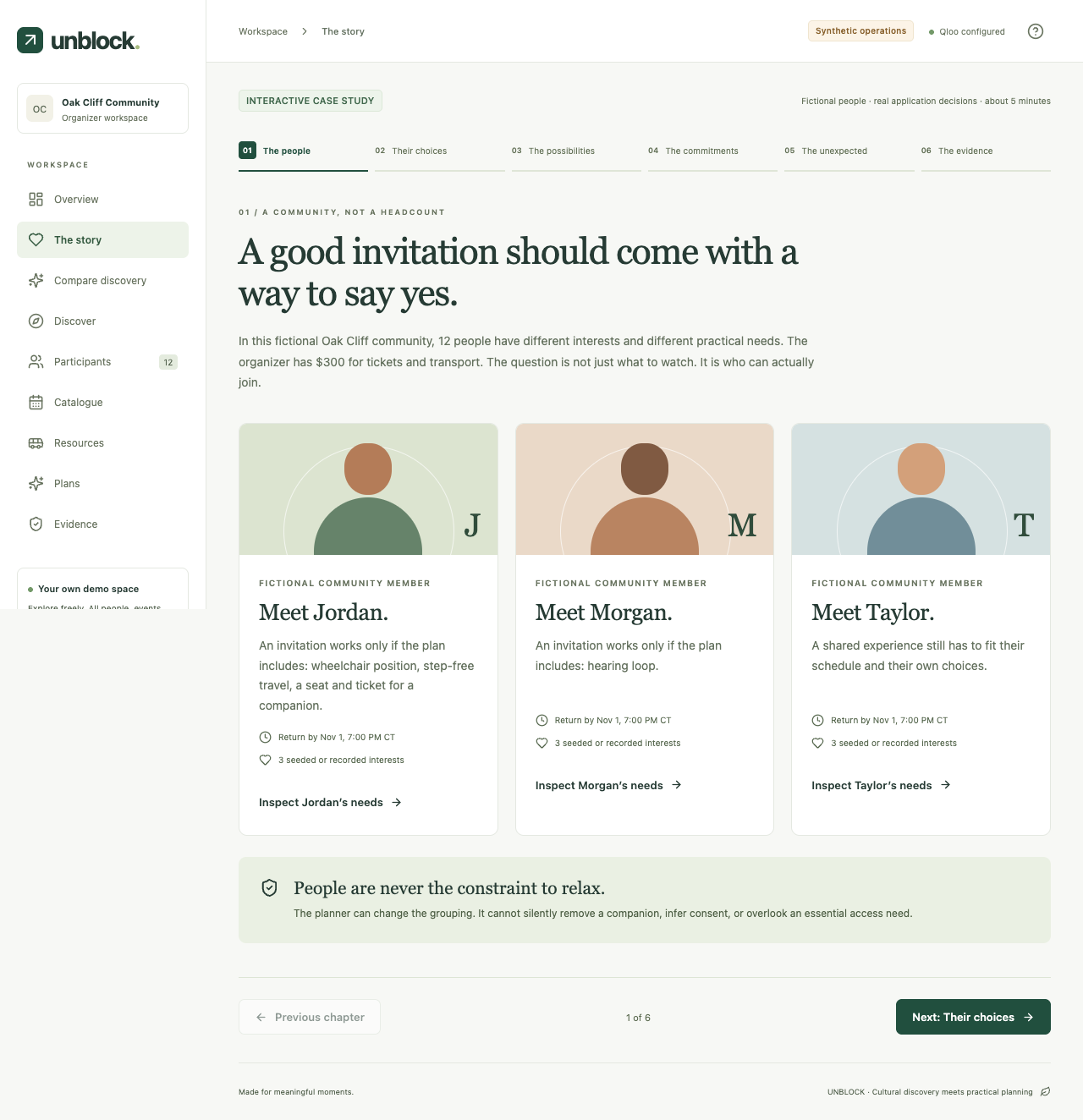
Every plan starts with individual needs.
-
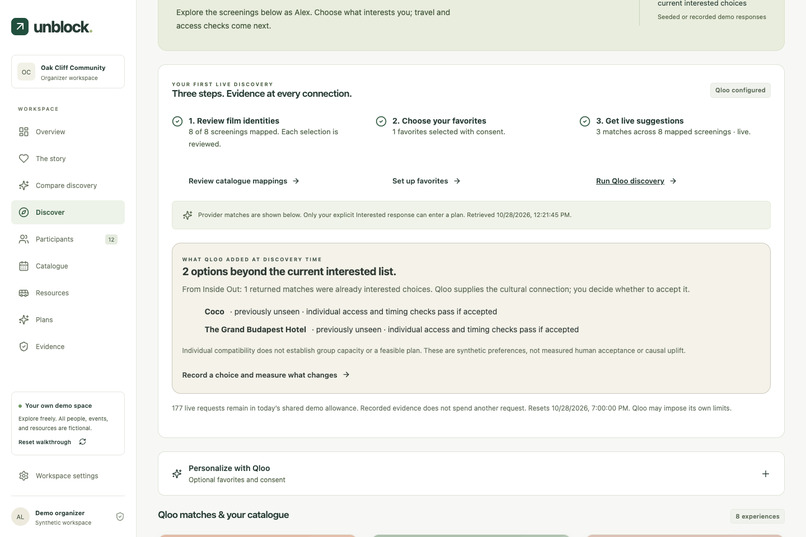
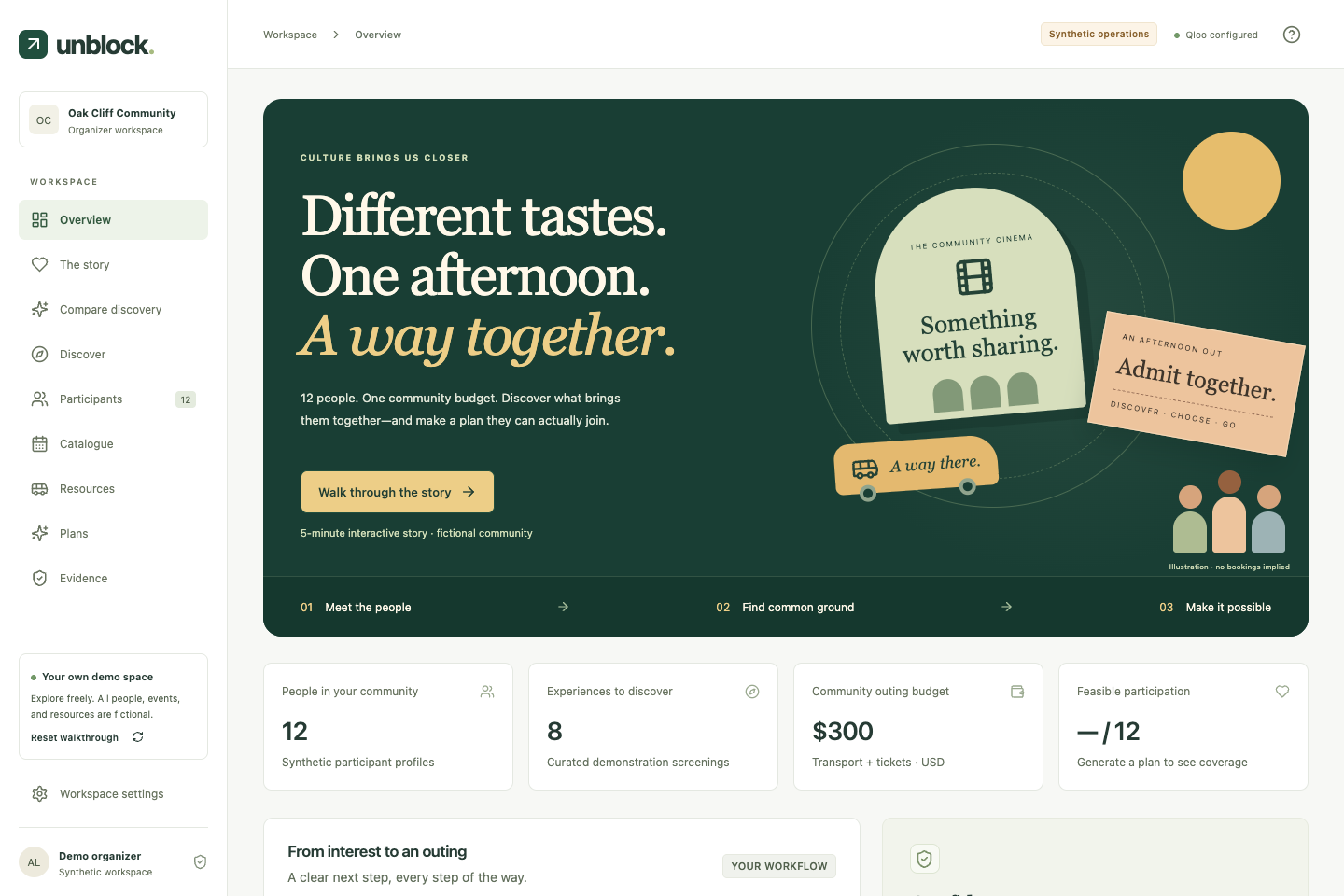
Live suggestions. Explicit participant choices.
-
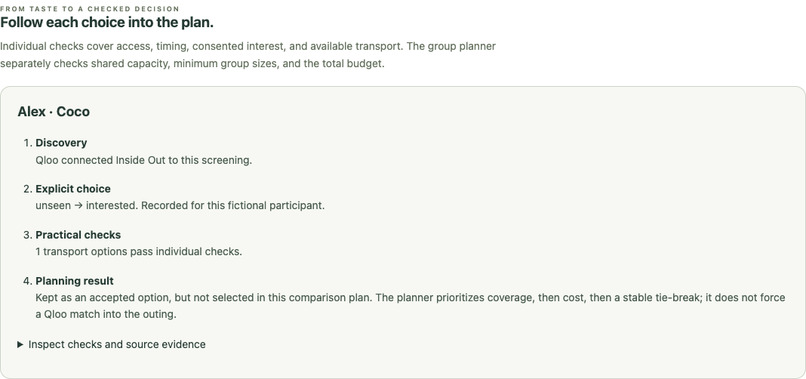
From Qloo suggestion to checked planning outcome.
-
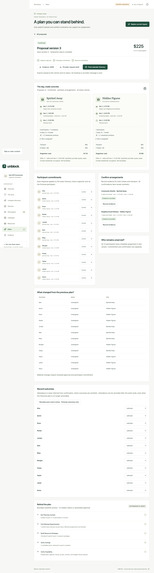
Separate approvals, commitments, and synthetic confirmations.
-
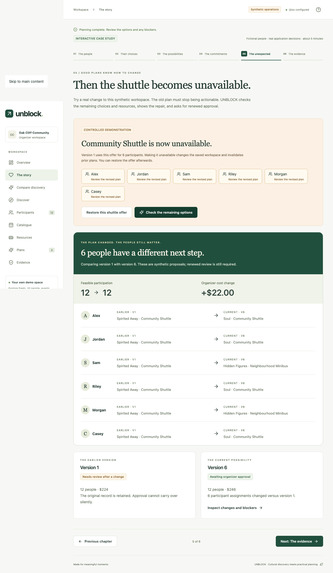
Six assignments changed; 12 still covered; cost +$22.
-

Participant needs, clearly presented on mobile.

Inspiration
A recommendation can tell you what someone might enjoy. Getting them there is a different problem.
For a community activity coordinator, a movie afternoon means balancing different tastes, accessible transport, companion seats, return deadlines, and a shared budget. An appealing suggestion can fall apart because the shuttle is full or someone’s access requirements cannot be met.
We built UNBLOCK around one question: What would it take to turn “I’d love to go” into “I can actually join”?
Our proposed first audience is community activity coordinators organizing small cultural outings. Research from the University of Minnesota for the National Center for Mobility Management identifies accessibility, affordability, service flexibility, and fragmented transportation as barriers to older adults’ social participation. That research informed our problem framing; it does not establish that UNBLOCK solves those barriers.
What it does
UNBLOCK connects cultural discovery to practical group planning.
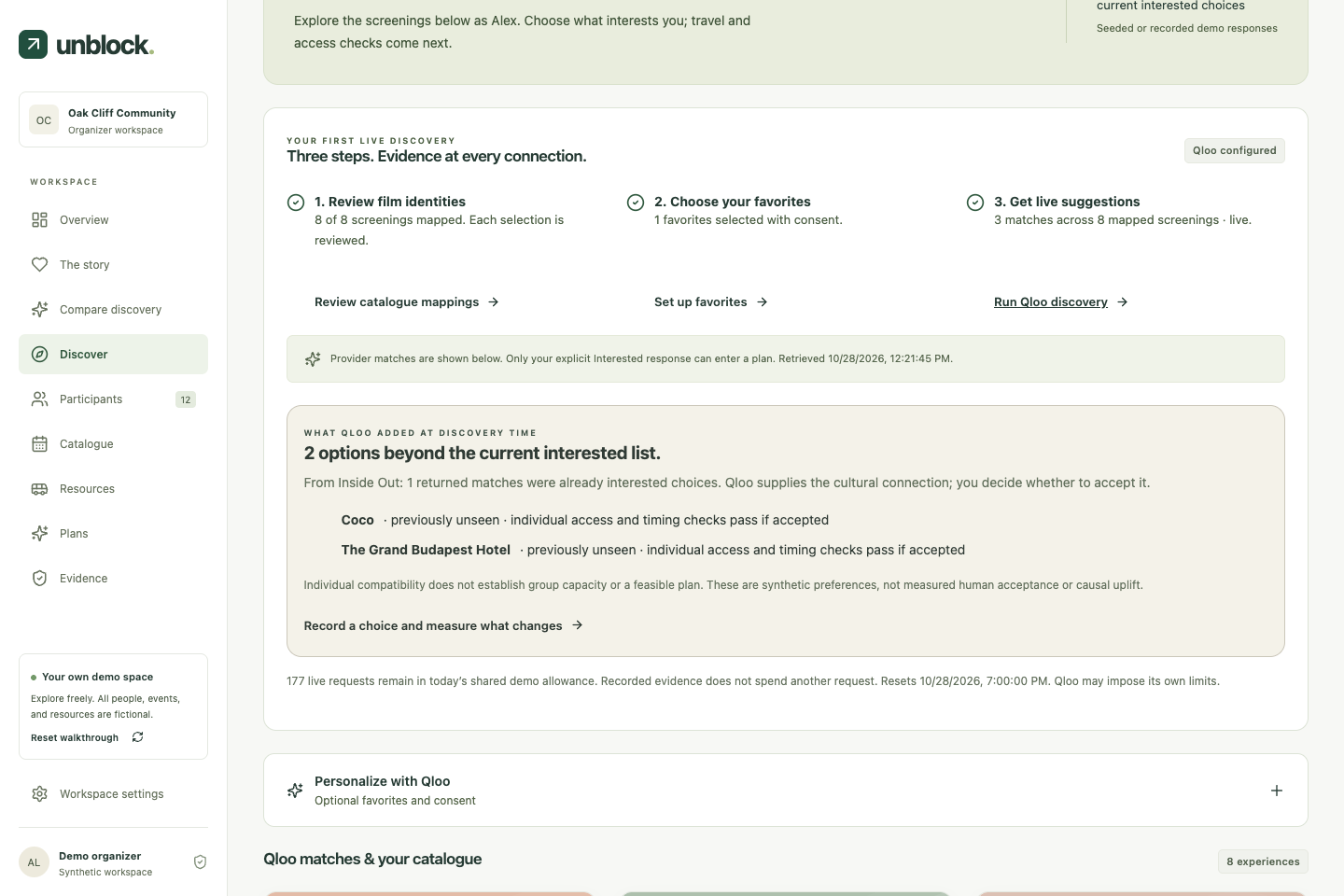
The journey starts with a favorite film. Qloo returns culturally related recommendations, which UNBLOCK matches to reviewed catalogue identities. The app distinguishes newly surfaced options from existing interests and retains the source evidence.
Each person explicitly chooses what interests them. Recommendations never become RSVPs automatically.
From those choices, UNBLOCK:
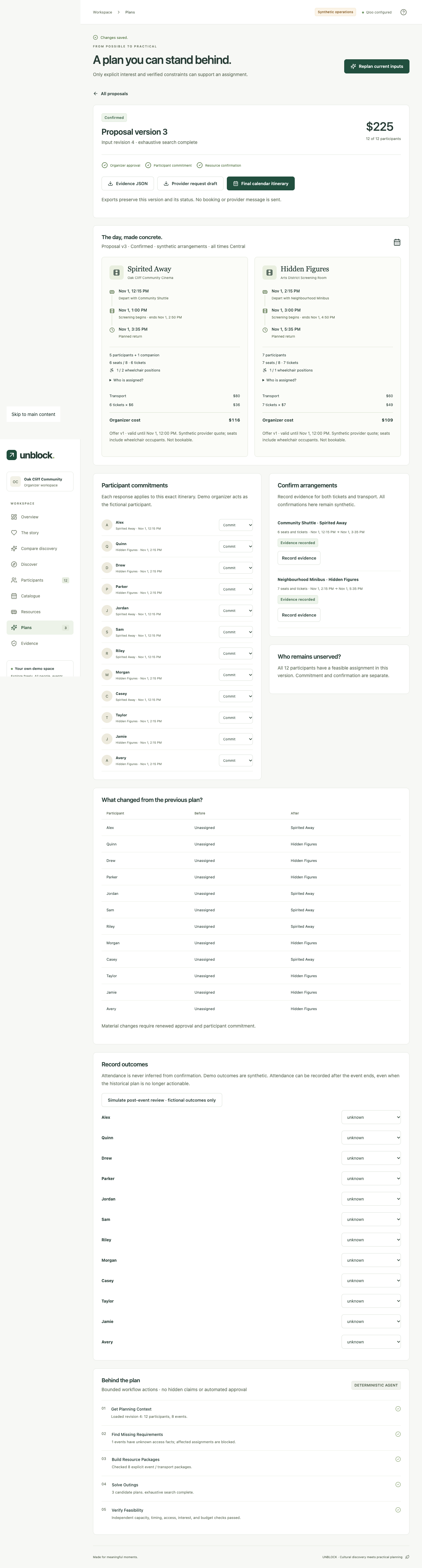
- Generates checked outing proposals that respect transport, accessibility, companion needs, timing, shared ticket inventory, and budget.
- Shows assignments, itemized costs, and reasons someone remains unserved.
- Separates organizer approval, participant commitments, and provider confirmation.
- Makes the final itinerary available only after the required gates pass.
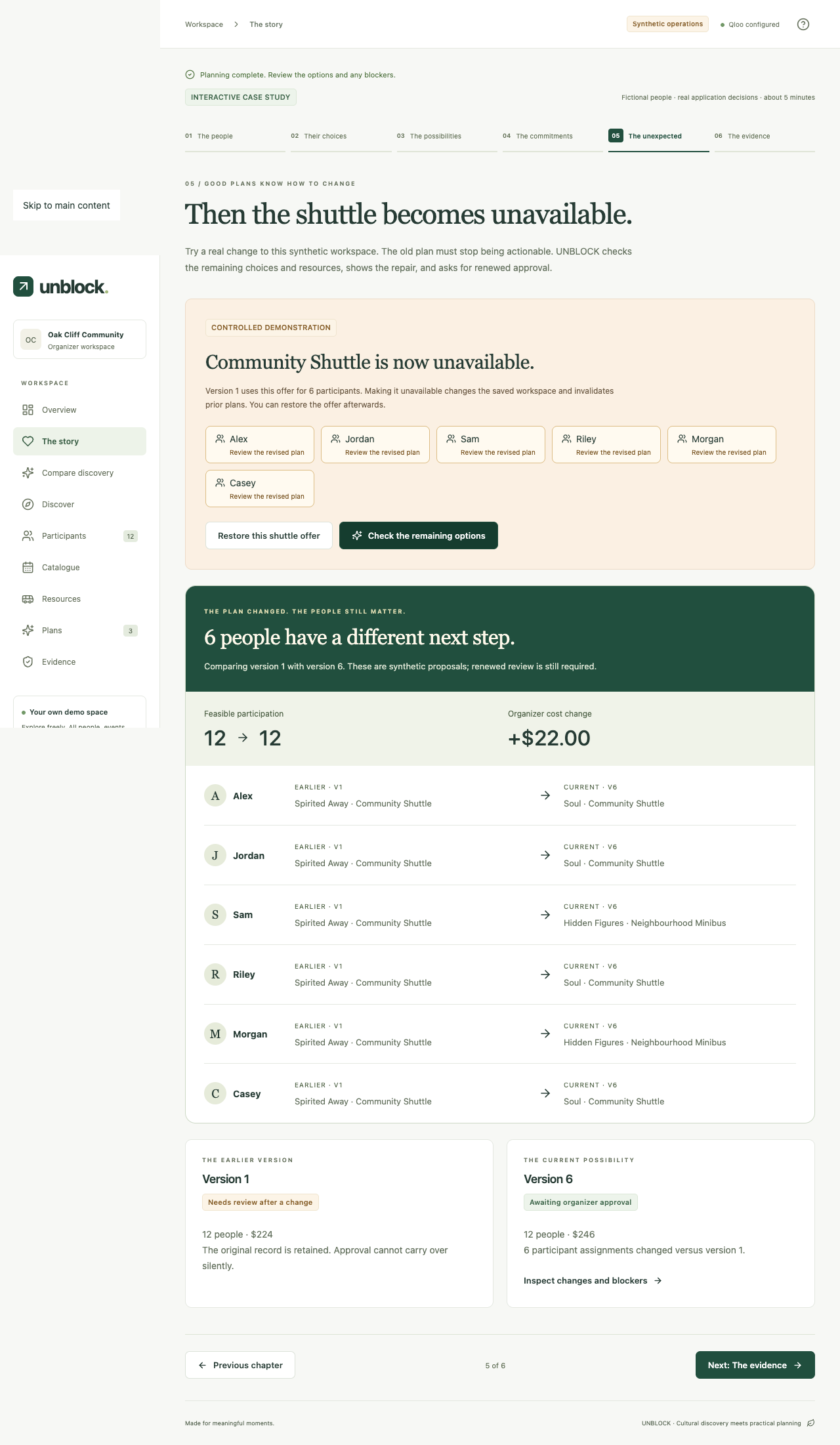
- Marks affected plans for review when circumstances change and helps the organizer inspect a repair.
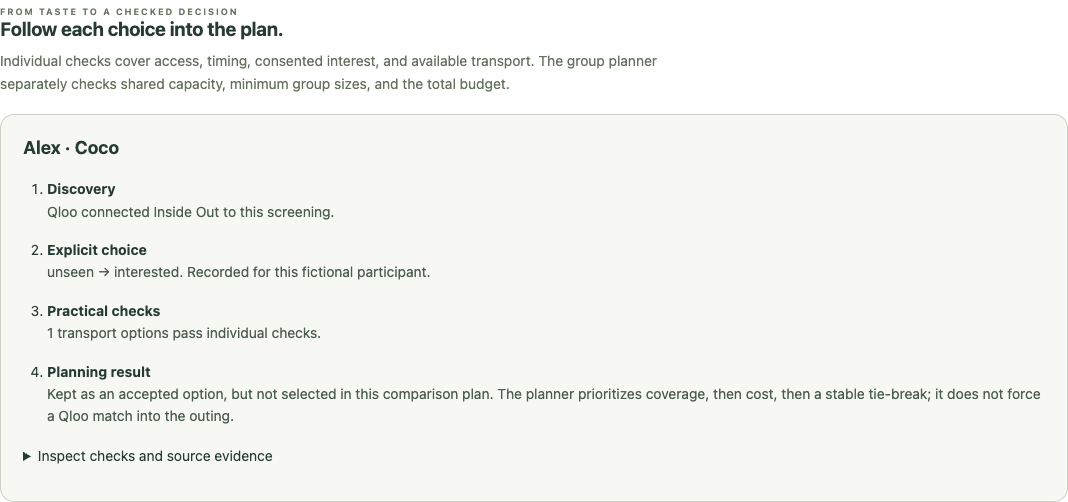
Follow each choice into the plan makes Qloo’s contribution visible:
Selected favorite → Qloo evidence → explicit response → practical checks → actual planning outcome.
A new option may pass individual checks but remain unselected in the group plan. The interface explains that distinction, and the comparison export retains the same evidence.
The public demonstration uses live Qloo discovery with fictional participants, screenings, transport, and confirmations. Post-event outcomes are explicitly simulated. It does not make real bookings or contact providers.
How we built it
We built the responsive interface with React and TypeScript, backed by Python and FastAPI. The application runs on Render, with SQLite on persistent storage and isolated, expiring demo workspaces.
Qloo runs server-side. Its search API supports reviewed film identities, while its Insights API connects explicitly selected favorites to recommendations. We retain provenance and retrieval times, cache repeated requests, and enforce persistent provider-call budgets. Missing matches never become invented affinity scores.
A bounded deterministic planning workflow inspects requirements, assembles event and transport options, searches for feasible assignments, and independently verifies candidates. The optional language-model adapter is disabled in the public deployment; the demonstrated workflow does not depend on it.
Plans retain their original inputs. Exact-version approvals and conflict checks prevent stale decisions or slow requests from silently overwriting newer changes.
The comparison uses the same frozen resources, requirements, budget, and evaluation time for both searches. Only explicitly recorded interest responses differ.
Challenges we ran into
The hardest challenge was preserving the meaning of each decision.
A culturally relevant suggestion does not establish interest. Individual compatibility does not establish group feasibility. An approved proposal does not establish provider confirmation. A confirmed itinerary does not establish attendance.
We represented these as separate records and gates throughout the product.
Change handling required similar care. A transport cancellation must invalidate affected plans, while browsing cultural recommendations should not erase an otherwise valid approval. We separated taste metadata from operational planning inputs.
Testing exposed practical interface and reliability issues: mobile evidence overflow, low-contrast source text, unclear no-plan feedback, technical import errors, and a delayed session response that could replace a newly created workspace. We fixed those behaviors and added regression coverage.
Finally, we needed to evaluate discovery honestly. Our authored baseline already served all 12 fictional participants. We preserved it rather than weakening the starting choices to manufacture an improvement.
Accomplishments that we're proud of
We shipped a public application with a coherent journey from people and preferences through discovery, planning, commitments, disruption, repair, and evidence.
In a live check, the reviewed Inside Out profile surfaced Coco and The Grand Budapest Hotel beyond Alex’s existing interested list. A scripted choice accepted Coco. The new decision trail showed that its individual checks passed, while the group comparison retained a different assignment. Discovery expanded the accepted options without changing coverage or cost.
The operational story demonstrates another concrete result: the authored baseline serves 12 fictional participants for $224. After the demonstrated shuttle disruption, a repaired candidate preserves checked coverage at $246 while showing six changed assignments. These are synthetic scenario results, not observed attendance or savings.
Verification includes:
- 55 passing backend tests.
- Six passing browser journeys.
- Ten passing scenario groups in the expanded public-app check.
- Live Qloo discovery and cache reuse.
- Matching decision paths in the interface and exported evidence.
- Mobile layout and automated accessibility checks.
- Consent withdrawal, stale-action rejection, replanning, and workspace deletion.
- Zero browser exceptions in the expanded live check.
We are especially proud that the product makes unsuccessful or unchanged outcomes inspectable instead of hiding them.
What we learned
Cultural discovery and operational planning contribute different kinds of value.
Qloo can reveal options someone had not considered. Explicit choices establish what that person wants to explore. Operational checks determine which combinations can support a group outing.
More accepted options do not automatically mean lower costs or higher coverage. Showing discovery contribution separately from planning outcomes makes the product easier to understand and evaluate.
We also learned that software correctness and customer value require different evidence. Automated tests establish behavior in the scenarios we checked. Real organizer feedback and supervised use are still needed to establish usefulness.
What's next for UNBLOCK
Our next step is a formative study with five community activity coordinators using fictional outing tasks.
We plan to compare their current process with UNBLOCK, counterbalancing task order and including data-entry time. We will measure planning and repair time, missed essential requirements, facilitator interventions, and whether organizers understand the evidence and approval gates.
This study has not yet been conducted. We have published the proposed protocol so the measures and progression criteria are explicit before collecting results.
Before supporting real outings, we need private organizer accounts, participant invitations and consent, verified operational sources, provider agreements, and appropriate data-management controls.
The direction remains the same: help people discover something they want to do—and make joining possible.
Built With
- docker
- fastapi
- github-actions
- playwright
- pytest
- python
- qloo
- react
- render
- sqlite
- typescript
- vite


Log in or sign up for Devpost to join the conversation.