Inspiration The dating app industry is worth $9 billion entirely built to help people fall in love. Yet when that love turns toxic, manipulative, or controlling, there is nothing waiting on the other side. No tool. No map. No mirror. A simple and devastating observation inspired us: in a world obsessed with connection, no one has built anything for the people it breaks. We know the research. 1 in 3 people globally experience psychological abuse in an intimate relationship. Men are the least likely to seek help. LGBTQ+ individuals face compounded barriers to recovery. And across all of them, the damage doesn't end with the relationship it rewires the nervous system, erodes self-trust, and quietly follows people into every connection that comes after. We built UnBind because that person deserves a tool as sophisticated as the wound.
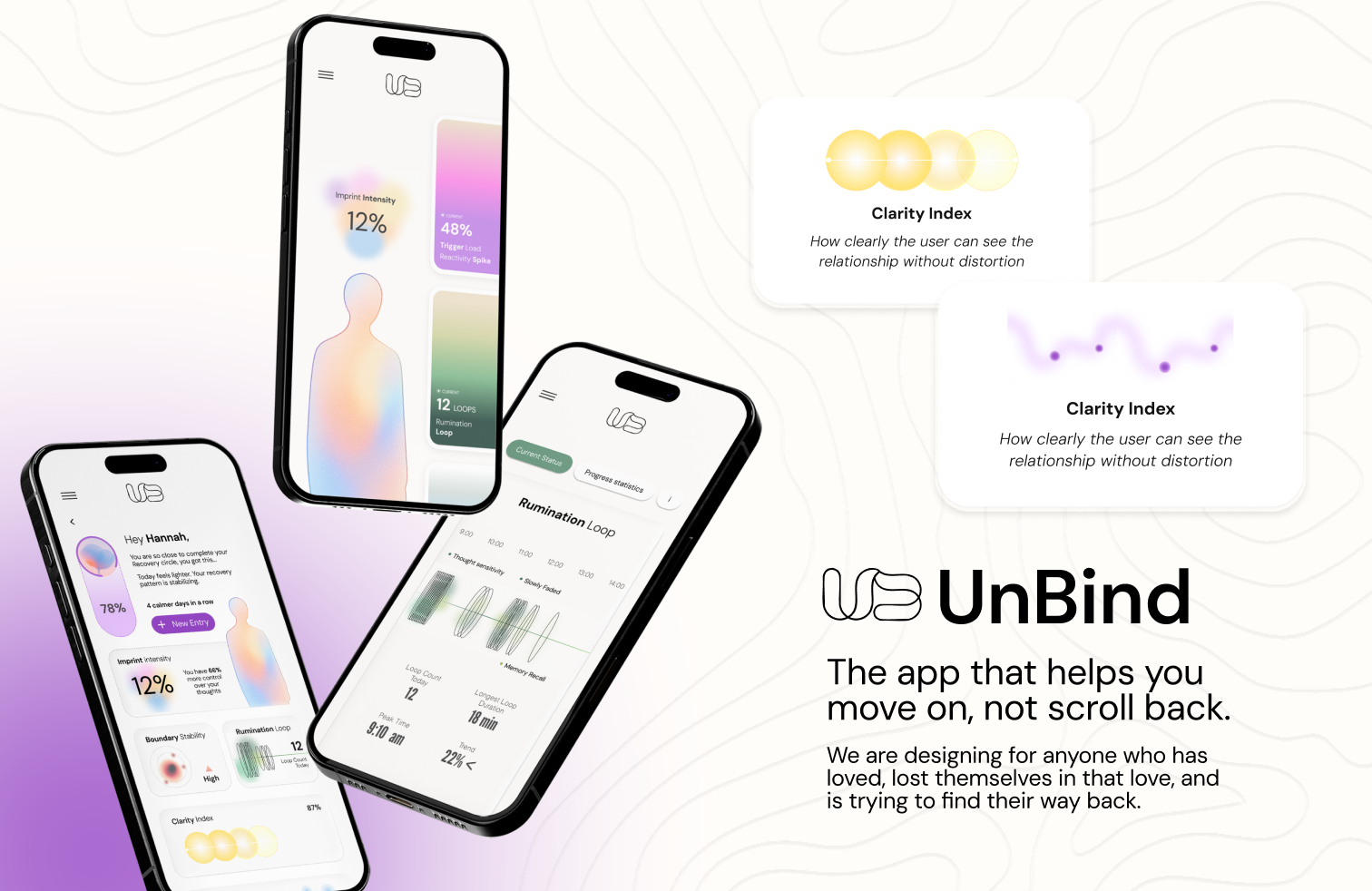
What It Does UnBind is a two-surface recovery tool smart glasses paired with a mobile app designed for anyone who is healing from a psychologically toxic or manipulative romantic relationship. The glasses sense the user's body in real time during social interactions: breath shifts, facial tension, stress spikes, and conversational dynamics cross-referencing everything against the user's personal history of triggers and patterns, communicating only through subtle haptic pulses and peripheral lens tints. Silent. Private. Never interrupting. The app is where reflection and recovery happen. The app helps you think about and heal from your experiences. It starts with a guided setup that shows how your relationships have shaped you; includes daily check-ins with simple, honest questions; and tracks ten key areas across three stages of recovery—the Imprint, the Recovery, and the Rebuild so Un No diagnoses. No labels. Just one question at the center of everything:
Is what I'm feeling right now mine, or is it an echo of what was done to me?
How We Built It UnBind was built as a concept-stage design project that combines product strategy, UX (user experience) research, interaction design, and speculative hardware design, which involves imagining and designing future technologies that may not yet exist.
Research foundation: grounded in peer-reviewed literature on coercive control, gaslighting, trauma bonding, and psychological recovery across all genders and orientations Design system: built in Figma with a custom design language cream base, Orange Burn, and a full palette of recovery-coded accent colors, paired with League Gothic, Europa Grotesk SH, and DM Sans App architecture: ten biometric and behavioural metrics organised across three recovery arcs, calculated from a combination of wearable data, journal language patterns, and daily check-in responses Glasses concept: speculative wearable design focused on somatic sensing — breath, tension, gaze — with outputs limited to haptic and peripheral visual cues to preserve conversational presence Safeguard system: a full privacy and safety architecture including on-device data storage, decoy mode, biometric lock, emergency wipe, and a four-stage crisis protocol
Challenges We Ran Into
Inclusivity without erasure: designing a product that genuinely serves all genders, orientations, and backgrounds without flattening the very real differences in how people experience and recover from relational trauma Language as medicine: every word in the app had to be non-diagnostic, non-alarming, and non-judgmental—finding the precise language that reflects without labeling was one of the hardest design problems we faced The false positive problem: a high Pattern Match Risk score on someone safe could reinforce avoidance of exactly the kind of connection the user needs. Designing around this required pairing every risk signal with a Safety Signal and building user correction into the system Hardware ethics: the glasses sense other people people who haven't consented to being analyzed by them. The solution was fundamental to the architecture: the system never profiles the other person. It only ever profiles the user's response to them Dependency risk: building a tool for people whose self-trust has been eroded means actively designing against over-reliance progressive withdrawal features, dependency tracking, and language that always returns interpretation to the user
Accomplishments That We're Proud Of
A fully realised product concept that addresses a genuine and underserved global need A ten-metric recovery framework grounded in clinical research and translated into human, accessible language A design system and interaction language that feels like a private journal rather than a clinical dashboard A safeguard architecture that takes the specific vulnerability of the user population seriously, including decoy mode, emergency wipe, and a four-stage crisis protocol An inclusive product narrative that speaks to anyone who has loved and lost themselves in that love regardless of gender, orientation, or background A pitch framework that uses one person's story to make a universal wound visible
What We Learned
The most important design decisions in a product like this are not interface decisions—they are language decisions Trauma-informed design requires a fundamentally different relationship to data: the user is never a subject to be analyzed, always a person to be reflected back to themselves Inclusivity is not a feature added at the end—it has to be present in the research, the language, the metrics, the safeguards, and the story from the very beginning The gap between the mental health app market and the specific needs of relational trauma survivors is vast, largely invisible, and almost entirely unaddressed Hardware and software can work together somatically the body knows things before the mind does, and good design can create space for that knowledge to surface safely
What's Next for Unbind?
Q3 2026 : App MVP build + wearable sensor integration with existing smart glasses hardware Q4 2026 : Closed beta with 200 users across diverse genders, orientations, and backgrounds in therapeutic recovery contexts; therapist partnership programs and LGBTQ+ organisation partnerships established Q1 2027 : Public launch at £14.99/month subscription 2027 and beyond: Therapist-facing dashboard (raw data export for clinical use); group recovery features for shared healing contexts; expanded wearable integration, including watch-based sensing for users without glasses.
The dating apps helped them find love. Unbind helps them find themselves again. Know what's yours.
Built With
- chatgpt
- claude
- figjam
- figmake
- fonts


Log in or sign up for Devpost to join the conversation.