-
-
-
-
Safety
-
Un-Said system architecture
Inspiration
The last thing a lot of kids text their mom is "k."
More than 1.17 million international students were in the US last year, 363,019 of them from India (IIE Open Doors 2025). Many have a mom on the other side of the world checking her phone at 9 PM her time, wondering if today is a call day. It usually isn't. Nothing is wrong, and that's exactly why nothing gets said. Friends drift the same way, and so do relationships, when the words don't come in time.
Facebook brought back the people. Instagram kept the photos. Nothing kept the words that never got attached to them. That's what we wanted to build: not another chatbot or a journal that swears secrecy, but a way for unsaid words to actually reach someone.
We also knew what we didn't want to be. Phones already deliver about 63 notifications a day (Pielot et al., MobileHCI 2014). Un-Said had to earn every interruption.
What it does
- Your photos, on your phone. Un-Said opens on your own camera roll, read on the device.
- One knock. You stop on a photo of you and Mom and stay there. Un-Said knocks, once: "We noticed you've been quieter with the people closest to you lately. Want to say what you haven't?" Open the next photo and it stays quiet.
- The photo remembers. If you've talked on this photo before, you see "You said this here before." with your own words and voice from Tuesday.
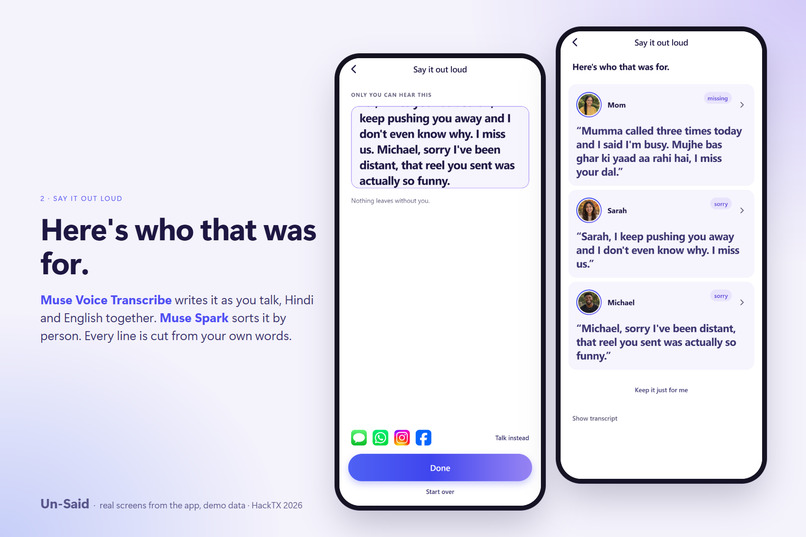
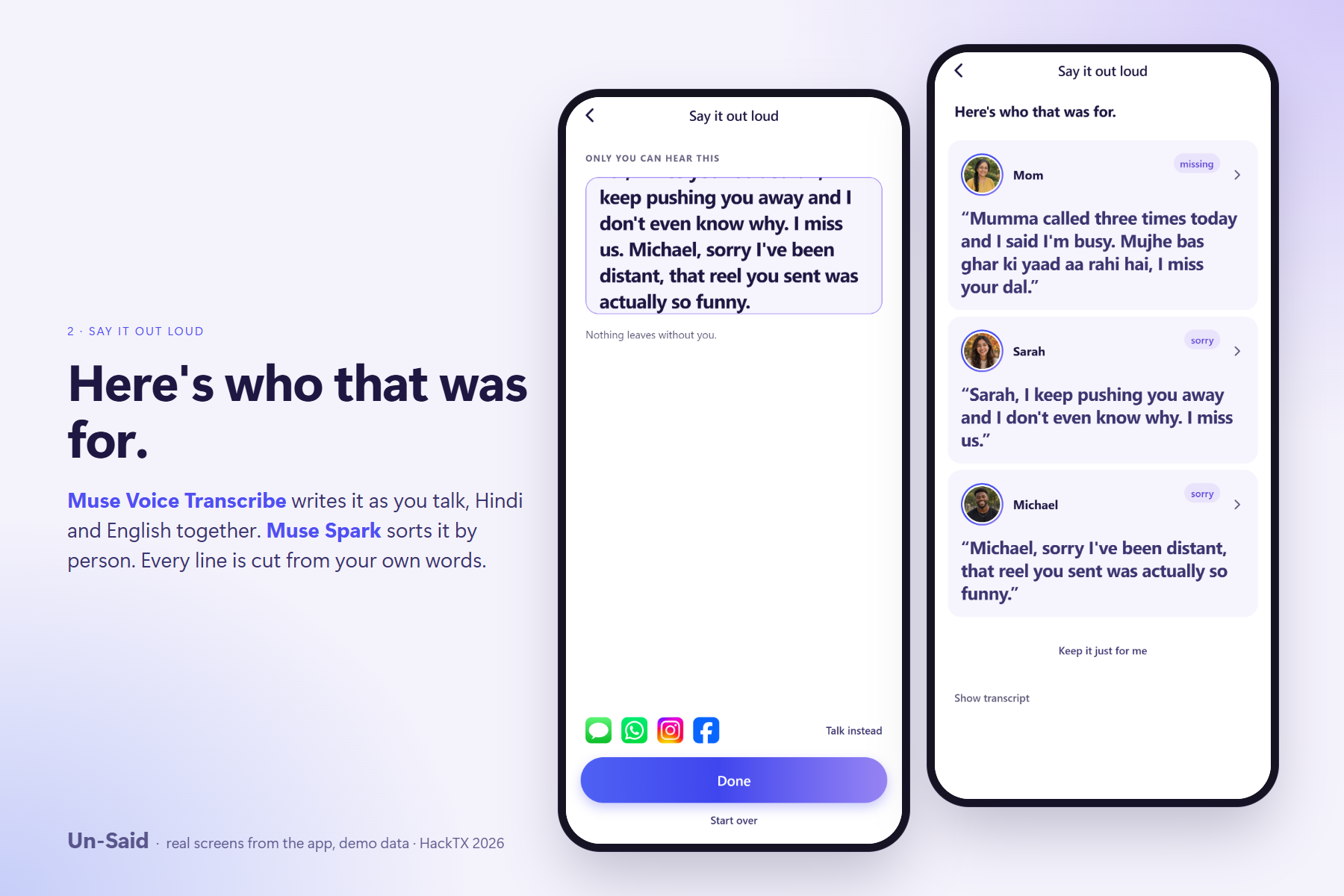
- Say it out loud. Tap the mic and talk, as messy as you need. Muse Voice Transcribe writes it as you speak, Hindi and English in the same breath. Nothing leaves without you.
- Here's who that was for. Muse Spark sorts what you said by person: Mom, Sarah, Michael. Every line on every card is cut verbatim from your transcript. Under the person you keep saying things to, once: "Tell them how you feel. Communication helps."
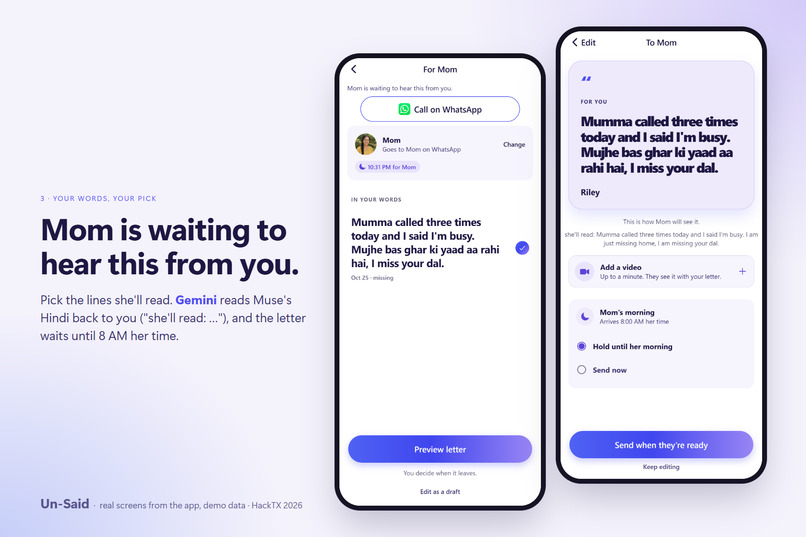
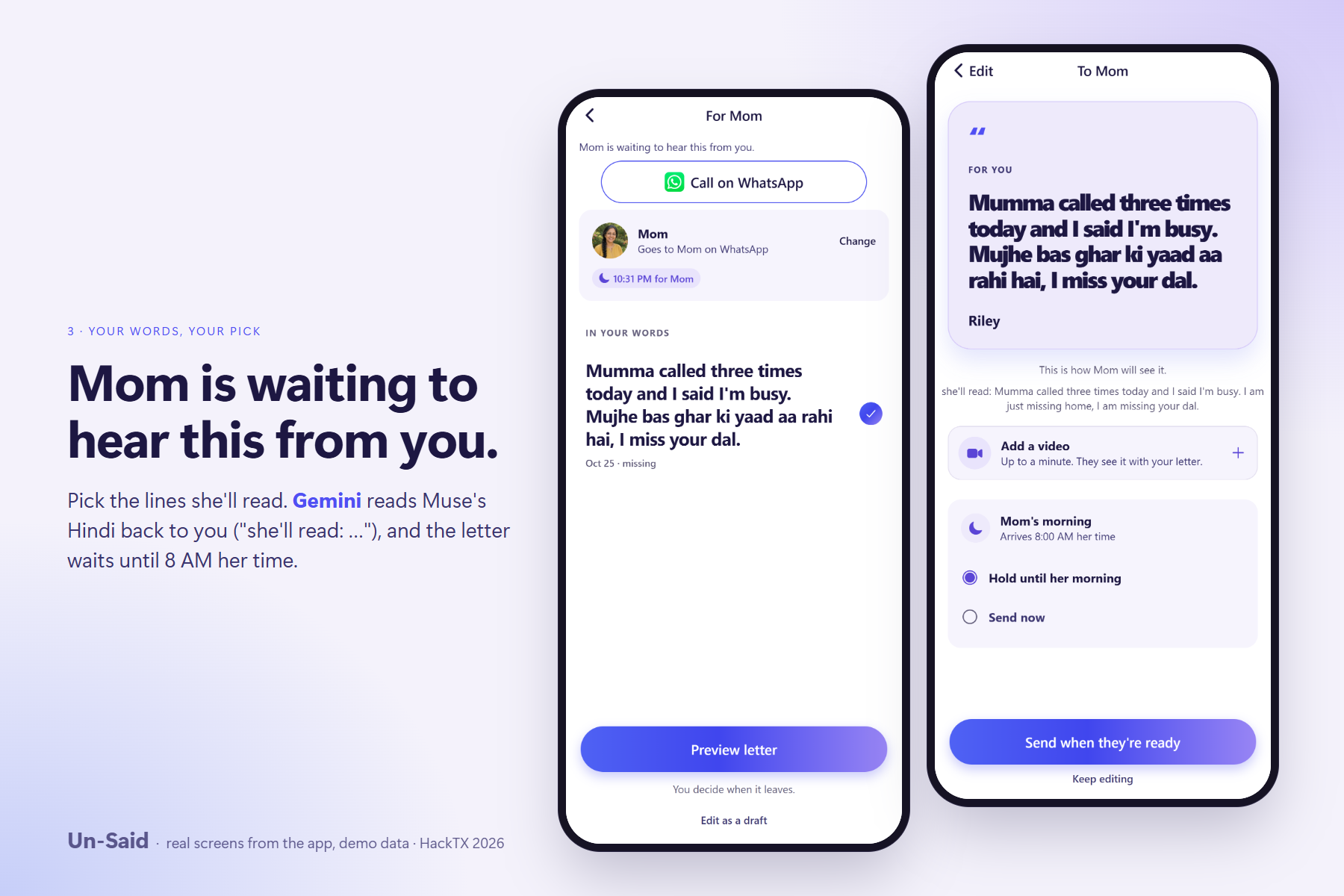
- Your words, your pick. Open Mom's pile, choose which of your lines she'll read (nothing is pre-picked), and preview the letter as she'll see it. Under the Hindi, Gemini reads Muse's translation back to you in English ("she'll read: …"), so you know what Mom will actually read before it goes.
- Hold until her morning. It's 5:02 AM in her kitchen. Un-Said holds the letter until 8:00 AM her time, then it goes out through WhatsApp. At her morning, Un-Said hands it to your own WhatsApp to send, so it comes from you. (The WhatsApp Cloud API path is built for sending it automatically, but it needs an approved template we don't have yet.)
- No app on her side. Mom taps the link and gets a page with the photo, your words with a Hindi caption, and your voice (only the part that was about her). She can Hold to reply, Write back, or Call you.
- Her voice comes back. Her reply lands in Letters, transcribed in Hindi and captioned in English.
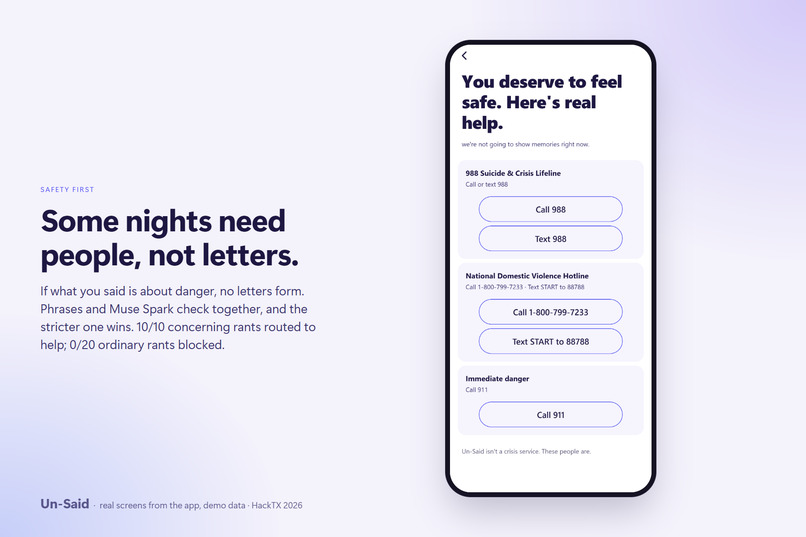
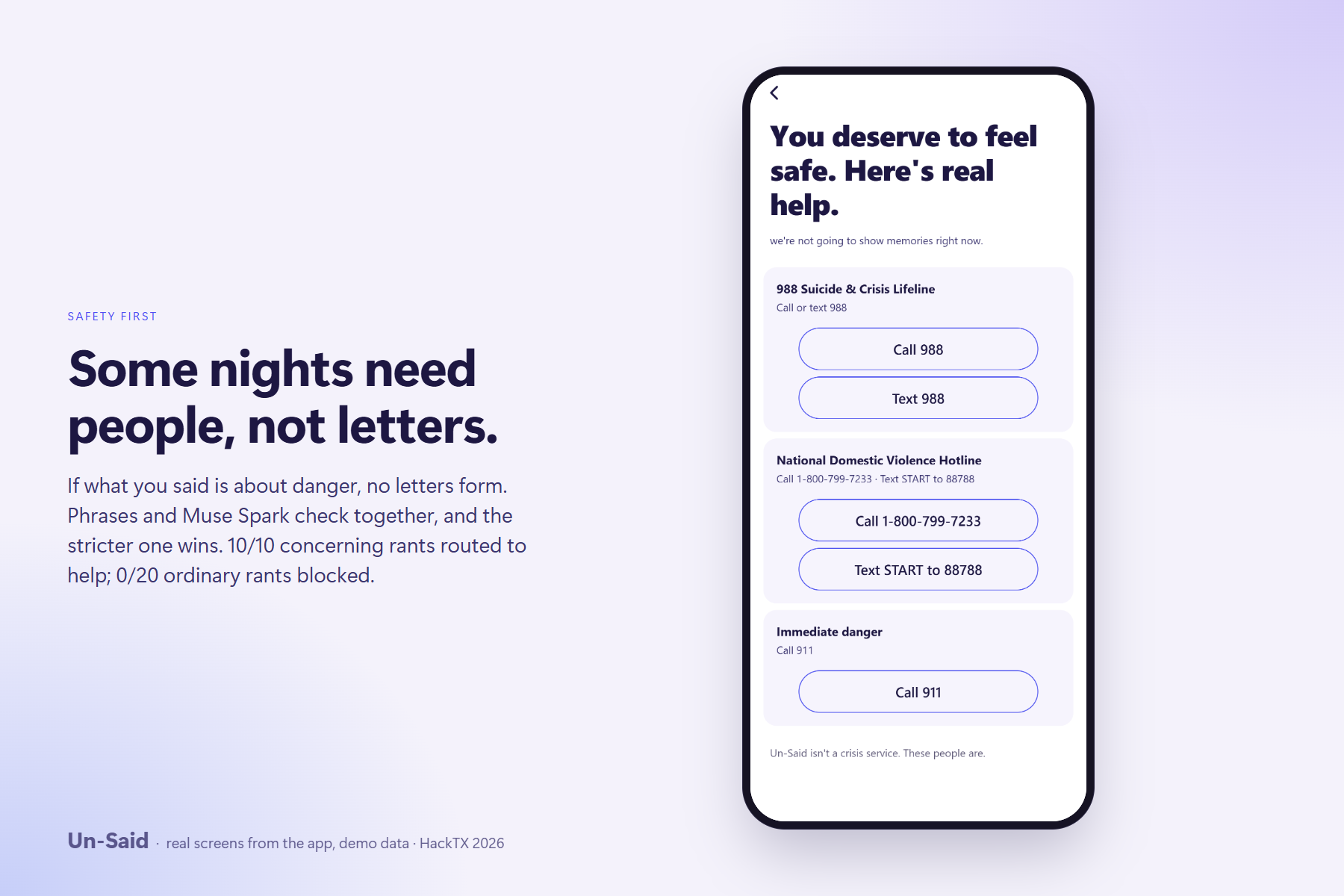
- Safety first. If what you said is about fear, control or hopelessness, no cards form. You get 988 and the domestic violence hotline instead.
How it strengthens human connection (meaningfully, not metrically)
- It's a hallway, not a fifth app. Every send leaves through the person's real app: WhatsApp for Mom, Messages for Sarah, Instagram for Michael. Success is a conversation happening somewhere else.
- No streaks, no counts, no guilt. There's no "you haven't called Mom in 12 days" anywhere.
- An attention budget, in code: at most one knock per session, two per day, three hours apart. It only knocks on photos of people you've already talked about. It goes quiet for that person after you say not now, and stays quiet after a safety concern. Two "not now"s in a row pause knocks for a week.
- Manners both ways. Your letter waits for her morning. Un-Said also holds its own notifications until yours (quiet hours 22:30–08:00 by default).
- The comfort comes from people. In a whole evening, Un-Said shows three short lines, each written by a person and shown by a rule. The model never talks to you. Mom, Sarah and your own words do the rest.
Why AI is essential (and where it isn't)
| Without AI, this breaks | How |
|---|---|
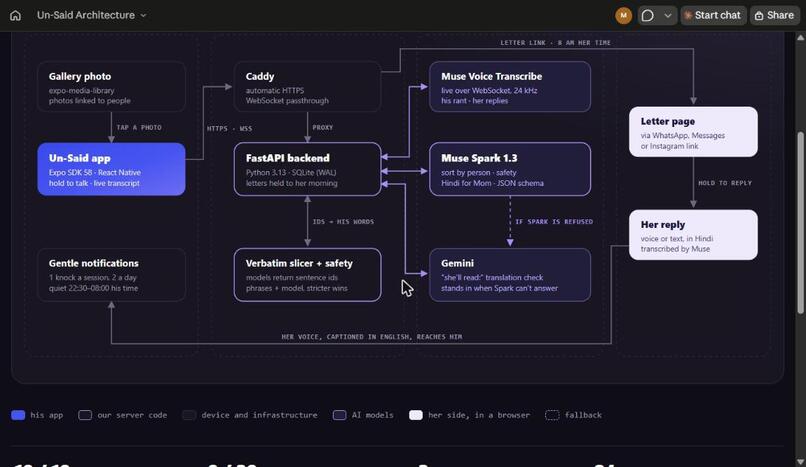
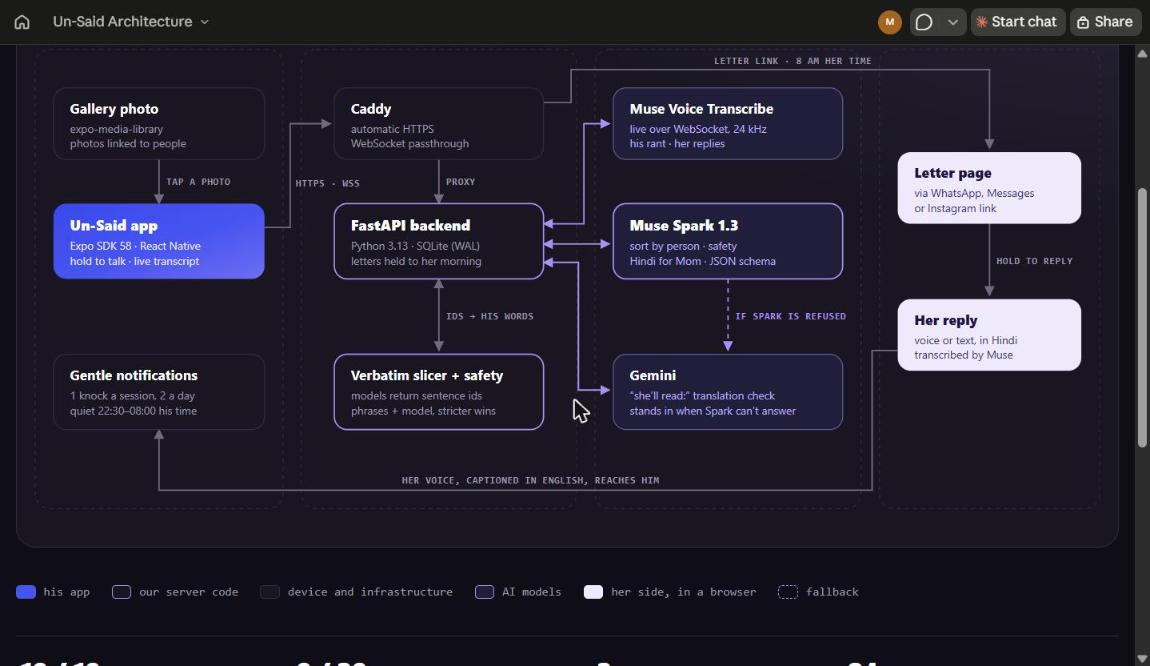
| Understanding a raw, code-switched rant as it's spoken | Muse Voice Transcribe realtime (wss://api.meta.ai/v1/asr/realtime, ENDPOINTING, languageBias: ["English","Hindi"]). The phone streams 24 kHz PCM to our relay; the API key never touches the phone. If the socket drops, the WAV the phone also recorded is transcribed as a file instead |
| Knowing which sentence is for whom | Muse Spark (muse-spark-1.3, response_format: json_schema, low reasoning effort). The server numbers the sentences, and Spark returns only {person, sentence ids, tone}. The server cuts the text, so Spark can't write a word on any card. Bad ids, unknown people and reused sentences are dropped |
| Telling an ordinary hard day from danger | Spark classification plus a phrase list that includes transliterated Hindi. The stricter one wins, and unknown output counts as a concern |
| Mom reading his words in her language | Spark translates only the lines he approved. Her voice reply is transcribed in Hindi and captioned in English for him |
| Knowing the Hindi says what he meant | Gemini (gemini-3.5-flash-lite) reads Spark's translation back into English on the preview. It never edits the letter, and Send never waits on it |
| Staying up when a model is down | If Muse Spark doesn't answer, Gemini takes the same prompt and the same JSON schema, so it still only returns sentence ids. The app's Settings shows which model sorted |
| Where AI deliberately isn't | Why |
|---|---|
| Timing | Her morning, and his, are time-zone math (IANA zones, quiet hours) |
| The words | Every word is his, enforced in code and checked by a test |
| Who it goes to | He picks the lines and the person |
| The knock | A budget written as rules, not a model's judgment |
| Delivery | It leaves through apps he already uses |
How we built it
- App: Expo SDK 58 with Expo Router, running on a Samsung Galaxy Z Fold 8 through Expo Go, in a demo-data mode that never reads the phone's own photos or contacts (the phone is borrowed).
- Phone demo: a Next.js mock of the Fold 8 (One UI home, look-alike WhatsApp, Google Messages, Instagram, Phone and Gallery) with the real Un-Said app running inside it. The film is recorded on it.
expo-media-library(the SDK 58QueryAPI) reads his gallery on the device.expo-audio's AudioStream captures 16-bit PCM, resampled to 24 kHz, and streams it over a WebSocket.expo-image-manipulatorturns the one photo he sends into a 1200 px JPEG.react-native-svgandexpo-linear-gradientcarry Gurneal's three gradients.
- Backend: FastAPI and Uvicorn, with SQLite.
- A WebSocket relay to Muse Voice Transcribe realtime, with the handshake authenticated on the server.
- Turn timestamps, so his audio can be cut per person: Mom never hears the sentence he said about Sarah.
- Muse Spark through Meta Model API's OpenAI-compatible Chat Completions.
- A scheduler that releases held letters at her morning, then hands them to his WhatsApp. WhatsApp Cloud API template sends are built but not yet approved.
- Gemini for the "she'll read:" check, and as the stand-in when Muse Spark can't answer.
- A public letter page behind unguessable tokens. Links expire in 30 days, can be revoked, and stay sealed until release.
- Design: Gurneal's Un-Said system: a white, light theme with a blue → violet → lilac gradient family, heavy rounded system type, and no handwriting fonts or Meta logos anywhere.
- AI tools we used to build it: Claude Code wrote much of the code from our specs. Grok reviewed the product and wrote the first Gemini echo. Every change was reviewed and tested by us.
- Testing:
- 84 backend tests, including the whole evening end to end on labeled mock AI. A test asserts that every card line is a substring of what he said, and one checks the Gemini fallback.
- A Playwright walk of the web client with a fake mic and camera: 15 screenshots across the whole flow, zero console errors.
- A 30-rant safety eval.
- Deploy: a Vultr Cloud Compute VM in Dallas (Ubuntu, Docker Compose) running the FastAPI backend behind Caddy with automatic HTTPS, at https://45-32-200-63.sslip.io. Live transcription, the letter pages and her replies run there. One script updates it from
main.- Meta's API answered Muse Spark from our laptops but returned
model_not_foundfrom the Vultr VM with the same key. Voice Transcribe worked from both. So on Vultr, sorting and translation fall back to Gemini, and the app says so. Our safety eval numbers are from Muse Spark.
- Meta's API answered Muse Spark from our laptops but returned
Safety
- The gate runs before any card forms. A concern means no cards and no reconnection prompts, only the resources: 988 Suicide & Crisis Lifeline (call or text 988), National Domestic Violence Hotline (1-800-799-7233, text START to 88788), and 911. Un-Said isn't a crisis service. These people are.
- The eval, 30 rants (20 ordinary, 10 concerning, some code-switched):
- phrase layer only: 10 concerning, 9 routed to resources; 20 ordinary, 0 blocked. The miss was the subtle one ("there's no point… I don't see a reason to keep going"), which is what Spark's layer is for.
- with Muse Spark (Oct 25, real key): 10/10 concerning routed to resources; 0/20 ordinary blocked. Spark caught the subtle one the phrase list missed.
- No knocks after a concern. Knocks stay off for 24 hours.
- Privacy:
- Photos stay on the phone; only the photo you send is uploaded, as one resized JPEG.
- There's no face recognition.
- Rants are private until you pick lines.
- Mom hears only audio that was entirely about her.
- We use Meta's Model API in Standard mode, which doesn't use your content to train Meta models (docs).
What's real today vs. what needs Meta
Real (running on the phone and on Vultr):
- the gallery and the photo view, with knocks and "you said this here before"
- the live transcript through Muse Voice Transcribe
- the split by Muse Spark (Gemini on the Vultr VM, see Deploy)
- the safety gate
- piles, letter previews with the Gemini "she'll read:" check, and hold until her morning
- WhatsApp, Messages and Instagram delivery through his own apps' share sheets
- Mom's letter page with her voice reply or a written one
- Letters
The video is generated and animated by our team to tell the story. It isn't a screen recording. Everything it shows the app doing, the app does.
What needs Meta (our Round 2 ask):
- the knock on photos people already scroll in Instagram and Facebook memories, not only inside Un-Said
- notifications that live inside WhatsApp and Instagram
- sending as the person inside WhatsApp, rather than from a business number
Challenges we ran into
- Live transcription from a phone without exposing the key. Expo's AudioStream gives raw PCM. We resample it to 24 kHz, relay it through our server to Meta's realtime socket, and fall back to file transcription when the socket drops.
- A model that answered from one machine and not another. The same Meta key ran Muse Spark from a laptop and got
model_not_foundfrom our Vultr VM. We added a fallback with the same prompt and schema, and the app labels which model sorted, so the demo never pretends. - Making it impossible for the AI to write his words. Our first design asked the model for character offsets, and models are bad at counting. We switched to numbered sentences, which is more reliable and still guarantees verbatim text.
- Cutting his voice per person. Voice Transcribe gives turn-level timestamps only, so a turn is played to Mom only if every sentence in it was about her.
- Restraint. Designing a knock that helps without nagging took longer than building one.
- Moving targets: Expo SDK 58 replaced the media-library API, Expo Go now requires matching sign-ins, and pushing over a phone hotspot kept dropping.
Accomplishments we're proud of
- An AI feature that refuses to write your feelings, and a test that proves it.
- A whole evening, from the knock to Mom's 8 AM, that runs on real Meta models, real time zones and the apps she already has, deployed on Vultr.
- A design system strict enough that nothing looks like a default component.
- A knock budget that holds up even in a demo: one per session, two per day.
What we learned
- The hardest part of an AI product about feelings is deciding what the AI must never do.
- Timing is part of kindness. "Record at 3 AM, deliver when they're awake" changed how the whole product feels more than any model choice did.
- Saying where we didn't use AI made our use of it more believable.
What's next
- The knock on Meta's own memory surfaces (Round 2).
- The phone's own assistant (not built yet). On Android, Un-Said would expose AppFunctions so Gemini can ask "is a letter waiting for Mom?" or open her pile from anywhere. On iPhone, the same functions become App Intents for Siri and Apple Intelligence. The assistant only learns that a letter exists and who it's for. The words stay inside Un-Said, with Muse.
- Muse Spark Open on a Vultr GPU, so sorting runs on Meta's open weights on our own server.
- Home-culture dates (Diwali, Lunar New Year, Eid, Mother's Day in her country).
- Drafts you can type into.
- An on-device, opt-in "who's in this photo," built so faces never leave the phone.
Built with
expo · react-native · expo-router · typescript · python · fastapi · uvicorn · websockets · sqlite · meta-model-api · muse-spark · muse-voice-transcribe · gemini · vultr · docker · caddy · whatsapp · pytest · playwright · claude-code · grok
Team
Gurneal Chandi: product, design system, cast and copy, film. Mudit Upadhyay: backend, app, Meta integrations.
Links
- Code: https://github.com/MuditUpadhyay04/HackTX
- Live backend: https://45-32-200-63.sslip.io
Built With
- caddy
- claude-code
- docker
- expo-router
- expo.io
- fastapi
- gemini
- grok
- meta-model-api
- muse-spark
- muse-voice-transcribe
- playwright
- pytest
- python
- react-native
- sqlite
- typescript
- uvicorn
- vultr
- websockets
