Inspiration
The idea behind ULTRON started with a simple thought: AI should be able to do more than just answer our questions.
Today, we use AI to find information, compare products and make decisions. But when we actually want to get something done, we still have to jump between different websites, search for products, compare specifications, prepare orders, handle approvals and complete payments ourselves.
We thought, what if we could simply tell an AI what we need and let it coordinate the work?
For example, imagine typing:
"Find me a laptop under $200 with 16GB RAM and an SSD. Compare the available options and prepare the best purchase for my approval."
Instead of receiving just a list of suggestions, we wanted the system to understand the request, break it into tasks, search for products, evaluate the results and take the procurement process forward.
That idea became ULTRON — Commerce Command.
We wanted to explore how AI could move from being a conversational assistant to becoming something that actually helps people complete tasks, while keeping important decisions and financial approvals in human hands.
What it does
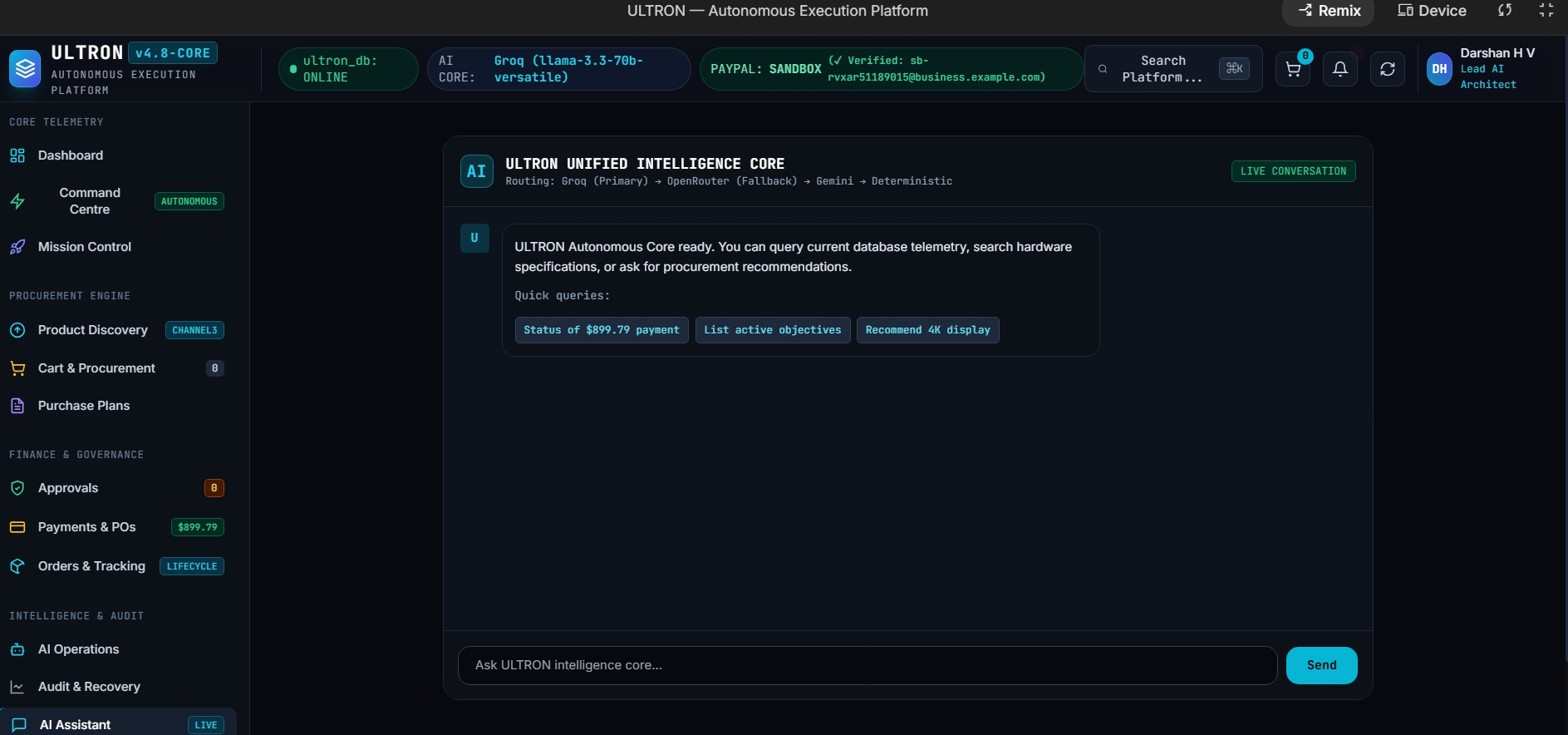
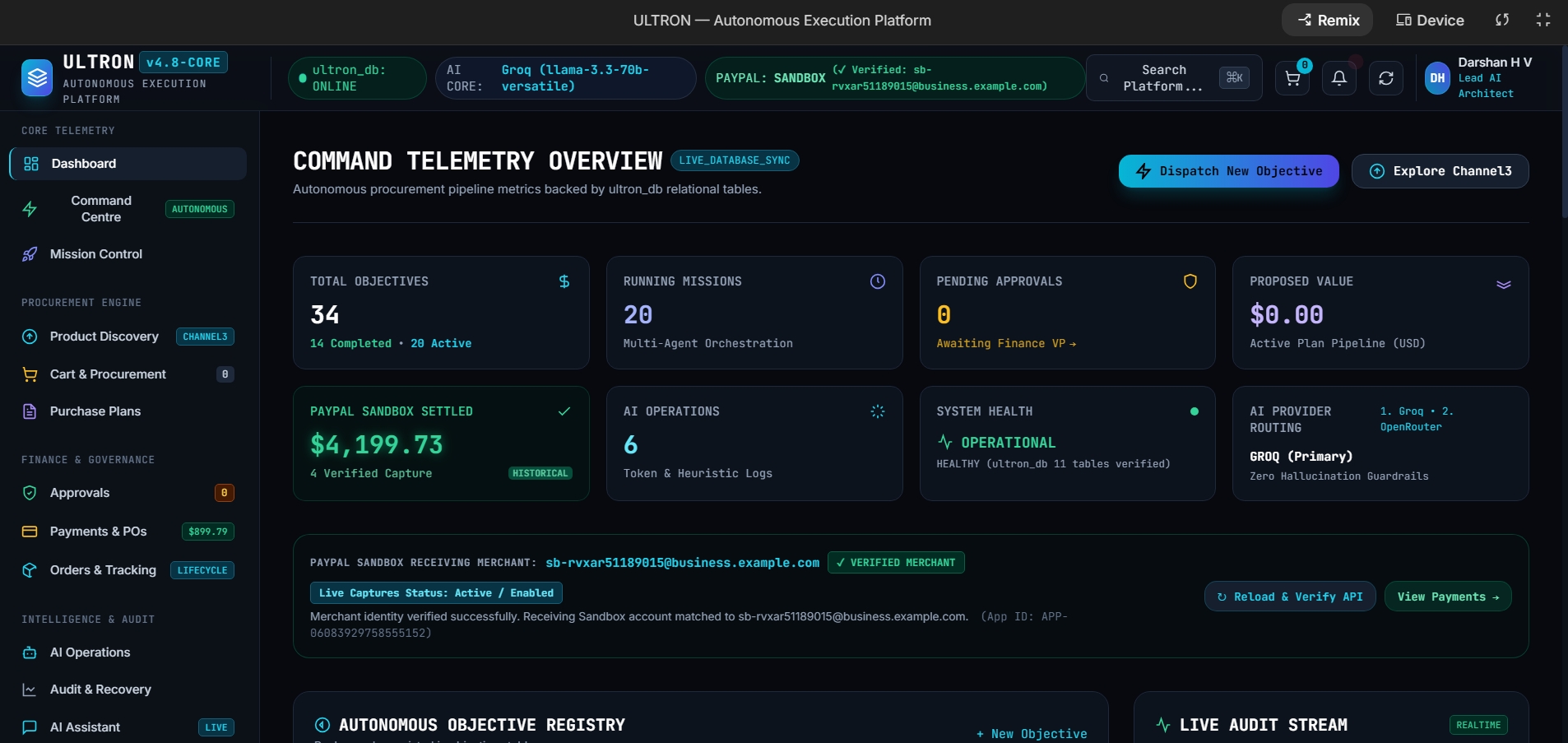
ULTRON is an AI-powered autonomous procurement platform that turns ordinary natural-language requests into structured procurement workflows.
Users don't need to know which API to call or which procurement screen to open. They simply describe what they want.
ULTRON then works through the request using its AI and connected services.
Some of its key capabilities include:
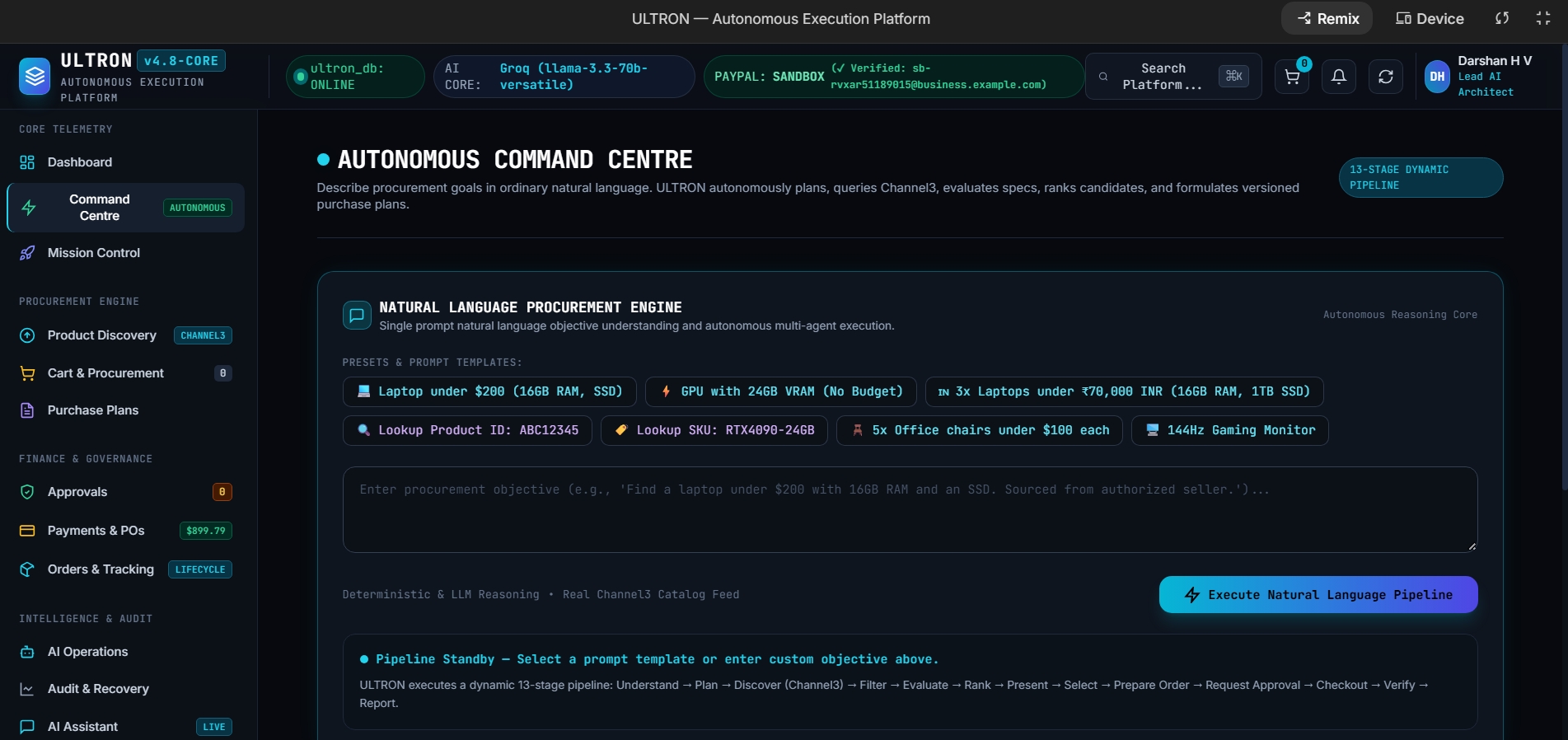
- Natural-language procurement: Users can describe products, budgets, quantities and technical requirements in everyday language.
- Intelligent requirement extraction: The AI identifies product categories, mandatory specifications, budget constraints and preferences.
- Dynamic task planning: The system breaks an objective into smaller tasks and coordinates their execution.
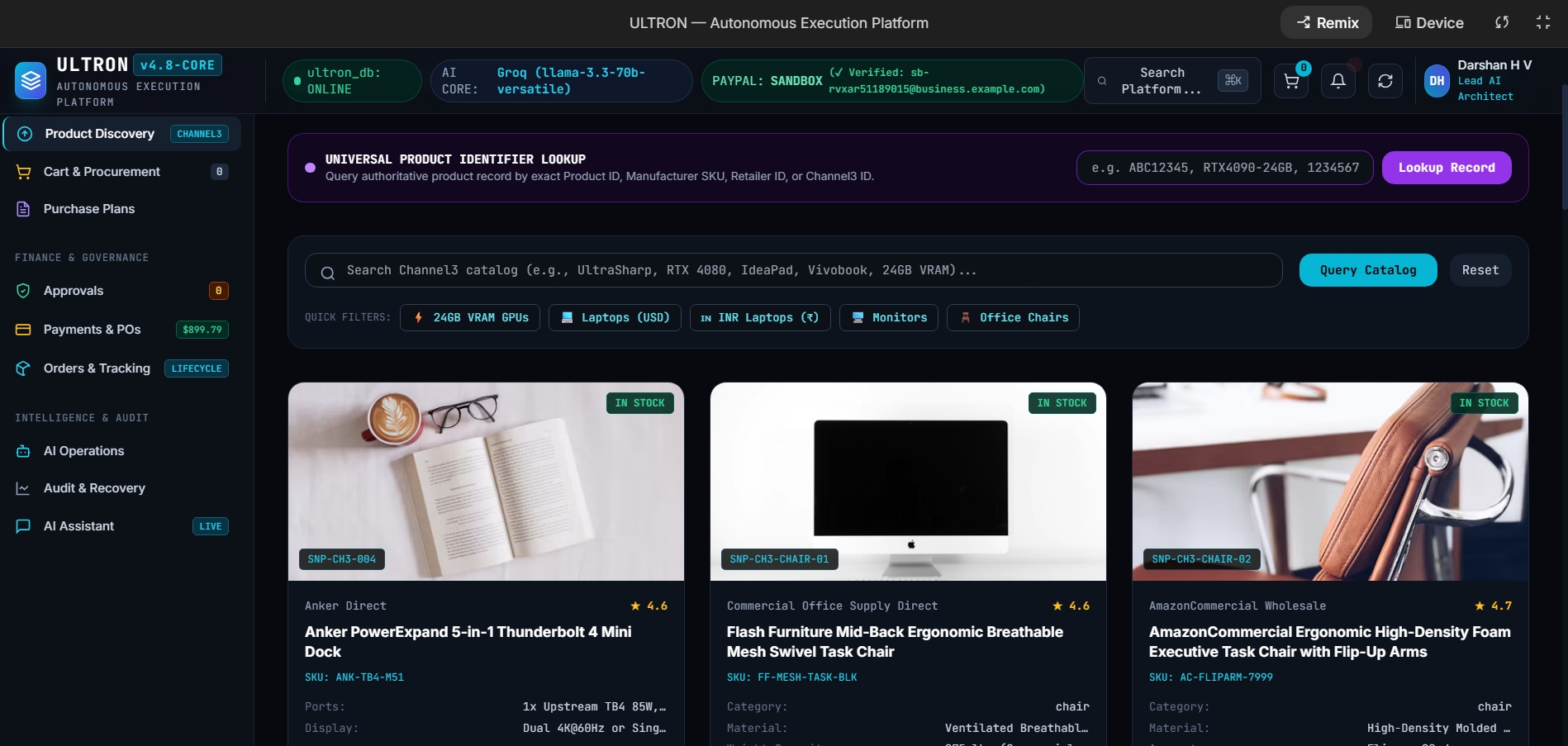
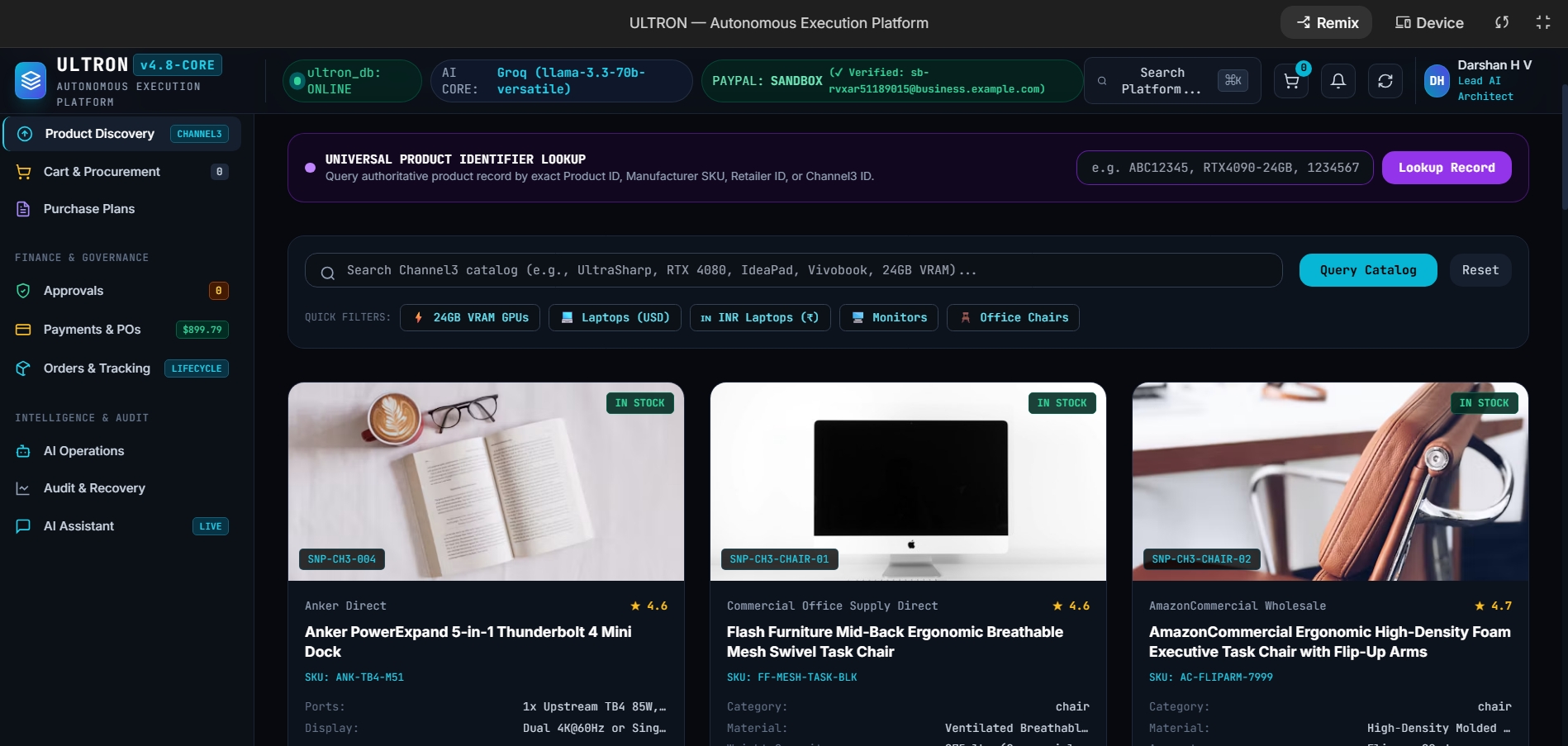
- Product discovery: ULTRON connects with Channel3 to retrieve product information from its available catalog.
- Product evaluation: It filters and compares products based on specifications, price and the user's requirements.
- Purchase planning: Selected products can be organized into a purchase plan with quantities and calculated totals.
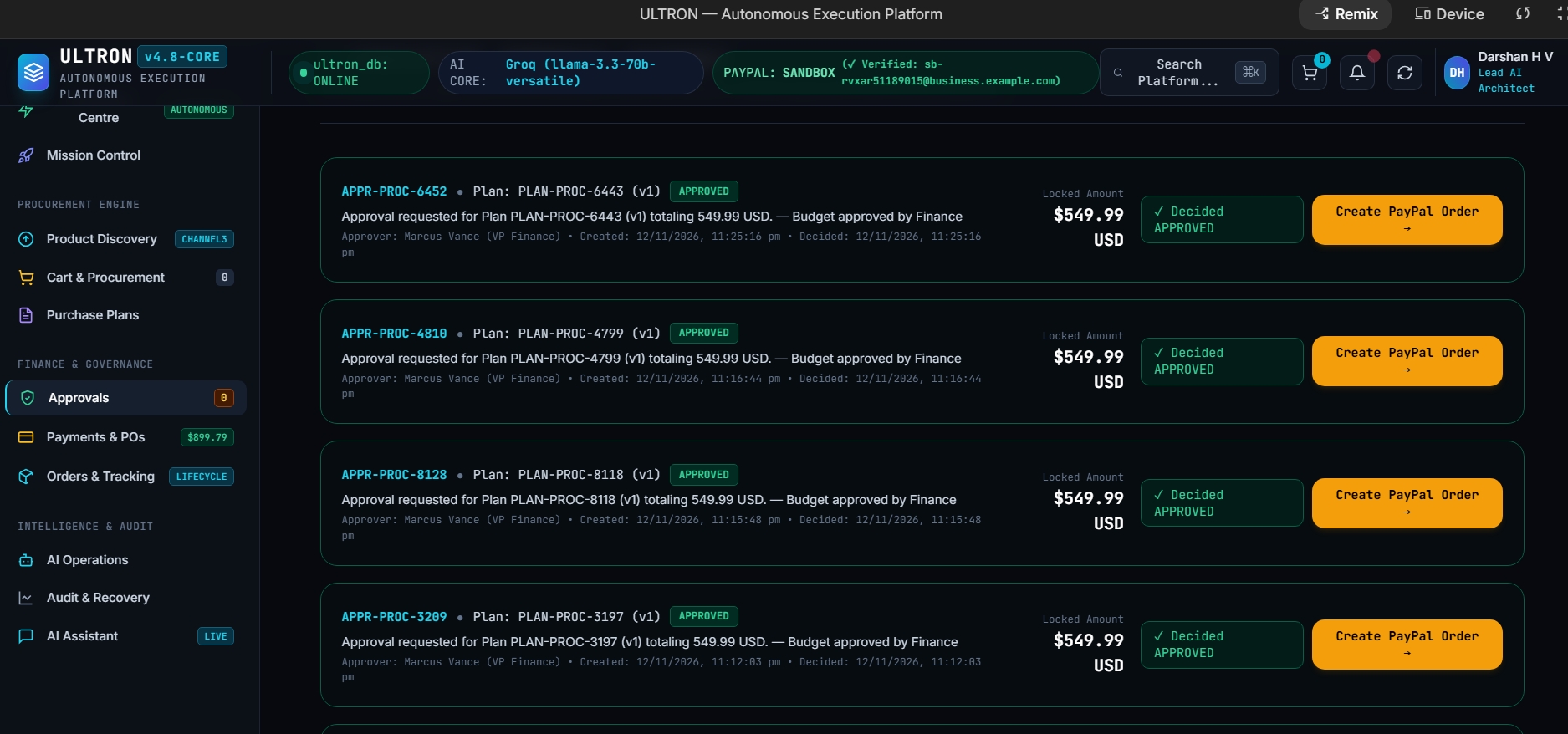
- Human approval: Users review and authorize the purchase before a payment operation proceeds.
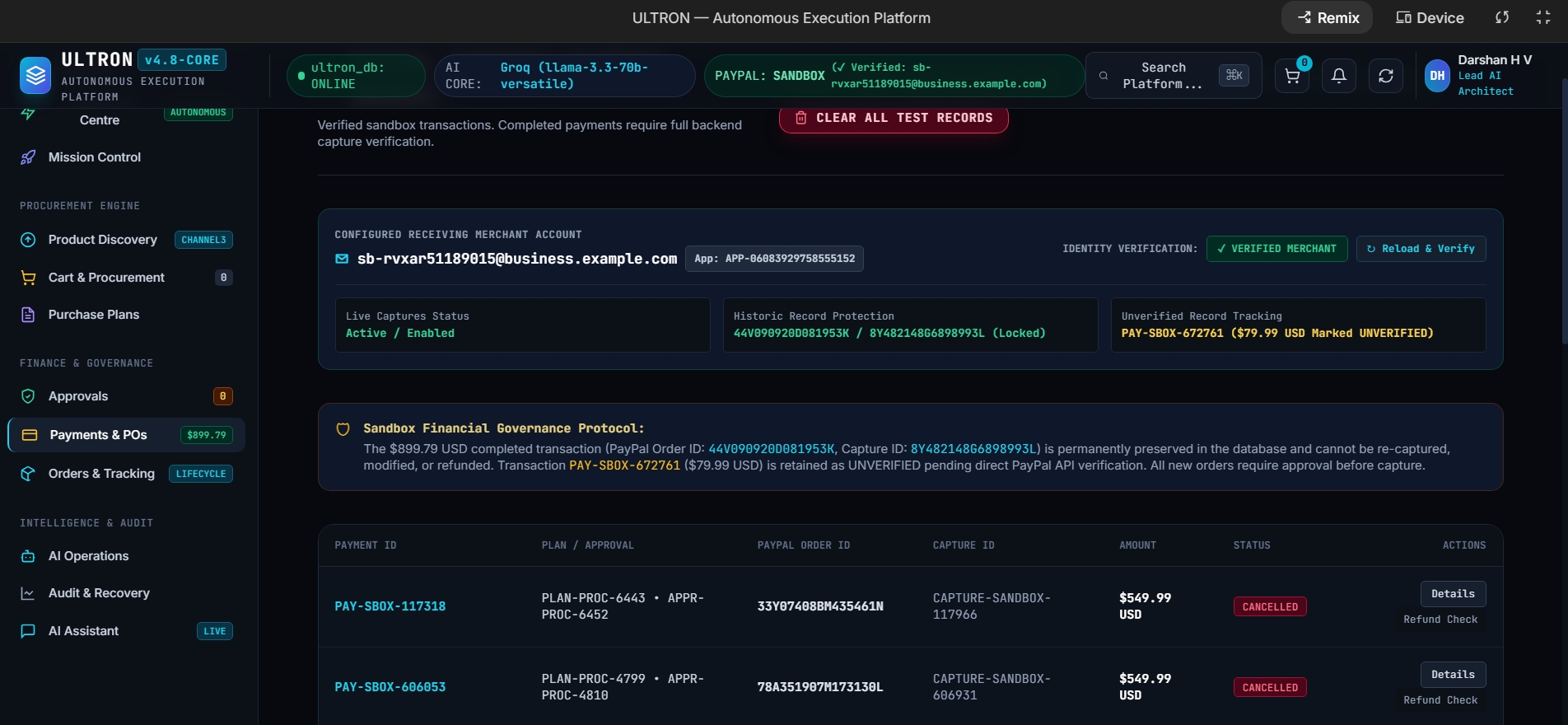
- PayPal integration: PayPal Sandbox is used to demonstrate merchant checkout, buyer approval, payment capture and transaction verification.
- Order lifecycle management: ULTRON provides a unified view of procurement, payment and external fulfilment states.
- Execution history: The platform maintains records of objectives, plans, approvals, payments and execution events.
One thing we consider particularly important is the separation between a payment received by the ULTRON merchant account and an actual purchase from an external retailer. These are different operations, and the platform is designed to represent them separately.
How we built it
We built ULTRON using a combination of AI services, backend engineering, external APIs and a custom web interface.
For the frontend, we used HTML, CSS and JavaScript to create a single-page interface with a dark, command-centre-inspired design. We wanted the application to feel like a place where users could initiate objectives and monitor their execution, rather than just chat with an AI.
The backend is built with Python and FastAPI. It handles objective processing, API communication, task execution, purchase plans, approvals and payment operations.
For AI, we integrated Groq as our primary model provider and OpenRouter as a fallback. The AI helps interpret natural-language requests, extract requirements, evaluate options and support task planning.
We integrated Channel3 for product discovery, allowing ULTRON to retrieve product information from the connected catalog rather than depending entirely on manually entered product data.
We used MySQL to maintain persistent application data, including objectives, product snapshots, plans, approvals, payment orders and execution history.
PayPal was an important part of our implementation. We integrated the PayPal Developer Sandbox environment to test the payment lifecycle. This included obtaining an access token, creating a payment order, redirecting the buyer for approval, capturing the payment and verifying the resulting transaction.
We also designed the application to distinguish between AI-generated decisions and operations that must be validated by deterministic backend logic. For example, calculations, approval checks and payment verification are handled by the backend rather than simply trusting an AI response.
Challenges we ran into
One of our biggest challenges was getting natural-language instructions to translate into reliable structured requirements.
A request such as "Find a GPU with 24GB VRAM" should not automatically receive an invented budget. The system needs to understand what the user actually specified and leave missing information unspecified.
Another challenge was integrating product discovery with the rest of the procurement workflow. Finding a product is only the beginning. Its specifications, price, source and availability need to be handled carefully before it can become part of a purchase plan.
Payment integration also required considerable attention. Creating a PayPal order, receiving buyer approval and successfully capturing a payment are separate stages. We had to make sure that the application did not mistake a successful redirect for a completed payment.
We also had to think carefully about what happens after payment. A payment to our configured ULTRON merchant account does not automatically mean that an external retailer has received an order. Retailer checkout, shipping and tracking require their own integrations.
Finally, connecting all these components into one application was challenging. We had to coordinate the frontend, backend, database, AI providers and external services while maintaining consistent records and transaction states.
These challenges helped us understand that building an autonomous system requires much more than connecting an LLM to a few APIs.
Accomplishments that we're proud of
We are particularly proud that ULTRON has developed beyond the idea of a simple AI shopping assistant.
We built a connected procurement application with a natural-language Command Centre, AI provider integration, product discovery, purchase planning, approval workflows, payment management and order lifecycle visibility.
One of our most important milestones was successfully completing a PayPal Sandbox payment test. We created an order, completed buyer approval, captured the payment and verified the completed transaction in our application with its corresponding capture reference and amount.
We are also proud of the architecture behind the application. We brought together FastAPI, MySQL, Groq, OpenRouter, Channel3 and PayPal into a common workflow.
Another achievement is the attention we gave to transaction safety. We wanted payment status to be based on actual verification, not simply on what the frontend displays.
Most importantly, we learned to think about AI in terms of execution and accountability, rather than only generating answers.
What we learned
This project taught us that making an AI application work in the real world is very different from making a chatbot produce an impressive response.
We learned how important structured outputs, API integrations, database consistency and execution-state management are when building systems that interact with external services.
We also gained practical experience with PayPal's Sandbox payment lifecycle, including OAuth authentication, order creation, buyer approval, capture and transaction verification.
One of our biggest takeaways was that AI should not be responsible for everything. It is useful for understanding intent, reasoning and planning, but financial calculations, permission checks and transaction verification should be handled by reliable backend logic.
We also learned to be careful about the difference between an operation being requested, an operation being initiated and an operation actually being completed.
That distinction has influenced how we designed ULTRON.
What's next for ULTRON: Commerce Command
ULTRON is a foundation that we want to keep developing beyond the hackathon.
Our next goal is to make product discovery more comprehensive, improve product identifier lookup and strengthen natural-language understanding so that users can express more complex procurement requirements without needing to fill out forms.
We also want to improve dynamic task execution, allowing ULTRON to recover from failed tasks, reconsider alternatives and continue when appropriate.
On the commerce side, we plan to explore additional verified retailer checkout integrations so that product purchasing can move beyond discovery and payment to the ULTRON merchant account. We also want to expand real order confirmation, carrier tracking, cancellation and refund capabilities through supported external APIs.
Security, auditability and reliable execution will remain important priorities as the platform grows.
Our long-term vision is to make ULTRON a platform where people can describe an objective in their own words and have AI coordinate the tools and services needed to accomplish it, with transparent progress and human control over important decisions.
We don't want ULTRON to simply tell people what they could buy or what they should do. We want it to help them move from an idea to an actual, verifiable outcome.
Built With
- agentic-ai
- ai-agents
- api-integration
- artificial-intelligence
- autonomous-ai
- backend-development
- channel3
- css
- fastapi
- frontend-development
- groq
- html
- javascript
- large-language-models
- multi-agent-systems
- mysql
- natural-language-processing
- openrouter
- paypal
- paypal-sandbox
- procurement-automation
- python
- rest-api
- sqlalchemy
- task-automation
