-
-
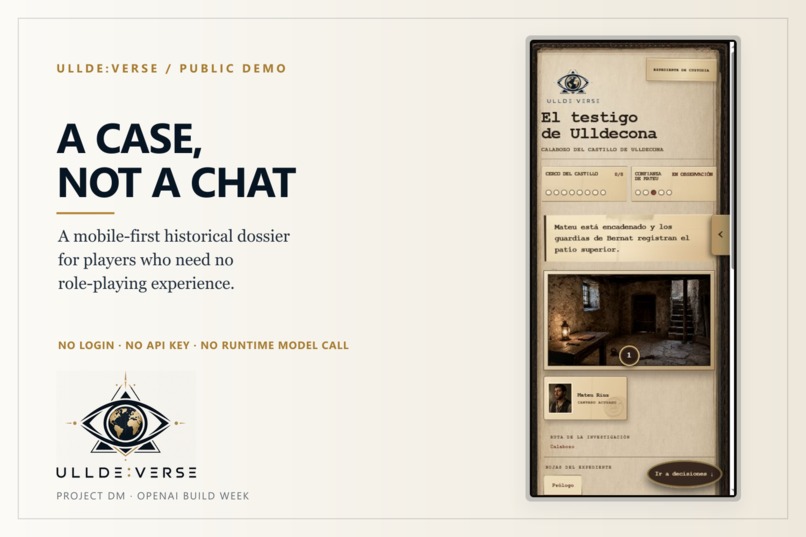
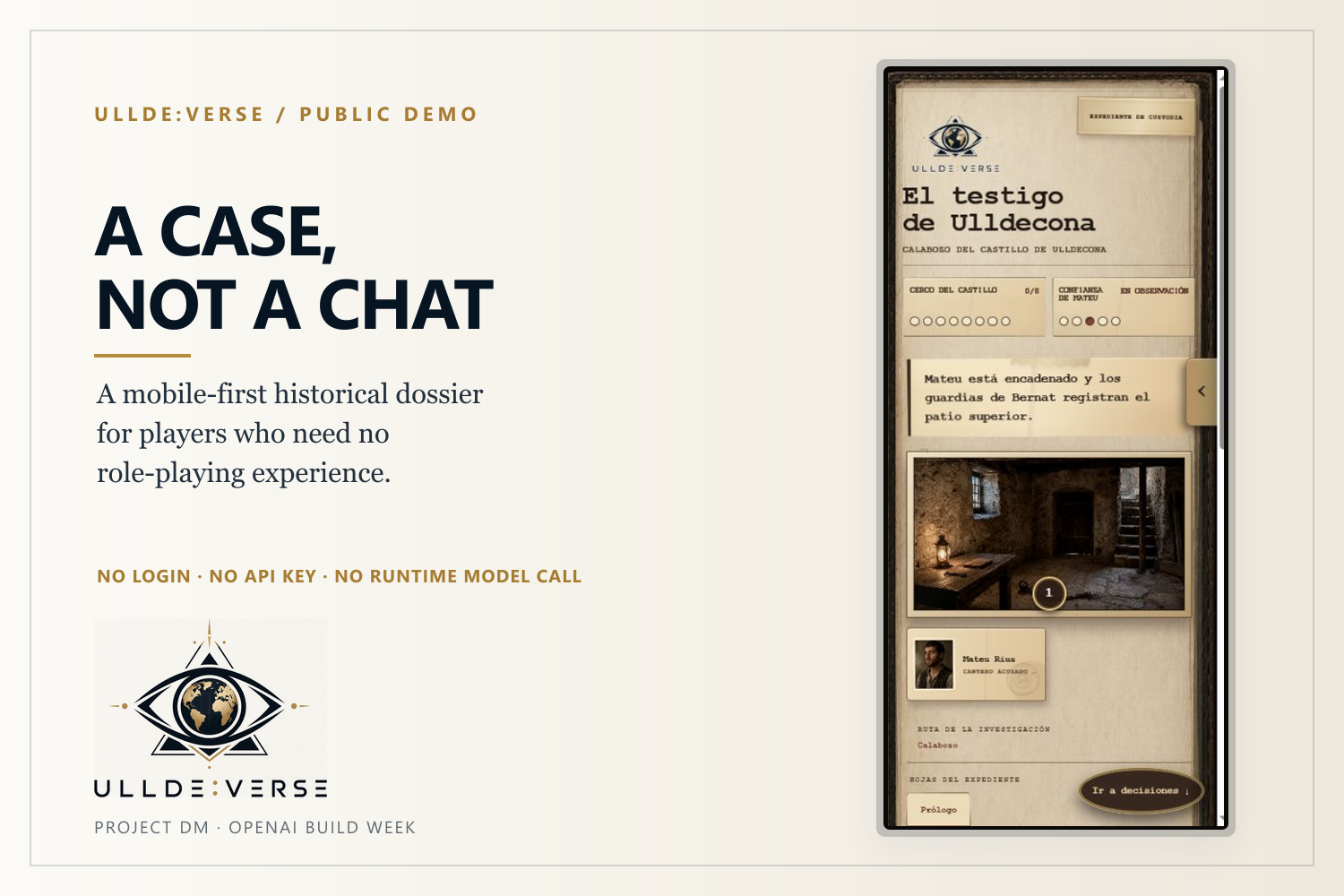
A case, not a chat — The mobile dossier introduces the world, objective and current pressure without requiring role-playing knowledge.
-
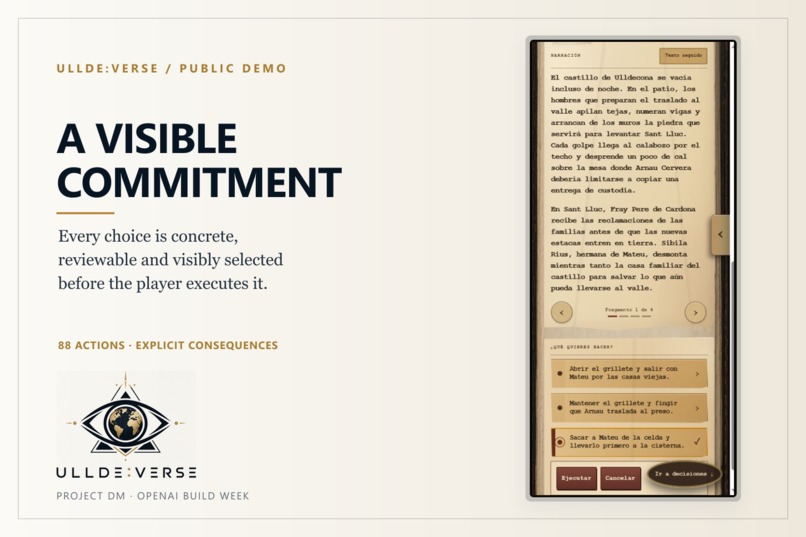
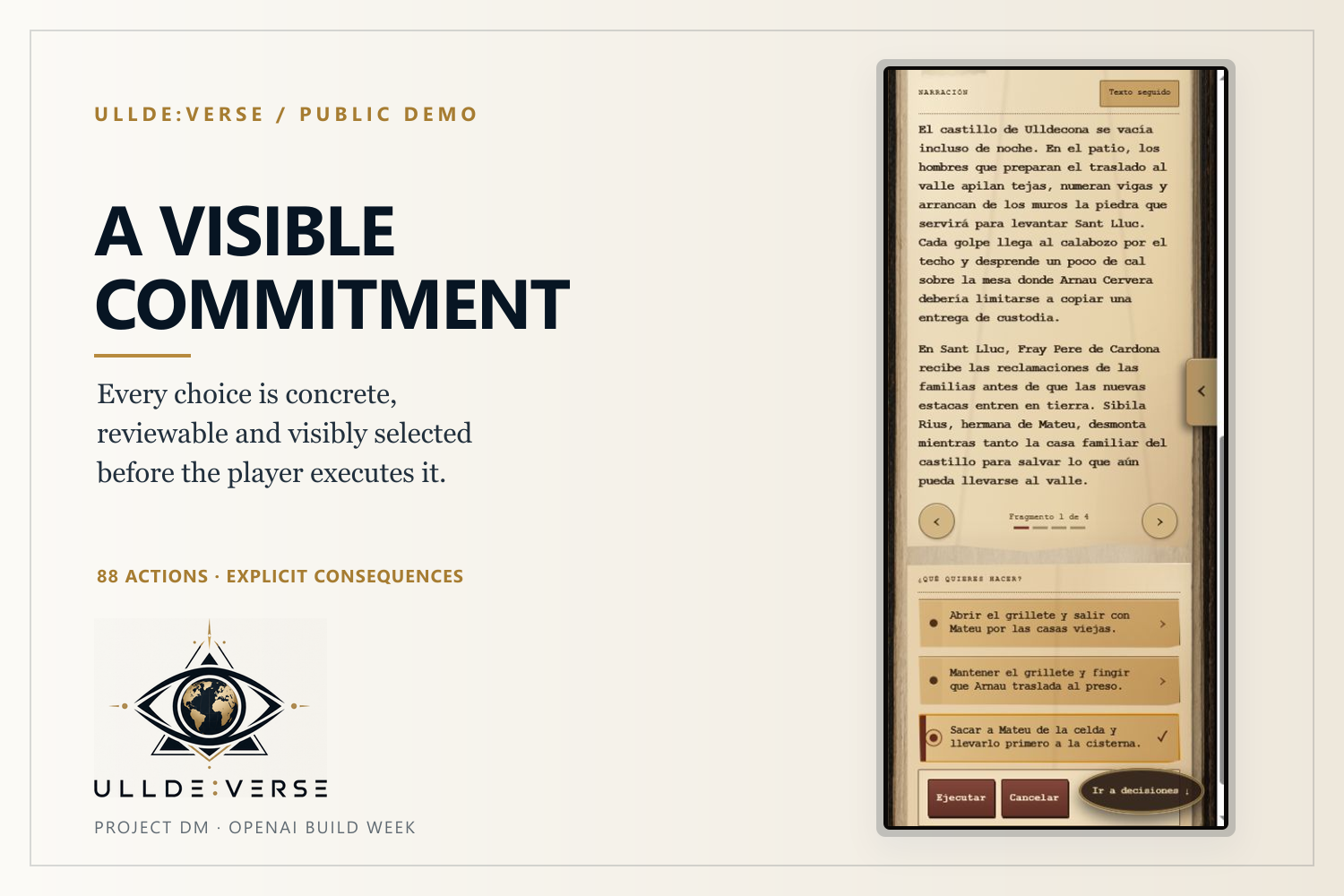
A visible commitment — The selected decision changes visually before execution, then updates the canonical case state.
-
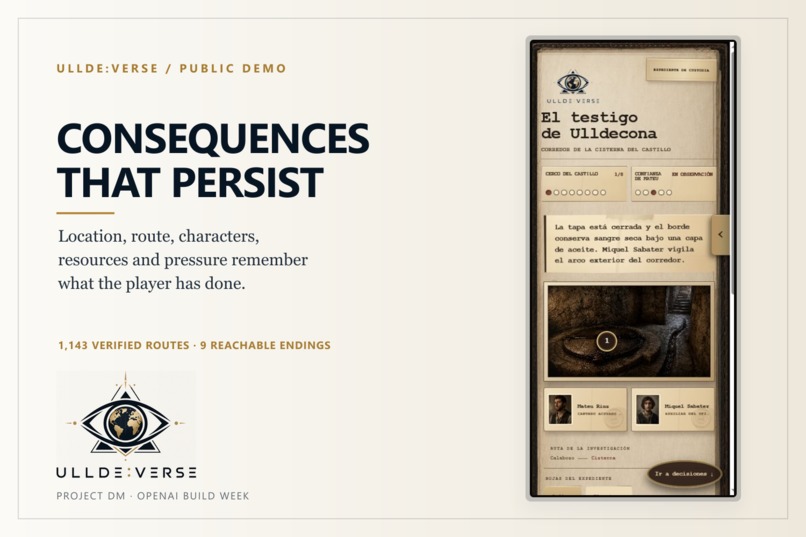
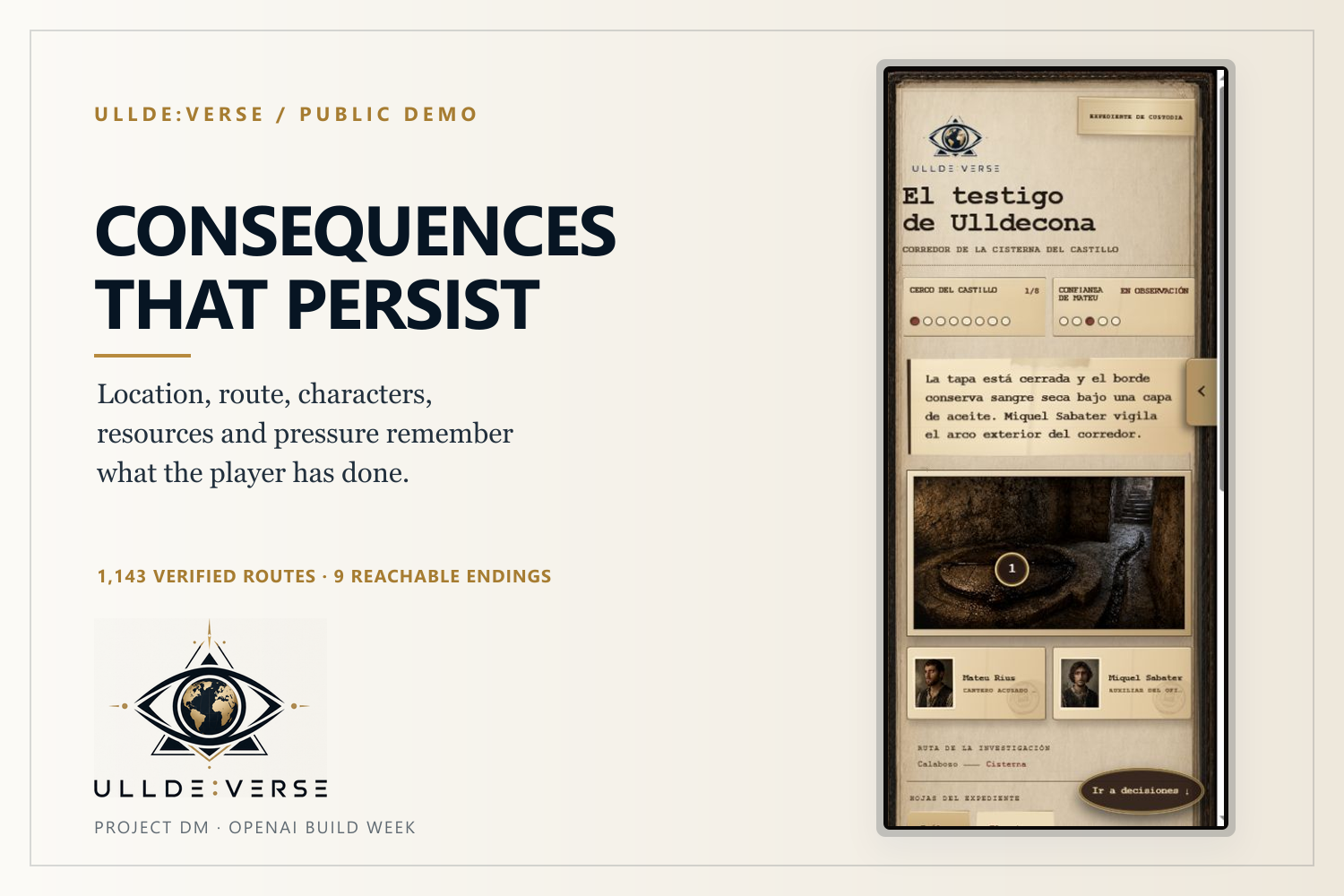
Consequences that persist — Routes, relationships, evidence and later possibilities remember earlier actions.
-
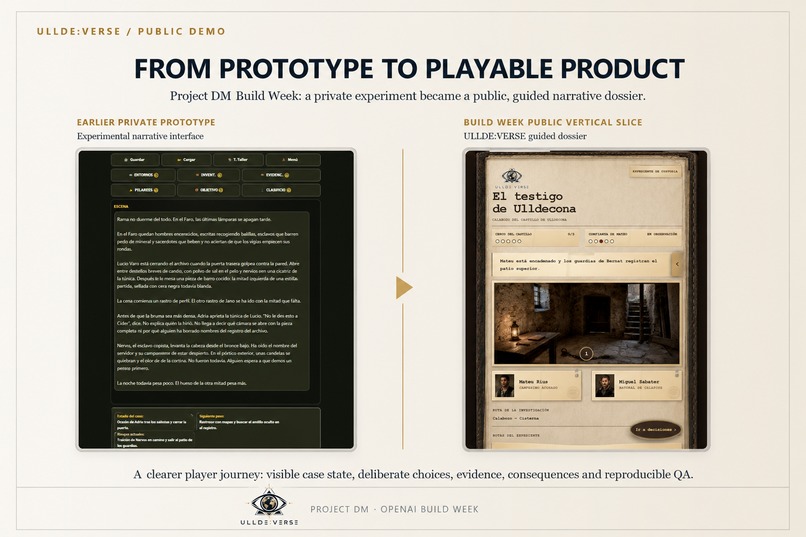
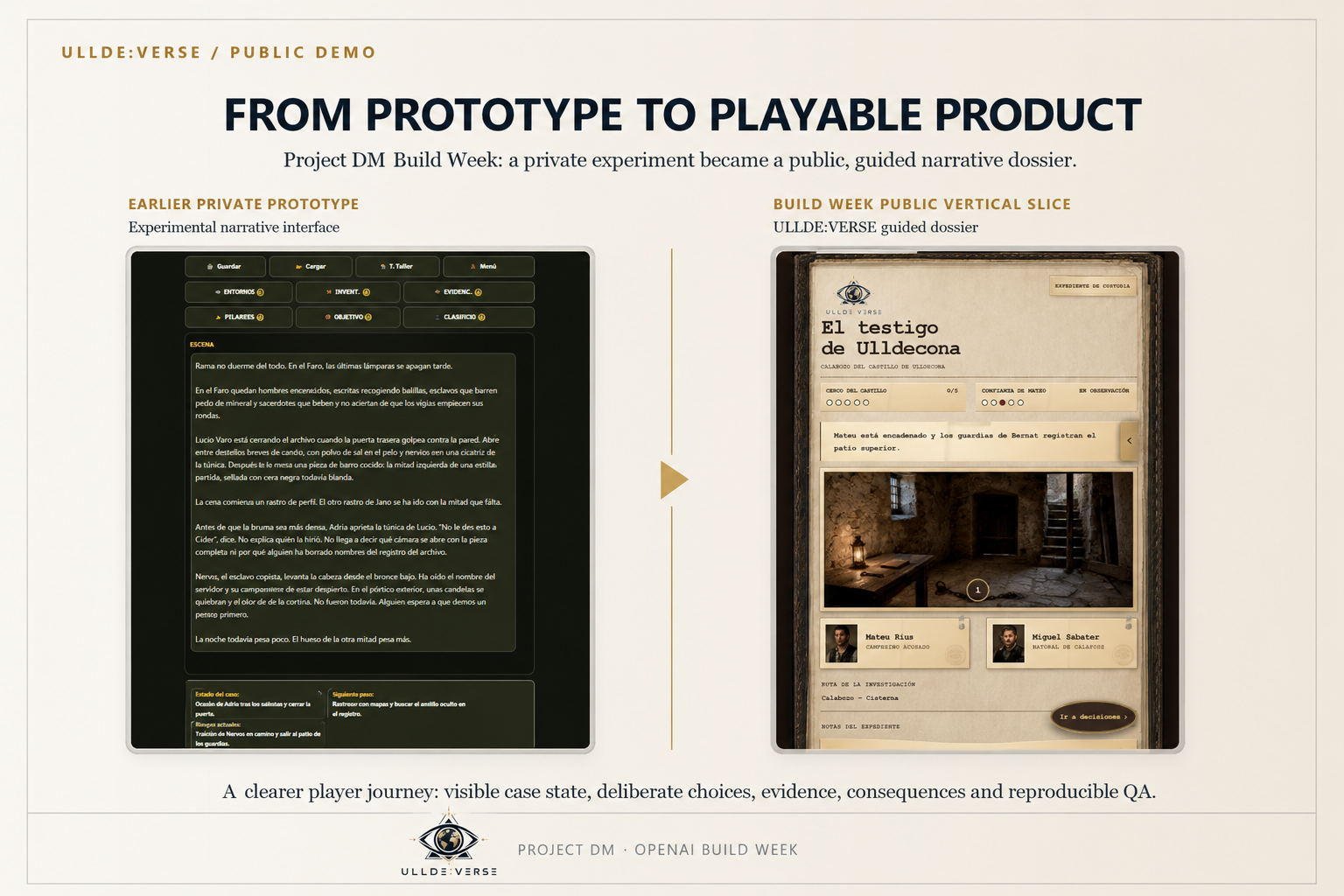
Build Week turned a private prototype into a public mobile dossier with clearer choices, persistent consequences and reproducible QA.
Overview
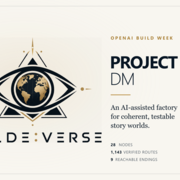
Project DM helps independent creators, educators and cultural organisations turn a defined premise into a short interactive world whose choices can be tested before it reaches players. ULLDE:VERSE is its first complete vertical slice: a smartphone-first historical investigation in which every decision updates a canonical, testable case state.
Inspiration
Generative narrative systems can produce vivid prose, but they are difficult to reproduce, debug and ship. A model may invent an exciting scene while forgetting an earlier promise, exposing an impossible option or ending the story generically.
I wanted a player with no role-playing experience to open a short adventure, read, decide and immediately understand the consequences. I also wanted a practical path for a local-history educator, museum, writer or small creative team to make an interactive experience without hand-maintaining a fragile maze of branches. The production system behind that experience should behave more like a compiler and test suite than an unconstrained prompt.
I am an independent creator outside the software and games industries. I work in Spain’s public sector and studied Political Science. Before Build Week, I had explored Project DM with separate AI tools, but I could not reliably connect narrative design, code, world state and testing. Using Codex let me work across one repository and make those pieces answer to the same coherent product. That shift helped turn a prototype I was close to setting aside into a public, testable vertical slice with a credible path to grow.
What it does
Project DM turns confirmed human intent into a structured experience seed, a causal world architecture, a compiled runtime artifact and a set of executable quality gates.
That makes a short world usable as more than entertainment: a cultural institution can turn a place or archive into an explorable case; an educator can frame a lesson around consequential decisions; and an independent creator can test whether a compact narrative remains coherent before publishing it. These are target use cases for the factory, not features claimed as already automated in this first vertical slice.
ULLDE:VERSE presents the result as a mobile investigation dossier. In El testigo de Ulldecona, the player:
- reads scenes and testimony;
- chooses concrete actions;
- discovers characters, objects and deductions;
- changes relationships, resources, pressure and later possibilities;
- reaches one of nine materially different endings.
The public guided demo runs entirely in the browser, stores only local play state and requires no account, API key or runtime model call.
How we built it
The production chain separates responsibilities:
- A human confirms the intended experience.
- A structured seed records audience, tone, central relationship and desired decision texture.
- World architecture declares nodes, actions, resources, deductions, pressure, causal promises and endings.
- A compiler produces the canonical world consumed by the runtime.
- A versioned visual manifest binds scenes, characters and props through stable identifiers.
- Automated gates explore the graph and reject structural, causal, presentation and deployment failures.
- ULLDE:VERSE renders the verified artifact as a responsive dossier.
The submitted world contains 28 narrative nodes, 88 actions and 9 reachable endings. Automated exploration verifies 1,143 valid routes.
How Codex and GPT-5.6 were used
The private project existed before Build Week as an experimental narrative engine with prototype worlds and evolving factory contracts.
The decisive change was not code generation alone: Codex helped me reason across narrative contracts, canonical JSON, runtime behavior, interface, QA, deployment and documentation as one connected system.
During the Submission Period, I used Codex with GPT-5.6 as an engineering and product collaborator to turn that baseline into the submitted vertical slice. The Build Week extension:
- established the Project DM / ULLDE:VERSE / El testigo de Ulldecona product identity;
- redesigned the smartphone dossier and its decision feedback;
- replaced identity-bearing content with fictional names and portraits;
- curated and secured a minimal public evaluation repository;
- built a deterministic browser runtime and production deployment package;
- added repository hygiene, hosted-artifact and HTTP playthrough checks;
- converted recurring narrative and runtime failures into executable QA.
GPT-5.6 helped reason across narrative structure, interaction design, implementation, privacy and release decisions. Codex inspected and edited the repository, ran verification, diagnosed deployment failures and iterated until the public artifact matched the canonical world. Human decisions remained authoritative for product intent, privacy and final acceptance.
Challenges we ran into
Preserving player agency
A branching story can contain many buttons while still producing the same outcome. We addressed this by enumerating routes and checking reachability, irreversible choices, climax differentiation and ending families.
Making resources and memories causal
Objects and discoveries must change what the player can credibly do. Dedicated gates now validate acquisition, consumption, later reads and declared causal promises.
Producing a stable judged experience
The private runtime supported optional external providers, but judges should not depend on credentials or network model availability. We created a browser-only guided adapter that uses the same canonical world and verifies its equivalence during QA.
Publishing without exposing the workshop
The private repository contained local state, reference media, conversations and unrelated prototypes. We created a deliberately small public repository, regenerated fictional portraits and added a hygiene gate that rejects credentials, personal paths and runtime files.
Accomplishments that we are proud of
- A complete, coherent product experience rather than a prompt demonstration.
- 1,143 verified play routes through one canonical world.
- Nine reachable endings across failure, order, protection and revelation families.
- Thirty-seven approved visual assets resolved through stable identifiers.
- A guided experience that works locally and publicly without credentials.
- One command,
npm test, that verifies the submission from repository hygiene through HTTP playthroughs and hosted packaging.
What we learned
AI-assisted narrative production becomes more reliable when creative generation and acceptance are different jobs. Models are valuable for proposing architecture, prose, code and fixes, but the artifact becomes shippable only when stable contracts can reject incoherence.
We also learned that product identity, privacy and ease of evaluation are part of technical quality. A judge should be able to understand the promise, try the product and reproduce its evidence without entering the private workshop that produced it.
What's next
Project DM currently proves the factory with one finished world. The next steps are:
- record a continuous build of a new mini-world from human premise to passing QA;
- reduce authoring time while preserving the same acceptance gates;
- add reusable visual-production profiles;
- pilot new worlds with local-history educators, cultural organisations and independent creators;
- measure whether players perceive later consequences as genuinely caused by their earlier decisions.
Testing instructions
Fastest path
Open the public ULLDE:VERSE demo, keep Corto guiado selected and choose Jugar este mundo. No login or API key is required.
The playable historical fiction is intentionally in Spanish. An English translation and playthrough guide is available.
For a visible state change, choose:
Sacar a Mateu de la celda y llevarlo primero a la cisterna.
The selected decision highlights before confirmation. After execution, the location, route, known characters and case state update.
Local verification
With Node.js 20 or newer:
npm ci
npm test
npm start
Then open http://localhost:3000. The optional assisted free mode is not required for evaluation.
Before/after disclosure
Pre-existing baseline: private experimental engine, prototype content and evolving factory documentation.
Evaluated Build Week extension: curated vertical slice, product identity, mobile interface redesign, fictionalized public content, deterministic hosted runtime, deployment packaging, security hardening, public documentation and executable submission QA.
The dated commit trail and primary Codex Session ID document this extension.
Built With
- cloudflare-workers
- codex
- css
- express.js
- gpt-5.6
- graph
- html
- javascript
- json
- node.js
Log in or sign up for Devpost to join the conversation.