-
-
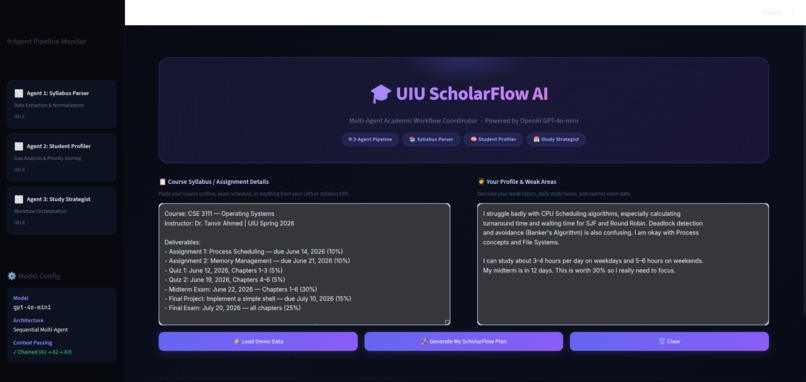
Dashboard
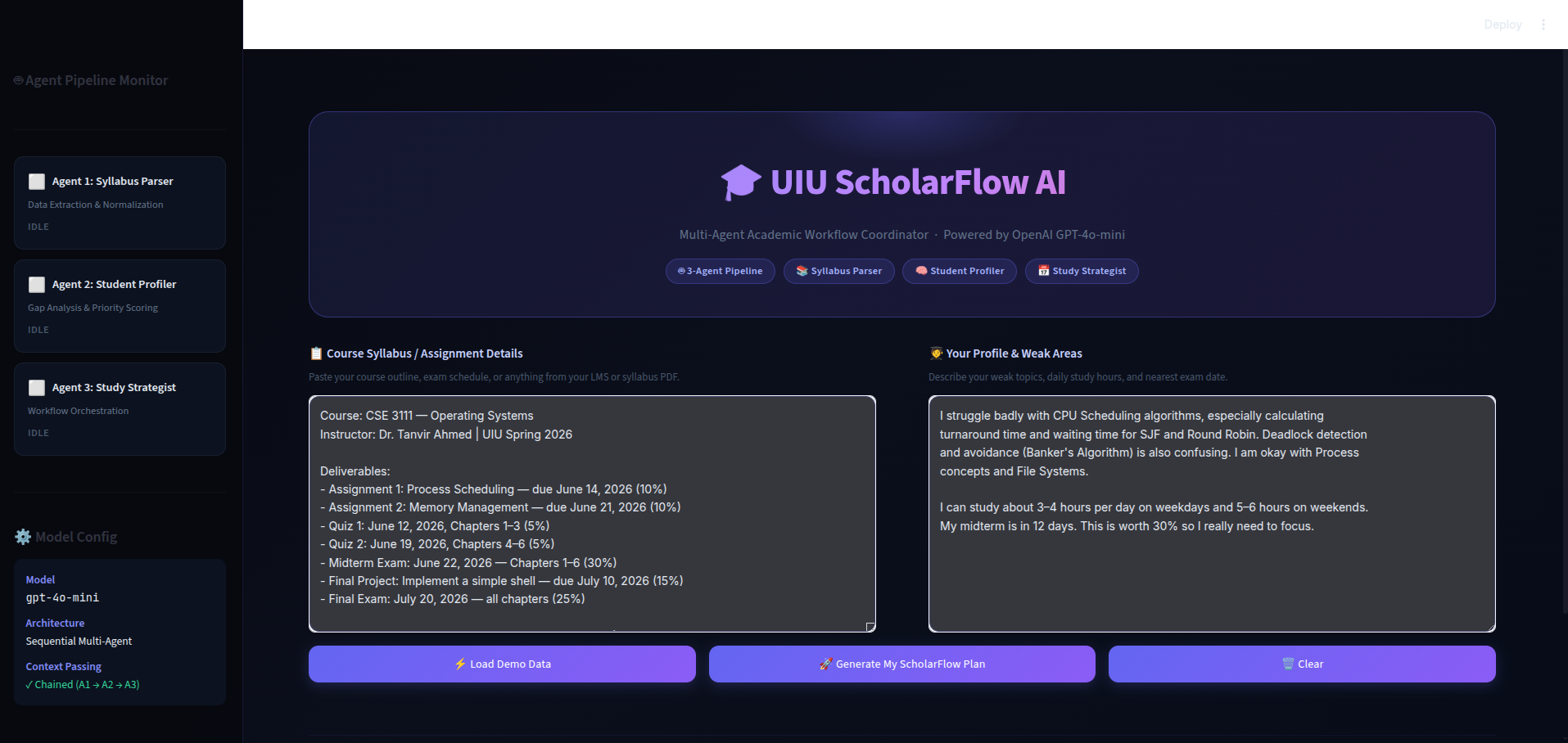
Inspiration
Every UIU student knows the panic — it's 11 PM, your midterm is in 72 hours, and your syllabus is scattered across LMS announcements, WhatsApp messages, and handwritten notes. You spend the first hour just figuring out what to study before you've studied anything at all.
We wanted to eliminate that planning paralysis entirely. The inspiration was simple: what if an AI could read the chaos, understand your weaknesses, and hand you a battle-ready study plan in under 30 seconds?
What it does
UIU ScholarFlow AI is a multi-agent academic workflow coordinator. You paste your course syllabus or assignment details, describe your weak areas and available study hours — and a 3-agent GPT-4o-mini pipeline does the rest:
• Agent 1 (Syllabus Parser) extracts assignments, deadlines, exam dates, and grade weights into structured JSON • Agent 2 (Student Profiler) cross-references that data with your self-reported weaknesses and generates a priority matrix — scoring every topic from 1–10 on urgency and difficulty • Agent 3 (Study Strategist) synthesizes both outputs into a day-by-day Markdown study sprint, with Power Hour deep-work sessions for your weakest, highest-stakes topics
The result: a personalized, downloadable study plan delivered through a clean Streamlit UI with a live agent status monitor.
How we built it
The core is a sequential multi-agent pipeline built on the OpenAI Python SDK (gpt-4o-mini). Each agent has a distinct temperature tuned to its job — 0.1 for factual extraction, 0.2 for analytical scoring, 0.7 for creative planning.
Context passes explicitly as JSON between agents, so no information is lost across steps. Agent 1's output becomes Agent 2's input; both feed into Agent 3.
The frontend is Streamlit with a custom dark glassmorphism CSS design system — a live sidebar monitors each agent's status (idle → running → done) in real time. The agent architecture is fully documented in AGENTS.md and skills.md following modern agentic workflow conventions.
Stack: Python · OpenAI GPT-4o-mini · Streamlit · pandas · python-dotenv
Challenges we ran into
• JSON reliability: LLMs occasionally wrap JSON in markdown fences even when instructed not to. We added a fence-stripping fallback before every json.loads() call to prevent pipeline failures.
• Session state in Streamlit: Managing widget state across reruns while keeping demo data fillable without triggering key conflicts required careful separation of widget values from session state keys.
• Temperature calibration: Getting Agent 3 to produce motivating, structured output without hallucinating deadlines required iterating on the system prompt and grounding it firmly in Agent 1's extracted JSON rather than letting it invent dates.
• Time: Built entirely in under 2 hours before a midnight deadline.
Accomplishments that we're proud of
• A clean, fully functional 3-agent pipeline where each agent has a single responsibility and passes structured context forward • The priority matrix — a scored topic ranking by urgency × difficulty that makes the study plan genuinely data-driven, not generic • A production-quality Streamlit UI with live agent status monitoring, real-time progress tracking, and a downloadable plan export • Comprehensive AGENTS.md and skills.md documentation that clearly articulates the agentic architecture and skill definitions • Zero hallucinated deadlines — the plan stays grounded in the student's actual syllabus data throughout the pipeline
What we learned
• Agent temperature matters enormously — the same model behaves very differently at 0.1 vs 0.7, and matching temperature to task type (factual vs creative) is a key architectural decision • Explicit structured context passing between agents is more reliable than conversational memory for multi-step academic reasoning tasks • The "Plan-Execute" pattern (profiling before planning) produces significantly better personalized output than single-prompt approaches • AGENTS.md and skills.md aren't just documentation — writing them forced clearer thinking about agent boundaries and responsibilities
What's next for UIU ScholarFlow AI
• Quiz Agent: Auto-generates self-test questions from each day's study topics so students can validate retention • Progress Agent: Tracks daily completion and dynamically re-schedules uncompleted sessions forward • Alert Agent: Sends WhatsApp or email reminders 24 hours before each deadline extracted by Agent 1 • PDF/Image Input: Accept syllabus images or PDFs directly via the Files API instead of requiring copy-paste • Multi-course mode: Coordinate study plans across multiple concurrent courses, resolving scheduling conflicts automatically • Peer Agent: Match students studying the same course on the same timeline for accountability partnerships

Log in or sign up for Devpost to join the conversation.