-
-
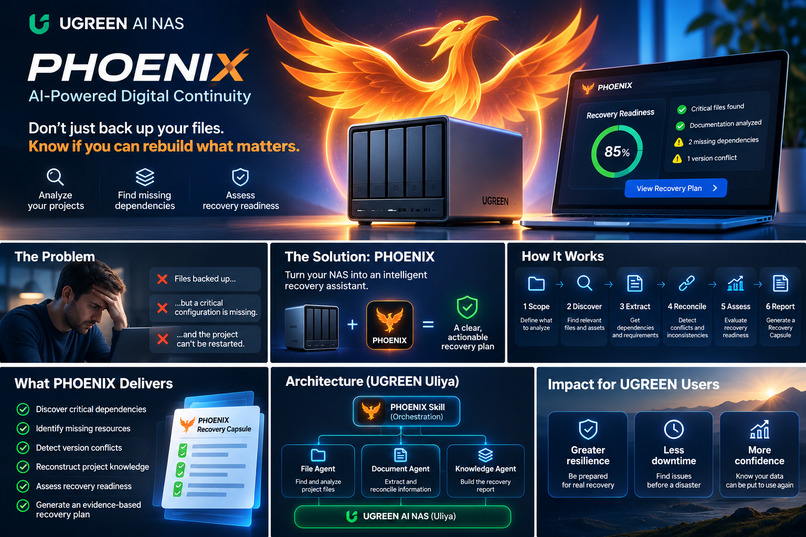
Concept Preview
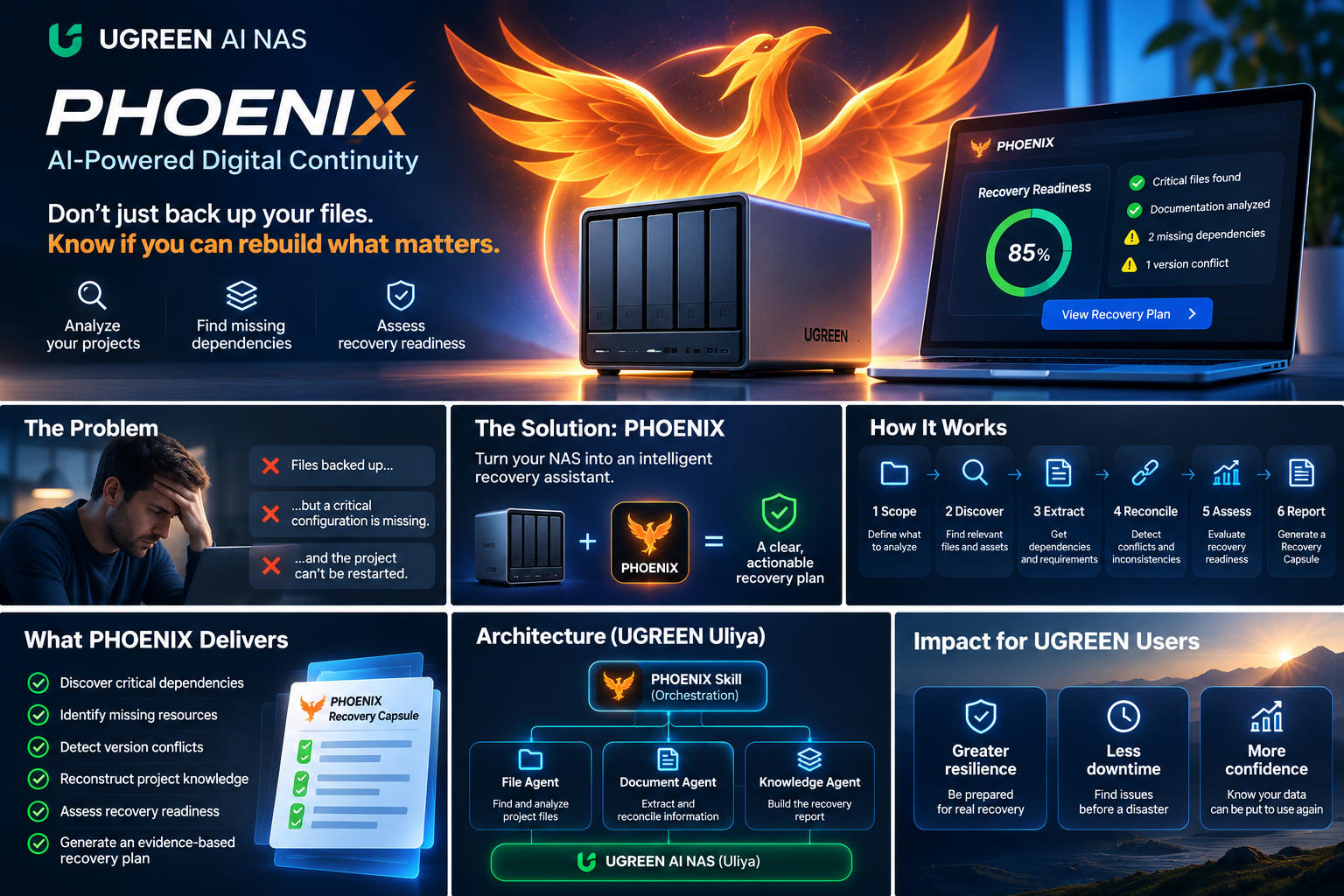
Inspiration
Your backup survived. Your project didn't.
Imagine losing your computer. Your NAS has thousands of backed-up files—but one missing configuration, incompatible dependency, or undocumented procedure makes rebuilding your project impossible.
What if your NAS could detect that risk before disaster strikes?
That's why I created PHOENIX — Recovery Intelligence for UGREEN AI NAS.
I believe the next revolution in storage isn't about saving more data. It's about understanding whether that data is enough to rebuild what matters.
What it does
PHOENIX transforms a NAS from a file repository into an evidence-driven recovery-readiness investigator.
Ask one question:
"If my computer disappeared tomorrow, could I rebuild my project?"
PHOENIX is designed to investigate the answer through five capabilities:
- Discover: Identify critical dependencies hidden across files and documentation.
- Verify: Detect missing configurations, incompatible versions, and contradictory requirements using cited evidence.
- Plan: The Evidence Gain Planner identifies exactly what to verify next, why it matters, and what would resolve each documentary blocker.
- Recheck: Recovery Closure examines fresh evidence after an issue is addressed and produces a before-and-after Recovery Delta.
- Protect: Refuse unsupported conclusions. If evidence is insufficient, PHOENIX says so.
Its Proof Graph and Recovery Readiness Passport make the findings explainable and actionable.
PHOENIX doesn't just tell you what's missing. It tells you what evidence could move you closer to recovery.
How we built it
Built specifically for UGREEN's Uliya ecosystem using the official Skill Developer Kit v0.7.3.
PHOENIX orchestrates three native expert agents:
File Agent → Document Agent → Knowledge Agent
Together, they discover project assets, analyze dependencies, verify evidence, and generate recovery-readiness reports.
The Skill is Markdown-based, permission-aware, read-only by default, and requires no external APIs or custom runtime executables.
I also built a reproducible local evaluation framework to test its reasoning, reliability, and failure handling before real NAS access.
Challenges we ran into
The hardest challenge wasn't finding files. It was teaching an AI when NOT to declare success.
A file can exist but be incompatible. A document can be incomplete. A confident AI answer can be dangerously wrong.
I built explicit evidence states, source verification, contradiction detection, and fail-closed verdicts to prevent false reassurance.
Another challenge was making complex dependency analysis understandable to ordinary users—without sacrificing technical rigor.
Accomplishments that we're proud of
PHOENIX has progressed beyond a conceptual Skill into a locally validated recovery-intelligence prototype.
- 8/8 correct verdicts on a predefined synthetic local benchmark, versus 6/8 for a retrieval-plus baseline.
- 92/92 local acceptance checks on the fully supported test environment.
- 17/17 mutation tests passed.
- Zero errors and warnings from the official Uliya static checker.
- Evidence Gain Planner: 12/12 locally evaluated actions include explicit resolution criteria, compared with 0/12 before its introduction.
- Recovery Closure: Rechecks evidence and traces documentary blocker resolution without pretending a real restoration occurred.
These are reproducible local results, not real UGREEN NAS runtime measurements.
What we learned
Storage preserves files. Intelligence can help preserve the ability to use them.
We learned that trustworthy recovery assistance must do more than locate information. It must connect requirements to evidence, expose uncertainty, and give users a concrete next step.
Most importantly, an AI that knows when it cannot prove something is more valuable than one that always sounds confident.
What's next for UGREEN PHOENIX
The next milestone is validating the complete Skill on real UGREEN AI NAS hardware, capturing native execution evidence, and demonstrating the full investigation-to-recheck workflow.
Beyond the hackathon, PHOENIX could evolve into a Digital Continuity Intelligence Platform, with recovery digital twins, proactive dependency monitoring, automated backup verification, and controlled recovery rehearsals.
The long-term vision is an intelligent NAS that doesn't just protect your files—it helps you understand whether your projects can survive a disaster.
PHOENIX — Don't just back up your files. Know what the evidence says you can rebuild.
Built With
- agent-orchestration
- ai-agents
- ai-assisted
- artificial-intelligence
- backup-and-recovery
- business-continuity
- data-protection
- dependency-analysis
- digital-resilience
- disaster-recovery
- document-ai
- file-management
- information-extraction
- knowledge-management
- knowledge-retrieval
- large-language-models
- local-ai
- markdown
- natural-language-processing
- network-attached-storage
- privacy-first-ai
- semantic-search
- ugreen-ai-nas
- uliya
- uliya-skill-sdk

