-
-
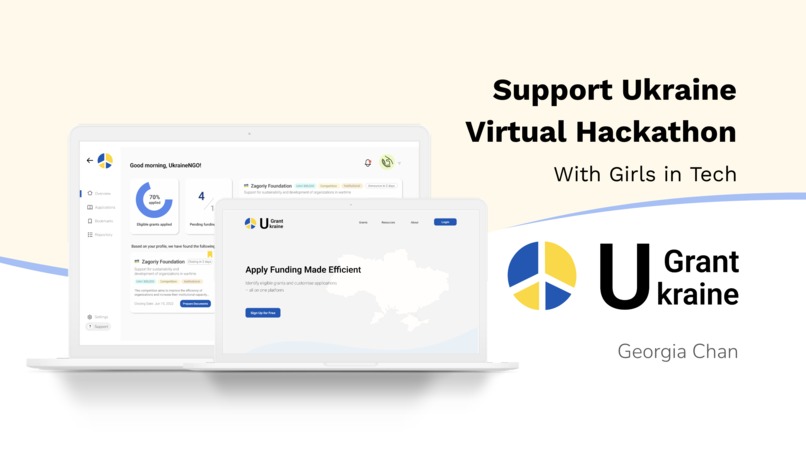
Support Ukraine Virtual Hackathon_Georgia Chan
Inspiration
The hard work of kind-hearted people in local nonprofits, working day and night to help the local community in need of aid, inspired me to commit to the project and be a part of the social good. In order to narrow down a problem and design a good user-focused product, I interviewed Irene, the project operations manager of QUASAR. She provided solid insights into the current situation in Ukraine and the challenges faced by local NGOs, and also invited me to join their group chat to observe their daily operations. This opportunity gave me a glimpse of their determination and commitment to contribute to the local community, especially those who were marginalised or turned away from other organisations due to their precarious locations.
As someone who is privileged enough to live without constant fear or trauma, their efforts tug at my heartstrings and motivates me to go above and beyond to do my part. The messages of smiling expressions and gratitude from those who received aid go to show how an act of kindness changes people’s lives.
Target Audience of UGrant Ukraine
It is also important to note that the target audience for this product are local nonprofits, that are more grassroots-oriented and are usually underrated despite the positive impacts they made in society.
In Ukraine, while the government focuses on defending their territory, their homes, the tasks of sustaining vulnerable civilians' lives and boosting the economy rest on the local nonprofits. QUASAR volunteers bought supplies such as pasta, diapers, baby formula, medicine and more from proprietors in the neighbourhood, who were struggling to keep their business going during such hard times. The resources were then transported to marginalised communities, like families with children, the elderly and people with disabilities, even those who were living in dangerous regions where international aid has been cut off.
The challenges for local nonprofits was that the lack of sustainable financial resources to support humanitarian programs caused by the complex grant application preparation process. These pose a huge threat to their daily operations and humanitarian projects in terms of sustainability. Since these local nonprofits were lesser-known than international organisations and could reach less prospective donors, their financial support was very limited. Coupled with the time-consuming grant documents preparation, it was challenging for them to have long-term access to humanitarian supplies due to financial difficulty.
What it does
UGrant Ukraine is a platform that aims on enabling local NGOs effective use of time, effortless and sustainable provision of humanitarian resources. It offers an elegant solution to accelerate the funding application process in order to enable nonprofits to serve their unique visions and support Ukraine civilians’ human rights and livelihoods.
After registered NGOs signed up for the freemium and constructed their profile by inputting the nonprofits’ information, they will be redirected to a dashboard that is tailored to their needs and capabilities.
Problem 1: Grant Searching
Overview
The platform extracts useful data i.e. grant competition requirements or additional information, from websites through web scraping and reorganises them in an easily digestible format. With the organisational information gathered during users’ profile creation, the platform identifies grants that the NGOs are eligible to apply to.
It also notifies them when the winners or results of funding programs they applied for are announced.
Applications
The Applications page allows users to see all the eligible funding programs at a glance. You can also arrange the queries based on the categories, including name of the funding programs, fund amount, entity, type, closing date, application status and results announcements.
Problem 2: Paperwork
Repository
The platform is also equipped with a repository of guiding questions and quick responses. The process is easy – just drag and drop the guiding questions into the repository; edit and save your quick responses; and they are automatically saved for use when you are preparing for your application documents.
Application Documents
Once users have chosen their templates for applications, the reorganised information will appear with the original website or press release where the grant was announced, as well as an embedded word document. The word document will display different layouts of information based on the template the user chooses. Meanwhile, some information will be filled in automatically, including the NGOs’ logo, name, organisational type and what they do – these are information they provided when they signed up on the platform.
Instead of composing new answers with every funding program, users can drag and drop the saved prompts from the repository and fill the application with ease. They can also make adjustments to the word document and edit the details after referring to the repository, so that they can cater to different needs of the grants. Afterwards, they can save the filled application on their own devices or server for it to be submitted with other additional documents needed by foundations or organisations that held the funding programs.
How it was built
The project was built in two weeks, and it was a steep learning curve. Since I did not know any Ukrainians, I conducted secondary research and brainstormed ideas at first. But realising it was going nowhere, I started to reach out to NGOs and conducted user research to identify what pain points I can help solve. Irene in QUASAR was kind enough to commit time, energy and her effort to help as much as possible. It was through her insights and sharing that I had a purpose in this hackathon project.
Afterwards, I started to develop my low fidelity wireframes and high fidelity wireframes on Figma. For days, I kept iterating the prototypes based on user journeys and feedback from friends with coding backgrounds. I got rid of some unnecessary features like NGOs’ validation of legal status. I also sent QUASAR members the prototype and asked for honest feedback.
Challenges
Although I am satisfied with my prototype to a large extent, doing a design sprint as the first UX research and design experience is not ideal. Being pressed for time exerted a lot of pressure on developing an end product as soon as possible, which prompted me to skip a lot of steps in the process. I developed a few low fidelity wireframes before abandoning it to move on to the prototype. I did not develop a persona or plan a user flow map, which leads to deviation from the root cause of the issues and biases from assumptions during the empathise and ideation process.
Accomplishments
I am glad to have found a worthwhile issue to work on. Understanding NGOs’ pain points through user research is a fulfilling task. It is a common yet overlooked pain point for these organisations that aim to contribute to the local community. Knowing that local nonprofits who struggle to sustain their organisational operations, cater to the marginalised who are often overlooked gave me even more motivation to do my part and try to help. This is also my first hackathon and design sprint. Before I had no professional experience or projects on UX/ UI, now not only do I have the golden opportunity and motivation to apply the knowledge and skills I learnt, but I also can make a positive difference in the world.
Lessons learned
This hackathon provided a valuable opportunity in applying and improving UX/ UI skills. Having no previous experience in user research or interface design, I conducted user research, narrowed down a problem statement, designed a high fidelity wireframe and developed a Figma prototype. These ‘first time’s are exciting prospects for me, as I found myself more passionate about UX/ UI. I am still a long way from being proficient, but I am looking forward to future prospects of UX/ UI skills application. This experience also drove me out of my comfort zone, ignorance and sequential apathy to the world outside of my own. Understanding more about current events and learning about people have given me an opportunity to self-reflect and grow. Knowing Irene and her team, who are inside Ukraine, yet keep trying their best to help those in need is really inspiring. I learnt to appreciate what I have, and to think about how to give.
What's next for UGrant Ukraine
The final project will be published onto the web and be used by the target audience.
This is a scalable project since this is a subscription-based, flat rate pricing SaaS. It provides value through tailored insights to NGOs to ensure sustainable practice through ongoing access and efficient application preparation to all eligible grants. Furthermore, long-term and loyal clients are acquired through freemiums.
Regionally, the target audience will expand from local NGOs in Ukraine, to those around the world.
Special thanks
Special shoutout to Quasar, one of the local nonprofits in Ukraine. They are doing meaningful work by providing targeted assistance to the marginalised civilians, some of which live minutes away from the battlefield. They serve displaced families with young children, the elderly and people with disabilities. They are such kind-hearted people who strive to do good in the community.
I would also like to take this platform to express my gratitude to Irene. Not only did she provide me a glimpse of QUASAR's daily operations and volunteers' efforts behind the scenes, but most importantly she gave me valuable insights into the current situation in Ukraine, shared challenges for NGOs and provided so much support to the project, which inspired me to solve this problem and complete the hackathon.
Built With
- figma


Log in or sign up for Devpost to join the conversation.