Inspiration
As engineering students and developers, we constantly store massive volumes of multi-format learning materials—lecture PDFs, research papers, and C++/Python repositories—on our NAS. However, as directories expand, finding interconnected concepts becomes chaotic. Existing cloud AI tools pose serious data privacy risks when indexing local drives, while standard desktop AI tools require continuous manual prompting and miss critical prerequisite knowledge gaps. We were inspired to build an autonomous, privacy-first solution that turns static UGREEN AI NAS storage into a self-organizing learning companion.
What it does
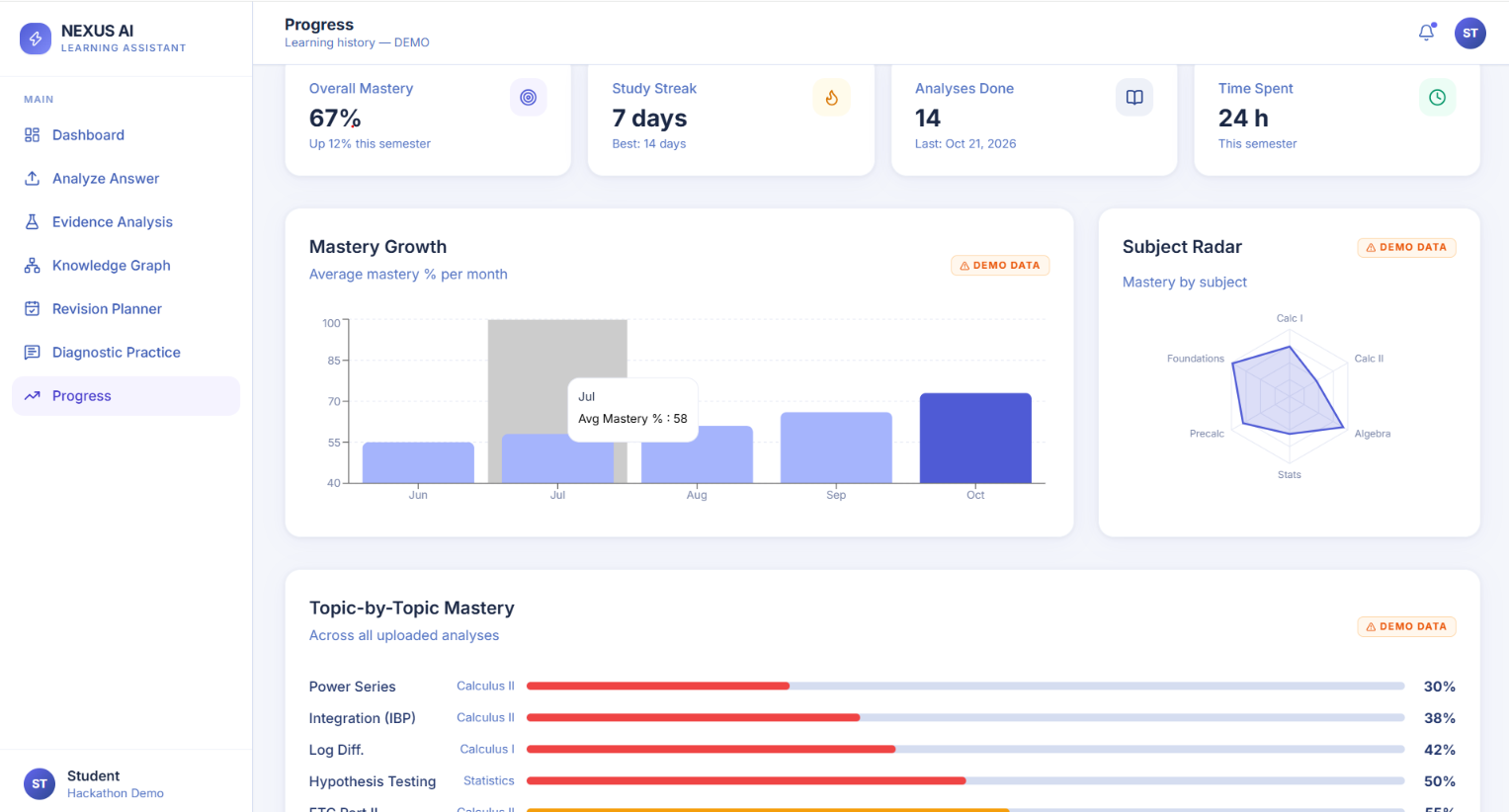
UGOS Synapse is an autonomous, privacy-first local AI agent that operates silently on UGREEN AI NAS. It continuously parses stored documents, cross-indexes source code with theoretical PDF lecture notes, and automatically flags missing prerequisite topics (Knowledge Gap Detection).
Key Capabilities:
- Passive Background Gap Detective: Automatically analyzes newly uploaded lecture notes against existing drives to alert users of missing foundational prerequisites.
- Code-to-Doc Dependency Mapping: Cross-links theoretical concepts (e.g., C++ Virtual Functions) directly to corresponding textbook PDF sections.
- 100% On-Device Privacy: Processes embeddings and semantic search entirely using UGOS local compute and isolated container runtimes with zero cloud dependencies.
How we built it
UGOS Synapse employs a modular multi-agent architecture:
- Extractor Agent: Utilizes
PyPDF2for document text parsing andtree-sitterfor source code AST (Abstract Syntax Tree) extraction. - Dependency & Indexing Agent: Builds concept-node dependency graphs and embeds processed data into a lightweight, local
chromadbinstance running within a UGOS container sandbox. - Analysis Agent: Leverages on-device local LLM instances (Ollama / UGOS Local Inference Engine) to conduct semantic retrieval, dual-perspective summaries (concise vs. deep-dive), and concept-gap reasoning.
Challenges we faced
- Resource Boundary Management: Optimizing multi-threaded document parsing and vector embedding generation to ensure smooth background performance on local NAS hardware without spiking host CPU/RAM usage.
- AST-to-Text Mapping: Structuring cross-references between structured programming code logic (C++/Python) and unstructured natural language in PDF study notes.
What we learned
We gained deep insights into local vector database orchestration, multi-agent task execution on low-power NAS architectures, and designing privacy-centric, background-event-driven developer tools on UGOS.

Log in or sign up for Devpost to join the conversation.