Vynce — AI-Powered UGC Ads Platform
DEMO : https://drive.google.com/drive/folders/1rGuhwCUEj_tc4KGUx-SZ6o8DLCBC2gVI
Inspiration
Every brand wants user-generated content because it converts better than polished ads, but the way brands actually find creators is broken. It runs on DMs, agencies, and who-knows-who — which locks out new and low-income creators who make great content but don't have the network to get discovered. On the other side, brands routinely pay upfront for content that never performs, with no way to verify a creator's link is even real before the money is gone.
We wanted a platform where the content itself does the talking: creators get paid for what their videos actually earn in views, not for who they know, and brands only pay for performance they can verify.
What it does
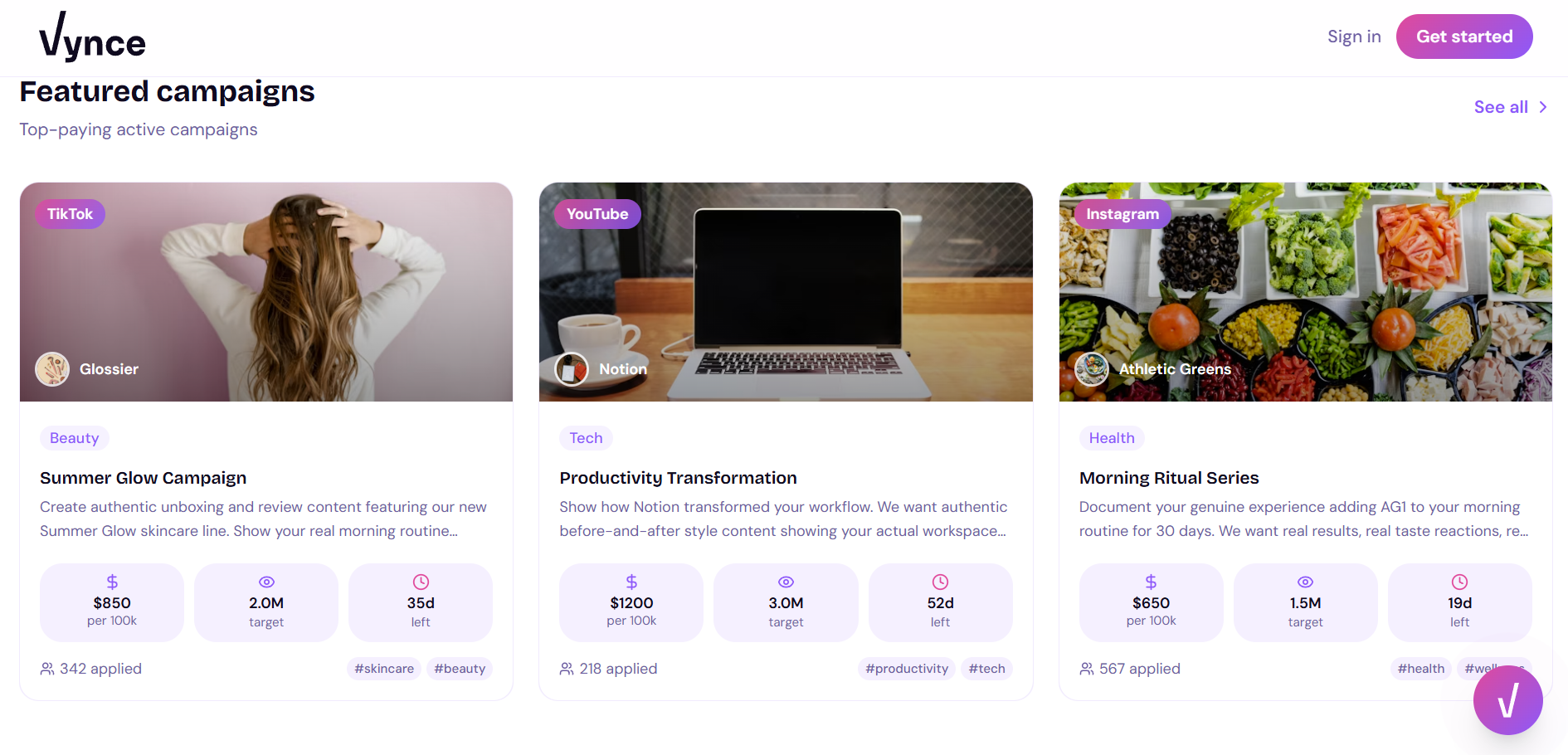
Vynce is a two-sided marketplace connecting brands with content creators. Brands post campaigns — platform, reward per 100k views, target views, budget, deadline — and creators browse, apply, post the content on their own social accounts, and submit the link as proof of work.
From there our AI layer takes over. Every submitted link gets scraped and investigated: we pull real engagement numbers straight from YouTube and TikTok, run an SEO and site-signal success score, and score the copy itself for which persuasion hooks it's using — urgency, social proof, authority, aspiration, calls to action. In parallel, a fraud pipeline flags suspicious activity using a rule-based scorer backed by a RandomForest model trained on real and fake-engagement data, so brands aren't paying out on inflated numbers. The result of all of that gets turned into a short, readable AI-written report explaining not just how a piece of content performed, but why — which is also the seed of the premium analytics dashboard: aggregate that same analysis across thousands of scanned posts and you get concrete, campaign-level guidance for brands and creators alike.
A single account isn't locked into one role — the same person can run brand campaigns and apply to other brands' campaigns as a creator, which mirrors how a lot of small businesses and creators actually operate.
How we built it
The platform is split into two systems that talk to each other:
- The backend is a FastAPI + MySQL API handling users, brand/creator profiles, campaigns, and applications, with JWT auth and Alembic-managed migrations. It exposes the marketplace itself — posting and browsing campaigns, applying, submitting links — and a recommendation endpoint that ranks open campaigns against a creator's profile by keyword overlap between their bio/portfolio and the campaign description.
- The AI toolkit is a separate pipeline that a submitted link gets run through in four stages: scrape (DNS, WHOIS, HTML/JS fingerprinting, a shallow crawl), score (SEO visibility plus real platform engagement, plus a rule-based hook/marketing-language analyzer), suspect (a transparent 0–100 suspicion score, plus a RandomForest classifier trained on labeled real vs. fake-engagement data), and explain (a local LLM turns all of that into a plain-English performance write-up, with a rule-based template as a guaranteed fallback so a report always gets produced).
We deliberately kept every score transparent and explainable rather than just a black-box number — both the success score and the suspicion score are broken down into their exact weighted components, which matters a lot when the output decides whether someone gets paid.
Challenges we ran into
Real engagement data was the hardest part. YouTube has a clean official API, but TikTok has no public API for this at all — we ended up parsing the JSON data blob that TikTok already embeds in its own public video pages, which works but is inherently fragile to layout changes. Instagram was tougher still: it blocks unauthenticated scraping entirely, so instead of building something fragile and against their terms, we designed that path around the official Graph API for accounts a brand actually manages, and made the system degrade honestly instead of guessing when it can't get real numbers.
Fraud detection was its own challenge because "fake engagement" doesn't announce itself — we had to lean on a combination of site-structure signals (link counts, security-scan findings), reputation checks, and engagement-ratio features like comment-to-view and like-to-view ratio, since no single signal reliably tells real from fake on its own.
We also had to make sure the AI-written report never became a single point of failure — running a local model means it can go down mid-demo, so every AI step needed a deterministic, good-enough fallback that produces the same shape of output.
Accomplishments that we're proud of
Our fraud/fake-engagement classifier isn't just a proof of concept — trained on real labeled data, it holds up on data it's never seen, with a cross-validated ROC-AUC around 0.96 and a held-out test ROC-AUC around 0.97. We're also proud that every score in the system, from SEO success to suspicion, is fully explainable: you can point at any number the platform produces and see exactly which signals built it, which matters a lot for a product that's ultimately deciding who gets paid.
What we learned
We learned just how much of "AI-powered" work is actually disciplined, honest engineering underneath — building a fraud score that's genuinely explainable, or a scraper that reports "not available" instead of fabricating a number when a platform blocks it, took a lot more care than just calling a model. We also learned a lot about the real constraints of social platforms' data access — what's genuinely open (YouTube), what's a reasonable gray area (TikTok's public page data), and what has to be done the sanctioned way (Instagram's Graph API) — and how to design a system that's honest about the difference.
What's next for UGC ADS platform
The natural next step is turning the per-post analysis we already generate into the premium analytics dashboard: aggregating patterns across thousands of scanned posts to tell a brand things like which hooks, formats, or platforms are actually driving performance for their specific audience, and giving creators the same kind of feedback on their own content before they even submit it. We also want to close the loop on fraud detection by continuously retraining the classifier on new labeled data as the platform grows, and extend real engagement fetching to more platforms as their access options allow it.
Built With
- fastapi
- mysql
- nextjs
- python
- typescript

Log in or sign up for Devpost to join the conversation.