-
-
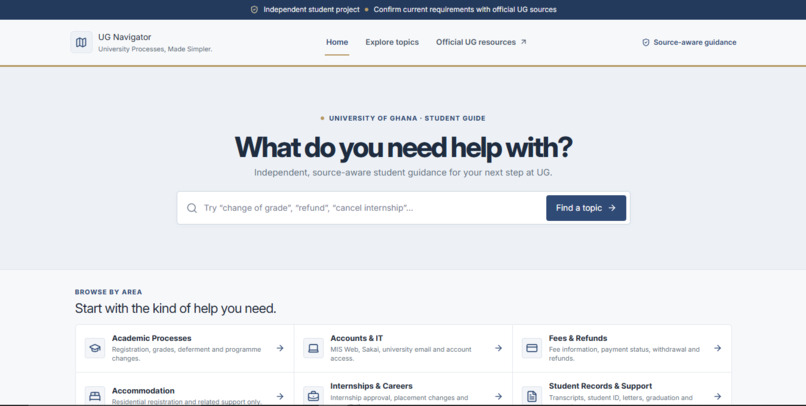
Landing page
-
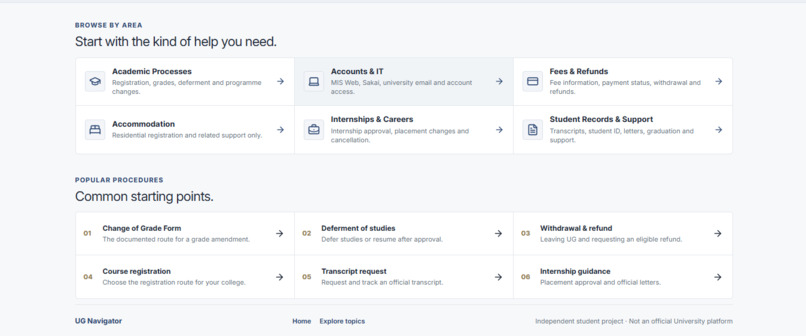
Landing Page
Inspiration
What it does
How we built it
Challenges we ran into
UG NAVIGATOR — Devpost Submission
Inspiration
Starting and navigating university life can be overwhelming, especially for freshers who are encountering university systems and formal procedures for the first time.
At the University of Ghana, important information can be spread across different websites, portals, official documents, announcements and informal student communication channels. Students may know what they want to accomplish but struggle to find the correct instructions, understand which rules apply to them, or determine what to do next.
We wanted to address this gap by building something that helps students navigate university life with greater clarity and confidence. Rather than requiring students to search through multiple sources and piece together instructions themselves, we envisioned a platform that brings relevant university guidance closer to them.
That idea became UG Navigator: University Processes, Made Simpler.
What it does
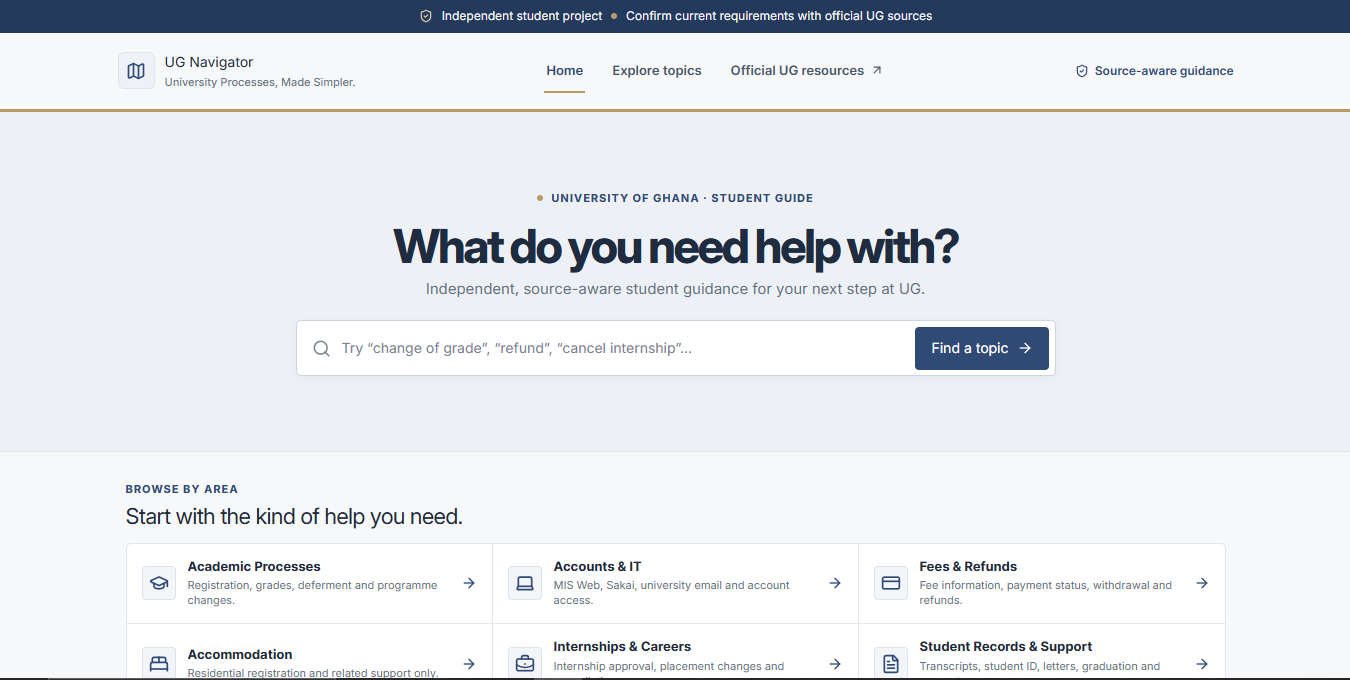
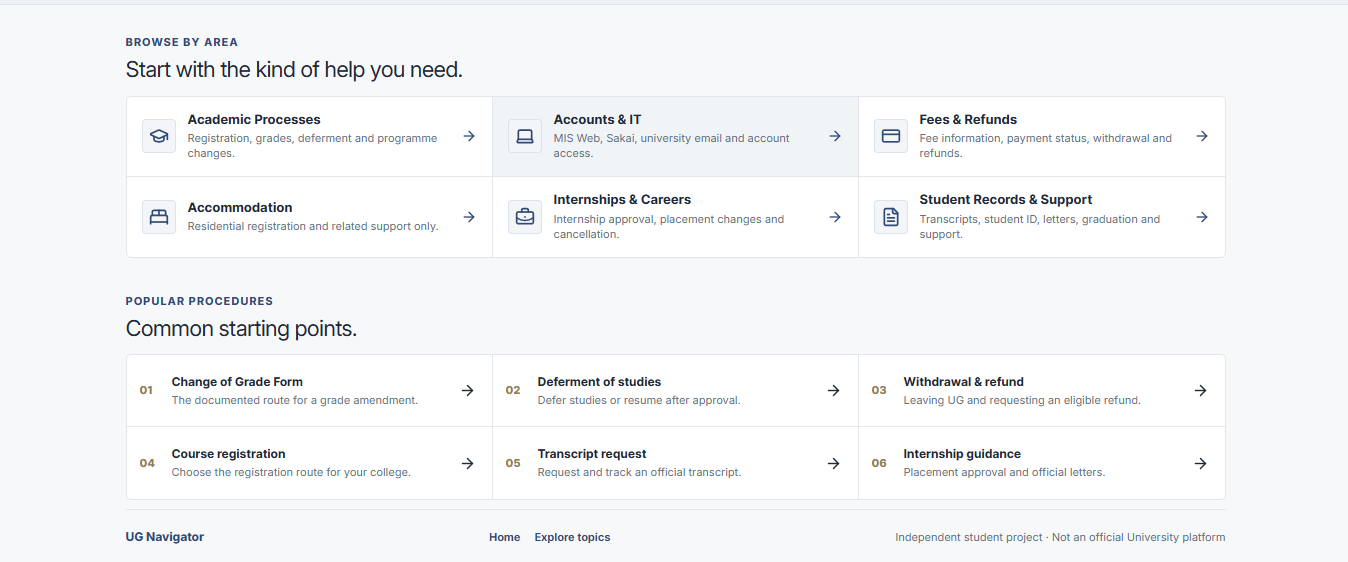
UG Navigator is a student-focused web application designed to make university information easier to find, understand and act upon.
The platform focuses on two main needs.
First, helping students complete formal university processes. Instead of merely directing students to websites or offices, UG Navigator aims to provide clear, ordered, actionable instructions for processes such as course registration, deferment, accommodation applications and other academic procedures. Where appropriate, students can follow a checklist and track their progress.
Second, helping students understand important university information. Students can access straightforward explanations of university platforms, academic terminology, requirements and student services, helping them understand what different systems are used for and how to navigate them.
The broader vision is to make university procedures less confusing by providing relevant guidance in one accessible place, while recognising that instructions may differ depending on a student's programme, college, level or circumstances.
UG Navigator is an independent student project and does not replace official university systems or decisions.
How we built it
We approached UG Navigator as a practical web application centred on the needs of students navigating university processes.
Our focus was on making information understandable and actionable. This meant distinguishing between processes that require step-by-step instructions, topics that require direct explanations, and problems that require troubleshooting.
We structured the application around university-related topics and guidance, with the aim of making it easier for students to find the information relevant to their situation. For process-oriented topics, the intended experience is an ordered checklist that students can follow. For informational topics, the application presents explanations directly rather than forcing every topic into a checklist.
We also considered the importance of reliable information. University procedures, deadlines and requirements can vary, so the platform needs to rely on trustworthy sources and clearly distinguish verified information from details that still require confirmation.
Throughout development, we prioritised a simple, accessible experience that could be expanded with additional university guidance without making the application unnecessarily complicated.
Challenges we ran into
One of our biggest challenges was not simply building the application, but determining how to make its information genuinely useful.
We realised that directing students to places where information might exist was not enough. A student who needs to register courses or apply for deferment needs to understand the actual procedure, the order of the steps, the requirements and what to do when something goes wrong.
Another challenge was the fragmented nature of university information. Different processes may be documented in different places, and some instructions depend on a student's college, programme or category. Bringing this information together requires more than collecting links; it requires organising, verifying and presenting the instructions in a way that students can follow.
We also had to think carefully about scope. University life involves many processes, from registration and accommodation to internships, academic records and graduation. Covering everything immediately would risk producing a large catalogue with incomplete information.
These challenges helped us recognise that the quality, accuracy and completeness of guidance matter just as much as the interface through which it is delivered.
Accomplishments that we're proud of
We are proud to be addressing a practical problem that students encounter in their everyday university experience.
UG Navigator is built around the idea that students should not have to become experts at navigating university bureaucracy just to complete basic academic and administrative tasks.
We are also proud of the direction we have established for the platform: combining process-based guidance with direct informational support, while keeping the experience simple and focused on what a student needs to accomplish.
Most importantly, we have become more deliberate about what makes the product useful. Our goal is not merely to list university services, but to help students understand their options, follow the right steps and know where to turn when a problem requires official intervention.
What we learned
We learned that providing information and helping someone use that information are two different things.
A list of links may help a student discover a source, but it does not necessarily help them complete the task that brought them to the platform. Effective guidance must explain what to do, why it matters, what to expect and what to do if the process does not go as planned.
We also learned that personalisation and accuracy are essential when dealing with formal university procedures. A generic answer can be misleading if it ignores differences between programmes, student categories or academic requirements.
Finally, we learned that building a useful student platform requires us to think beyond the features we can implement. We must also consider the quality of the underlying information, how students actually experience university processes, and how to keep guidance reliable as requirements change.
What's next for UG NAVIGATOR
Our next step is to expand UG Navigator's coverage of important formal university processes while preserving the simplicity of the experience.
We want to develop more complete guidance for freshers, course registration, hostel applications, deferment, internships and industrial attachment, resit examinations, scholarships, transcripts, national service preparation and graduation requirements.
We also aim to make the guidance more relevant to individual students by accounting for differences in programme, college, level and student category wherever reliable information permits.
Another priority is improving how we verify and maintain our content. Official sources, clear verification records and honest handling of uncertain information will be essential to building student trust.
Ultimately, we want UG Navigator to become a dependable starting point for navigating university life at the University of Ghana: a platform that helps students spend less time figuring out university procedures and more time focusing on their education and opportunities.
Accomplishments that we're proud of
What we learned
What's next for UG NAVIGATOR
Built With
- replit

Log in or sign up for Devpost to join the conversation.