-
-
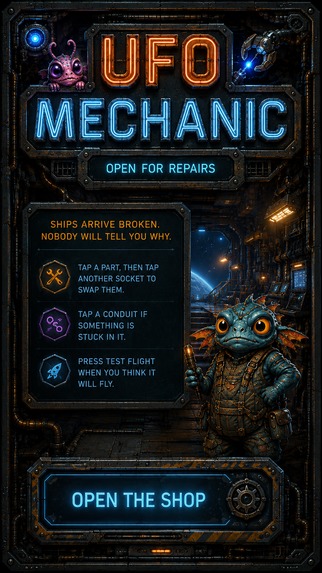
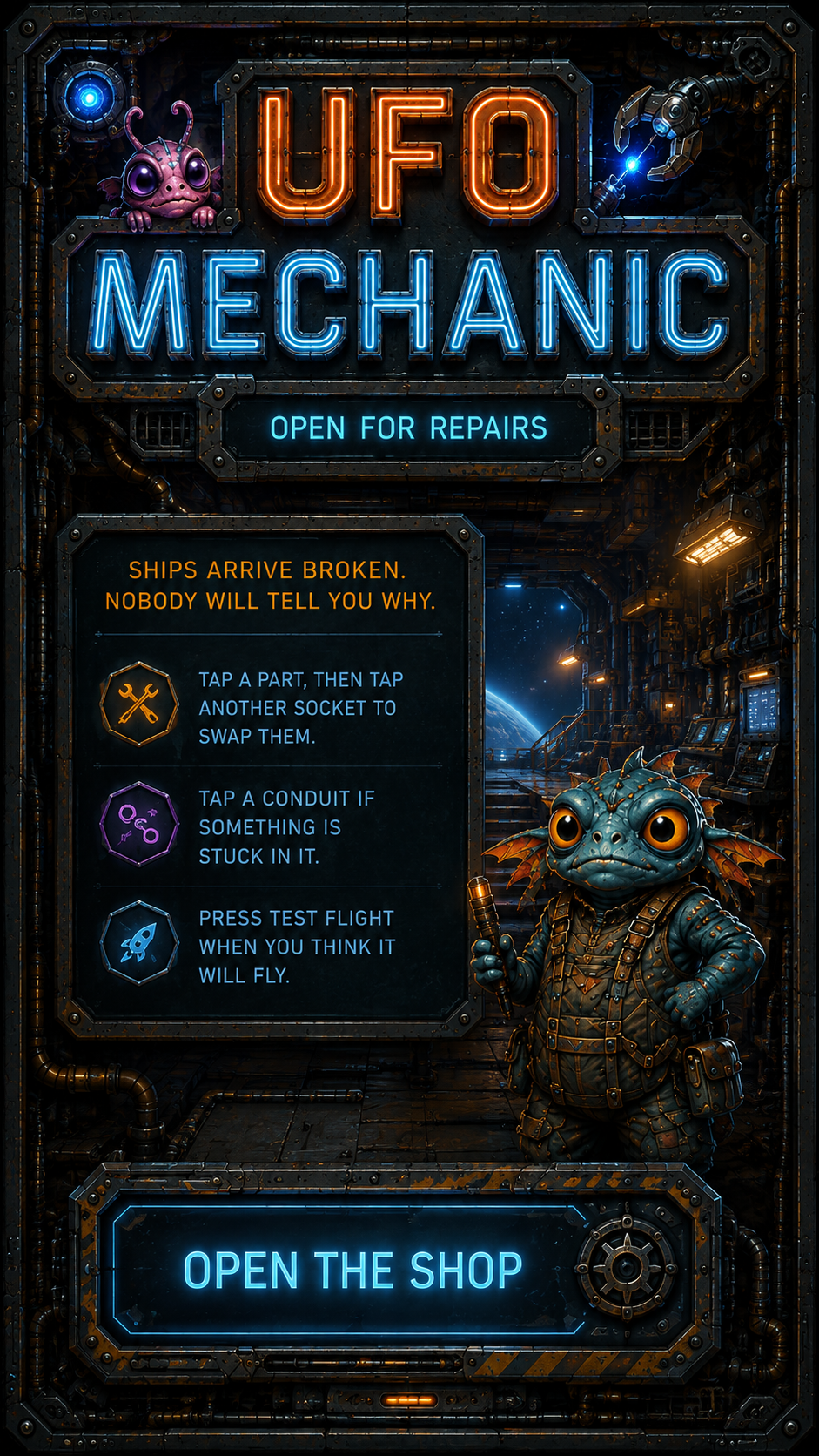
Title Screen
-
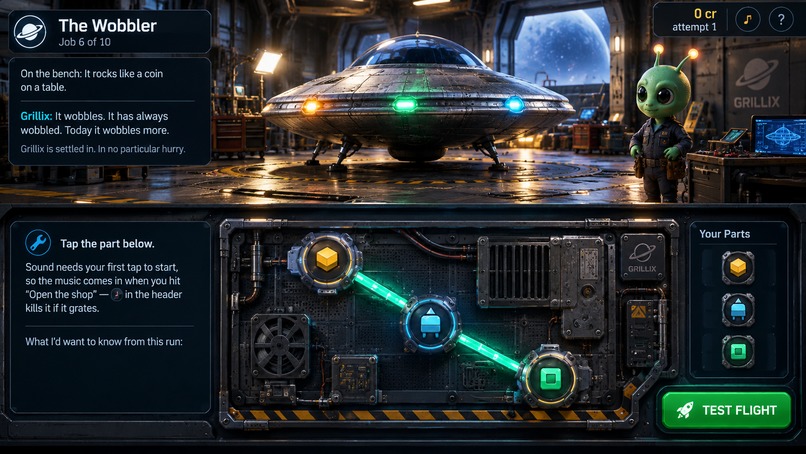
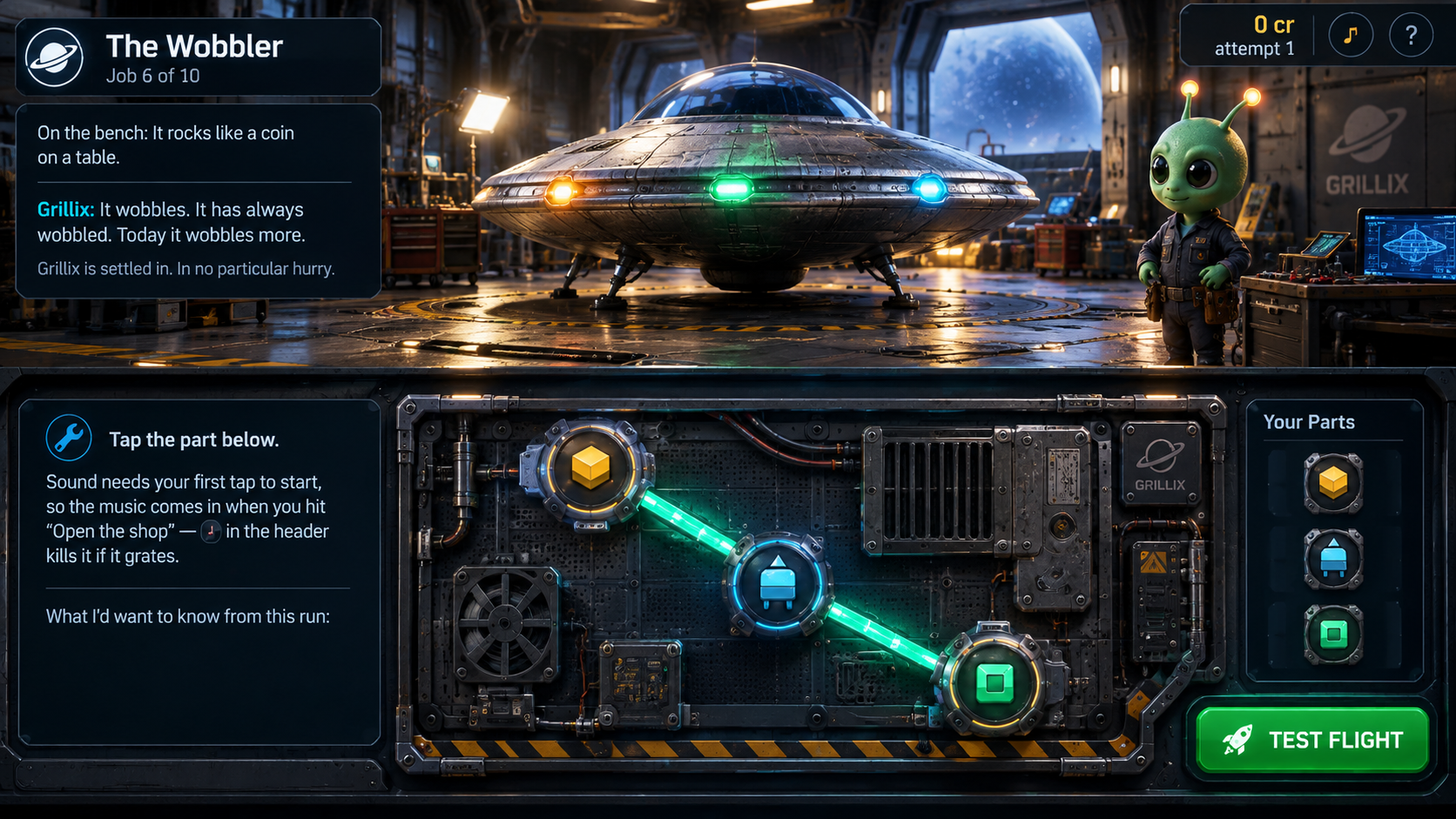
gameplay
Inspiration
I wanted a repair game where the repairing was actually the game. Most mechanic sims highlight the broken part in red and hand you a wrench — the "diagnosis" is finding the icon. Alien technology gave me permission to remove the labels entirely. If you've never seen the machine before, nobody can tell you what's wrong with it. You have to watch what it does.
What it does
You run a repair shop for alien spacecraft. Ships land, a hatch swings open, and you're looking at an engine bay full of unlabelled components. Nothing is ever marked as broken. The ship shows you the problem by misbehaving — it rocks, it hovers upside down, it sits dark and smoking — and each part shows whether it's running, starved, straining or dead. You form a theory, change something, and commit to a test flight. Get it wrong and the ship performs your mistake. Then you write the bill, and decide how much you can get away with charging.
How I built it
Entirely by prompting AI, art included. The game is one HTML file with no engine and no libraries — hand-drawn SVG for the interface, WebAudio for every sound and the music, so there isn't a single audio file in the build. The art came from image generators: ship sheets, a hangar, a parts sheet, alien characters, all cut out and wired in. The whole thing runs offline.
Underneath it is one small power simulation. Every symptom, every part's state, every fire is derived from it — which is what makes the ship's behavior honest instead of scripted.
Challenges
The biggest one was resisting my own instinct to help the player. Every time I added a feature, the easy version of it gave away the answer. When I wanted the parts to look alive, the obvious move was to make the broken one glow — which is exactly the mechanic I was trying to avoid. What I built instead was every part showing how it's coping, where the part that's suffering is usually not the cause.
The technical ones were funnier. Adding a component that boosts power broke the game instantly, because conduits are undirected and the coil fed its own output back into its own input, gaining a point every pass. The creature that sits in a socket appeared to crawl across the board when it breathed, because SVG needs transform-box: fill-box for a transform origin to mean anything local. And once I switched to photographic ships, a "dead" ship sat there glowing, because its running lights were baked into the photo.
The one that taught me most: I had automated tests playing all ten jobs every build, and they passed a level that was genuinely unwinnable for a human. The script always fed the creature and placed the part in the correct socket. A person put it in the wrong one and got stuck with no way back.
Accomplishments
A player can be wrong four different ways and each one produces a different, specific, funny outcome instead of an error message. And the whole thing fits in 3.5% of the size limit, because everything except the art is computed rather than stored.
What I learned
Scripted tests prove a game is solvable. They can't prove it's understandable, and they can't prove it's fun. Every real bug in this build was found by a person playing it.
What's next
I would build out the shop more, bays laid out differently by species, and customers who come back with the consequences of repairs you made earlier. It needs more polish and events that can throw a wrench in the repair process. more things to unlock and funny interactions.
Built With
- ai
- chatgpt
- claude


Log in or sign up for Devpost to join the conversation.