Inspiration
It’s an open secret that students do not have access to the food they need across campus. Though there are several dining halls, a variety of plentiful restaurants near campus, and both on and off-campus grocery stores such as Food Lion or the POD Market, UD students are still often going hungry. This isn’t because students are too lazy or busy to eat; instead, it is caused by a different barrier: Cost.
Eating on campus is expensive. To access the dining halls on campus, one needs a meal plan, and while that’s required for students living in many places on campus, students in the area living in on or off-campus apartments often go without. On top of that, even students who do have the required meal plan often find it is inconvenient and even incompatible with their needs, especially when meal exchanges are only available at certain times of day and the dining halls provide food that many students describe as inadequate or poorly prepared. Students already paying for an expensive meal plan have a hard time justifying the purchase of ingredients to cook for themselves, especially if they have no access to an in-room kitchen – this issue is compounded when many of these students are new or inexperienced with cooking as a whole. In addition, dietary restrictions only put further pressure on these students.
There are so many students on campus unable to regularly attain food that suits their lifestyle. Though, yes, the basic need of food is provided readily on campus, students still regularly go hungry, and this project was designed to take a look at these deeper, systemic issues and attempt to provide a variety of healthy students food while eliminating the greatest barrier - cost. As well as providing students with more options, and bringing our community together.
What it does
Our project was a mobile app/website designed for group meal planning. By bringing people together to cook meals, we figure we could offset the costs and burdens of cooking while providing for students on campus in need. This allows for large meals to be made, at a cheaper price, and to create community while doing so, encouraging students to cook on their own time in their own way.
Our app organizes meals between peers at UD! It functions as a hub to group students together to cook and eat! Students can set up community meals in the app, picking the date & location, number of open slots, and what ingredients they’d like people to bring. Then, students populate the meal and attend, cooking together. Students may browse community meals from a list in the app, pick a meal they’re interested in and sign up by offering an ingredient to bring. It is cheaper to buy in bulk, after all, but buying in bulk often leaves many ingredients going bad. If students buy a single ingredient in a larger quantity, they may spend only a few dollars for a complex meal that would cost them much more to cook alone, while helping provide for a larger group.
How we built it
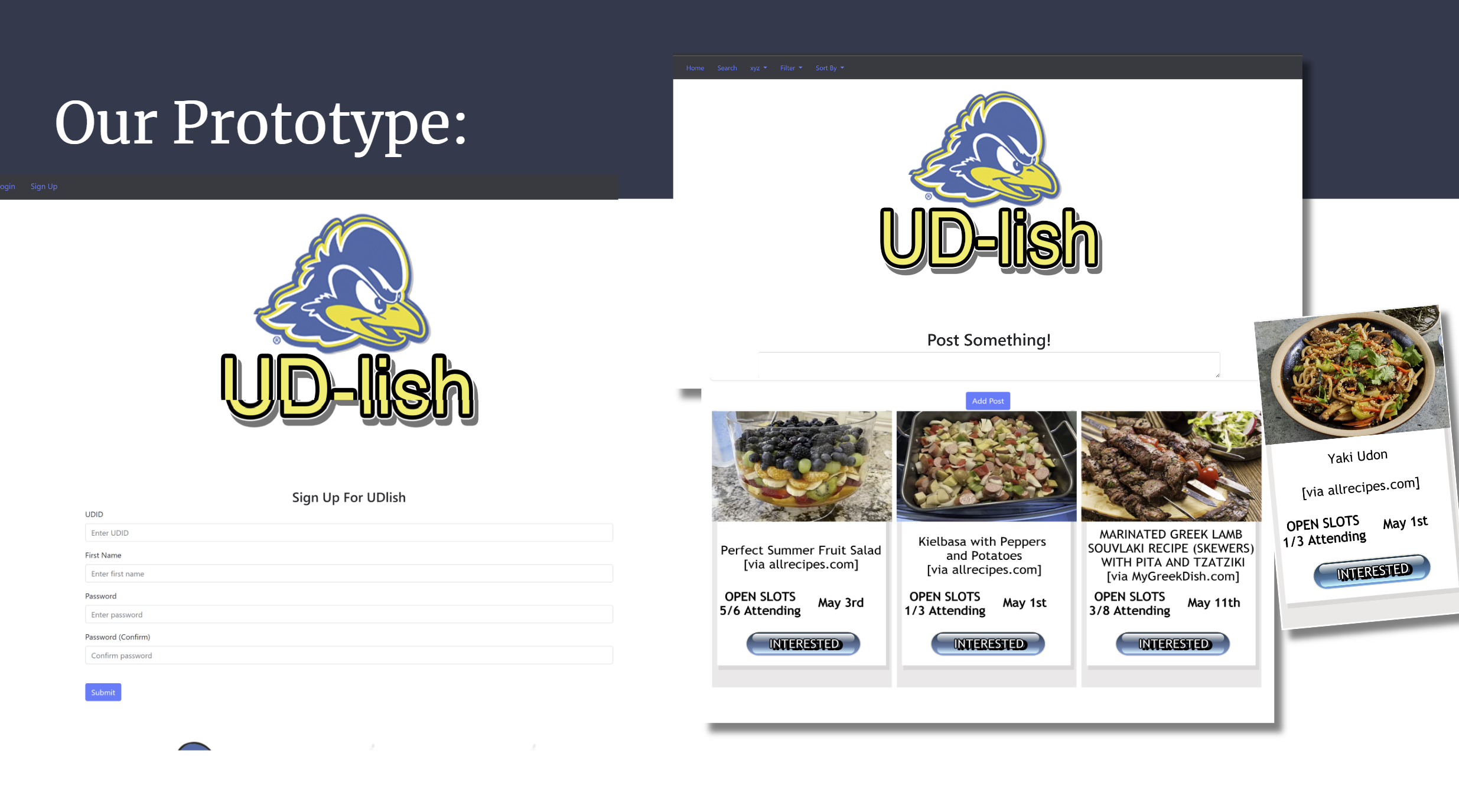
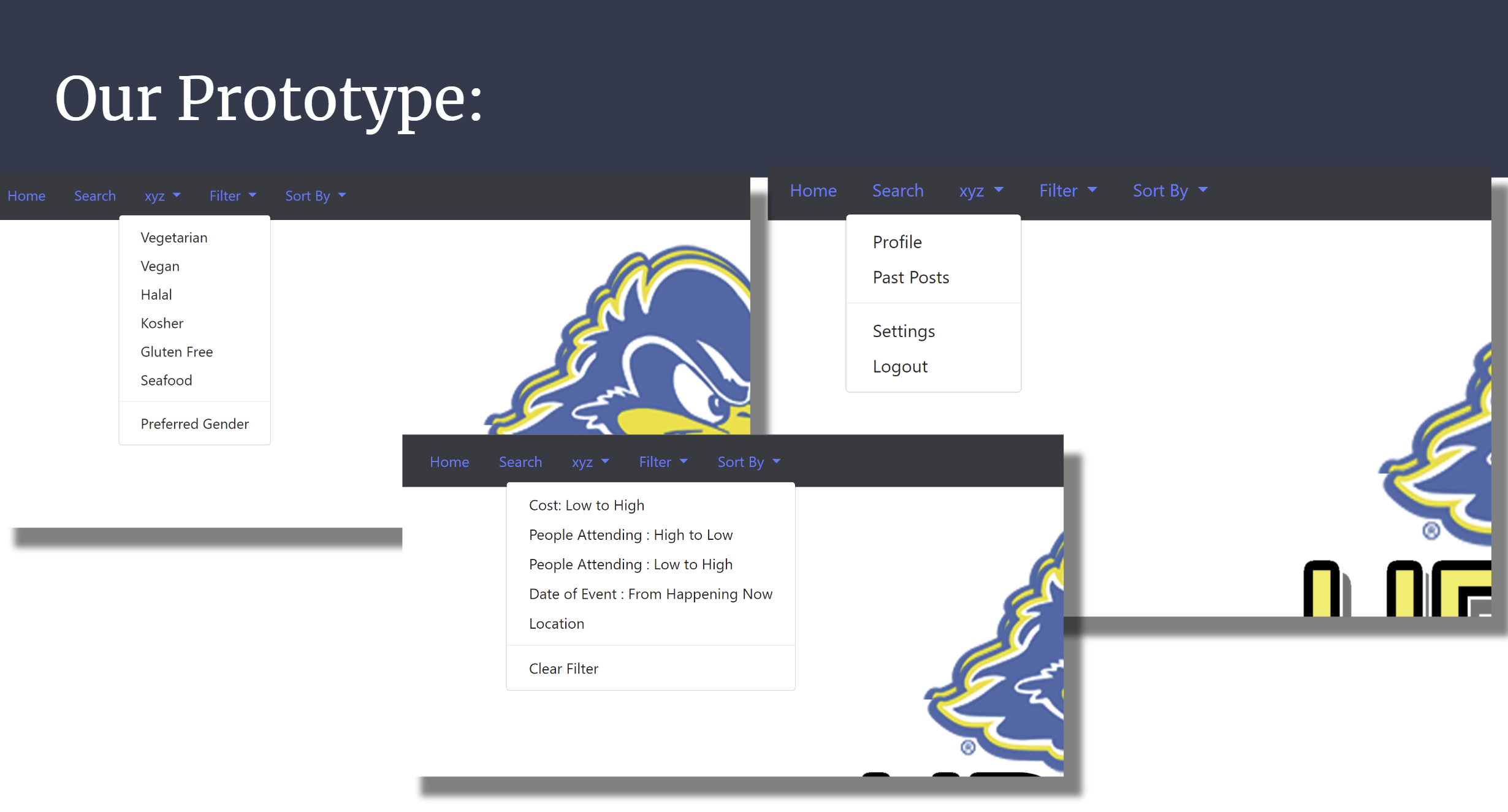
Unfortunately with the lack of time, and this being most of our first Hackathon we weren't able to make a fully fledged out a mobile application and full stack website. That being said, we have built the basics of our current site, using HTML, CSS, and python to design the basic layout and imbed sample images of what posts would look like through VsCode. We also used a free art program called FireAlpaca to mock up the sample posts on the site, drawing images and recipes from popular cooking websites with the goal of simulating what an end product with many users could look like.
Challenges we ran into
Time was our primary obstacle. This is a 24-hour event and building a site with the robust accessibility and safety features needed for a project like this to be successful wasn’t feasible in that time frame given our levels experience. That said, we made strides to at least build out the framework in HTML as best as possible, creating a working early prototype.
In addition to this, we are still unsure of exactly how the reputation portion of our safety system should work. After talking with several UD students about our idea at and around the hackathon space, we worry about misuses of a simple safety system that could be used to discriminate against users. At the same time, we need a way to root out bad actors. We have not fully thought of a final solution at this time, but we have several ideas we have been considering.
Accomplishments that we're proud of
We are really proud of our Idea and some of the features we’ve planned out for it. The issue of dining and finding affordable food on campus is something we all have had issues with. Also, despite our team members each having different housing situations and dietary restrictions, we still all found individual benefit in a program like this. UD-lish provides options for anybody and everybody at UD and is driven by the community. This is another thing we take pride in as community is a big part of UD, and this would help foster this community by also solving a major issue within this environment.
We are really proud of how far we were able to take this project within the 24 hours we had and of how fleshed out it has become despite the very limited timeframe. We have a working prototype of the website built from scratch and a wide breadth of different features that we at least have an understanding of how to implement.
What we learned
Most of us haven’t really had much web-dev or app development experience before so making this on the fly was a little difficult. Some of us had to learn HTML and CSS for the first time, so a lot of our development and coding time was spent learning how to make what we envisioned. We also haven’t designed a brand new UI and interface before but this was a great learning experience in that aspect. Drawing out how we wanted the site to look was a group effort that we brainstormed, and didn’t happen in one go. We went through multiple iterations and drew up a few designs until we felt good with what we currently have, giving us a taste of a highly-constrained iterative design process. Also creating sensical features and thinking about what a user would want was also a good learning experience, especially when it came to adapting those features based on the feedback of real users.
What’s next for UD-lish
We’re considering potential Improvements for this project such as more robust GUI and overall improved graphical fidelity, potentially by working with artists and actual graphic designers. We would love to pursue a partnership with UD Dining services and/or local restaurants for educational experiences and to help establish spaces within UD buildings for regular cooking events to occur. In addition, we’d like to implement some of our planned features such as options for nutritional planning and cooking education hosted within the app, a potential price-comparing system for sourcing local ingredients, and a built in recipe book with popular items. We’d also like to take a deeper dive into safety and accessibility features than was possible in the first 24 hours, potentially including integration into existing UD safety technology such as the LIVESafe App. Finally, we’d like to start thinking about a marketing plan to acquire users and expand the early reach of the program


Log in or sign up for Devpost to join the conversation.