-
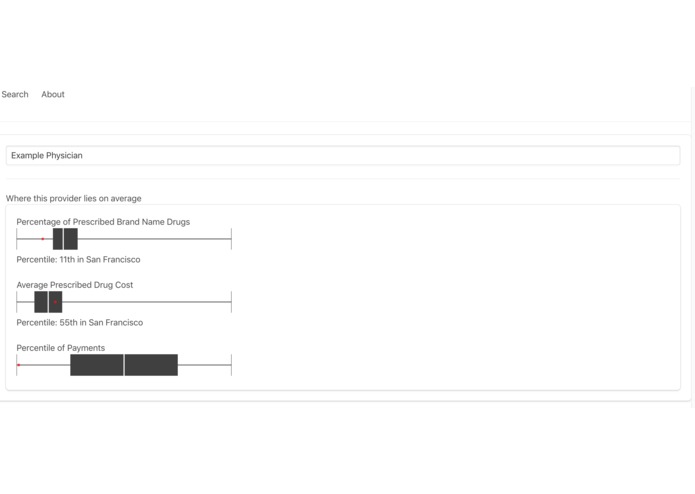
Example Provider View of their Prescribing Behavior and Contributions in Relation to Other Psychiatrists in San Francisco
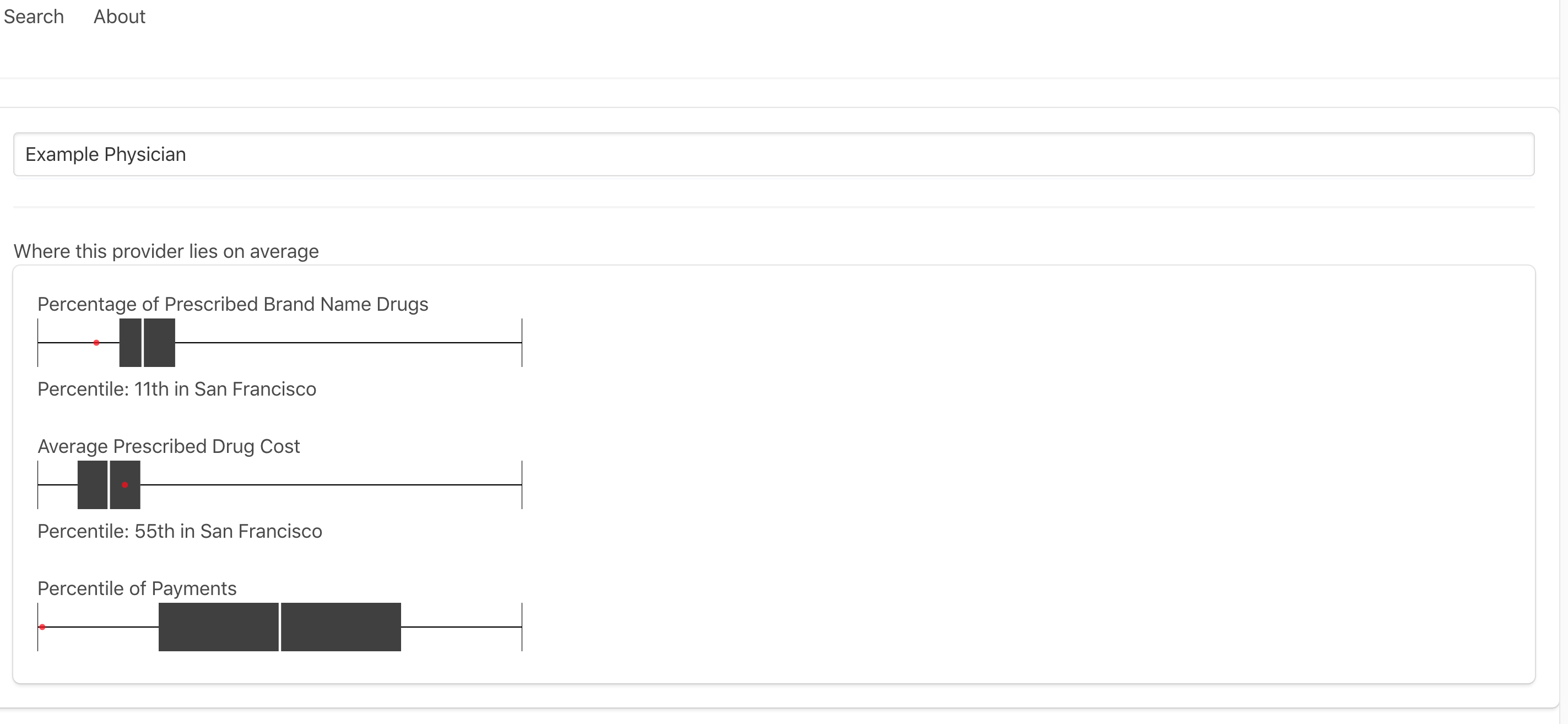
Finance Alignment and Prescribing Patterns: A Case Study in San Francisco
Problem Statement
Pharmaceutical companies invest heavily in marketing. Between 1990 and 2008, pharmaceutical expenditures on marketing increased more than six-fold from $3 billion dollars to $20.5 billion dollars (Congressional Budget Office, 2009). A large fraction of these dollars are through the form of detailing, in which drug companies provide financial incentives to prescribers in the form of information, free samples, meals, and gifts. In 2010, the Physician Payment and Sunshine Act, a provision of Obamacare, was passed to increase the financial transparency between prescribers and pharmaceutical manufacturers, allowing us to finally know the magnitude of detailing. From 2013 - 2017, pharmaceutical manufacturers made payments worth a total of $33 Billion to providers, with $8.3 Billion coming in 2017. However, providers should make decisions about prescriptions independently and with patients’ well-being as the ultimate goal, regardless of whether or not they receive payments from the pharmaceutical industry. Doctors hone their craft over a decade’s worth of training and dedicate their lives to helping their patients live healthy lives. As a result, detailing potentially creates financial misalignments and conflicts of interest that could harm the doctor-patient relationship.
In Project Finance and Rx, we use San Francisco as a case study to explore the link between financial contributions and prescribing behavior for mental health providers. Our goal is to create an educational tool that informs the public, empowers policy makers and researchers to understand the current state of the system, and allows providers to see where they lie in terms of brand-name prescriptions relative to other psychiatrists in the same geographic location. The tool serves as a natural extension of ProPublica’s Dollars for Docs project that already shows how much providers across the country received in payments from the pharmaceutical industry. Each physician will have a profile, accompanied by three visualizations that represent psychiatrists in SF: 1) a box-and-whisker plot that displays the distribution of the monetary amount of industry payments (and a dot displaying where the specific physician falls) 2) a box-and-whisker plot that displays the distribution of the percentage of name-brand drugs (and a dot displaying where the specific physician falls) and 3) a graph showing the percentile at which this specific physician falls among all psychiatrists in SF for both industry payments and percent of branded drugs prescribed.
Ultimately, our end goal is to empower both patients and providers to result in better cost-effective care to improve healthcare outcomes. This is not to say that we think that BigPharma has “corrupted” the entire industry. We also believe that strong relationships between physicians and industry are necessary; often, pharmaceutical companies fund large research projects that produces advances in medical care. Our goal is to provide transparency in an area that has been not as frequently discussed and ensure that financial incentives are as aligned as possible to ensure the best healthcare outcomes.
Impact: Transparency Patient Well-being Costs to the healthcare system
Main Goals: Policy-Makers Guide A tool Empowerment Financial Alignment
Next Steps Empowering Providers: we want to work closely with Providers to understand how this data can empower their abilities to provide the best care for their patient. We want to work closely with providers and show them detailed and personalized reports that display how they compare to other physicians in the same specialty and same geographical area. Our goal is to highlight any subtle subconscious influences that might have existed. Empowering Researchers, Journalists, and Policymakers: we want to work with researchers and journalists to deliver accurate information to the public that is interpreted in the right way. Where financial incentives could be better aligned, we want to work with Policymakers to understand the different facets to make the best decisions for the system at large.
Literature Review
DeJong, C., Aguilar, T., Tseng, C. W., Lin, G. A., Boscardin, W. J., & Dudley, R. A. (2016). Pharmaceutical industry–sponsored meals and physician prescribing patterns for Medicare beneficiaries. JAMA internal medicine, 176(8), 1114-1122.
King, M., & Bearman, P. S. (2017). Gifts and influence: Conflict of interest policies and prescribing of psychotropic medications in the United States. Social Science & Medicine, 172, 153-162.
Fickweiler F, Fickweiler W, Urbach E. Interactions between physicians and the pharmaceutical industry generally and sales representatives specifically and their association with physicians' attitudes and prescribing habits: a systematic review. BMJ Open. 2017;7(9):e016408. Published 2017 Sep 27. doi:10.1136/bmjopen-2017-016408
Ian Larkin, Desmond Ang, Jerry Avorn, and Aaron S. Kesselheim Restrictions On Pharmaceutical Detailing Reduced Off-Label Prescribing Of Antidepressants And Antipsychotics In Children HEALTH AFFAIRS 33, NO. 6 (2014): 1014–1023
King Marissa, Essick Connor, Bearman Peter, RossJoseph S. Medical school gift restriction policies and physician prescribing of newly marketed psychotropic medications: difference-in-differences analysis BMJ 2013; 346 :f264
Yeh, J. S., Franklin, J. M., Avorn, J., Landon, J., & Kesselheim, A. S. (2016). Association of industry payments to physicians with the prescribing of brand-name statins in Massachusetts. JAMA internal medicine, 176(6), 763-768
Seems like a thesis of some sort (i.e. not peer reviewed literature), but is a counterpoint to our position and also has 2 psychotropic drug examples that began to face competition from generics in 2012: http://www-personal.umich.edu/~mille/CareyLieberMiller_PhysicianPayments2015.pdf
Drug Company Payments to Physicians Tied to Harmful Prescriptions for Foster Youth: An Analysis from the National Center for Youth Law (2017) Policy Brief from the National Center for Youth Law, could be a powerful addition for the motivation behind this kind of app/project (basically, youth in foster care are prescribed psychotropic drugs at extremely high rates)
https://journals.plos.org/plosone/article?id=10.1371/journal.pone.0209383
Article about how https://www.nytimes.com/2018/09/05/upshot/letters-to-doctors-opioid-research.html
List of New FDA-Approved Psychotropic Drugs: https://www.centerwatch.com/drug-information/fda-approved-drugs/therapeutic-area/17/ Psychiatry-psychology
Fact Sheet from NAMI with a list of commonly-prescribed psychotropic drugs, including brand names and the respective generics: https://www.healthpartners.com/ucm/groups/public/@hp/@public/documents/documents/entry_194823.pdf
Source Data
Payments to Providers
Sunshine Act Data
Prescription Data
Medicare Provider Part D Prescriber Data Note, to connect Prescription Data with Payments to Providers see https://static.propublica.org/projects/d4d/20160317-matching-industry-payments.pdf?22

Log in or sign up for Devpost to join the conversation.