-
-
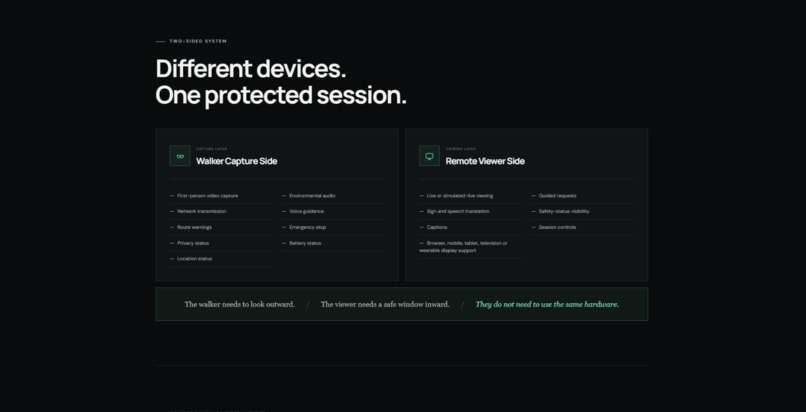
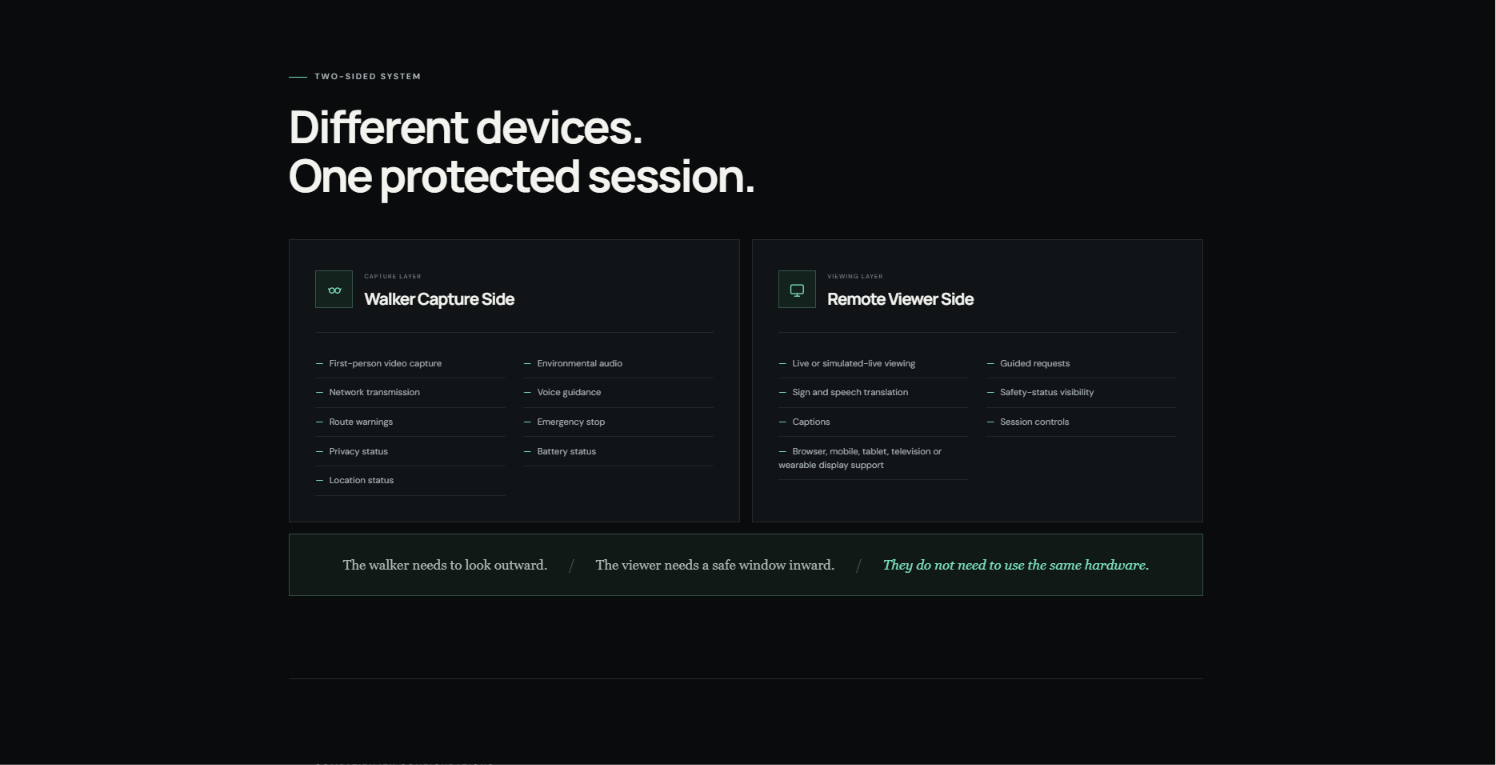
Different devices connect through one protected session and safety layer.
-
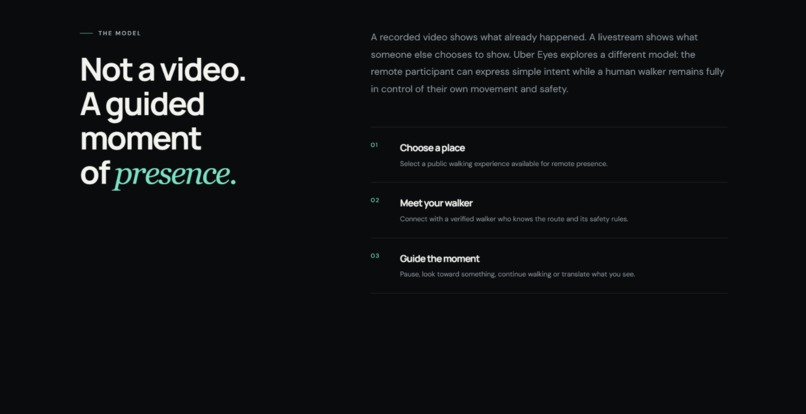
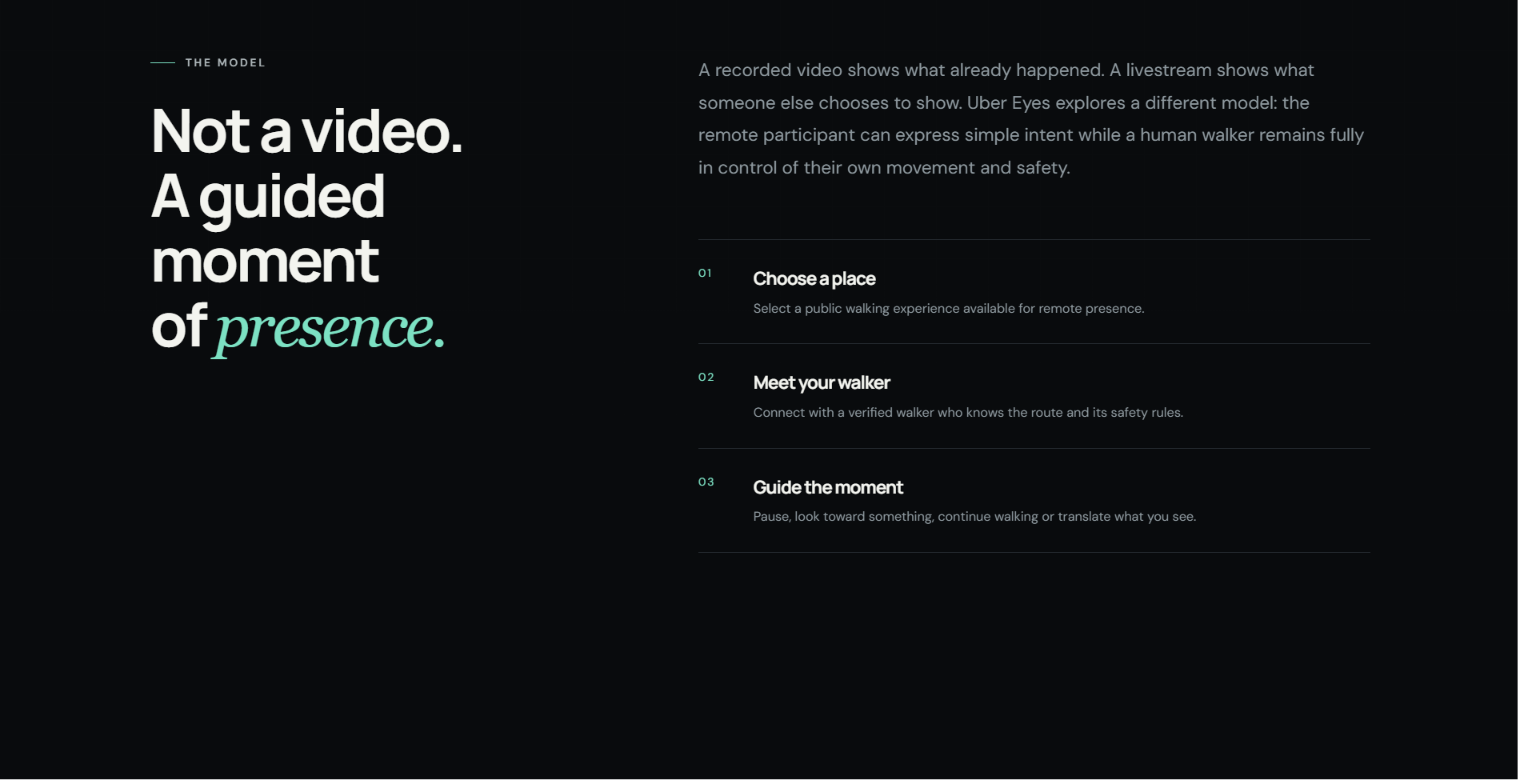
A guided moment of presence, not a passive video or ordinary livestream.
-
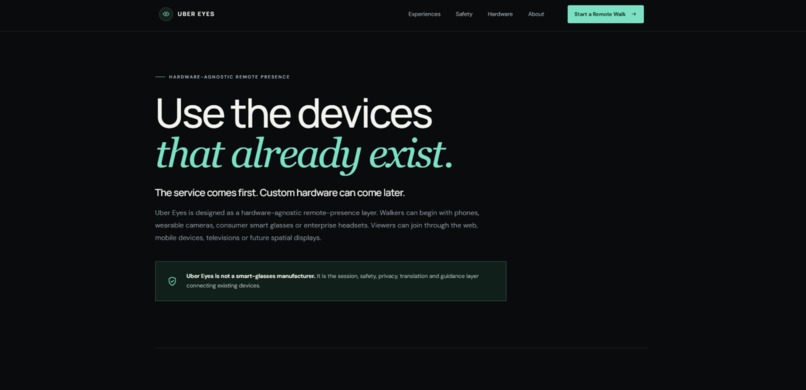
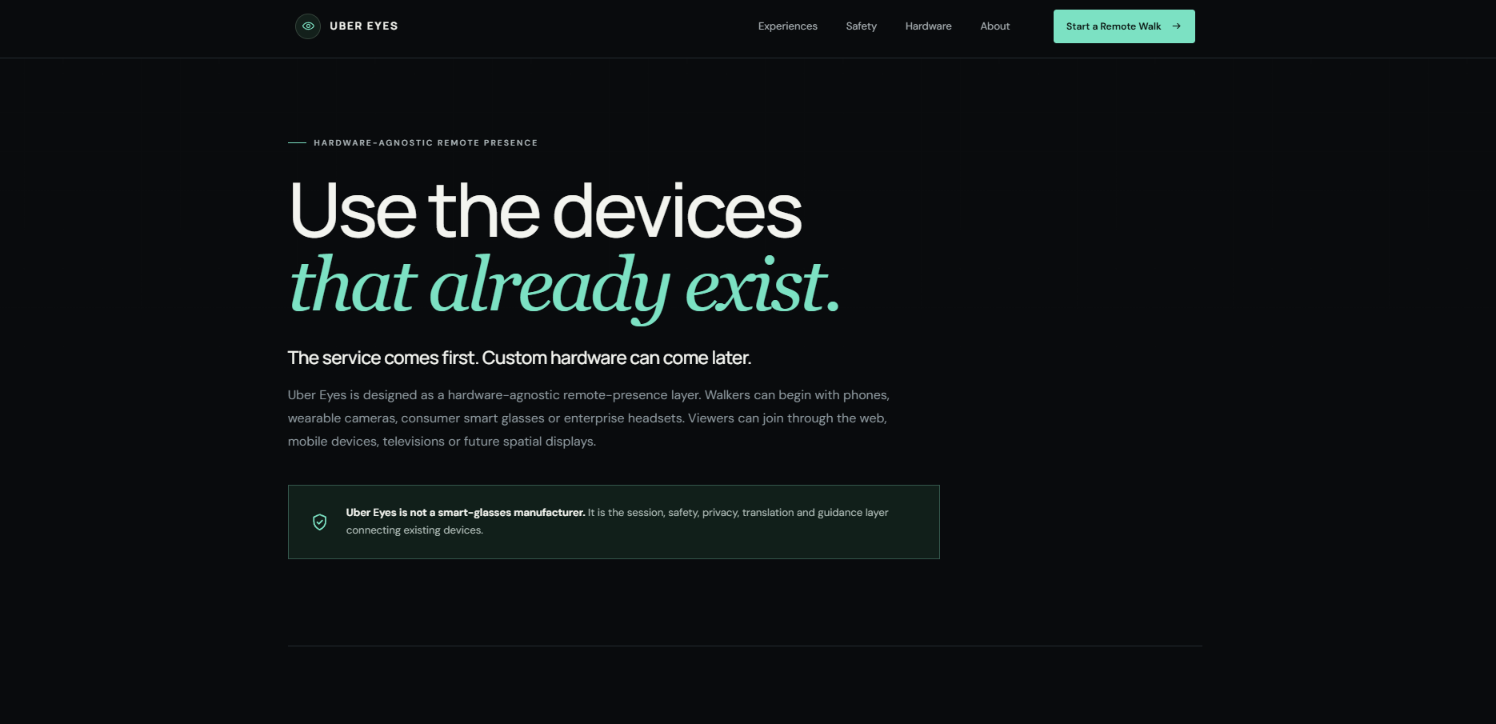
Hardware-agnostic by design: phones first, smart glasses and wearables later.
-
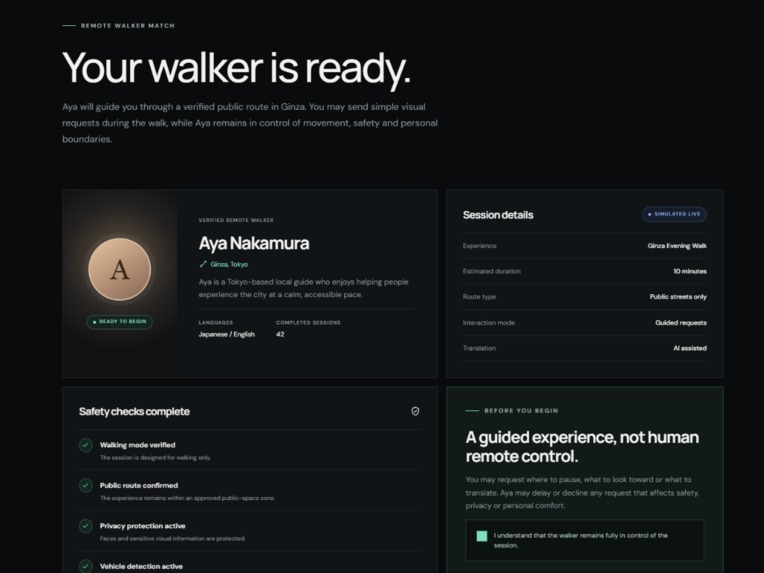
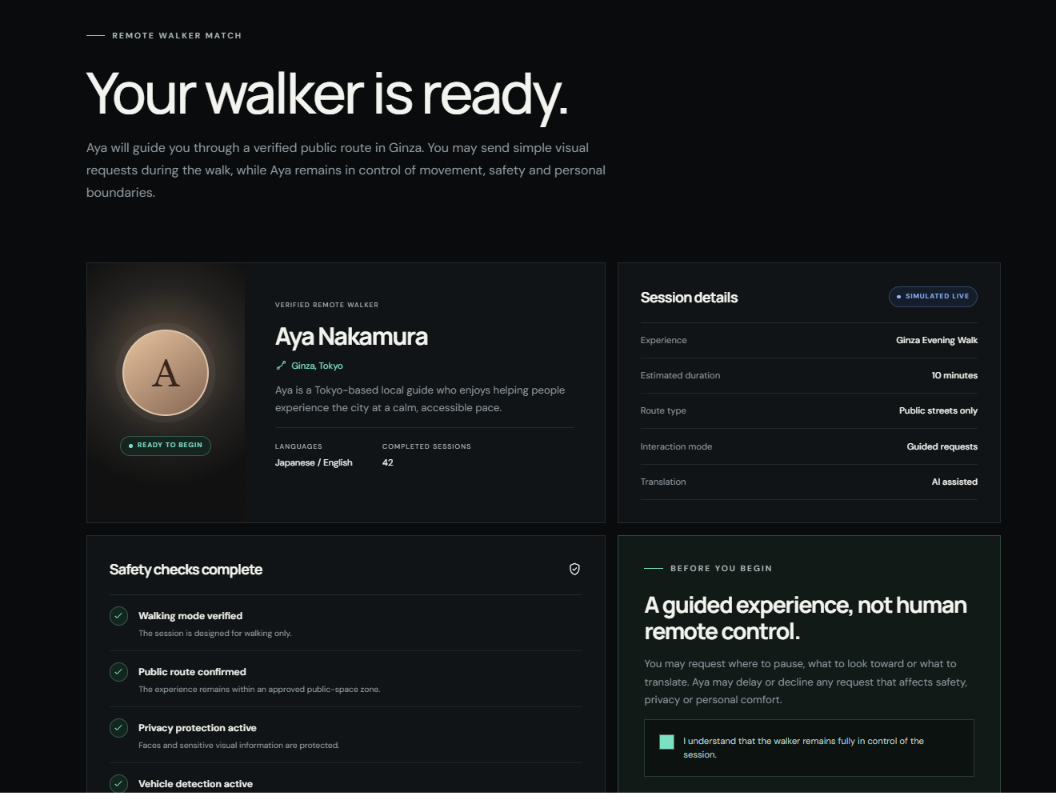
A verified Remote Walker remains fully in control of movement and safety.
-
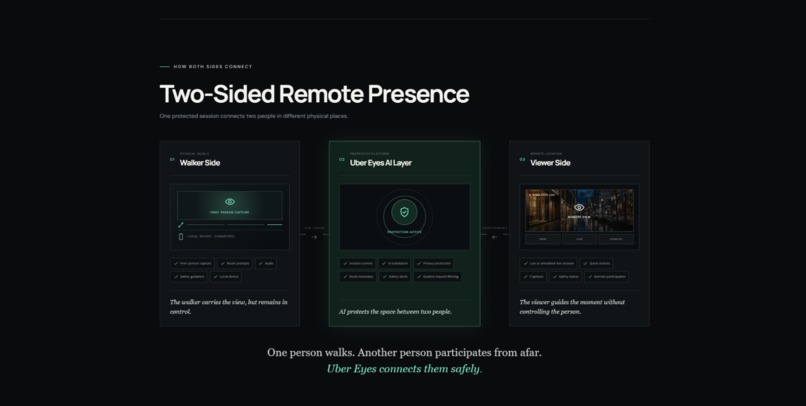
One person walks. Another participates from afar. Uber Eyes connects them safely.
-
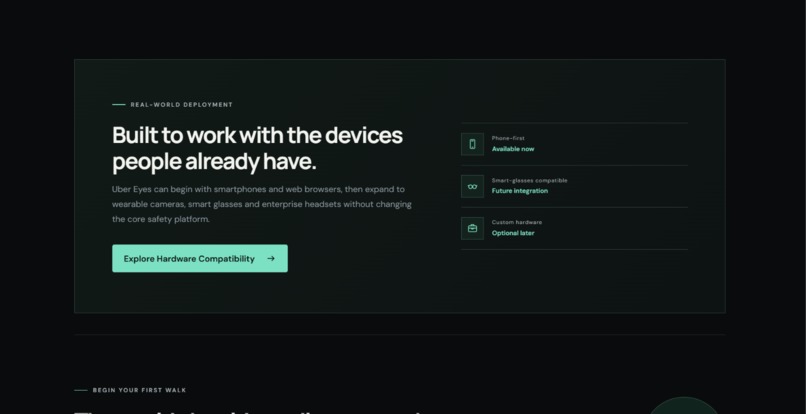
Built to begin with devices people already have.
-
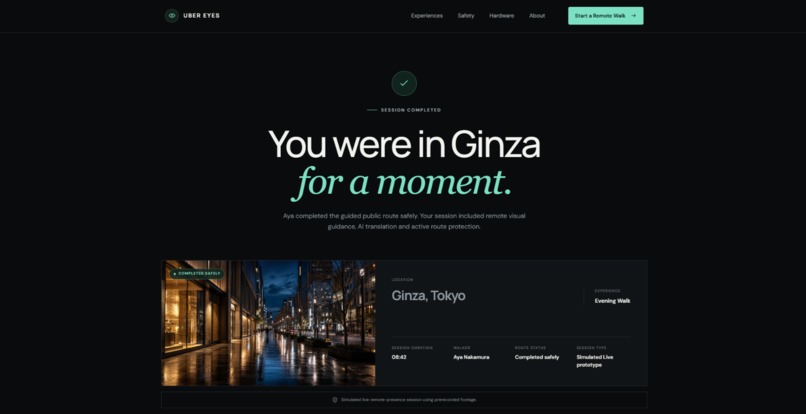
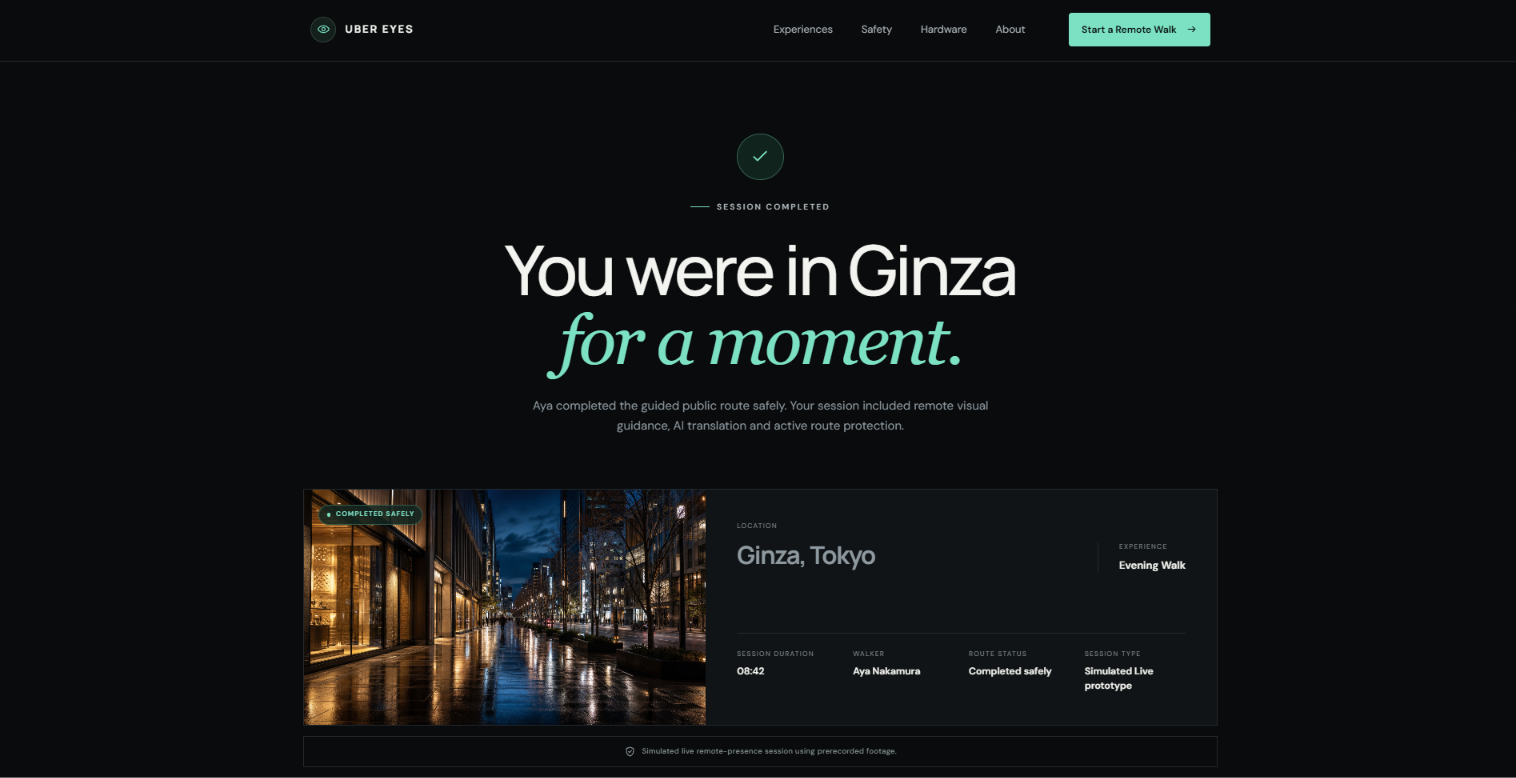
The session ends with a clear summary of place, guidance, translation and safety.
-
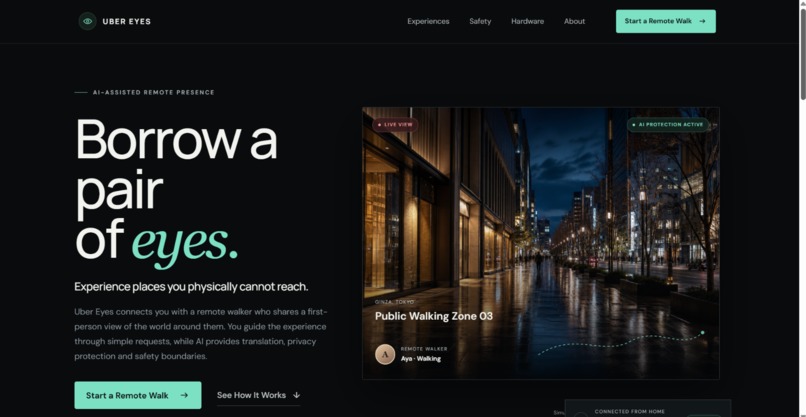
Uber Eyes — AI-assisted remote presence for places people cannot physically reach.
Inspiration
What it does## Inspiration
Millions of people cannot physically reach the places they want to experience.
Some are limited by mobility, illness, age, long-term care, cost, distance, time, or visa restrictions. Existing videos and livestreams can show a place, but they do not create the feeling that the viewer is actively present within it.
Uber Eyes began with a simple question:
What if someone who cannot go could still participate through another person’s eyes?
The goal was not to build another livestreaming platform, virtual reality experience, surveillance product, or system for remotely controlling a person.
The goal was to explore a new form of guided remote presence:
- one person physically walks in a public place,
- another person participates from somewhere else,
- and an AI safety layer protects the boundary between them.
What it does
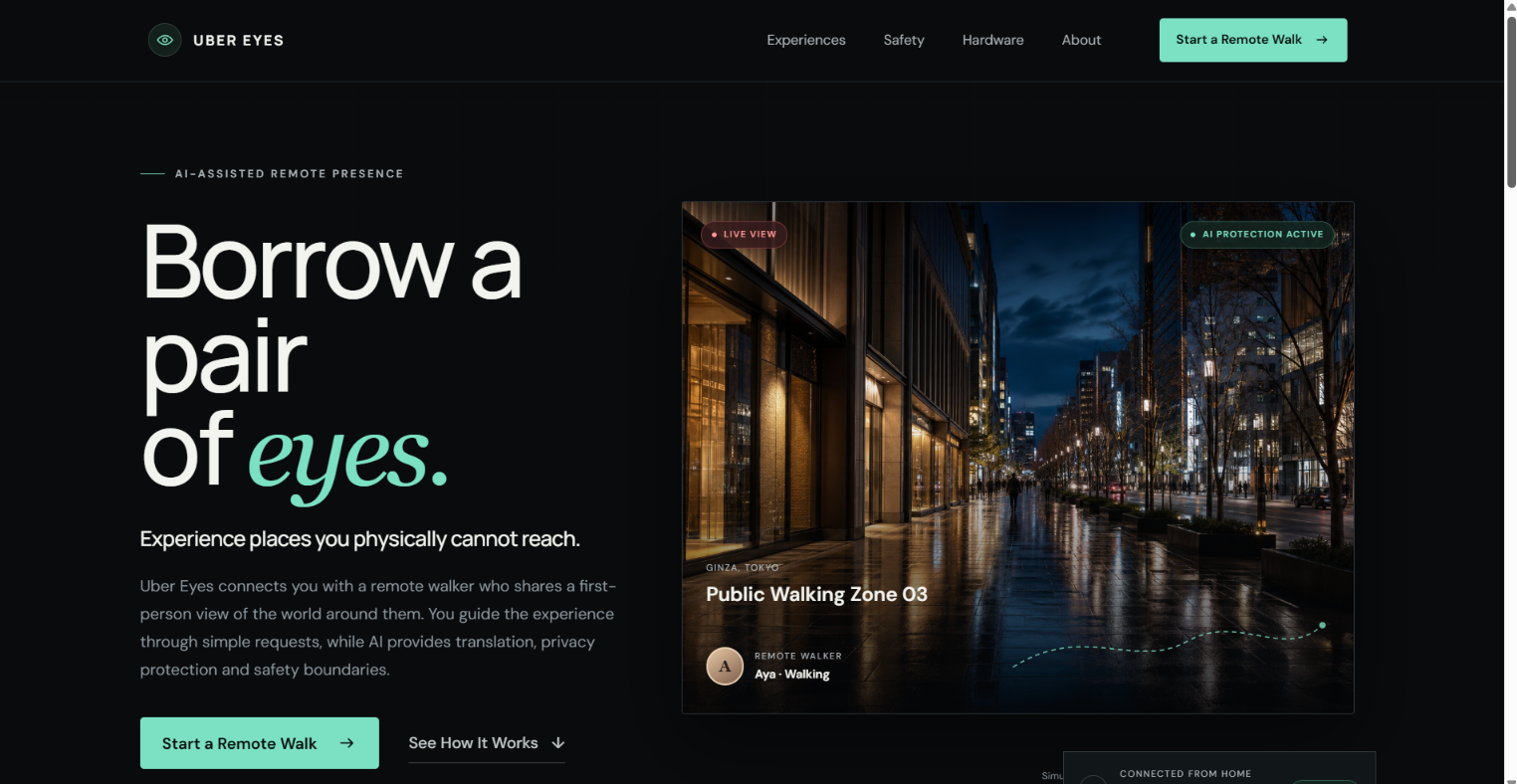
Uber Eyes is an AI-assisted remote-presence prototype.
A remote participant chooses a public walking experience and connects with a Remote Walker who carries a first-person view of the environment.
During the session, the participant can send a limited set of guided requests, including:
- Pause here
- Continue walking
- Look left
- Translate a visible sign
- End the session
The Remote Walker always remains in control of their own movement, safety, and personal boundaries.
The AI Safety Layer supports the experience through:
- privacy-protection states
- public-route boundaries
- walk-only verification
- vehicle detection
- sign translation
- guided-request filtering
- safety and session-status feedback
The current Build Week prototype uses prerecorded first-person footage from Ginza, Tokyo, to simulate a live remote-presence session.
The core experience
The prototype demonstrates a complete six-stage journey:
- Discover Uber Eyes
- Choose the Ginza Evening Walk
- Match with a Remote Walker
- Enter a simulated live session
- Interact through guided requests and AI safety states
- Complete the session and view its impact summary
Supporting pages also explain:
- how the AI Safety Layer protects both sides
- how the Walker and Viewer participate from different physical locations
- how Uber Eyes can begin with existing phones and wearable devices
- why custom hardware is not required for the first phase
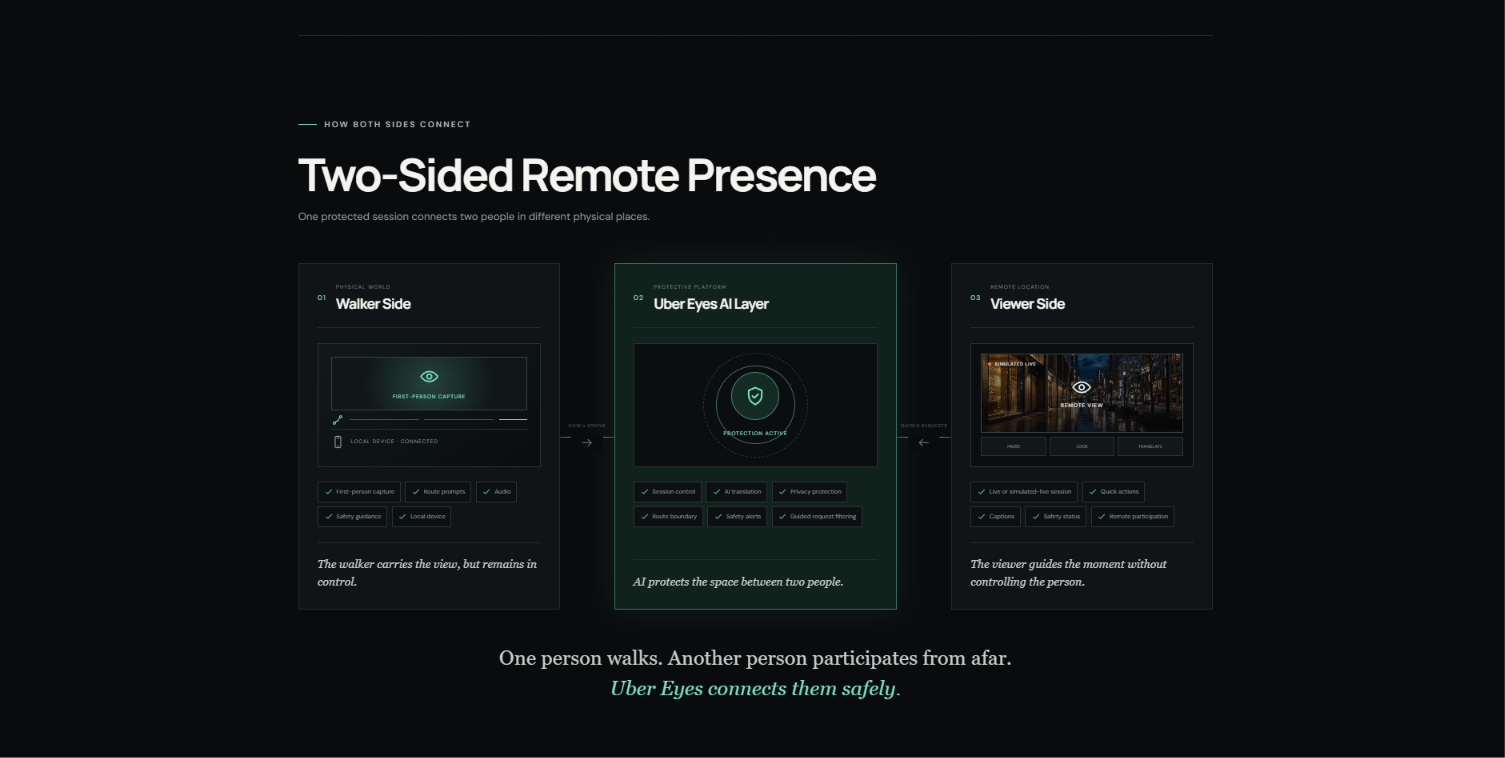
Two-sided remote presence
Uber Eyes is designed as a two-sided system.
Walker Side
The Walker carries the first-person view through a local capture device and receives route guidance, safety alerts, and session information.
Viewer Side
The Viewer participates remotely through a browser or other display and sends limited guided requests.
Uber Eyes AI Layer
The platform sits between them and handles:
- session control
- translation
- privacy protection
- route boundaries
- safety alerts
- guided-request filtering
The core principle is:
One person walks. Another person participates from afar. Uber Eyes connects them safely.
Human autonomy and safety
Uber Eyes is not human remote control.
The participant may guide the moment, but the Walker controls their body.
A Walker may delay or decline any request that affects:
- safety
- privacy
- route boundaries
- personal comfort
- public consent
This boundary is central to the product.
Presence is shared. Control is not.
Hardware-agnostic architecture
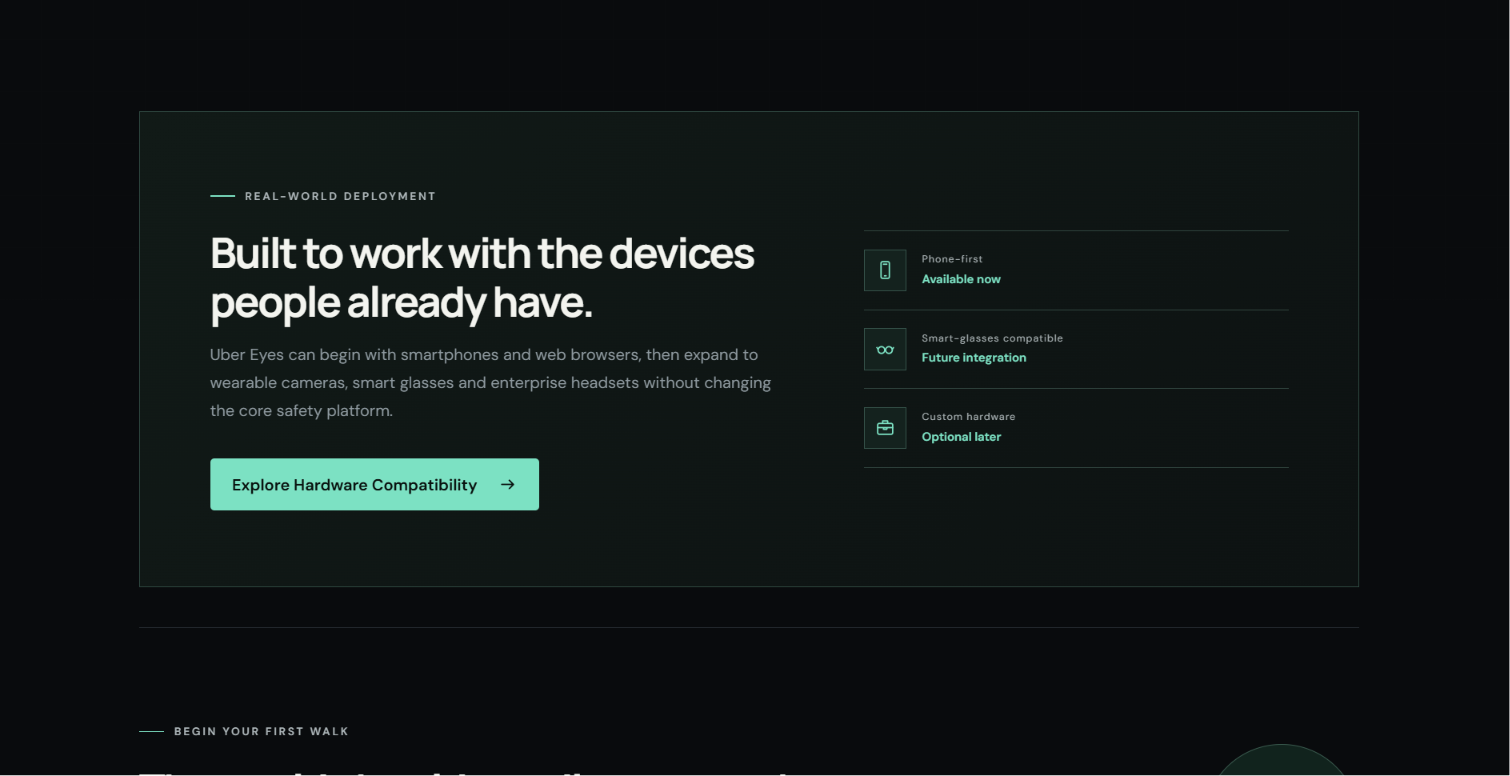
Uber Eyes is not positioned as a smart-glasses manufacturer.
The platform is designed to work with devices that already exist.
Possible Walker configurations include:
- smartphones
- chest-mounted or head-mounted cameras
- consumer smart glasses
- enterprise wearable headsets
- future certified capture devices
Viewers can participate through:
- web browsers
- mobile devices
- tablets
- televisions
- future spatial displays
The service layer remains the same even when the hardware changes.
Phone-first today. Glasses-compatible tomorrow. Dedicated hardware only if the experience proves it is needed.
How we built it
Uber Eyes was designed and built as an OpenAI Build Week prototype in approximately two days.
The project was co-created by Alex and AIVIS, with Codex used throughout the implementation process.
AIVIS was used to:
- define the product concept and boundaries
- structure the full user journey
- design the six-page information architecture
- write the interface language and product copy
- define the AI Safety Layer
- design the two-sided remote-presence architecture
- define the hardware-agnostic deployment model
- generate detailed construction prompts
- guide iteration, testing, GitHub release, deployment, and submission preparation
Codex was used to:
- scaffold the React and TypeScript application
- implement the interface
- create route and component structure
- build the Live Session interactions
- implement state changes and safety events
- create responsive layouts
- repair implementation issues
- run build checks
- prepare the project for GitHub and Vercel
The only manual media-editing step was placing the final on-screen captions into the demo video.
Technical implementation
The prototype was built with:
- React
- TypeScript
- Vite
- CSS
- local React state
- prerecorded video
- Vercel
- GitHub
- Codex
No production backend, payment system, account system, marketplace, or real-time streaming infrastructure was required for this prototype.
The focus was to build the smallest complete experience capable of proving that the product concept is understandable, operable, and worth developing further.
Challenges
The largest challenge was not creating a visually impressive website.
It was protecting the product from being misunderstood.
Uber Eyes could easily be mistaken for:
- a livestream platform
- human remote control
- surveillance
- a body-rental marketplace
- a VR project
- an unregulated remote-work platform
To prevent that, the prototype places human autonomy, privacy, public-space boundaries, and prototype transparency directly inside the user experience.
Another challenge was demonstrating live presence without building a real streaming infrastructure during Build Week.
We solved this by using prerecorded Ginza footage inside a clearly disclosed simulated-live session, while using interface states, guided requests, translation events, route warnings, and session feedback to demonstrate how the future experience would work.
What we learned
We learned that AI does not always need to replace the human inside an experience.
Sometimes its most valuable role is to protect the space between two people.
In Uber Eyes:
- the Walker provides real human presence
- the Viewer provides intent
- AI provides translation, context, safety, and boundaries
We also learned that new hardware is not required to begin validating the service.
Existing phones, cameras, browsers, and wearable devices already provide enough building blocks to test the experience before committing to custom hardware.
What’s next
Future versions of Uber Eyes could explore:
- real-time video sessions
- trained Remote Walkers
- accessibility-focused controls
- multilingual speech and sign translation
- production-grade privacy protection
- route-zone enforcement
- smart-glasses integration
- museums and cultural access
- education
- long-term care
- guided local experiences
- hardware-certification standards
- fair labour and Walker-protection policies
The long-term goal is not simply to let people watch distant places.
It is to create a carefully governed way for people who cannot physically go to remain connected to the world.
Final thought
The world is larger than the distance a body can travel.
Uber Eyes explores how AI can help people remain connected to it.
How we built it
Challenges we ran into
Accomplishments that we're proud of
What we learned
What's next for Uber Eyes
Built With
- accessibility
- ai
- codex
- css
- github
- human-computer
- openai
- presence
- react
- remote
- typescript
- vercel
- vite

Log in or sign up for Devpost to join the conversation.