Inspiration
One of us transferred to UBC from Langara and spent their first term eating lunch alone between classes, while hundreds of students were free a building away. Transfer, international, exchange and commuter students rarely lack interest in meeting people. They lack timing. Discord servers and club chats help you talk to people you've already found, but nothing helps you find someone free right now, near you, who has something in common with you.
What it does
UBC Meet answers one question. Who can I hang out with in my next gap, and where?
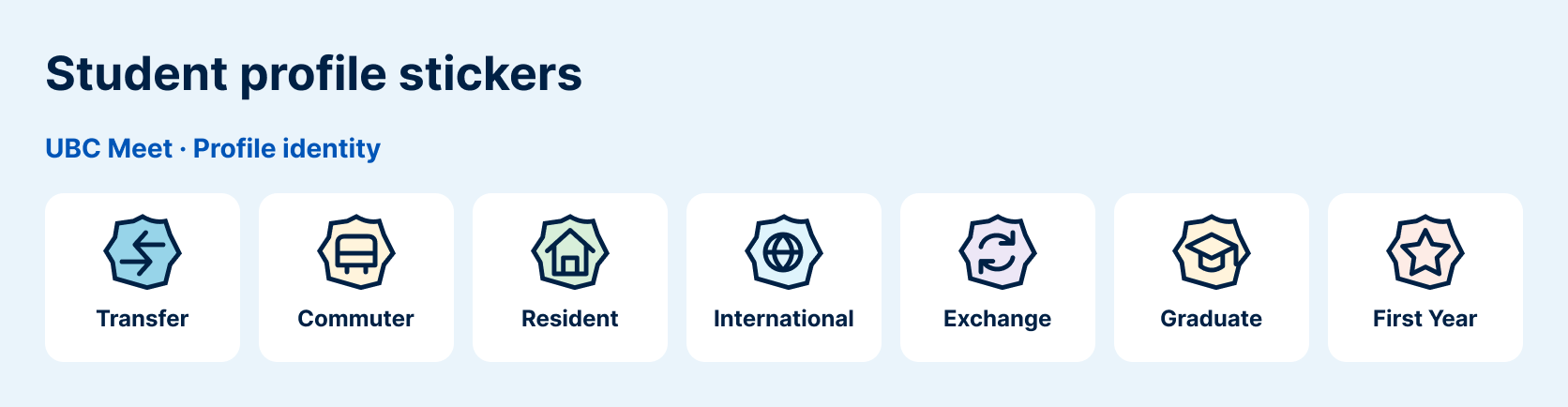
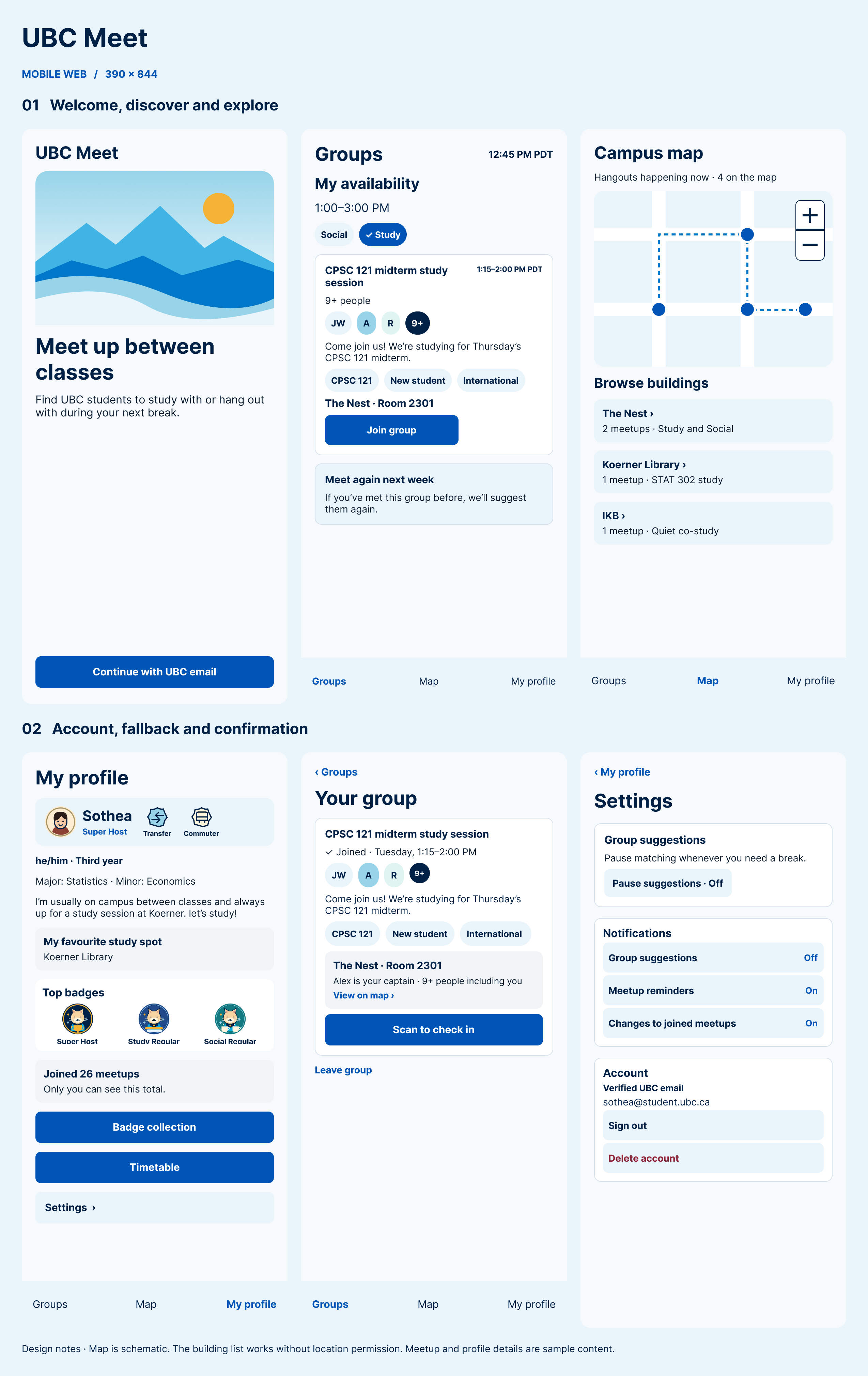
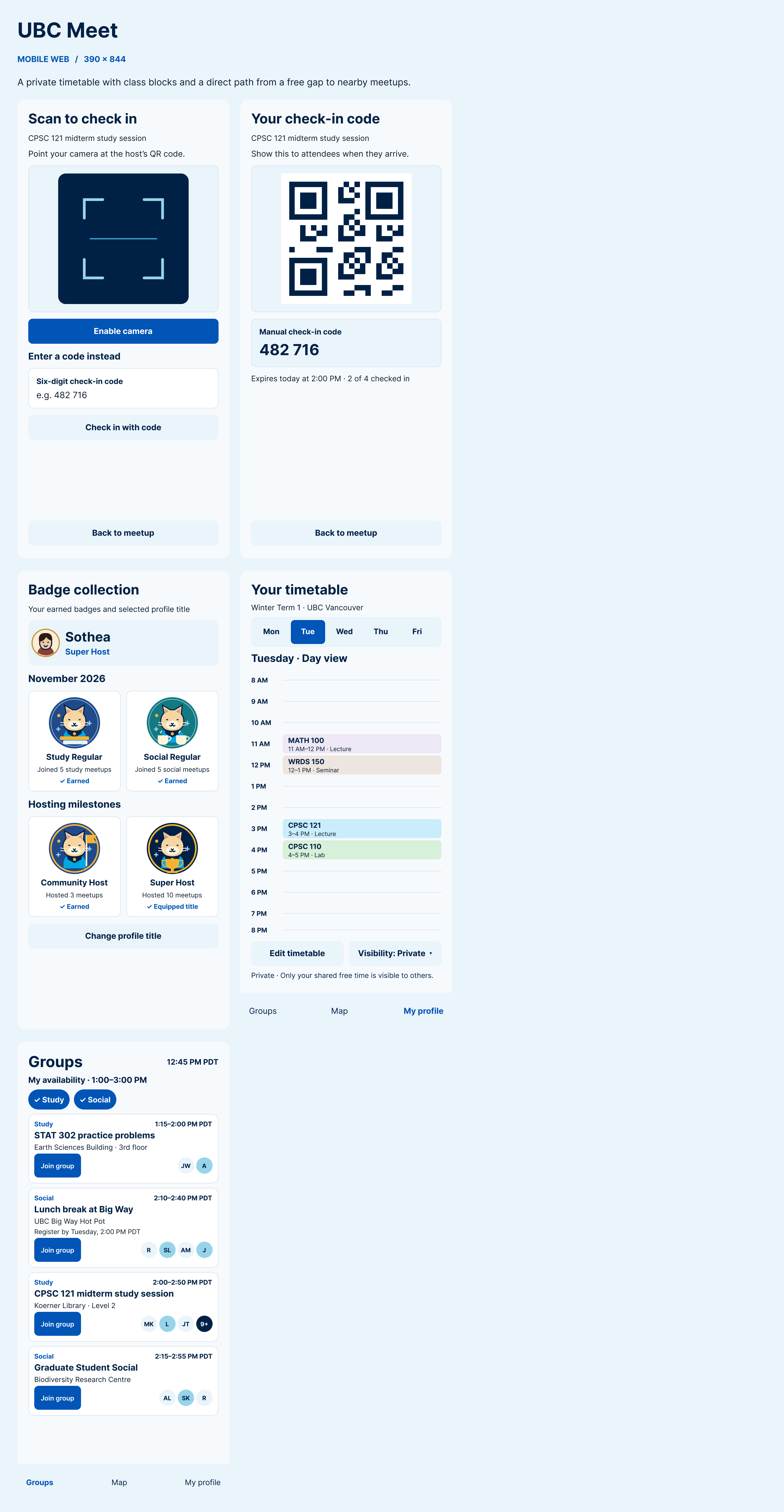
Students add their schedule and a few tags for who they are (transfer, international, commuter, exchange). Before each gap, the app suggests one small group of students who are free at the same time and share something, plus a public campus building to meet in. Students join or skip with one tap. When they find each other, they scan a groupmate's phone (or read out a six-digit code) to check in, which is how we count hangouts that actually happened.
If there's no match, students can join an open group in their gap or start their own, and the matcher fills it. A campus map shows where students are free right now, and a projector view shows groups forming live for events like this one.
Safety shaped every feature:
- Nobody sees anyone else's timetable.
- Names stay hidden until you're in a group.
- The meeting spot is only revealed once three people confirm.
- Map counts under three are hidden.
- There's no live location tracking.
How we built it
- Frontend. React and Vite as an installable web app, so anyone can join from a QR code with no download, with Leaflet for the campus map.
- Backend. Python and FastAPI on Supabase (Postgres). Group states, invitations and check-ins all live there.
- Check-in. Signed QR codes that change every 30 seconds and only work between members of the same group, plus a separate six-digit code people can read aloud.
- Gemini. Reads a screenshot of a student's timetable and turns it into free time blocks.
- Design. Built in Figma from UBC's colours, then matched screen by screen in code, with self-hosted fonts so the demo doesn't depend on venue wifi.
- Hosting. Served at ubcmeet.fit through a Cloudflare tunnel.
We also used coding agents heavily, with shared planning docs so several of them could work on separate branches at once without stepping on each other.
Challenges we ran into
- Verifying students. We planned to restrict sign-in to UBC student emails, but UBC's filters quarantined every verification code. We switched to guest accounts for the demo rather than claim verification we couldn't deliver.
- Groups that fall apart. A group of three becomes a group of two the moment someone declines or doesn't show. We added group states, so a meeting spot is only revealed once three people confirm, and a shrinking group can merge with another one nearby.
- Privacy versus a useful map. Showing where groups meet makes the map useful but makes people findable. We settled on activity per building, with small counts hidden.
- Proving people actually met. We first planned QR codes stuck on buildings, then realised scanning a building proves you're in it, not that you met anyone. Scanning a groupmate's phone proves both.
- Our own infrastructure. A schema mismatch made the live site look healthy while core pages failed, which taught us never to trust "the site is up" as proof a change shipped.
Accomplishments that we're proud of
- Privacy rules enforced on the server, not just hidden in the interface. Non-members can't even confirm a group exists.
- A check-in system that's hard to fake. Screenshots expire, outsiders are rejected, and the six-digit code reveals nothing about the QR code.
- Accessibility we measured rather than assumed. Every text colour pair passes 4.5:1 contrast in light and dark mode, and no tap target is under 44px.
- Over a hundred backend tests passing.
What we learned
- Loneliness on campus is often a scheduling problem, not a personality one.
- Safety is product design. Group size, when a location is revealed, and what the map shows each decide whether an app like this is safe to use.
- Build the thinnest version of the whole app first, then improve each part. That kept us demoable while plans changed.
- Coding agents are fast, but they're only as good as the written plan they're given.
What's next for UBCMeet
- UBC student email verification, sent
Built With
- claude
- cloudflare
- codex
- css3
- fastapi
- figma
- gemini
- github
- html5
- javascript
- leaflet.js
- postgresql
- pwa
- pytest
- python
- react
- supabase
- vite

