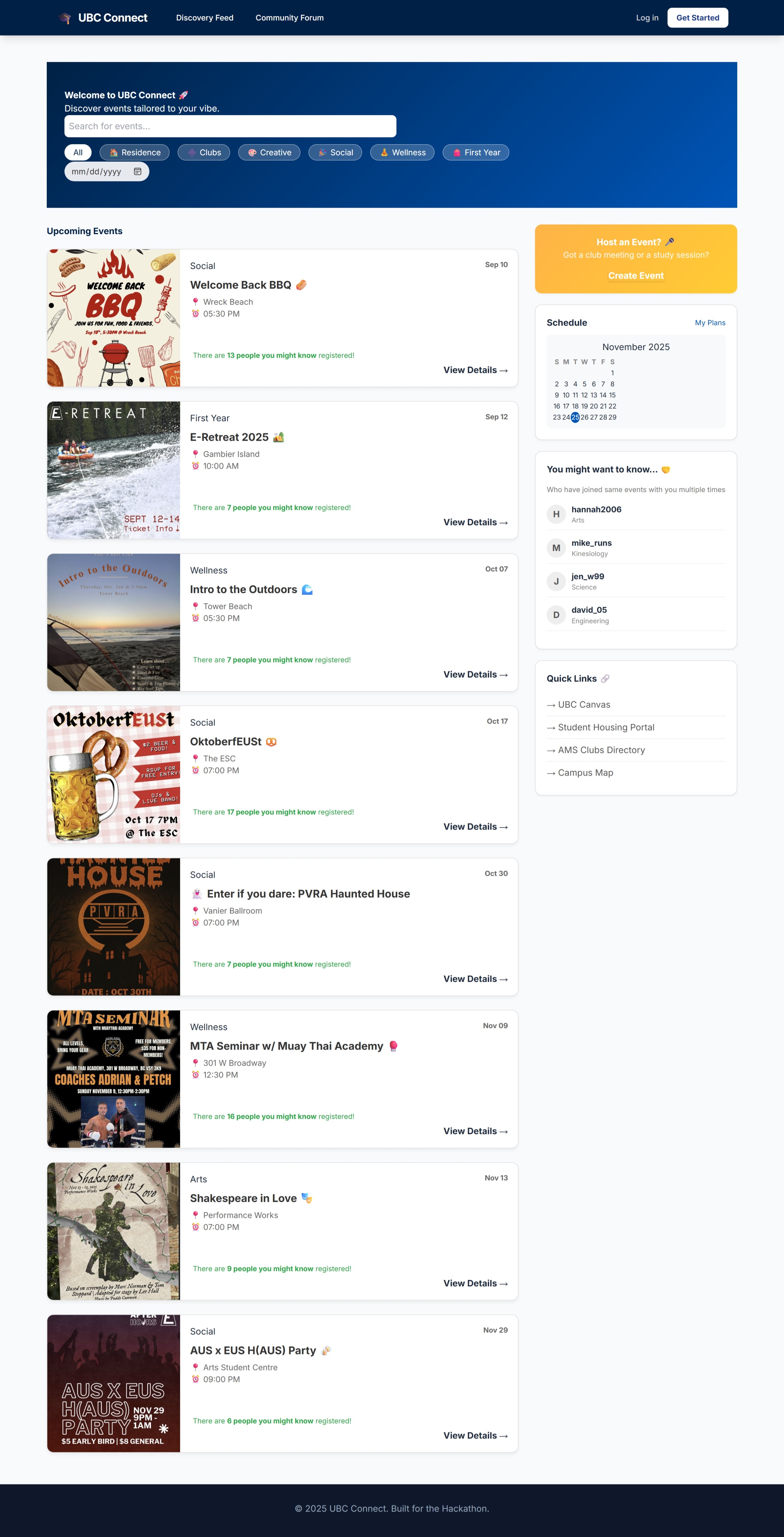
We’ve all been there: it’s Friday night, and you're scrolling through 500+ unread messages in a massive group chat just to find a plan. Or worse, you find a cool event poster, but anxiety kicks in—"Who is going? Will I be the only one there?"
We realized that university life isn't suffering from a lack of events; it's suffering from a connection gap. Existing platforms are just bulletin boards. We wanted to build a Social Operating System—something that doesn't just show you what is happening, but who is making it happen. We were inspired to kill the "fear of walking in alone" and replace it with social proof and gamified incentives to get students out of their dorms.
What it does UBC Connect is a platform that transforms campus discovery into a personalized, gamified experience.
Smart Identity: It filters the noise by verifying users based on residence and major, curating a feed relevant to their actual life.
Social Proof Engine: Unlike generic calendars, we show users exactly who is attending an event—highlighting mutuals, dorm-mates, and classmates—so they never have to attend alone.
Gamification: We turned socializing into a game. Users earn "Social Points" for RSVPing and attending events, ranking up from "Newcomer" to "Campus Legend" on their profile.
Reputation Building: It allows students to build a real-world social reputation that tracks their engagement and community involvement.
How we built it We started by designing the user experience in [Figma/Adobe XD] to ensure the "Social Proof" features were front and center.
Frontend: We built the interface using [e.g., React / Next.js / Vue] to create a snappy, app-like experience in the browser.
Backend: We used [e.g., Node.js / Python / Firebase] to handle user authentication (verifying residence/majors) and the event database.
The "Social Proof" Logic: We implemented a filtering algorithm that cross-references a user's profile attributes (Residence, Faculty) with the attendee list of an event to dynamically display "People you might know."
Challenges we ran into Balancing Privacy vs. Connection: We had to figure out how to show "who is going" without compromising user privacy. We solved this by abstracting data (e.g., showing "3 people from your dorm" rather than doxxing strangers) until connections are mutual.
The "Cold Start" Problem: A social app needs users to be useful. We tackled this by designing the Gamification System early on to incentivize early adopters to RSVP even if the platform was new.
Time Constraints: Building a functional reputation system within the hackathon timeframe was tight, forcing us to prioritize the core "RSVP = XP" logic over more complex features.
Accomplishments that we're proud of Pre-Launch Traction: Even before the code was fully finished, we validated the idea with the community. We are proud to be supported by over 50 students and 10 Residence Advisors at the launch stage.
The UI/UX: We managed to create a dashboard that feels less like a messy bulletin board and more like a clean "Operating System" for social life.
Gamification Logic: Successfully implementing the XP and Ranking system was a huge win, adding a layer of fun to the mundane task of scheduling.
What we learned Social Proof is King: We learned that students care less about what the event is and more about who is going. This shifted our entire development focus from "Event Details" to "Attendee Lists."
Verification Matters: By verifying residence and majors, we learned we could create a much higher-trust environment than anonymous group chats.
What's next for UBC Connect: The Campus Social OS Official Integration: We aim to partner with UBC Residence Life to make this the official onboarding tool for first-year students.
AI Recommendations: Implementing an AI model that suggests events based not just on major, but on past attendance history and friend groups.
Mobile App: Porting the web platform to a native iOS/Android app for real-time push notifications when friends RSVP.
Expansion: Scaling the "Social OS" model to other universities across Canada.
Built With
- python
- vscode


Log in or sign up for Devpost to join the conversation.