Inspiration
In our current political climate, it is incredibly difficult to decipher what our politicians and officials are supporting and what bills are being passed and put into law. With how little the US is currently invested in environmental policy this aspect of legislation is the least exposed to the public. We realized that most Americans might not actually be up to date with what US environmental policy is being enacted or looked at by the house and senate.
What it does
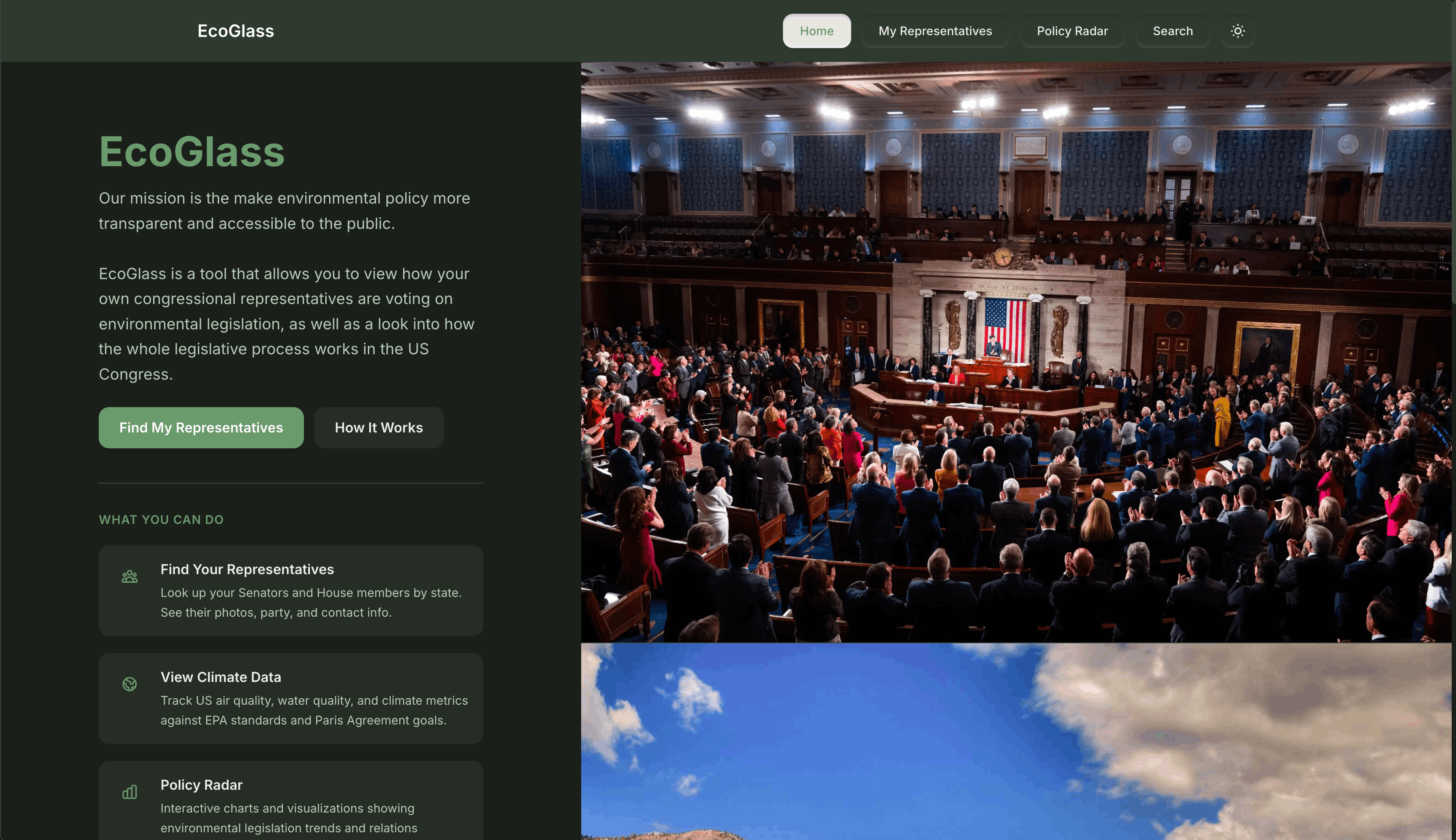
EcoGlass aims to make the US legislative process more accessible to the public, the very people that the system is supposed to be serving. With a focus on environmental policy, the website is able to give a streamlined look into the current climate policy, in limiting the scope the information is much more digestible by the average user.
How we built it
We started with an idea, this became a large structured plan on the scope of the website, what features we wanted to add and what our end goal should look like. From that point we chose our tech stack and modeled our data so we could process vast amount of data from the congress.gov API. At this point we delegated jobs and began building.
Challenges we ran into
- Data ingestion.
Accomplishments that we're proud of
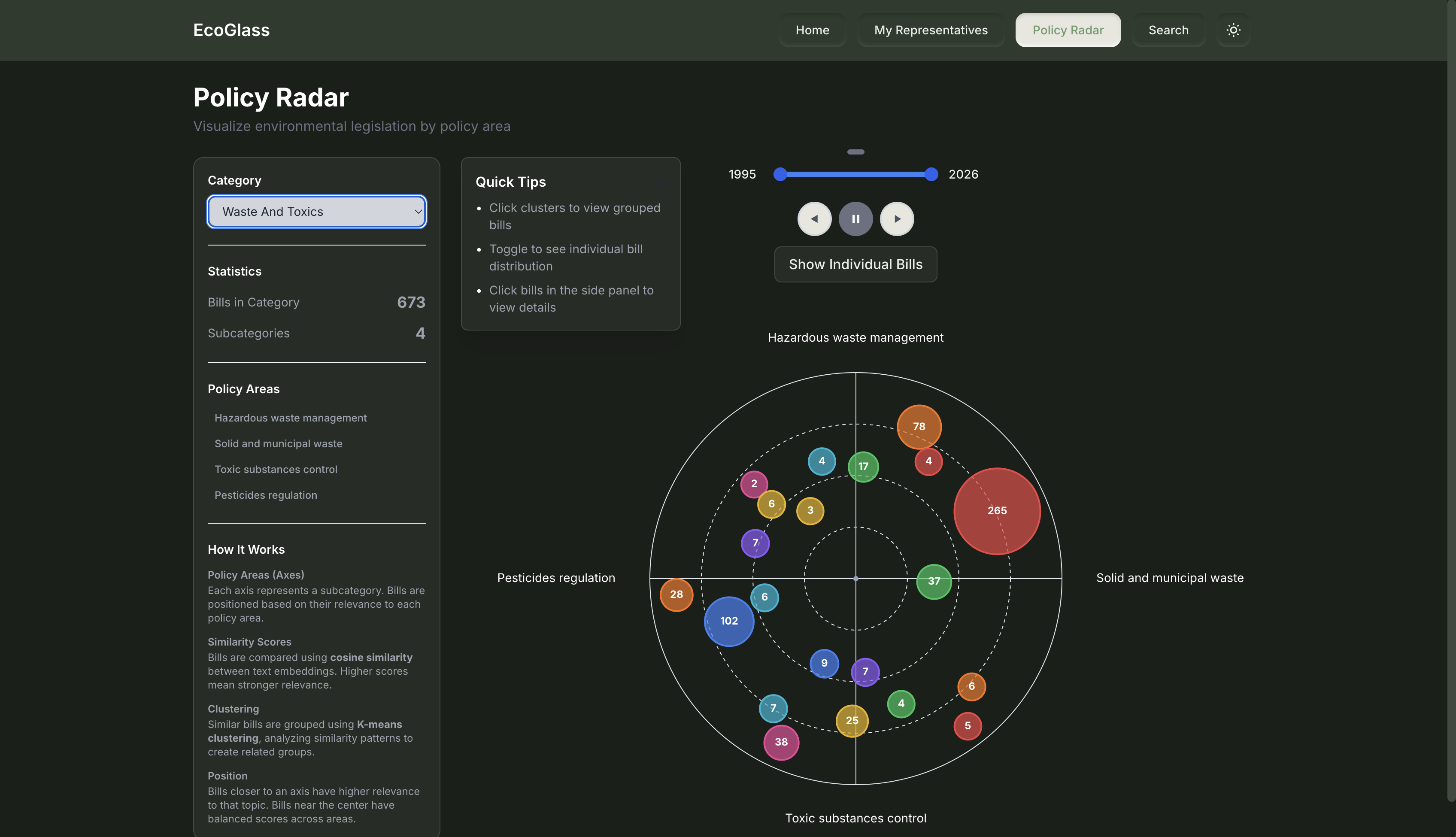
- Our bill similarity graph. Our usage of vector embeddings of bill data along with cosine similarity on subcategories allowed us to make digestible visualizations of what areas any given congress official is voting on and sponsoring. We implemented an unsupervised machine learning K-Means clustering algorithm to reduce the data from hundreds of data points to under 20, making visualization clear and easy to understand. This feature also allows the user to compare past congresses to the current congress and how US Climate Policy has changed and morphed over the last 30 years.
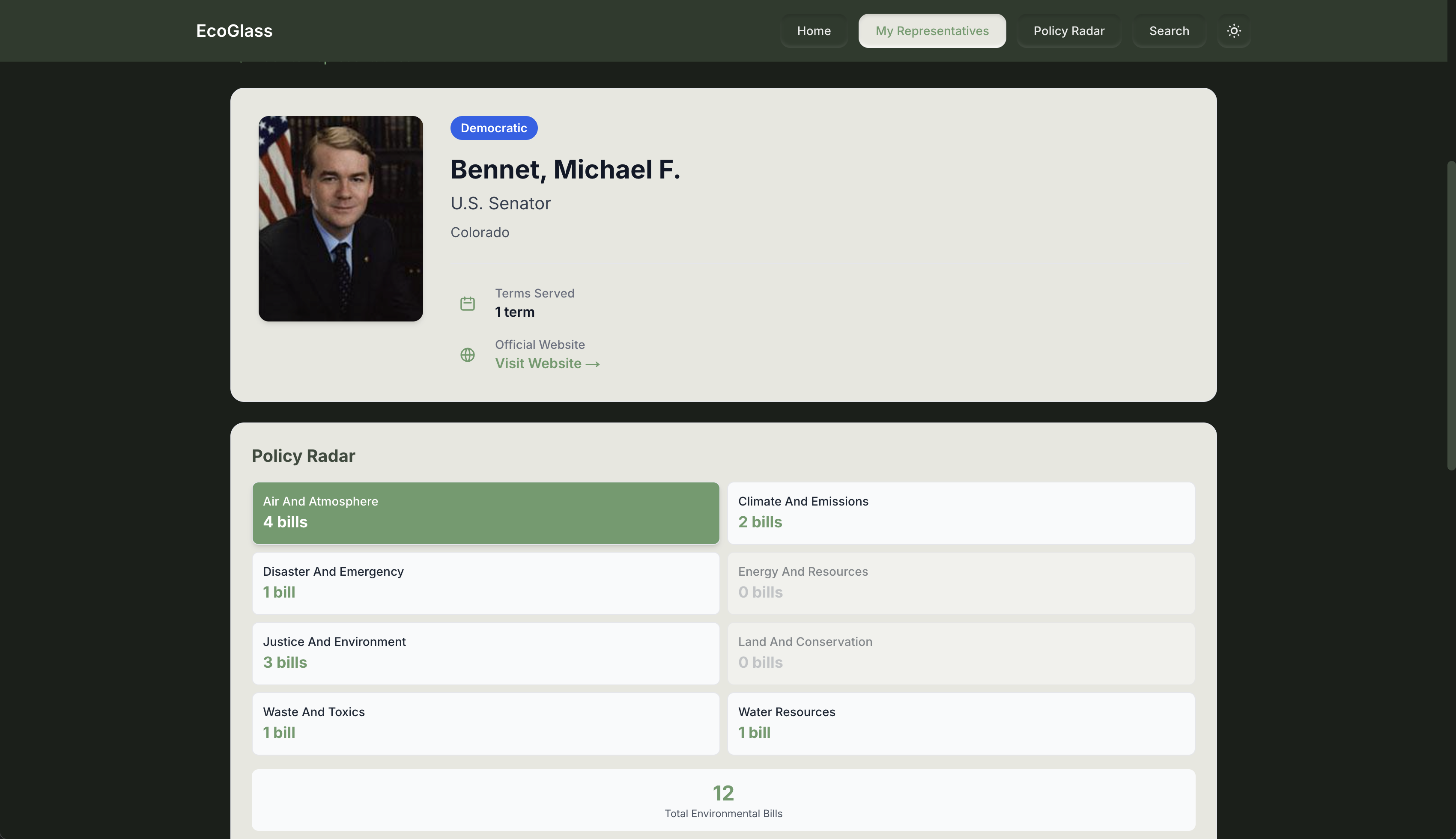
- The "Your Representatives" makes accountability a focus of our site. We believe being able to view the actions of the people that directly represent you, the user, is a tool of accountability and a force of good.
What we learned
- Reliable data ingestion is HARD. When using managed services, running past server hardware limits is easy, and inefficient data pipeline design will break easy and is incredibly error prone. We eventually landed on a multi-step message queue system. This was a first for all of us. ## What's next for U.S. Eco Glass
- We hope to improve our backend pipelines for data ingestion through things like improved fallbacks, logging and observability to make sure our data is always up to date.
- We also want to keep going back through the congress API to bring in data from before ~1990, as that is the limit of our current dataset.
- Other 3rd party integrations such as NewsAPI to bring in up to date data about public perception and coverage in environmental policy.
- Document stores. We want people to be able to use this site as a one-stop-shop, allowing people to directly view important documents through this site can push us towards this goal.
Built With
- next.js
- postgresql
- supabase
- typescript
- vercel


Log in or sign up for Devpost to join the conversation.