-
-
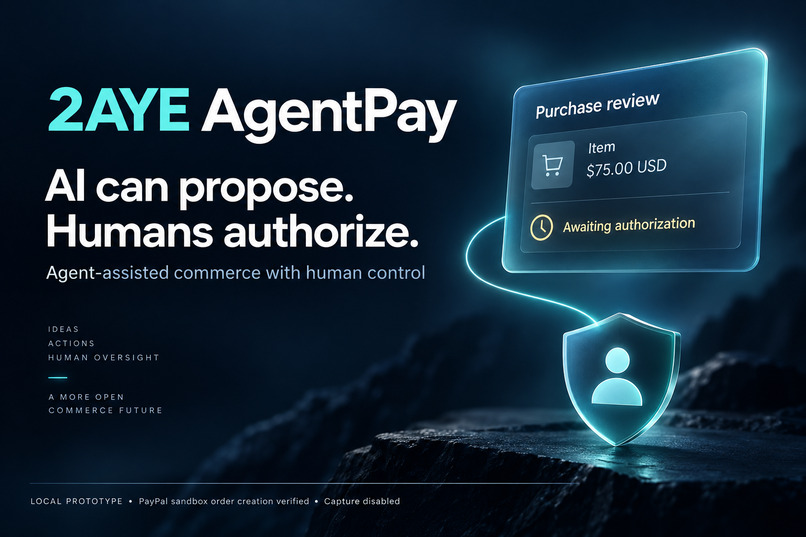
AgentPay prototype: AI-assisted purchasing, exact-term review and separate authorization and PayPal consent.
Inspiration
Small-business owners and office managers want AI to help buy supplies without giving it unrestricted permission to spend. A changed price or merchant must not become permission to pay.
What it does
Your AI shops. You decide. AgentPay recommends a purchase, preserves its exact merchant, amount and currency, and asks for purchase-specific approval before payment. PayPal buyer consent is a separate step. Changed terms and repeat payments are blocked.
The hosted example asks Claude for a wireless ergonomic keyboard within a $150 budget. Claude compares the evaluation catalog and recommends the $119 option. Server checks validate the product, quantity and price. The owner reviews the purchase, creates a real PayPal Sandbox order, approves the exact terms and completes buyer consent through PayPal.
Verified working result
On November 12, a fresh hosted journey completed a 119.00 USD Sandbox payment. The browser showed the matching receipt and consumed approval. Independent PayPal readback confirmed exactly one matching capture on that order. A new login recovered the receipt. Repeating payment returned HTTP 409. An altered amount was refused without asking PayPal to capture. An expired approval kept payment blocked until a fresh approval was signed.
The acceptance purchase approval was automated through a browser software key. This test does not establish human-presence or hardware assurance. PayPal Sandbox only: no live payments or real goods.
PayPal and AI working together
Claude uses read-only catalog tools through the Vercel AI SDK. Structured output and independent server checks constrain recommendations; the model cannot approve a purchase or capture money. PayPal Orders v2 creates and retrieves the actual Sandbox order. PayPal checkout handles buyer consent, and provider readback verifies the final capture.
How we built it
Next.js, React and TypeScript serve the interface and API. PostgreSQL stores owned purchases, sessions, approvals and payment evidence. Zod validates recommendations. Provider credentials stay on the server. Execution consumes the exact purchase approval once, and uncertain outcomes are checked against the existing payment rather than sent again.
Significant updates during the hackathon
Since October 1, this standalone edition adds catalog-backed AI recommendations, purchase review, PayPal Sandbox orders and checkout, verified self-service workspaces, purchase-specific software approval, changed-term refusal, receipt recovery and repeat-payment protection. The public Apache-2.0 repository contains the source, migrations, tests and setup instructions. No private repository is required to run it.
The deployed repair passed 151 application tests, 66 bundled SDK tests and four publication tests, with no failures or skips, plus lint, type checking and production build.
Try it
Demo: https://hackathon.agentpay.twoaye.com/hackathon Source: https://github.com/negasidev/agentpay-paypal-ai-hackathon Video: https://youtu.be/MG2dcnJwfhY
The 94-second video records the November 11 order-and-refusal flow. It does not show the subsequently verified completed payment. The hosted app and public acceptance record contain the later result.
Judge credentials and numbered testing steps are supplied privately. The shared judge account can inspect saved results but cannot approve or pay. Fresh purchase tests use an owned, email-verified Sandbox workspace and a separate PayPal Sandbox Personal buyer account. The catalog is a controlled evaluation catalog, not a live marketplace.
Built With
- anthropic
- next.js
- node.js
- paypal
- postgresql
- react
- tailwindcss
- typescript
- vercel-ai-sdk
- zod
