-
-
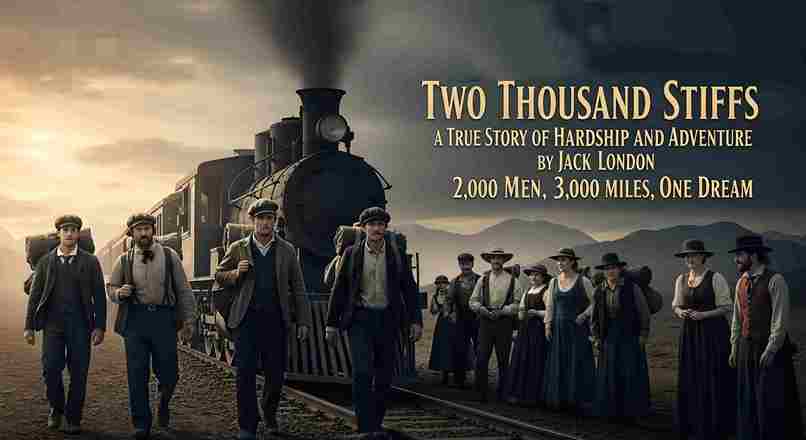
A.I. Generated Movie Poster
Inspiration
This project began when I read an intriguing article in Smithsonian about the Coxey Movement. I am well informed of our history but I had no idea about that amazing chapter in our past. Once I read Dr. Schwantes' book Coxey's Army: An American Odyssey, I realized what a tremendous story this is. Schwantes led to Jack London's The Road and the story of 2,000 Stiffs. My original goal was to tell this story as a documentary. The video you will see is my attempt as a One Man Band, to create a "Teaser Reel" for that documentary. The story of Coxey's Army—and the nationwide movement it sparked—has been largely ignored by mass media. Yet those ten extraordinary weeks in the spring of 1894 reshaped America’s social fabric more profoundly than any protest before or since. In the grip of the worst economic depression the nation had ever faced, ordinary men and women rose up, marched toward Washington, and demanded that government serve the people—not just the powerful. This is a story of deep despair, bold defiance, and the first mass movement to confront power in the heart of the nation’s capital.
What it does
This historical documentary was created using contemporary digital tools, including generative artificial intelligence and advanced image editing software, while maintaining a careful balance between technological innovation and historical integrity. Where authentic historical photographs and documents existed, they served as the foundation for the visual interpretations. In order to thoughtfully enhance these materials while preserving their essential character and documentary value, never replacing or fabricating historical records. Original AI-generated images were created using various A.I. tools under the general copyright protection to computer-generated works. These images are derivative works informed by historical photographs sourced exclusively from public domain archives, including the Library of Congress and similar institutions. All source material used by the author to inform the AI engines came from publicly accessible historical records, ensuring no copyright violations while creating new interpretive visualizations of historical events. AI and digital enhancement tools were employed to illuminate history — bringing clarity to faded images to help readers connect with historical moments while remaining faithful to the factual record. Every enhanced image respects the human story behind it and aims to make history more accessible while honoring the gravity and authenticity of the events depicted.
How we built it
I used A.I. tools exclusively to create the Teaser Reel. Those tools included: ElevenLabs for all narration; Suno.ai for all music and sound; LTX Studios and Katalist for the storyboarding and many of the images, as well as StableDiffusion, Runway, Soma, Stability, and google.labs products. The video was edited and compiled in OpenShot the opensource video editor. All this work was accomplished on a very minimal budget!
Challenges we ran into
Oh man!!! Where do I start??! This story got under my skin. I just KNOW that it would make a great Hollywood Blockbuster - or at least a five part Docudrama. The story is there! So many colorful characters, messages galore that we did not learn then and should be reminded of. The whole "1% vs. the Rest of Us" thing started here! But I'm not a "filmmaker". I haven't been initiated into the club. Man have I struggled to be recognized and find a way to tell this story... I have tried to work the traditional cycle. I partnered up with a couple of guys who have made films successfully, prepared scripts, recruited historians for interviews, put together Pitch Deck, Look Book, Script, music to include, and many other things. I have applied for probably twenty grants. I have an official Fiscal Sponsor (FillmCollab SF). BUT... the Film Industry HATES A.I. with the passion usually reserved for witch burners. On every single turn I have received scoffs and scorn. IT seems to me that pretty much every person who spent their time in the film industry feels overtly threatened - by funding cuts, by societal change in viewing habits, by the concentration of power in the industry - and those same forces threatening the industry with A.I. Needless to say, funding for all documentaries has taken a huge hit. The entire documentary film industry is reeling from the cuts at NPR and PBS as well as state funding and federal arts funding.
Accomplishments that we're proud of
I was able to recruit some great historians for help in the project including: Richard Aarstad, Montana State Archivist Richard is a historian and archivist at the Montana Historical Society with over 20 years of experience in research, archival management, and documentation. --- Aubrey Jaap Director, Butte-Silver Bow Public Archives where she has worked since 2007. Passionate about preserving local history, she leads initiatives like the Verdigris Project, collecting oral histories. --- Dr. Carlos Schwantes is the St. Louis Mercantile Library Endowed Professor of Transportation Studies at the University of Missouri–St. Louis. -- Dr. Kenneth Brandt Professor of English Literature and Executive Director of the Jack London Society
What we learned
I started using computers for productive work in 1984. Yes. Way bac then. I needed to learn to use one so I could produce a weekly free TV guide in Georgia. I was doing "Desktop Publishing" befor eth term was coined. I have been using, fixing, installing and cursing at computers in some way ever since. My partner and I developed solar power for portable computers in the late 90's. We received 2 patents for those products and we developed software that was sold to publishers and at one point, our templates were pre-installed on every Macintosh sold in the U.S. I started with a Mac SE and PageMaker version 1.2. So I have real history behind me. This is all to get to the point that I really enjoyed my journey learning and implementing generative A.I. I remember playing with PhotoShop when it first came out. It blew us all away! Same thing with Illustrator, PowerPoint, and many others. The A.I. tools I have been using have mostly been very well implemented and super powerful. I can't wait to see what you all come up with next!!
What's next for Two Thousand Stiffs: a Historic Documentary
I am sorry to say (and actually very relieved) that I have made the decision to largely give up on my own efforts in the Film Industry. The frustrations discussed above are never ending and I don't see a turn around in that industry - especially for inexperienced first timers - in the near future. This fact inspired me to make a big pivot. The graphics that i created or the video you will see are so cool that I knew they were perfect for something. What I have decided to do is create a new style of Graphic Novel using historic photos as the inspiration for the images. It's a revolutionary look for graphic novels and I believe that it worked real well. I hope this does not disqualify me for the video award. The Teaser Reel stands alone as a piece of work. I also intend to use printed copies of the book you will see if you follow the link to introduce Hollywood Types to the story. I think it's the perfect storyboard visualization of a great saga. Here's a .pdf of the current draft of the book - http://bit.ly/467kpKM
Built With
- as-well-as-stablediffusion
- elevenlabs
- google.labs
- katalist
- ltx
- runway
- soma
- stability
- stablediffusion
- suno

Log in or sign up for Devpost to join the conversation.