-
-
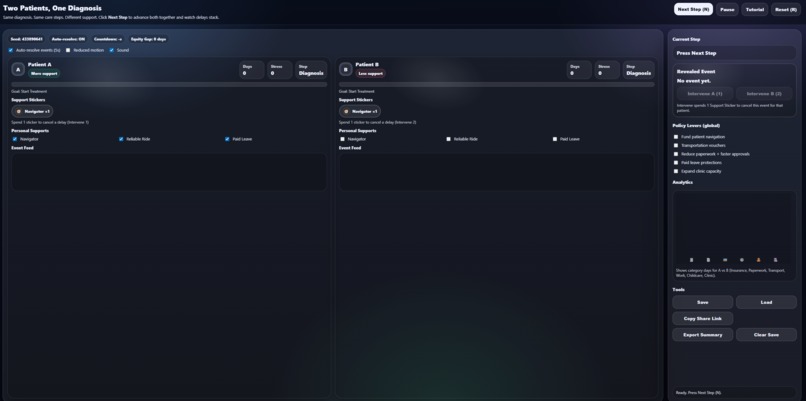
Two patients receive the same cancer diagnosis and begin the same treatment process.
-
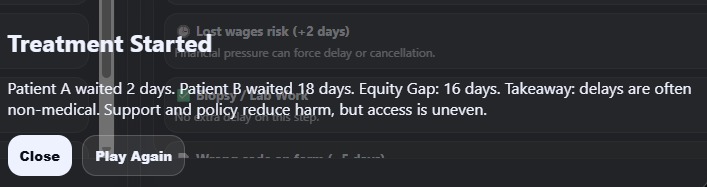
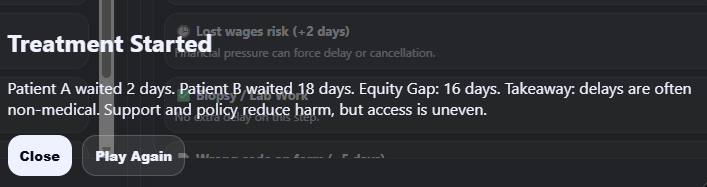
Both patients reach treatment, but at very different times due to unequal access to support.
Inspiration
I was inspired by how often cancer treatment delays are caused not by medical decisions, but by everyday systems around patients. Things like insurance approvals, transportation, work schedules, paperwork, and clinic capacity can quietly push treatment further and further away.
These barriers are hard to understand from statistics alone, so I wanted to build something that makes them visible and felt in a simple, interactive way.
What it does
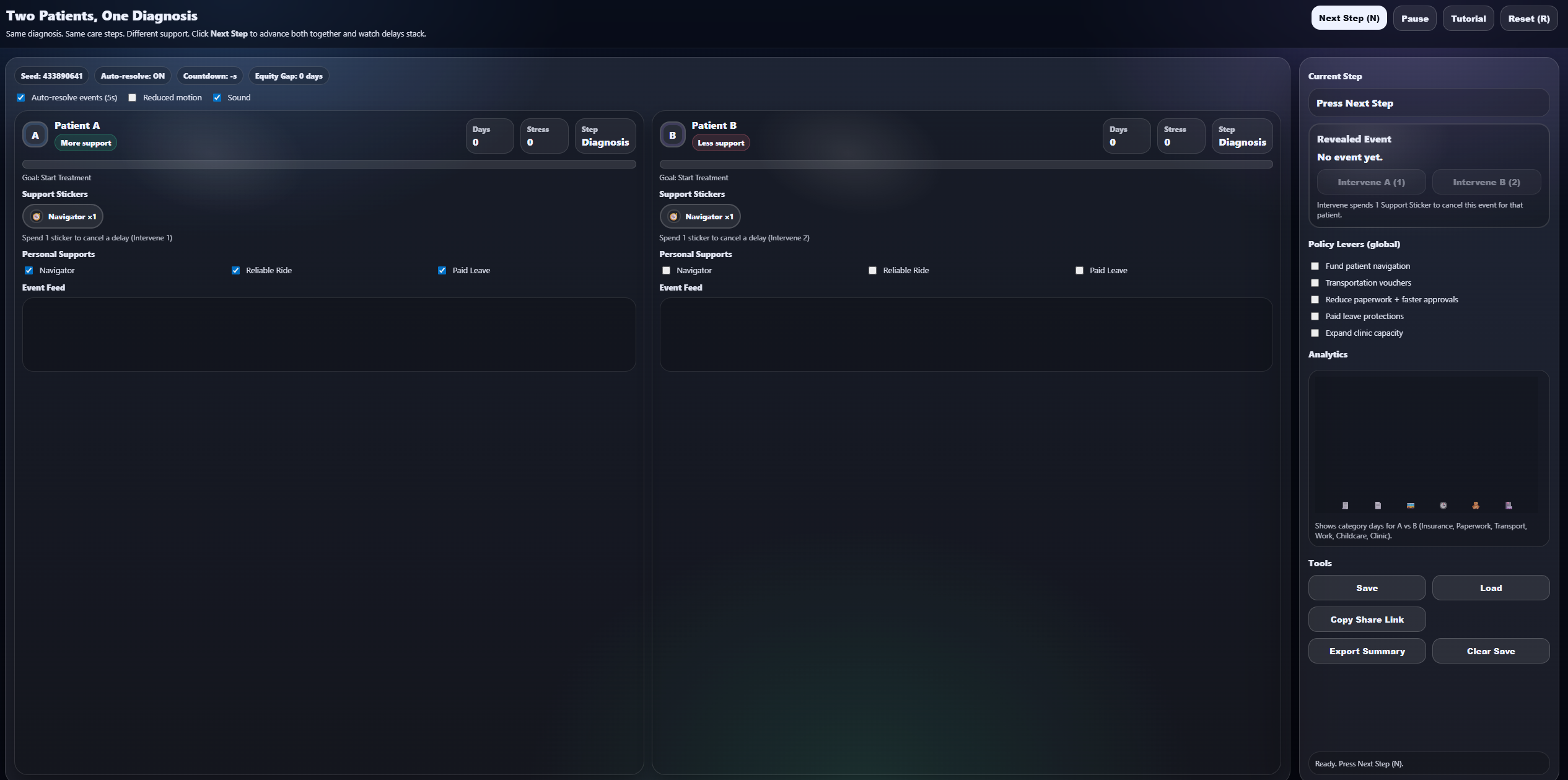
Two Patients, One Diagnosis is an interactive simulation that compares two patients who receive the same cancer diagnosis and move through the same treatment steps.
At each step:
- Both patients face the same potential delays
- One patient has access to support systems
- The other does not
As the simulation progresses, delays stack differently for each patient. By the end, both reach treatment, but often with a large gap in time, showing how access to support changes outcomes.
How we built it
I built the project as a browser-based simulation using:
- HTML for structure
- CSS for layout and visual clarity
- Vanilla JavaScript for simulation logic and state management
The app runs entirely in the browser with no backend. Each step calculates delays based on real-world categories such as insurance, administration, transportation, work, and clinic capacity. Support tools reduce the impact of these delays.
The design focuses on instant feedback so the project is easy to demo live.
Challenges we ran into
One challenge was balancing realism with simplicity. I wanted the simulation to be accurate enough to reflect real barriers without overwhelming users with complexity.
Another challenge was tone. I needed the project to be engaging and interactive without turning a serious topic into a traditional game. We solved this by focusing on comparison and visualization rather than competition.
I also spent time refining the flow so users could understand the message in under 30 seconds.
Accomplishments that I am proud of
- Creating an experience that communicates a complex equity issue almost instantly
- Designing a simulation that feels interactive without requiring instructions
- Building a polished, demo-ready tool using only front-end technologies
- Clearly showing that delays are often not medical, but systemic
What I learned
I learned that small barriers add up quickly, and that access to support systems can dramatically change treatment timelines.
I also learned that interactive tools can explain social and health issues more effectively than text alone. Showing the difference side-by-side makes inequity impossible to ignore.
What's next for Two Patients, One Diagnosis
Next, I would like to:
- Add role presets (for example, rural patient or hourly worker)
- Include more real-world data sources to tune delay probabilities
- Improve accessibility options for different users
- Expand the simulation to show how policy changes could reduce delays
My goal is to continue developing this into a tool that supports education, advocacy, and discussion around equitable cancer care.
Built With
- and-animations;-javascript-for-the-simulation-logic
- canvasapi
- css
- github
- html
- interactivity
- javascript
- layout
- responsiveness

Log in or sign up for Devpost to join the conversation.