-
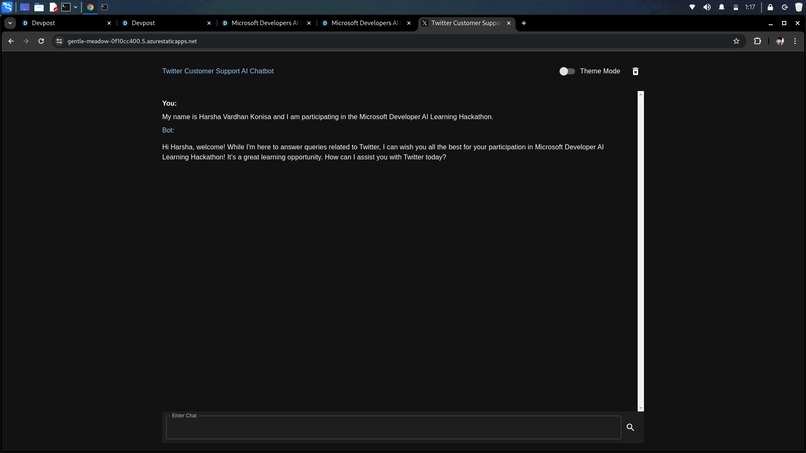
Dark Mode
-

-

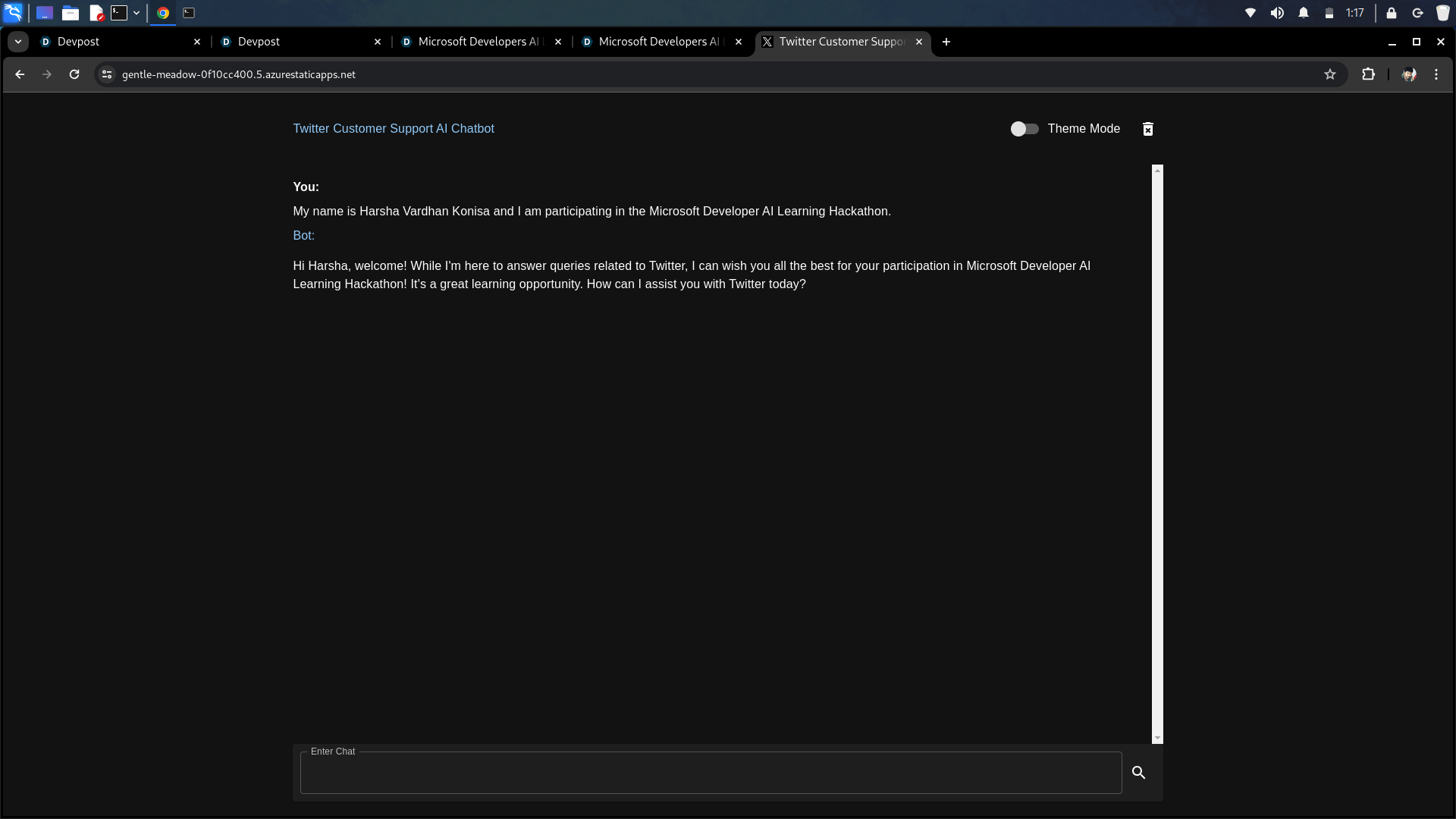
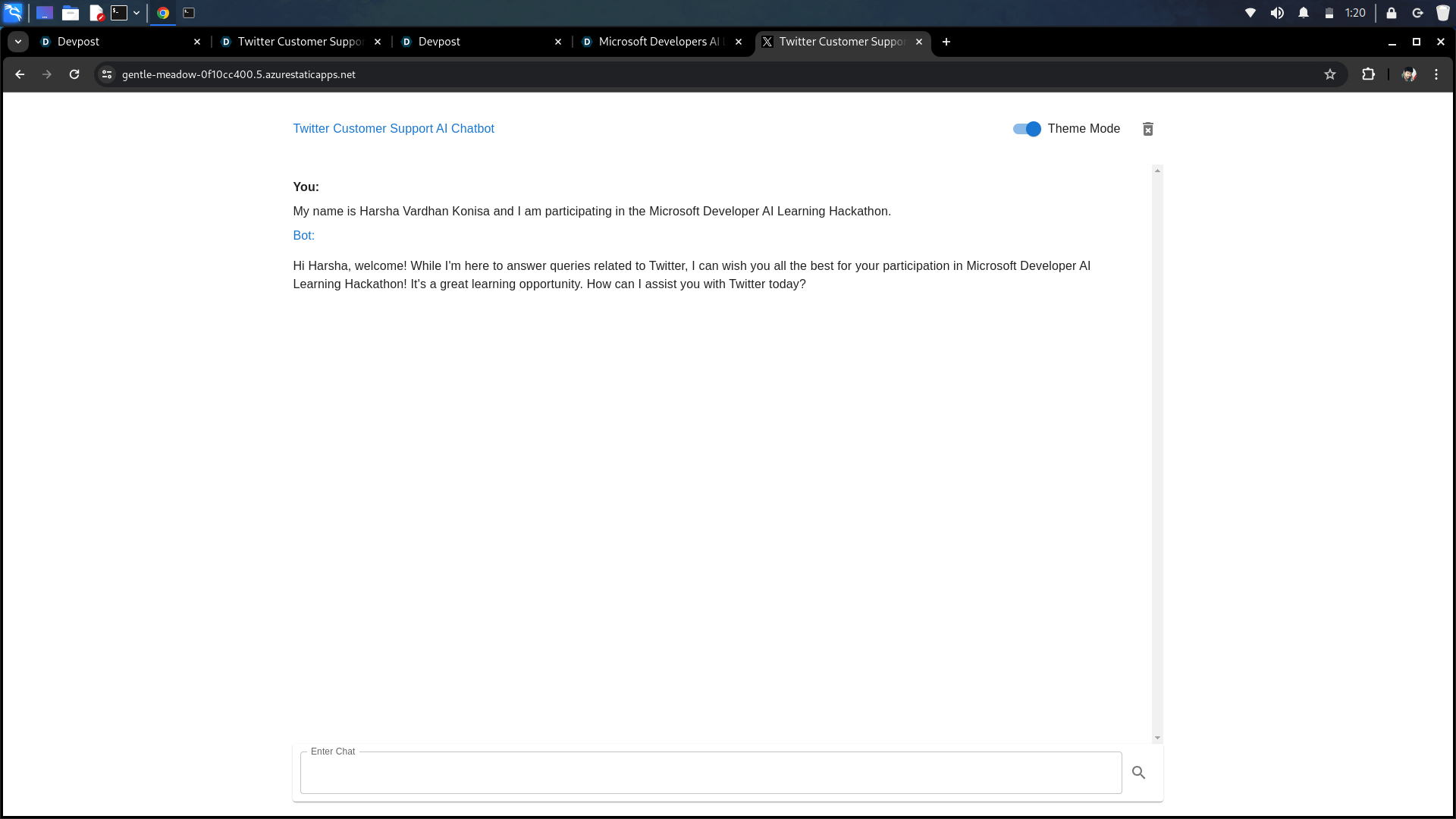
Light Mode
-



Inspiration
The inspiration behind the "Twitter Customer Support AI Chatbot" project stemmed from my passion for exploring AI's potential in enhancing customer service interactions on social media platforms like Twitter. I saw an opportunity to leverage AI and machine learning to automate and improve the efficiency of customer support processes, aiming to deliver quicker responses and better user experiences.
What it does
The "Twitter Customer Support AI Chatbot" utilizes advanced natural language processing techniques to analyze and respond to customer support queries. The chatbot aims to simulate human-like interactions to provide effective and timely support to users.
How I built it
I embarked on building the "Twitter Customer Support AI Chatbot" project as part of the Microsoft Developers AI Learning Hackathon. Following the structured guidance provided by Microsoft, I completed a comprehensive learning journey aimed at building AI applications powered by vCore-based Azure Cosmos DB for MongoDB and utilizing the Azure OpenAI API.
Implementation Approach
Armed with newfound knowledge and skills, I proceeded to implement the "Twitter Customer Support AI Chatbot." The backend was constructed using Python and FastAPI to establish a robust API endpoint, facilitating seamless interaction with Azure Cosmos DB for data management. For the frontend, I employed React.js to create an intuitive user interface that enhances the chatbot's usability and responsiveness.
Utilization of Azure Services
Central to the project's architecture was Azure Cosmos DB, chosen for its scalability and performance in handling large volumes of customer interaction data. Integration with the Azure OpenAI API enabled the chatbot to leverage advanced NLP capabilities, ensuring accurate and contextually appropriate responses to user queries on Twitter.
Hackathon Experience
Participating in the Microsoft Developers AI Learning Hackathon provided invaluable hands-on experience in integrating AI and cloud technologies into real-world applications. It not only enhanced my technical proficiency but also fostered a deeper understanding of AI's transformative potential in customer service automation.
Technologies Used
- Backend: Python with FastAPI for developing the API backend.
- Frontend: React.js and Material UI for creating the responsive user interface.
- Database: Azure Cosmos DB for storing and querying customer interaction data.
- AI Services: Azure OpenAI API for NLP and response generation.
Implementation Details
As the sole contributor, I handled all aspects of the project—from designing the architecture to implementing and deploying the solution. The backend was crafted using FastAPI to manage HTTP/HTTPS requests and interact with Azure Cosmos DB for data storage. The frontend, developed with React.js, provides a seamless user experience for interacting with the chatbot. Leveraging Azure OpenAI API, I integrated advanced AI capabilities to ensure accurate and contextually relevant responses.
Challenges I ran into
Developing the "Twitter Customer Support AI Chatbot" presented several challenges:
- Data Processing: Cleaning and preprocessing Twitter data to extract relevant customer support interactions.
- Integration Complexity: Ensuring smooth communication between backend services and optimizing frontend performance.
Accomplishments that I'm proud of
- Successfully designing and deploying a fully functional AI chatbot for Twitter customer support.
What I learned
This project provided invaluable learning experiences, including:
- Advanced techniques in NLP for sentiment analysis and intent classification.
- Practical application of cloud-based databases and AI services for scalable applications.
- Best practices in frontend development with React.js for building intuitive user interfaces.
What's next for Twitter Customer Support AI Chatbot
Looking forward, I plan to further enhance the chatbot's capabilities by:
- Implementing sentiment analysis to improve response customization based on user emotions.
- Continuously refining the AI model through feedback loops and adaptive learning mechanisms.


Log in or sign up for Devpost to join the conversation.