TwitchHive: One-Agent-Per-Viewer Interactive Stream Arena & OBS Overlay
Tagline: One viewer. One agent. A whole new way to play together.
Repository: https://github.com/tuannguyenvku/hack-twitchcon-codex
Repository: https://github.com/AgentAppStudio/twitchhive
Codex Session ID: 01a18b93-7177-7f81-8565-55d276f45250 — read verbatim from the repository's CODEX_SESSION_ID.txt. This document records the supplied session ID; it does not invent a new /status result.
License: MIT, copyright 2026 AgentAppStudio. Official source: https://github.com/AgentAppStudio/twitchhive.
Try it locally: npm ci, npx playwright install chromium, npm run build, npm start, then open http://127.0.0.1:3000/dashboard. Demo requires no Twitch account or model credentials. For development, npm run dev serves the React app on 3000 and proxies the backend on 3001.
Inspiration
A swarm consensus closes each round exactly once. Boss or Chaos events and temporary buffs/debuffs appear in an animated Canvas arena, alongside individual agents and a community leaderboard. Payments do not buy influence: every participant has one replaceable, equal-weight vote. Sub, Cheer and Raid notifications add visible celebration; a raid count does not fabricate individual viewer identities.
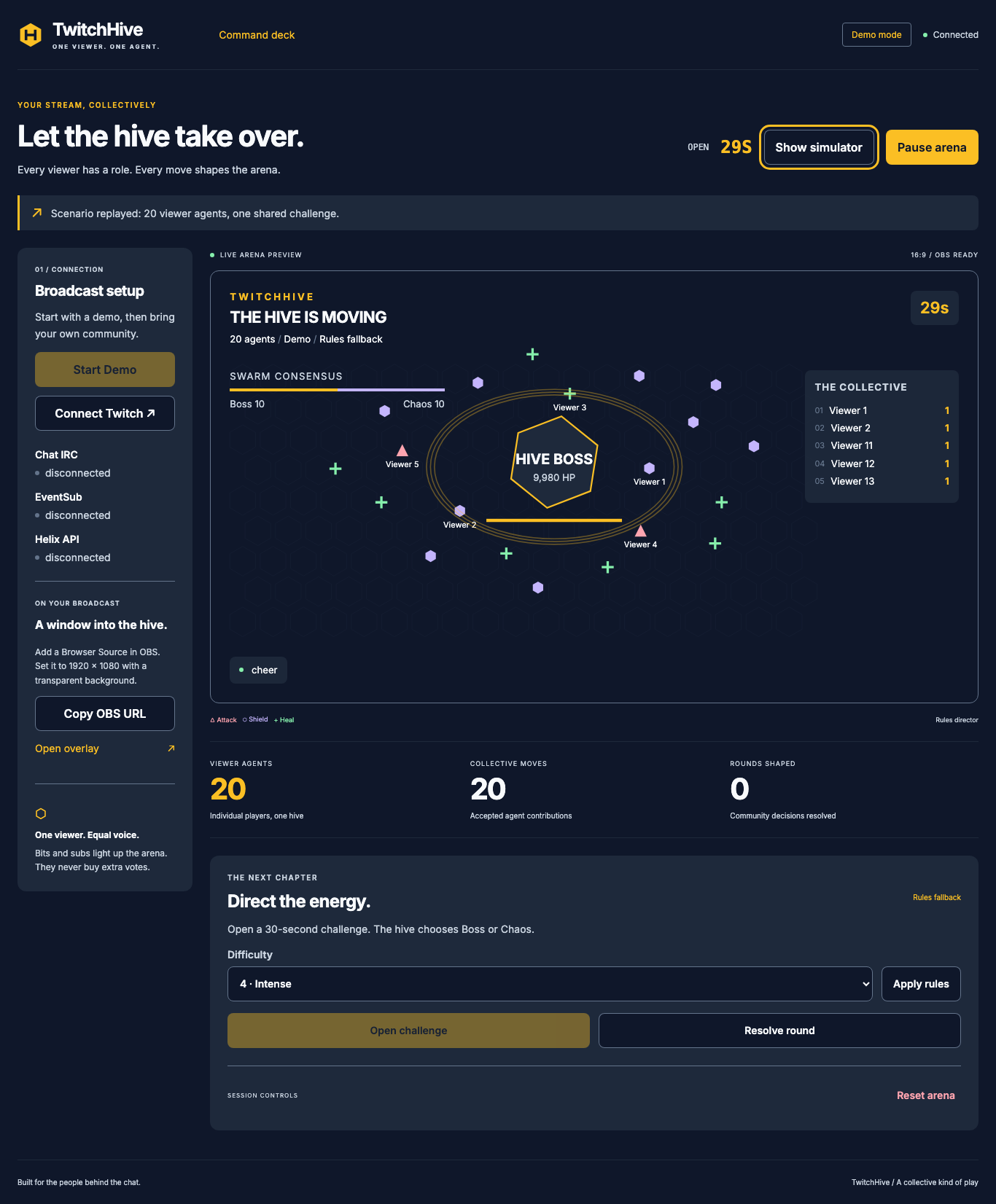
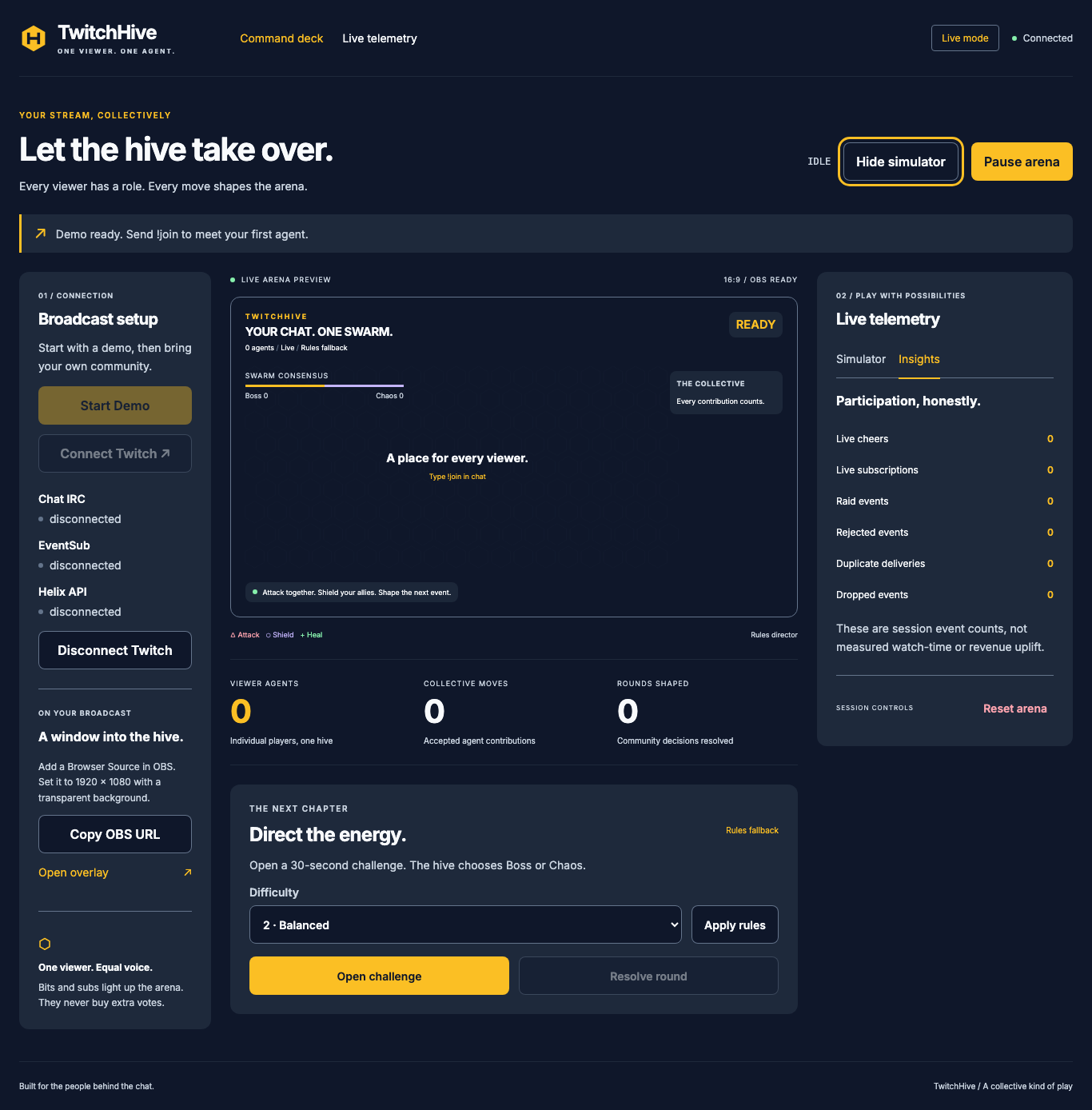
The streamer controls difficulty, challenges, pause/resume and reset from /dashboard. A read-only /overlay is designed for an OBS Browser Source at 1920×1080, with transparency and a legible HUD. The dashboard previews the same authoritative server state that the overlay receives.
The streamer controls difficulty, challenges, pause/resume and reset from /dashboard. A read-only /overlay is designed for an OBS Browser Source at 1920×1080, with transparency and a legible HUD. The dashboard previews the same authoritative server state that the overlay receives. Hide simulator switches to a two-column desktop Broadcast View; Show simulator restores the panel. Both support keyboard activation and announce expanded state. Reset remains available while hidden with a confirmation dialog and restored focus. Live mode selects Insights / Live telemetry automatically. Fresh E2E covers real-backend reset while hidden and a fixture-based Live transition; this does not replace real Twitch or OBS verification.
Judges can use a clearly labeled Demo immediately. The simulator sends joins, actions, votes, subs, raids and cheers through the same normalized-event/reducer pipeline as live adapters. Seeded replay makes the story repeatable. A bounded 500-agent audience load lets the renderer and transport be inspected under pressure. None of those simulated events causes a real donation, subscription, raid or Twitch chat write.
Codex was the engineering collaborator across specification, implementation, verification and review. The local Studio Harness commands supplied the workflow; they are Markdown instructions consumed in the Codex session, not additional OpenAI API endpoints.
- Context and architecture. Codex read
HACKATHON_BRIEF.mdand the approved.antigravity/IDEA_APPROVAL.json, then useddesign-init.md,spec.mdand the harness SPEC template to produce DESIGN.md, SPEC.md and AC-1 through AC-8. It corrected the older Extension description to match the approved Chat/EventSub/OBS direction. Commitb98714ecaptures that specification work. - Context and architecture. Codex read the approved
HACKATHON_BRIEF.md, then useddesign-init.md,spec.mdand the harness SPEC template to produce DESIGN.md, SPEC.md and AC-1 through AC-8. It corrected the older Extension description to match the approved Chat/EventSub/OBS direction. Commitb98714ecaptures that specification work. - Backend implementation. Following
build.md, Codex wrote failing unit/integration checks, implemented the authoritative arena and independent viewer agents, and integrated actual tmi.js, Helix, EventSub, HTTP/ws and constrained Director behavior. Tests use local HTTP and WebSocket fixtures instead of spending Bits, creating real subscriptions or making paid model calls. Backend commits6061ae4,54206b8ande5eb624separate the core, Twitch integration and transport/simulator work. - Frontend and browser verification. Codex implemented the React command deck and transparent Canvas overlay against the real backend, wrote reusable Playwright E2E files, inspected screenshots and browser console/page errors, and exercised keyboard/mobile and reconnect behavior. A five-minute browser benchmark records actual wall-clock frame/paint timings rather than treating the earlier fake-clock reducer test as rendering evidence.
- Review and handoff. Codex used
validate.md,cto.md, the VALIDATION template and command-report schema to map criteria to real logs, review architecture/security/scale/scope/business tradeoffs, update AGENTS.md and assemble this submission narrative. Missing external evidence is left blocked rather than fabricated. Final submitter checklist: public repository accessible; fresh-clone instructions work; real video <3 minutes uploaded; authentic Codex Session ID entered; project description copied; live/OBS evidence reviewed against VALIDATION.md. This file is prepared content, not proof that the Devpost form has been submitted.
Built With
- html5
- node.js
- obs-studio
- openai-codex
- react
- tmi.js
- twitch
- twitch-eventsub
- typescript
- websockets


Log in or sign up for Devpost to join the conversation.