-
-
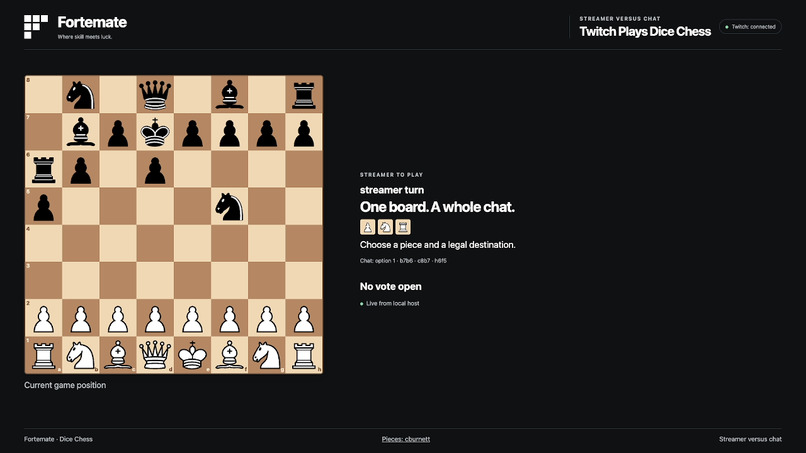
The streamer rolls three dice and chooses a complete legal turn.
-
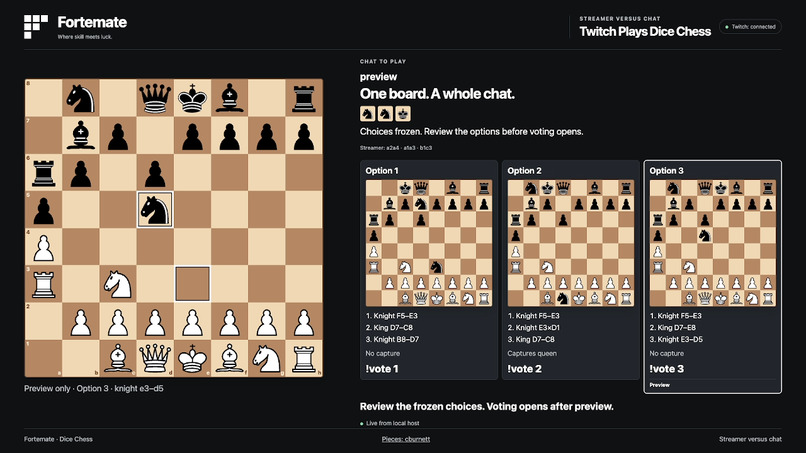
Three complete plans with final-position boards and an animated preview.
-
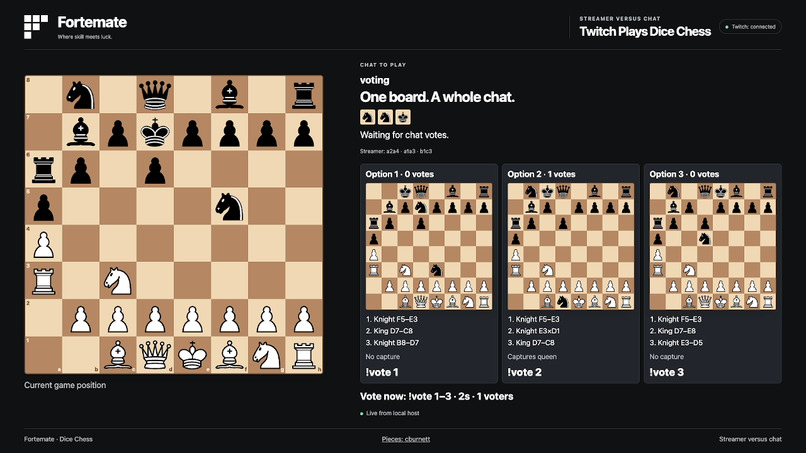
A real Twitch vote gives option 2 a 0-1-0 lead in this single-account rehearsal.
-
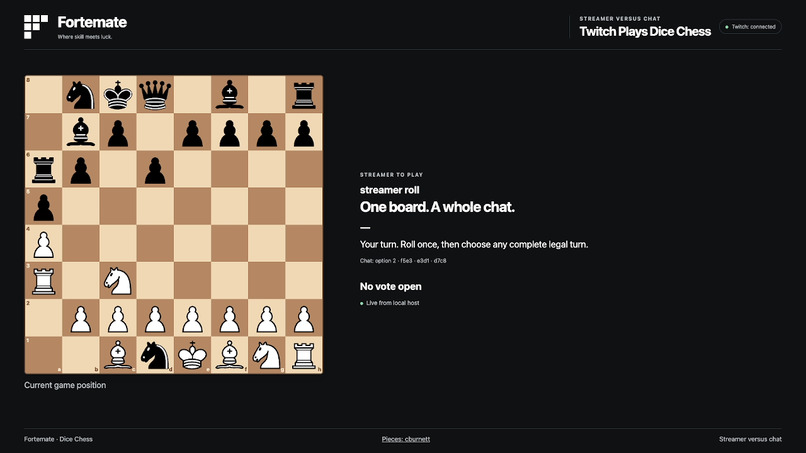
The selected plan captures the queen, then returns control to the streamer.
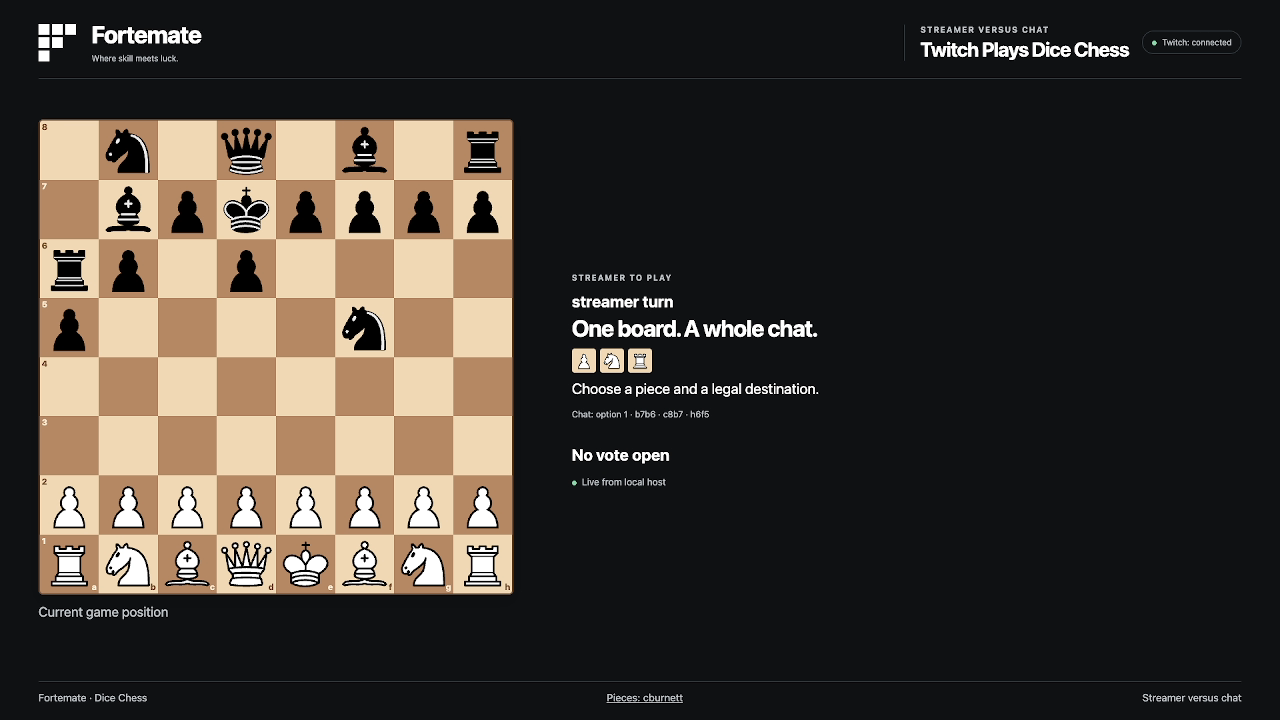
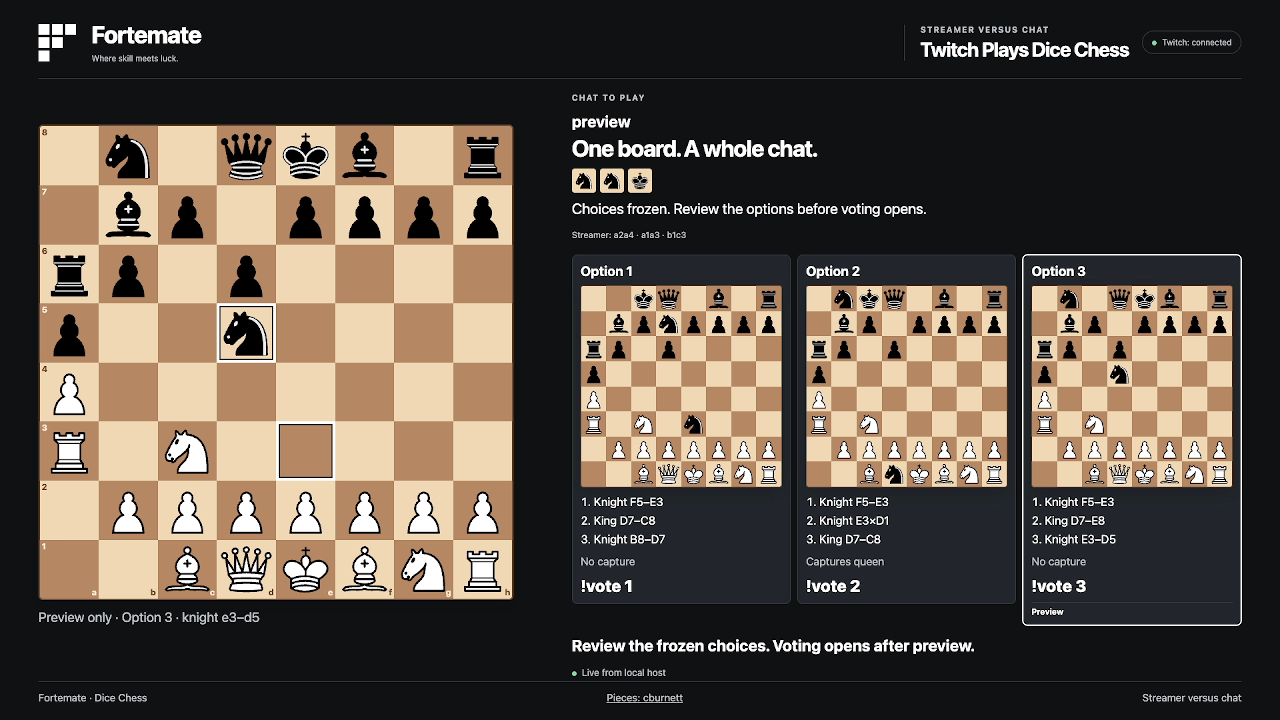
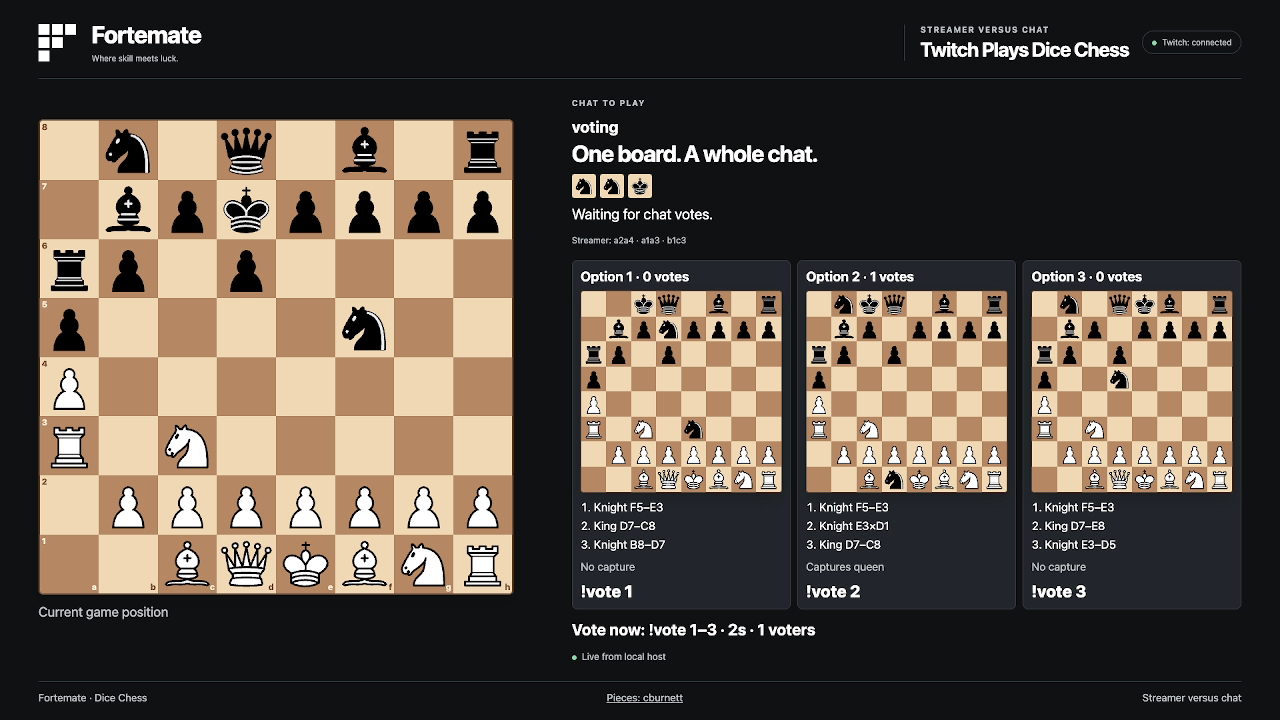
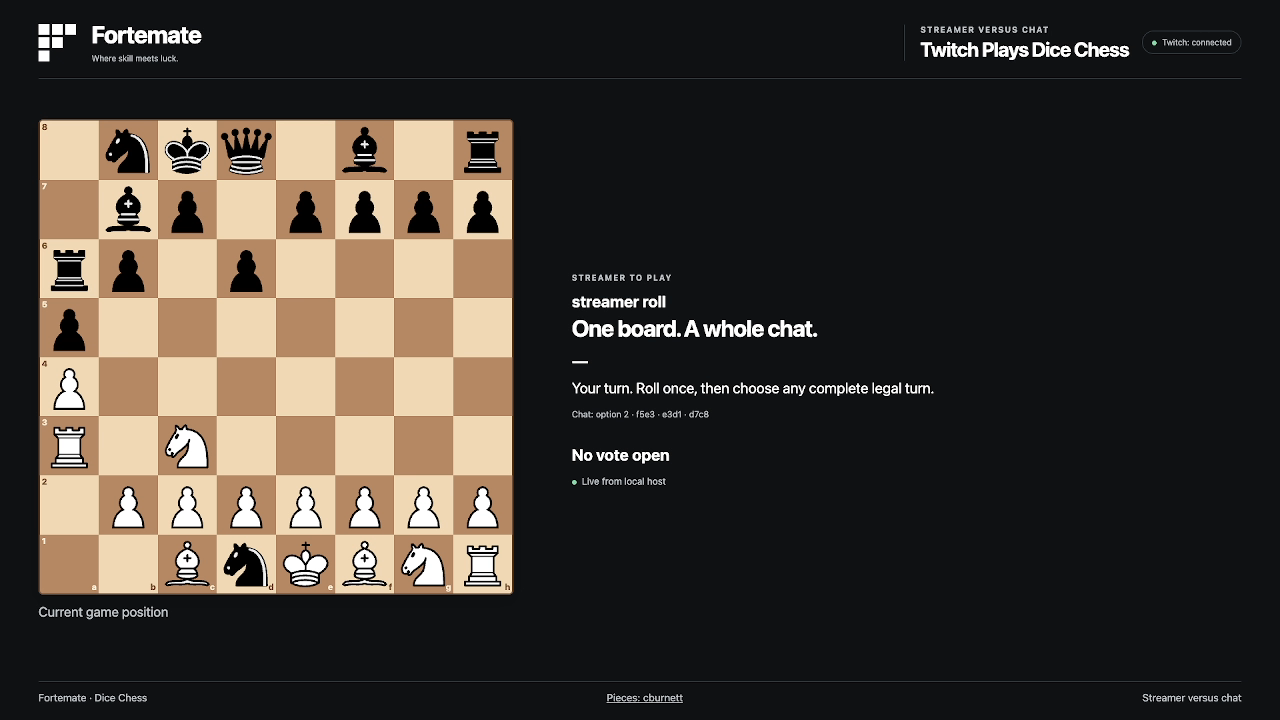
One streamer. One chat. Three complete plans.
Twitch Plays Dice Chess turns chat into the streamer's opponent. In the demo, a real Twitch vote selects a plan that sends a knight across the board and captures the streamer's queen. The host executes the whole plan, then hands the board back to the streamer.
Dice Chess uses familiar pieces, but dice specify which piece types can move. One turn can contain several moves; capturing the opposing king wins. The streamer chooses legal moves freely. Chat chooses between up to three complete plans from the same roll.
Why complete plans?
Voting on the first move of a multi-move turn hides what happens next. Counting free-form suggestions also makes it hard for a viewer to know what the group is actually choosing.
Each option therefore shows its final-position board, numbered move list and capture summary. Animated previews play the alternatives and restore the original board before voting opens. Viewers can compare consequences without entering chess notation. The design goal is a decision that is easy to follow and fun to watch; audience engagement has not yet been measured.
What streamers and viewers do
The streamer runs the local application, connects their Twitch channel and adds
a read-only browser scene to OBS. Viewers vote in the actual channel with
!vote 1, !vote 2 or !vote 3. Each viewer gets one equal vote and can
change it until the deadline. The winning complete turn plays automatically.
No votes means an explicit operator extension, not an invented audience choice. A roll with no legal action passes visibly. One retained meaningful plan plays automatically after preview; the application never pads the ballot with fake alternatives. This is a local streaming application, not a Twitch Extension.
How I built it with Codex
I directed product scope, reviewed the results and tested the broadcaster workflow. In the primary Codex chat, we built the candidate adapter, session host, Twitch authorization/EventSub transport, vote collection, previews, OBS scene and durable recovery.
The difficult parts were preserving complete-turn legality, deduplicating resulting rule states instead of reordered move lists, and keeping one host in charge of timers and execution. Real rehearsal also exposed connection timing and operator-control issues. Codex helped trace chat events, fix those paths and run the checks. The video includes genuine later Codex review/test work, rather than a recreated implementation scene.
Codex is the development tool. Gameplay does not call an LLM or require an OpenAI API key.
Implementation and existing foundation
TypeScript on Node.js owns the board, frozen roll, candidates, preview cursor,
voting deadline and execution. Workers use the existing public
@fortemate/dicechess-engine 0.14.9 for rules and search. That engine is not
claimed as new hackathon work; this application's Twitch interaction,
presentation and session orchestration were built during the event.
Twitch public-client device authorization and an EventSub WebSocket subscription
to channel.chat.message supply actual chat. Access is chat-read only. OAuth
material stays in host memory, outside broadcast snapshots and saved games. OBS
receives a separate read-only scene. Restart restores saved play paused;
interrupted polls discard partial votes and require explicit resumption.
Source is AGPL-3.0-only. The cburnett SVG pieces retain GPL-3.0-or-later notices; Fortemate branding has a separate bundled notice. Provenance is documented in the public repository.
Try it and check the evidence
Watch the English 2:39 demo, then follow the
public repository's run guide.
The demonstrated application revision is
d055ab79248536fd2be01b05e4973c6b2011f5cc. Use Node.js 24.22.1 and npm 11.19.1.
Local play and previews need no Twitch credentials; connecting your own channel
requires registering a public Twitch application and personally approving
read-only access. No private packages or models are required.
A clean public clone passed 80 Node tests, 14 Chromium scenarios and two complete games with real engine workers and fixture Twitch traffic. Real rehearsal separately verified broadcaster authorization, incoming chat, an accepted vote, automatic complete-turn execution and OBS output in Twitch playback. In the demo, option 2 wins 0–1–0: the knight moves f5–e3–d1, capturing the queen, and the king moves d7–c8.
Limits and next steps
Live evidence is a single-account rehearsal, not independent multi-viewer play. Fixture tests cover vote changes, duplicate delivery, deadlines and recovery; broader real-service failure tests, load and community impact remain unverified. Candidate search is bounded and does not promise the globally best three plans. Stream delay varies and late untagged commands cannot identify an earlier intended round. The application supports one local game/channel; hosted multi-channel service and click-to-vote Extensions are future work.
Built With
- eventsub
- node.js
- obs-studio
- openai-codex
- playwright
- twitch
- typescript
