-
-
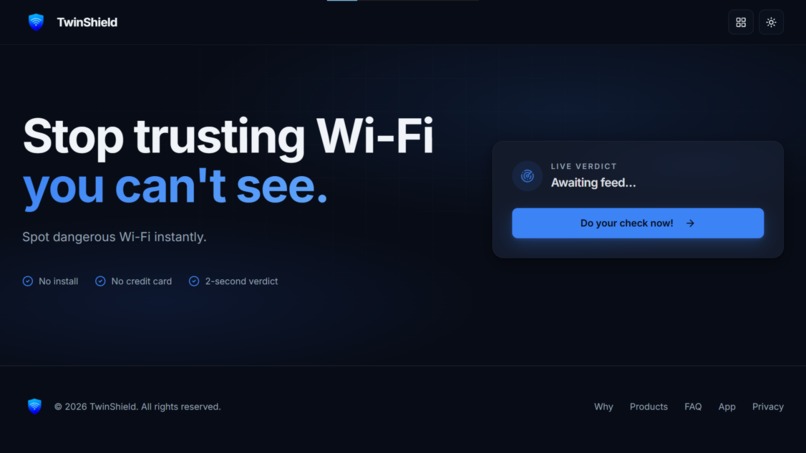
This is the first landing page
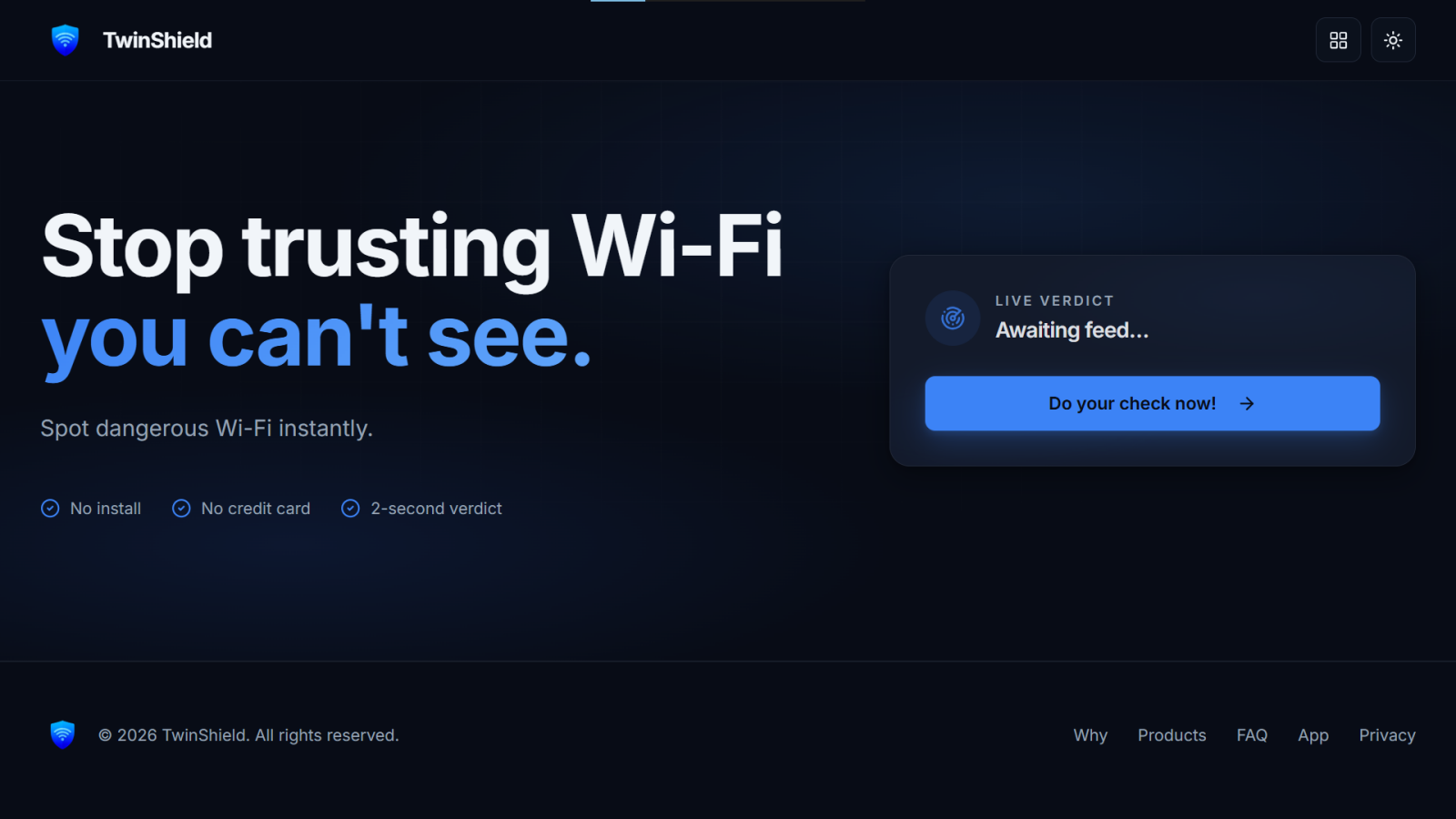
Inspiration
The inspiration for Twin Shield came from a moment of shared irony. As Computer Science majors, we spend our lives studying security protocols and encryption, yet the second we see a "Free Public Wi-Fi" sign in a café, our survival instincts are replaced by the need for high-speed data. We realized that if we are tempted by these "Evil Twin" networks, the average user doesn't stand a chance. We wanted to build a digital bodyguard that does the "thinking" for you, so you never have to guess if a network is a gateway or a trap.
What it does
Twin Shield is an AI-powered network guardian that sits between your device and the public internet. The moment you connect to a new network, the app captures critical metadata like SSID, BSSID, and Gateway behavior. It sends this "fingerprint" to an intelligent agent that compares it against a database of known safe networks and analyzes the network's behavior for anomalies. If the network tries to "Evil Twin" a legitimate spot or asks for suspicious information through a captive portal, Twin Shield triggers an immediate full-screen lockdown, protecting the user from data exfiltration.
How we built it
We utilized a modern, rapid-deployment stack to ensure the verdict is delivered in near real-time: Frontend: Built with Lovable to create a highly responsive, mobile-first interface. Logic Engine: We used n8n to orchestrate the AI agents. When a connection is made, a webhook triggers a workflow that performs a multi-step security check. The Brain: We integrated gemma4b, gemma12b within the n8n agent to analyze captive portal HTML for phishing patterns. The python script that sandboxes the connection.
Challenges we ran into
Our biggest hurdle was sandboxing the connection. We needed to analyze what a malicious Wi-Fi network was doing without actually exposing our laptop or phone to the attack. Creating an isolated environment that could "peek" at the network traffic and captive portal data while keeping the rest of the OS safe was a complex architectural puzzle. We also had to optimize the latency between the network connection and the AI's verdict; nobody wants to wait 30 seconds for a "Safe" pop-up.
Accomplishments that we're proud of
We are incredibly proud of the seamless "handshake" between the local device and the n8n agent. Achieving a security verdict in under two seconds feels like magic. We also successfully implemented a "Vibe-Check" for captive portals, where the AI can distinguish between a standard hotel login and a phishing page asking for excessive personal details.
What we learned
This project was a deep dive into the "Zero-Trust" philosophy. We learned that network security isn't just about encryption (HTTPS isn't enough if you're being redirected at the DNS level). We also gained significant experience in building agentic workflows, moving beyond simple "If/Then" logic into actual autonomous reasoning for cybersecurity.
What's next for Twin Shield
The future of Twin Shield is Total Autonomy. Offline Analysis: Our main goal is to move the AI models onto the device using Edge AI, allowing the app to run completely offline without needing to call an n8n webhook. Active Defense Swarm: We envision a decentralized network where every Twin Shield user acts as a "sensor," instantly updating a global database of malicious hotspots to protect other users in the vicinity. Automatic Disconnect: Moving beyond pop-up warnings to actually severing the hardware connection the moment a MITM (Man-in-the-Middle) attack is detected.
Built With
- agent
- ai
- loveble
- n8n
- ollama
- python
- virustotal


Log in or sign up for Devpost to join the conversation.