Project Story
Inspiration
Modern organizations generate an enormous amount of knowledge every day through meetings, decisions, projects, reviews, and conversations. Yet most of this knowledge becomes fragmented across documents, chats, project tools, and individual employees.
As teams grow, finding the right expert becomes difficult, understanding past decisions becomes slow, and organizational knowledge is often lost when people switch teams or leave the company.
We wanted to explore a simple question:
What if every employee had an AI-powered Digital Twin that could represent their expertise, communicate with other agents, preserve organizational memory, and coordinate work across teams?
This idea evolved into TwinOS, built on top of the AICOO (AI Chief Operating Officer) philosophy.
Instead of AI acting as a chatbot that waits for instructions, AICOO acts as an operational intelligence layer that understands people, projects, context, and workflows, helping organizations coordinate work more effectively while keeping humans in control.
How We Built TwinOS
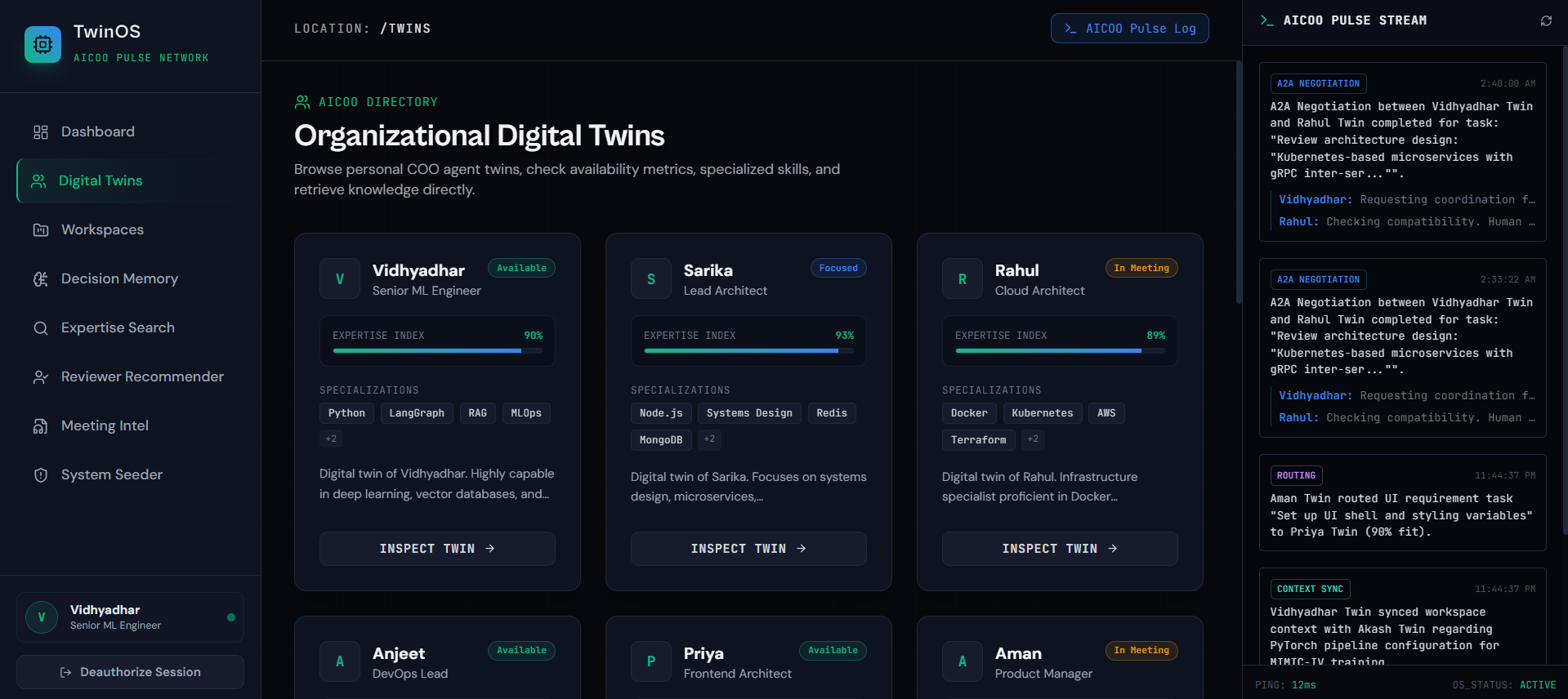
TwinOS creates a unique Digital Twin for every employee in the organization.
Each Digital Twin maintains its own identity, including:
- Skills and technical expertise
- Project involvement
- Collaboration preferences
- Availability information
- Historical decisions
- Organizational relationships
This allows every person to be represented by an AI agent that understands their role and context.
The system was built using:
- React + TypeScript + Tailwind CSS for the frontend
- Node.js + Express for backend services
- MongoDB Atlas for organizational memory storage
- Gemini for semantic reasoning and intelligence
- AICOO Pulse Protocol for agent coordination and routing
How AICOO Powers Coordination
1. Agent Identity
Every employee receives a dedicated Digital Twin with its own expertise profile, project history, and organizational context.
Instead of treating users as simple records in a database, AICOO treats them as active participants represented through intelligent agents.
This creates persistent identities that can reason about work and collaborate with other agents.
2. Agent-to-Agent Communication
Digital Twins can communicate with one another through the AICOO coordination layer.
For example:
- A reviewer recommendation agent can communicate with multiple employee twins.
- Project agents can request expertise from specialist agents.
- Organizational memory agents can provide historical context to decision-making agents.
This creates a network of cooperating agents rather than isolated AI assistants.
3. Intelligent Request Routing
One of the core challenges inside organizations is routing requests to the correct person.
When a user asks:
"Who should review our Kubernetes infrastructure?"
AICOO evaluates:
- Skills
- Past experience
- Current workload
- Availability
- Project relevance
The request is then routed to the most suitable Digital Twins, producing ranked recommendations with explanations.
Instead of manually searching through an organization, expertise becomes instantly discoverable.
4. Context Preservation and Reuse
Organizations lose valuable knowledge because context is rarely stored in a reusable format.
TwinOS continuously builds an Organizational Memory by storing:
- Project decisions
- Meeting summaries
- Reviewer assignments
- Workspace activity
- Team relationships
When someone asks:
"Why did we reject Redis?"
the system retrieves historical context and provides the reasoning behind the decision.
This ensures that important organizational knowledge remains accessible long after the original discussion took place.
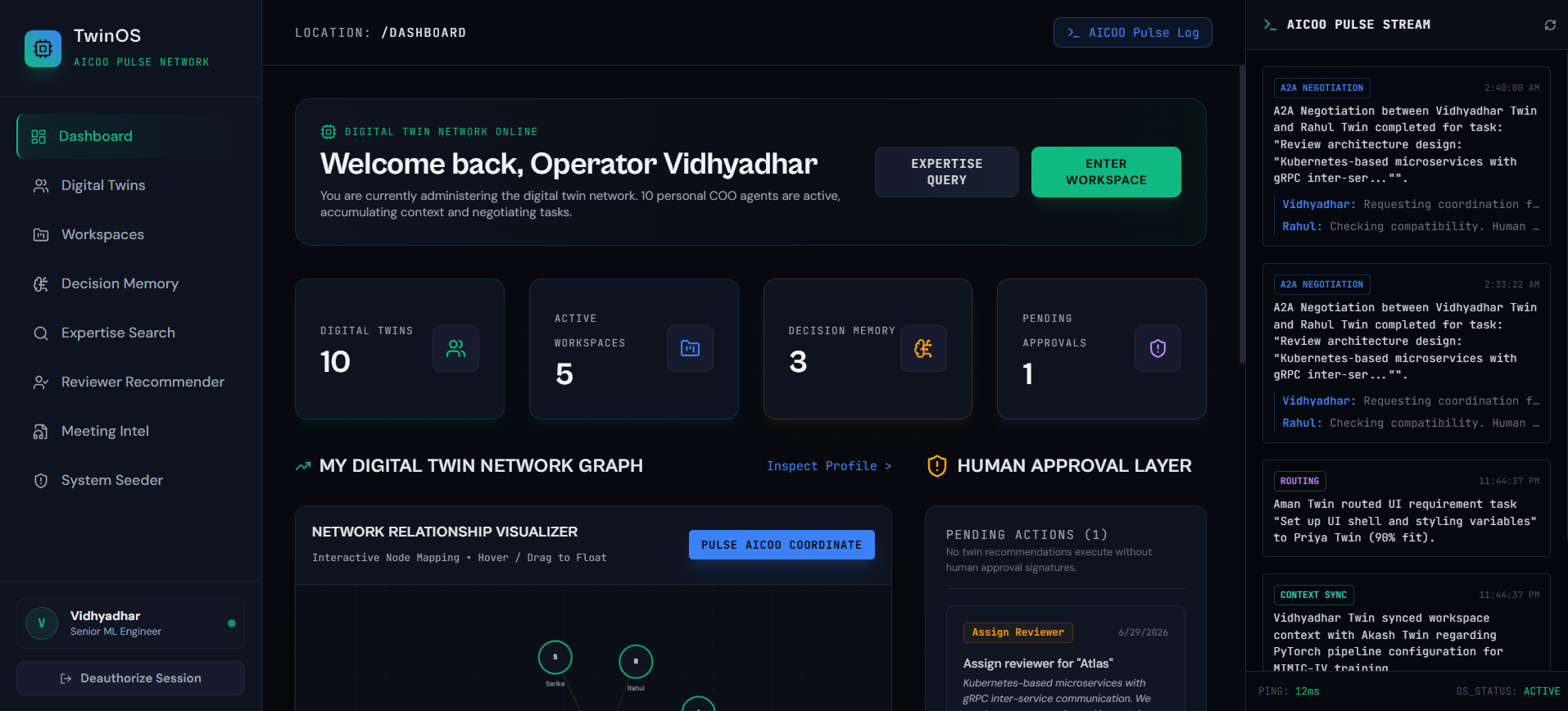
5. Human + AI COO Collaboration
AICOO is not designed to replace human decision-making.
Instead, it functions as an AI Chief Operating Officer that assists people throughout workflows.
The AI can:
- Recommend reviewers
- Discover experts
- Retrieve organizational knowledge
- Coordinate task routing
- Suggest actions
Humans remain responsible for approvals and final decisions.
This creates a Human-in-the-Loop workflow where AI improves coordination while preserving accountability.
6. Cross-Team Coordination
The strongest capability of TwinOS is cross-team coordination.
AICOO enables:
- People-to-People coordination
- Agent-to-Agent coordination
- Team-to-Team coordination
- Human-to-Agent collaboration
A frontend engineer can discover a backend specialist.
A project team can locate domain experts from another department.
A reviewer recommendation can span multiple teams.
An organizational memory query can access knowledge created by entirely different groups.
By connecting people, projects, agents, and knowledge through a shared coordination layer, TwinOS transforms fragmented organizational information into an intelligent operational network.
Challenges We Faced
The biggest challenge was designing a system that goes beyond a traditional chatbot.
We needed a framework where:
- Every agent maintains its own identity.
- Organizational context remains persistent.
- Requests can be routed intelligently.
- Agents can coordinate across users and teams.
- Human approval remains central to important actions.
Balancing autonomy and human oversight was particularly important.
We wanted AI to actively assist coordination while ensuring that significant decisions always require human approval.
Another challenge was building a meaningful organizational memory system capable of storing and retrieving context across projects, people, and time.
What We Learned
Building TwinOS taught us that the future of enterprise AI is not a single assistant serving one user.
The real opportunity lies in creating networks of specialized agents that represent people, preserve context, coordinate work, and collaborate across teams.
Through AICOO, we explored how AI can function as an operational layer for organizations, helping people find expertise, understand decisions, reuse knowledge, and move work forward together.
TwinOS is our vision for how organizations can scale knowledge, coordination, and collaboration without losing context.

Log in or sign up for Devpost to join the conversation.