-
-
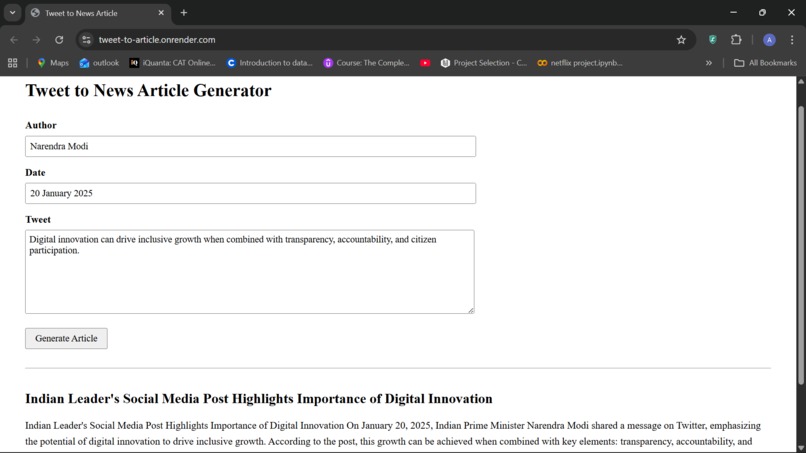
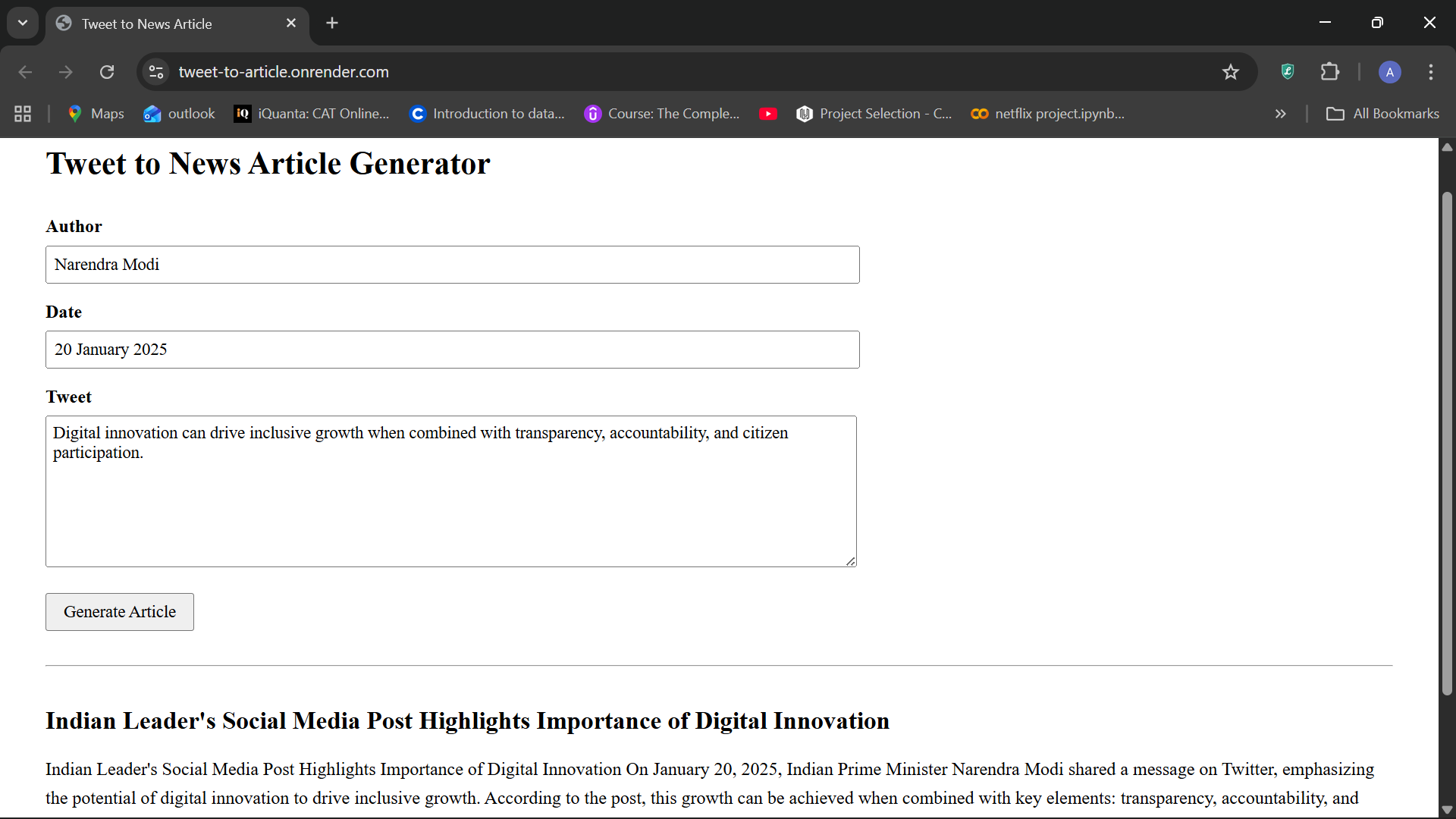
Web interface showing a tweet being converted into a neutral, newspaper-style article with a headline, article body, and disclaimer.
Inspiration
Public figures across the world increasingly communicate important messages through short social media posts. While these platforms allow instant global reach, the brevity of tweets often leads to confusion, misinterpretation, or lack of context—especially for international audiences. This project was inspired by the need for clearer, more responsible ways to interpret and share such public communication across borders.
What it does
Tweet-to-Article is a web application that converts public tweets into neutral, newspaper-style articles. Users can input a tweet along with the author and date, and the system generates a structured article with a clear headline, a concise explanation of the statement, and an ethical disclaimer. The goal is to improve readability and understanding while preserving the original meaning of the tweet.
How we built it
The project was built using a hybrid architecture. A rule-based analysis layer first extracts the core idea of the tweet to maintain factual grounding. This structured information is then passed to an AI language model, which rewrites the content into a neutral, journalistic format using constrained prompts to avoid adding new facts or opinions. The backend is implemented using Flask, while the frontend uses HTML, CSS, and JavaScript with a simple, newspaper-inspired design. The application is deployed on a cloud platform for live access.
Challenges we ran into
One of the main challenges was ensuring that the generated articles remained faithful to the original tweet without introducing assumptions or unverified information. Another challenge was handling sensitive or controversial content responsibly while maintaining a neutral tone. Balancing AI creativity with factual restraint required careful prompt design and the integration of rule-based logic.
Accomplishments that we're proud of
We are proud of building a fully functional, deployed application that demonstrates responsible AI usage. The hybrid approach successfully reduces hallucinations while improving clarity. The clean, minimal interface ensures readability and aligns with the project’s goal of ethical information presentation. Completing the project end-to-end as a working prototype is also a key achievement.
What we learned
Through this project, we learned how combining deterministic logic with AI models can lead to more reliable and interpretable outputs. We gained practical experience in prompt engineering, API integration, and deploying AI-powered web applications. Most importantly, we learned the importance of ethical considerations when working with public information and AI-generated content.
What's next for tweet-to-article
Future improvements include expanding support for multiple languages, incorporating source attribution, and enhancing context by linking related public statements. The system could also be extended to support other platforms beyond Twitter, further improving global accessibility and cross-border communication.

Log in or sign up for Devpost to join the conversation.