Inspiration
Twacha (त्वचा) is Hindi for skin. In India, skincare advice comes from three places: a cousin, an influencer, or a ₹1,000 dermatologist visit that many people put off. The result is a bathroom shelf of products bought on hype, often wrong for the skin type and the city. Humid Mumbai skin, dry Jaipur skin and Delhi-smog skin need different things. We wanted something that starts from what your skin actually shows, speaks your language, and respects a student's ₹500 a month as much as a ₹3,000 budget.
What it does
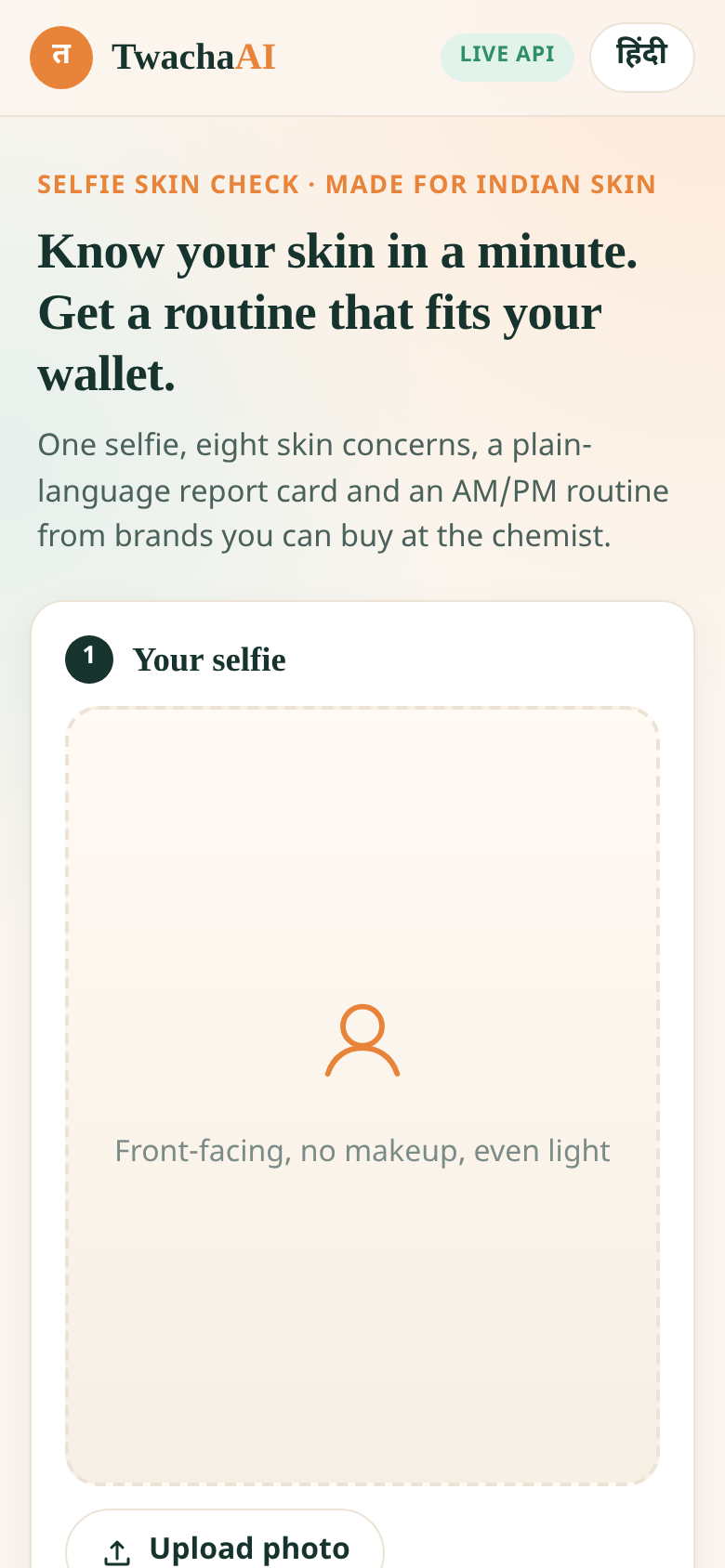
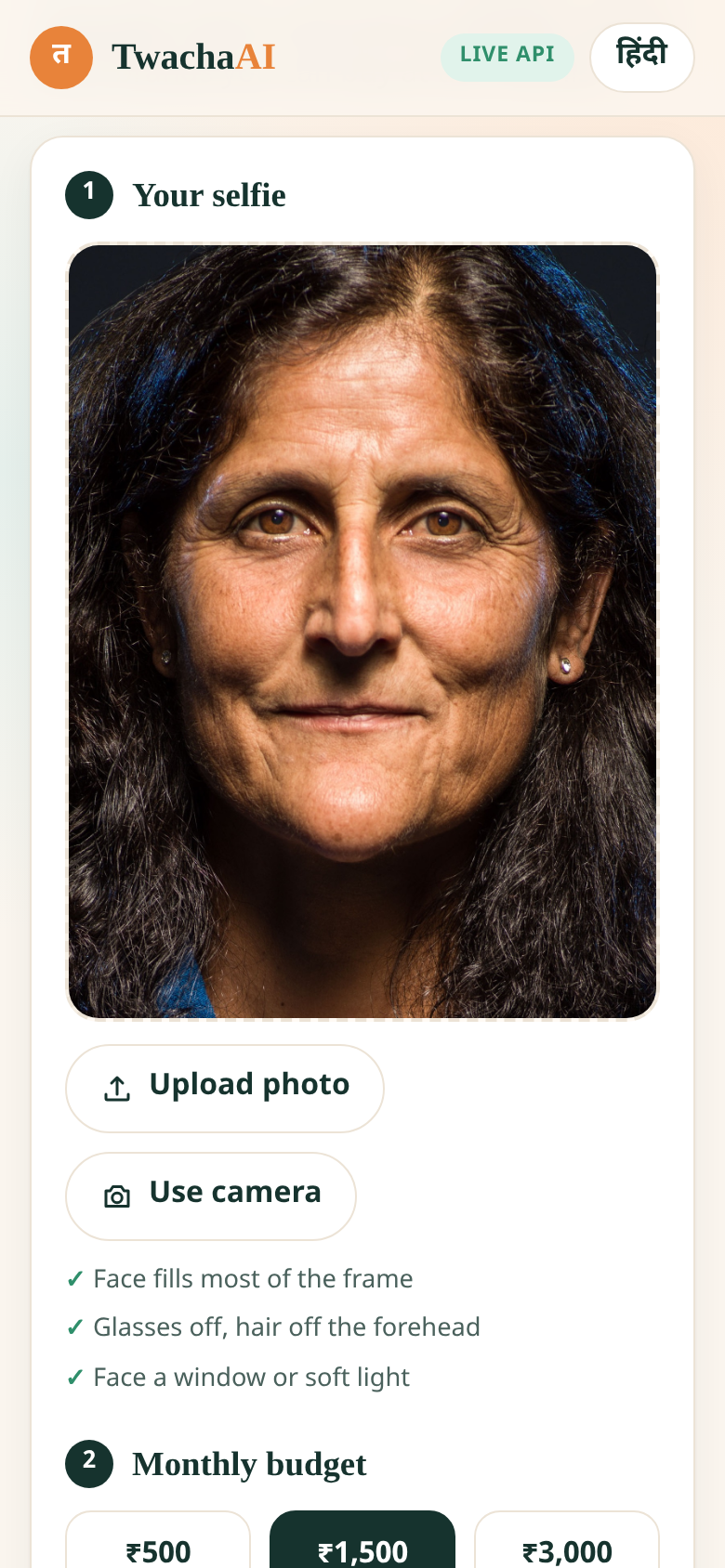
- You upload a selfie (or use the camera with a face guide), pick a monthly budget (₹500 / ₹1,500 / ₹3,000) and your climate (humid / dry / polluted metro).
- The YouCam Skin Analysis API scores 8 concerns: hydration, oil balance, acne, pores, redness, texture, dark circles and spots.
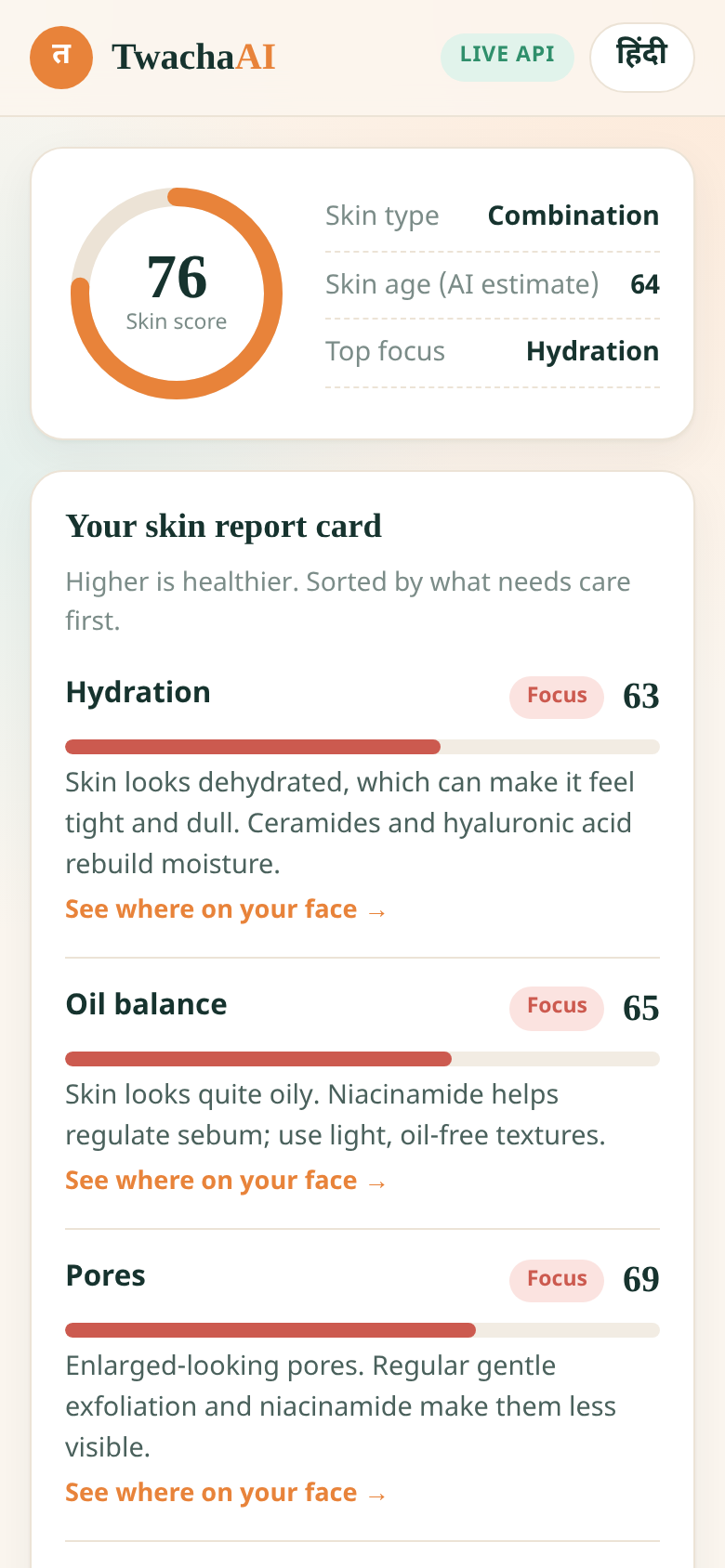
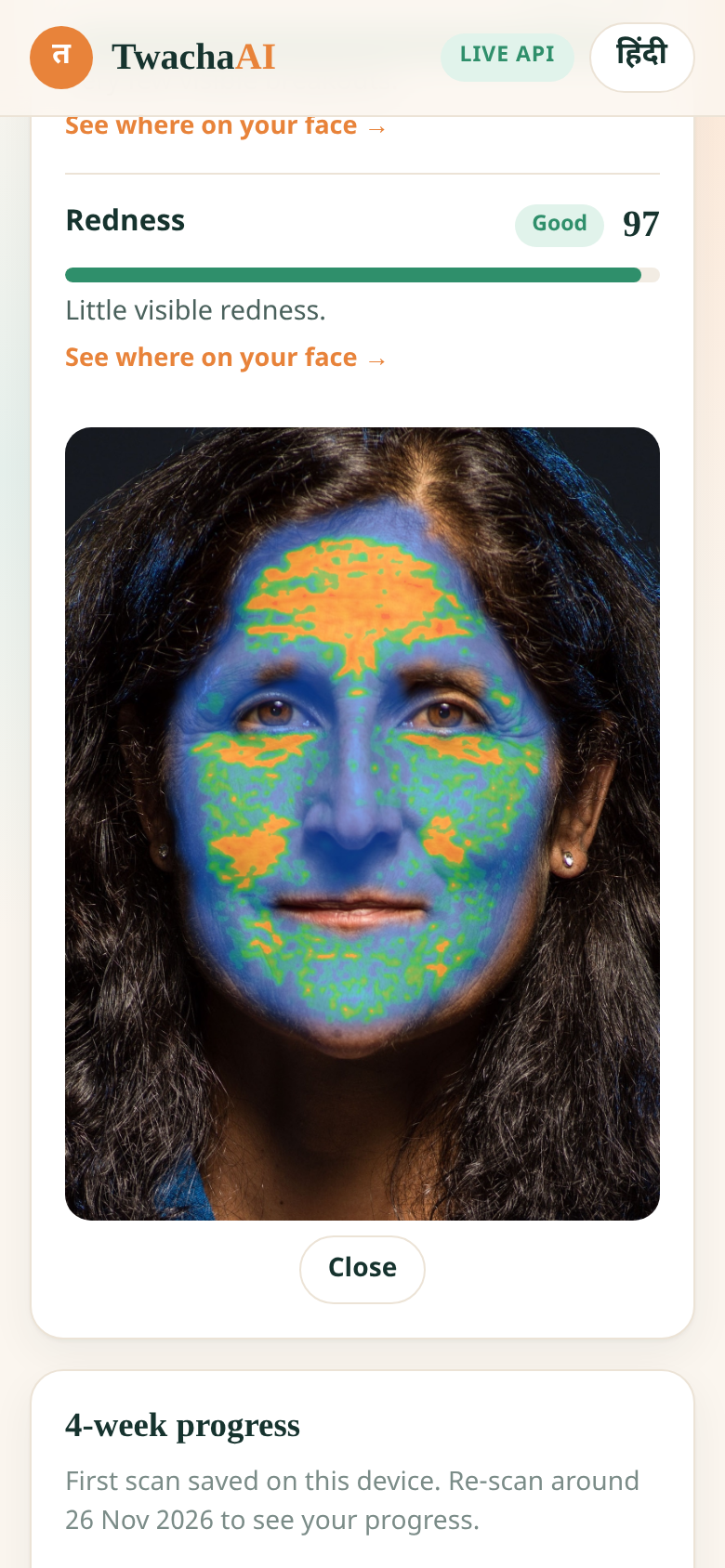
- You get a report card: each concern with a score, a Good / Watch / Focus level and a one-line explanation in English or Hindi. Tap a concern to see YouCam's overlay of where it shows on your face.
- A deterministic routine engine turns scores into an AM/PM routine by ingredient (salicylic acid for acne, niacinamide for oil and pores, vitamin C or alpha arbutin for spots, ceramides and hyaluronic acid for dryness), with sunscreen SPF 50 PA++++ every morning.
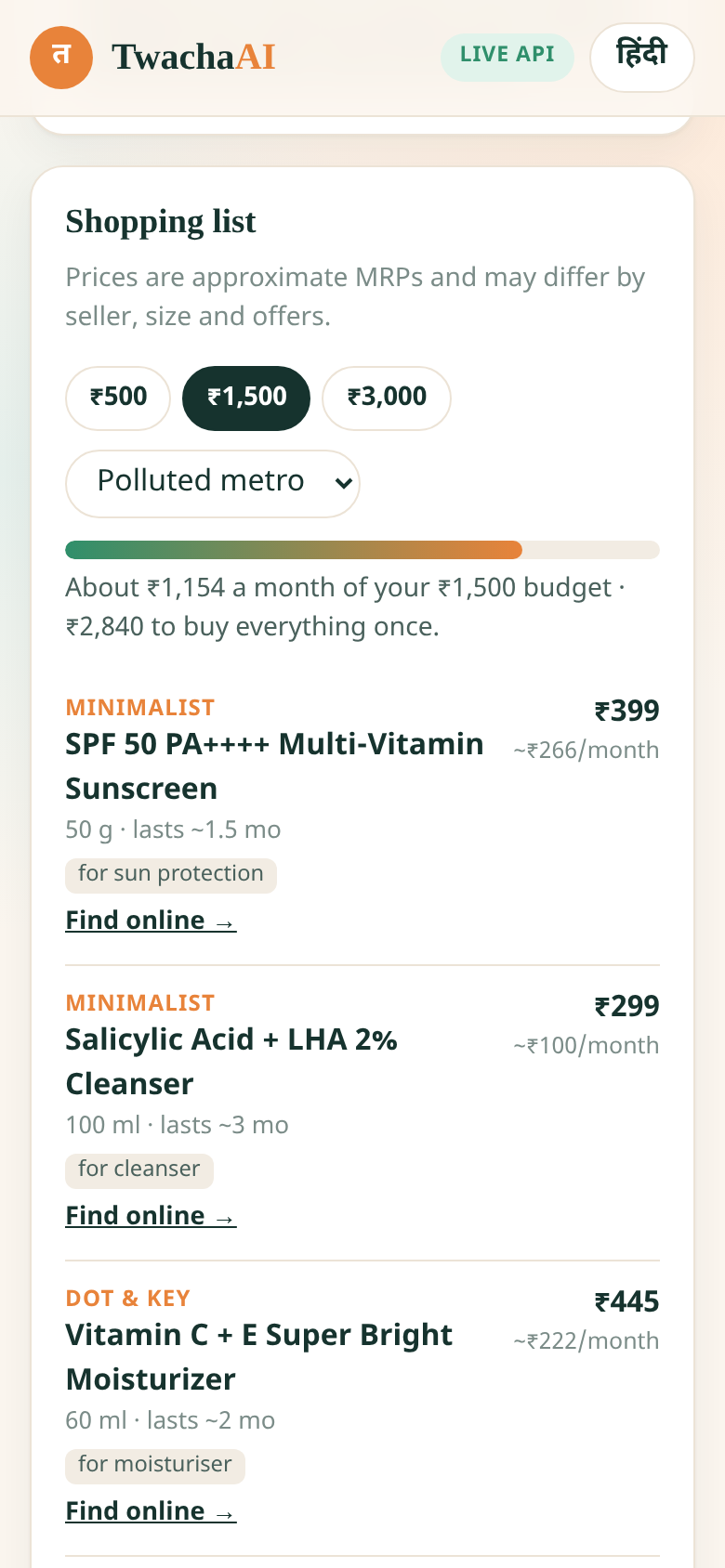
- It fills each step with real, widely sold Indian products (Minimalist, The Derma Co, Dot & Key, Cetaphil, Re'equil, Plum, Lakmé and more) and keeps the monthly cost under your budget. Whatever doesn't fit is shown as "add later". Switch budget or climate and the plan updates instantly.
- Re-scan in 4 weeks and see per-concern progress, stored privately on your device. One tap adds a calendar reminder.
- Clear safety copy throughout: it's a cosmetic check, not medical advice, and very low acne scores prompt a dermatologist visit.
How we built it
- Backend: FastAPI (Python 3.12). The YouCam V2 flow runs fully server-side so the API key never reaches the browser:
POST /s2s/v2.0/file→PUTthe bytes to the presigned URL with the returned headers →POST /s2s/v2.0/task/skin-analysiswithsrc_file_id,dst_actions,miniserver_args.enable_mask_overlayandformat: "json"→ pollGET /s2s/v2.0/task/skin-analysis/{task_id}. - Image prep: Pillow fixes EXIF rotation and downscales to ≤ 2560 px, then picks HD actions (
hd_moisture,hd_pore…) when the short side is ≥ 1080 px and SD actions (moisture,pore,dark_circle_v2…) otherwise. SD and HD are never mixed. - Score handling: we display YouCam's
ui_scoreand rank priorities onraw_score; region-aware HD results (pores by forehead / nose / cheek) are kept as detail. - Routine engine: pure Python rules with no LLM, so the same scores, budget and climate always give the same routine. It handles skin-type detection, sensitivity (skip acids when redness is high), climate nudges, actives that shouldn't share a night, and a per-budget cap on serums.
- Budget fitting: each product has an approximate MRP and how many months it lasts; essentials go in first at the cheapest suitable price, treatments are added by severity while the monthly total fits, and leftover budget upgrades the essentials to better-matched picks.
- Frontend: static HTML/CSS/JS with no build step, mobile-first, camera capture via
getUserMedia, an EN/हिंदी toggle andlocalStoragehistory. - Quality: a pytest suite covers the routine engine across every budget × climate × skin profile, the YouCam client with mocked HTTP (success, engine errors, 401, bad parameters, upload failure, timeout), the API endpoints, real captured YouCam responses, and a repo-hygiene check that
.envis never tracked.
Challenges we ran into
- Making ₹500 honest. A good SPF 50 PA++++ sunscreen alone costs about ₹270 a month when used generously. Instead of pretending a 6-step routine fits, the engine guarantees the three essentials and shows what to add when the budget allows.
- Two kinds of score.
ui_scoreis deliberately encouraging, whileraw_scoreis the model's direct prediction. In real responses a hydrationraw_scoreof 31 came back asui_score63. Showing one and prioritising on the other kept the UI kind without hiding real concerns. - HD vs SD. They can't be mixed and have different minimum resolutions, so the server picks one per photo after resizing.
- Hindi copy had to be plain and natural, not a literal translation of cosmetic jargon.
Accomplishments that we're proud of
- An end-to-end YouCam integration verified against the live API, with real HD and SD responses used as test fixtures.
- A routine engine that is explainable: every product says which concern it's for.
- A budget promise that is tested for every budget, climate and skin profile.
- A demo mode built on a real response, so judges can run it locally without a key (
pip install -r requirements.txt && uvicorn app.main:app).
What we learned
- YouCam's async task model (file → upload → task → poll) and its engine error codes, which map neatly to friendly retake tips ("move closer", "find better light").
- How region-level HD results (pores by forehead, nose, cheek) can make advice more specific.
- That a deterministic rules engine is easier to trust, test and explain than a generated routine.
What's next
- Live prices and stock from Indian retailers (Nykaa, Amazon, Tira) and affiliate checkout.
- YouCam Skin Simulation to preview what four weeks of the routine could look like.
- More Indian languages (Tamil, Bengali, Marathi) and voice explanations.
- Opt-in cloud sync for progress, and a "share with my dermatologist" PDF.
Built With
- css
- fastapi
- html
- httpx
- javascript
- pillow
- pytest
- python
- uvicorn
- youcam-api

Log in or sign up for Devpost to join the conversation.