-
-
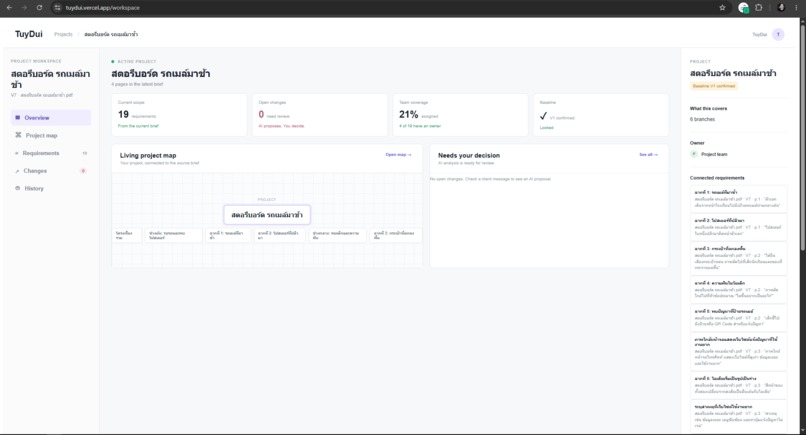
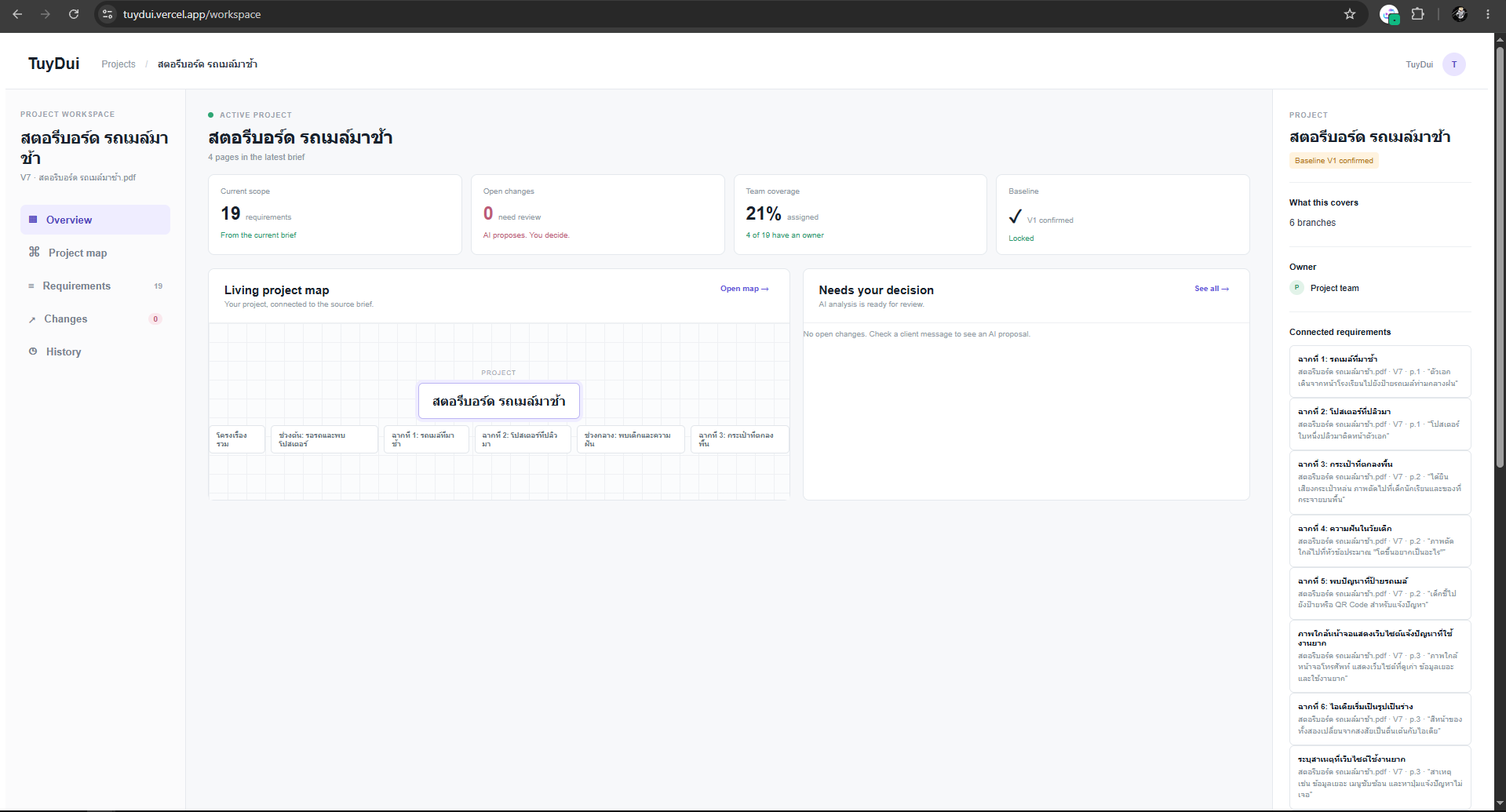
Current scope, baseline, team coverage, and linked requirements.
-
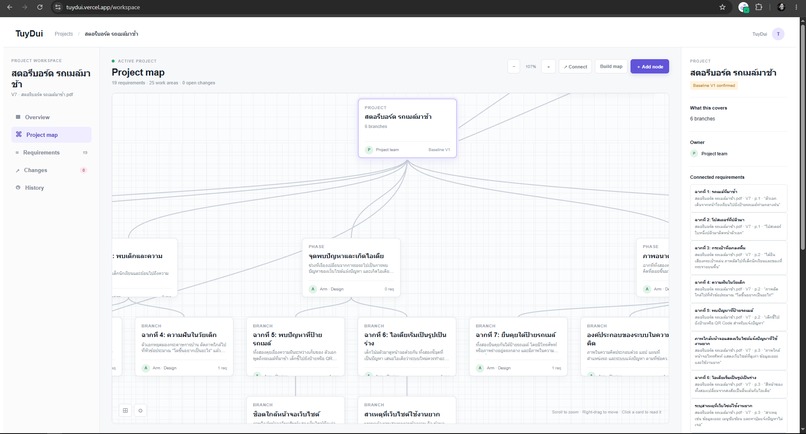
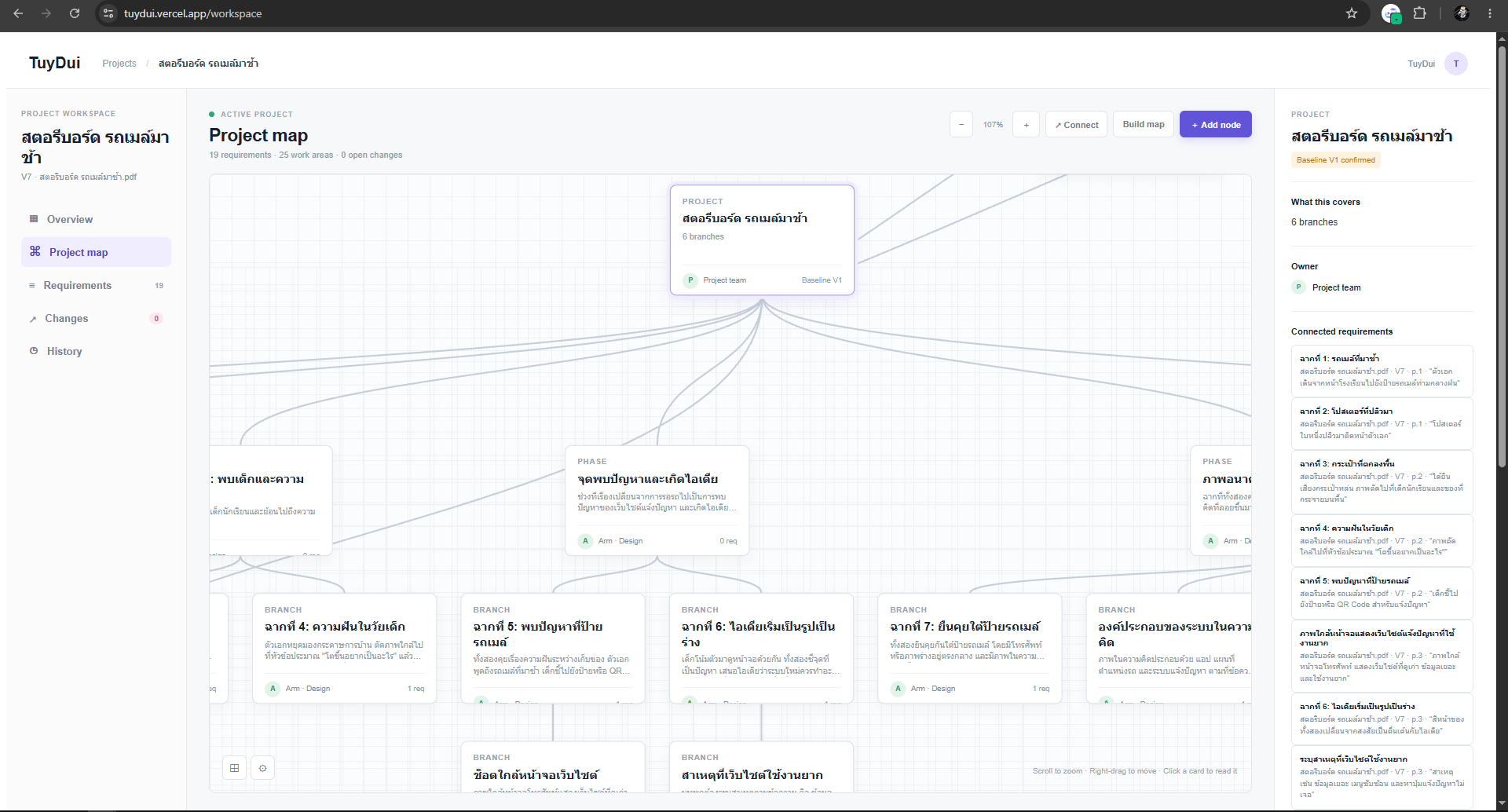
Visual map of work areas, requirements, and responsibilities.
-
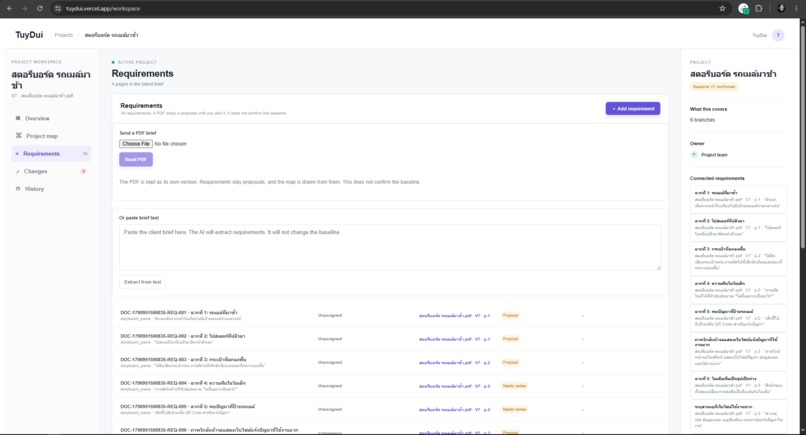
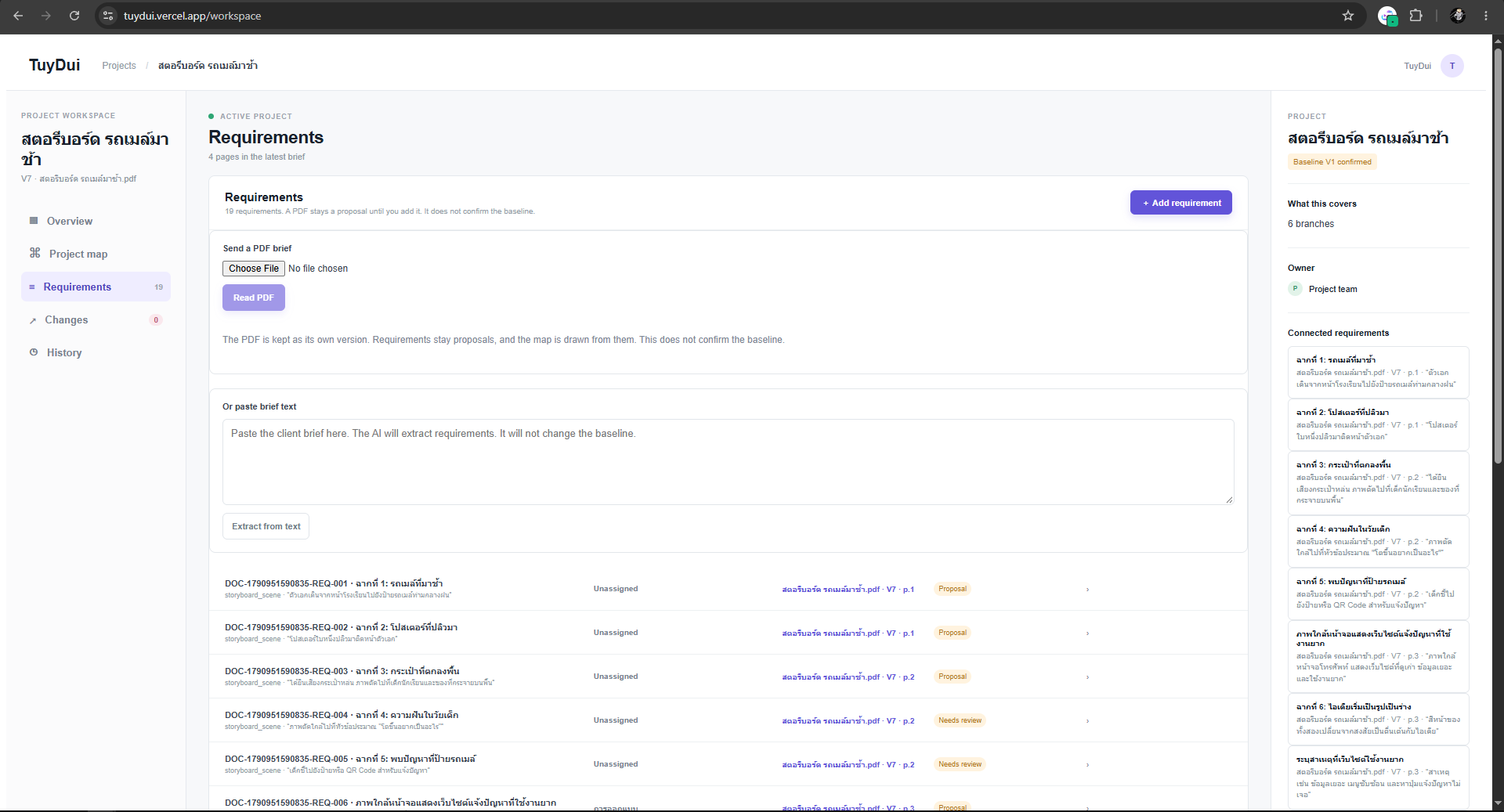
AI-extracted requirements with source references and review flags.
-
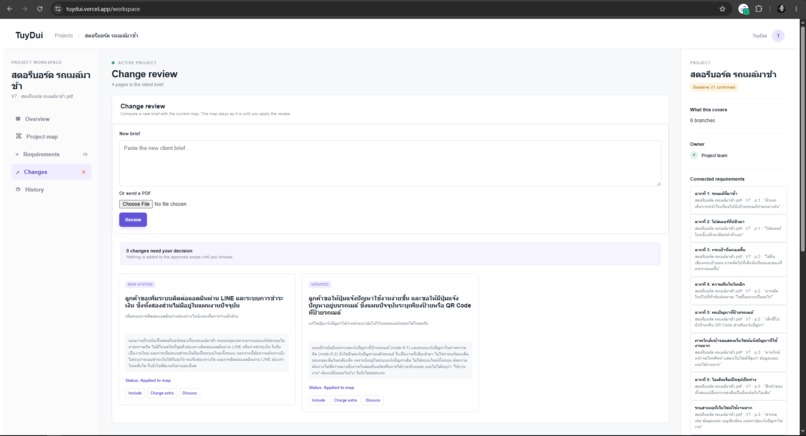
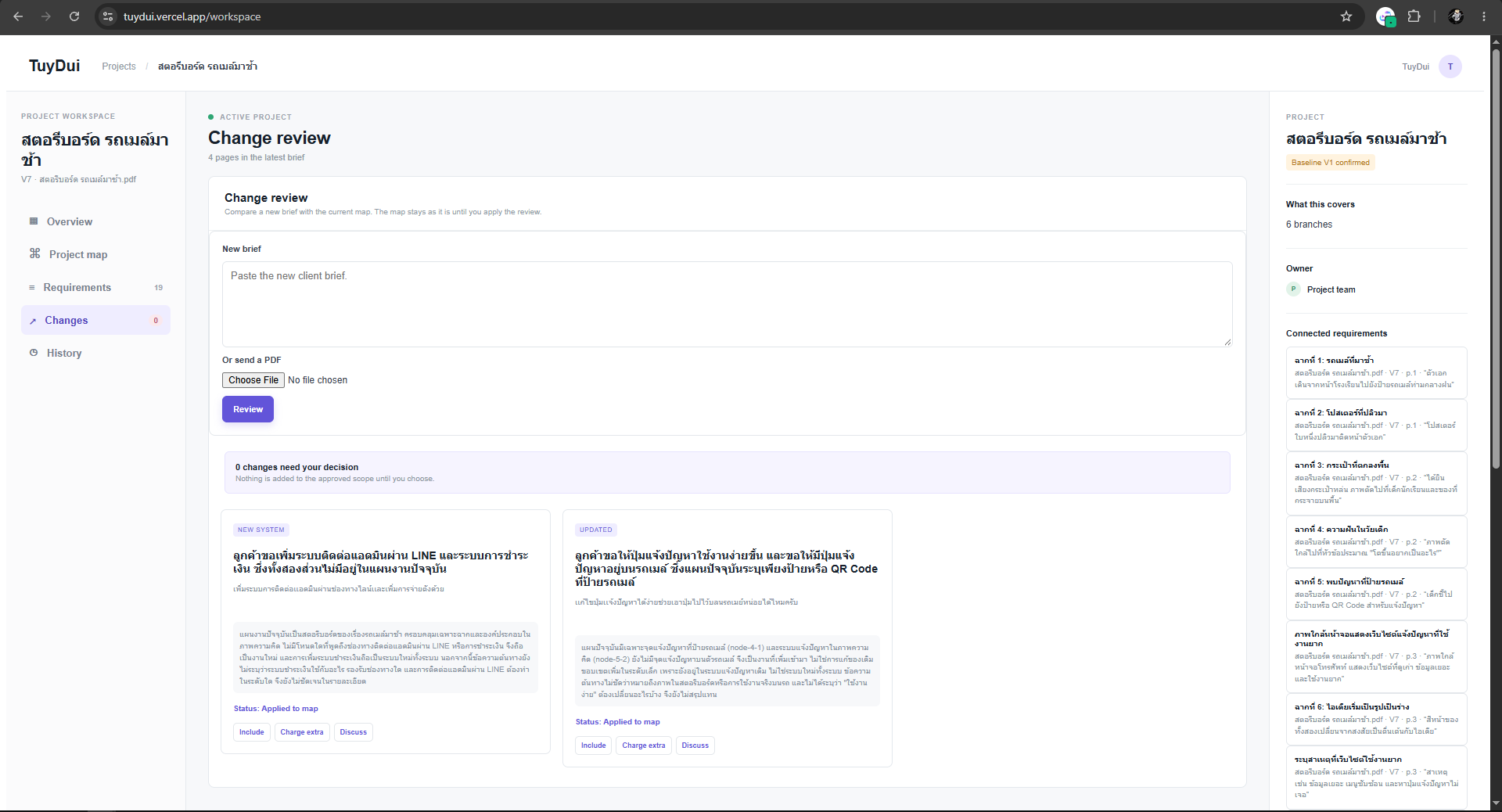
Compare client changes against the approved scope and decide next steps.
-
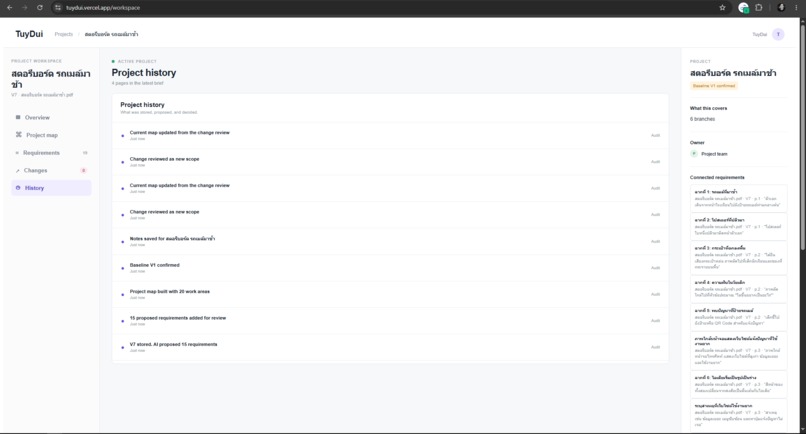
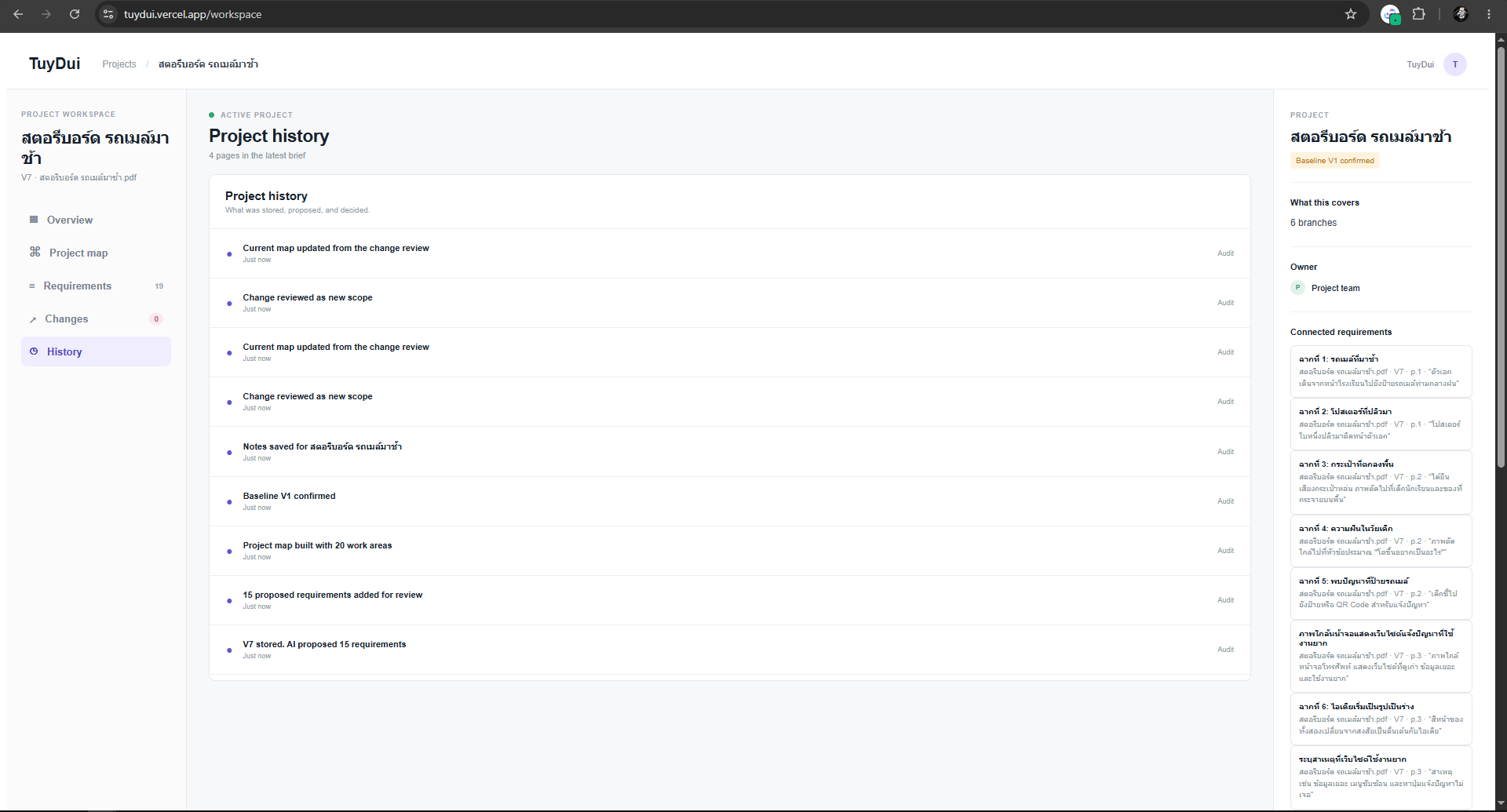
Audit trail of baseline, scope changes, decisions, and map updates.
Inspiration
Client projects rarely stay exactly as they were first agreed.
A freelancer, project manager, or small agency may begin with a clear client brief, but during development the client continues sending new requests through messages, emails, and revised documents.
Over time, it becomes difficult to answer simple but important questions:
- What was originally agreed?
- Is this request already inside the approved scope?
- Is this a modification or completely new work?
- Which part of the project is affected?
- Who on the team needs to revisit their work?
- Was this later change included for free or charged separately?
Most project-management tools track tasks, while document tools summarize documents. We wanted to build a system that keeps the original brief, project scope, responsibilities, and later changes connected throughout the life of a project.
That became TuyDui.
What it does
TuyDui is an AI-assisted scope-control workspace for client projects.
The workflow begins with the original client brief.
The user uploads a project document, and TuyDui extracts structured requirements such as features, constraints, deliverables, deadlines, and unclear points.
Each requirement remains connected to its original source evidence, including the relevant page and text from the document.
Those requirements are then organized into a Living Project Map, connecting project areas and work items to responsible roles and team members.
Before development begins, the project leader reviews the extracted information and confirms an original project baseline.
From that point forward, the baseline is preserved as the record of what was initially agreed.
Scope Change Intelligence
The most important part of TuyDui begins after the project starts.
When a client sends a new request through LINE, email, or another communication channel, the project leader can paste that message into TuyDui.
The system compares the request against the Current Approved Scope and classifies it as:
- In Scope
- Modified
- New Scope
- Ambiguous
TuyDui also explains the reasoning and identifies the project areas, roles, and team members that may be affected.
For example, if the original scope only contains email/password authentication and the client later requests Google Login, TuyDui can identify this as new scope and trace its impact to authentication, login UI, backend work, frontend work, and the responsible team members.
AI does not make the final business decision.
The project leader reviews the analysis and decides whether the change should be included at no additional charge or treated as additional work.
If the project leader decides to charge extra, they manually enter the price, additional time, deadline changes, and notes. TuyDui does not automatically calculate these business decisions.
Client Change Review
For approved scope-change proposals, TuyDui can generate a simple client-facing Change Review.
The client can see:
- What they requested
- What the previously approved scope contained
- Why the request changes the project
- Which areas are affected
- Additional price
- Additional time
- Updated deadline
The client can approve the change or request further discussion without creating an account.
When approved, TuyDui records the approved revision and updates the Current Approved Scope while preserving the original baseline and project history.
Revised Briefs
A major challenge in real client projects is that changes do not only arrive through messages.
Clients often send Brief V2, V3, or other revised documents.
TuyDui does not simply compare Brief V1 against Brief V2.
Instead, a revised document is converted into structured requirements and compared against the Current Approved Scope.
This matters because a requirement may have already been added and approved through a client message before appearing in the revised document.
For example:
- Brief V1 does not contain Google Login.
- The client later requests Google Login through a message.
- The project leader approves the change.
- Google Login becomes part of the Current Approved Scope.
- Brief V2 later includes Google Login.
TuyDui should recognize that Google Login is already approved instead of incorrectly reporting it as new work again.
How we built it
TuyDui was designed around one core relationship:
Source → Requirement → Project Work → Role → Person → Change Impact
Instead of treating AI output as free-form text, the system converts project information into structured data that can be reviewed, connected, compared, and updated over time.
The AI layer is used for tasks such as:
- Requirement extraction
- Requirement clarity analysis
- Semantic scope comparison
- Client-request classification
- Change-impact analysis
- Client-facing explanation drafting
AI output is not treated as the source of truth.
The core rule of TuyDui is:
AI proposes → Project leader confirms → System records
Important actions such as confirming the original baseline, accepting a scope change, setting price, changing deadlines, and approving commercial terms remain human-controlled.
Challenges we faced
One of the biggest challenges was realizing that simply comparing two documents was not enough.
Real projects evolve through multiple channels.
A requirement may start in the original brief, change through a LINE message, be approved by the project leader, and then appear again in a later document revision.
To model this correctly, we needed to separate:
- Original Baseline
- Current Approved Scope
- Client messages
- Document versions
- Scope-change events
- Project impact
- Approval history
Another challenge was deciding where AI should and should not be trusted.
AI is useful for understanding language and identifying semantic changes, but decisions involving project scope, pricing, work estimates, and deadlines require human judgment.
We therefore designed TuyDui so that AI assists with understanding and recommendations while the project leader remains the final authority.
What we learned
Building TuyDui taught us that the hardest part of an AI product is not simply connecting a language model.
The difficult part is designing the data and workflow around the model so that its output remains traceable, reviewable, and useful later.
We also learned that scope creep is not only a document-comparison problem.
It is a relationship problem between:
what the client said, what the team agreed to build, where that work exists in the project, who owns it, and how later changes affect the project.
What's next
The first version of TuyDui focuses on digital service projects such as:
- Web development
- Application development
- Software projects
- Design work
- Digital agencies
- Small outsourced teams
In the future, the same scope-change model could be expanded to other project-based industries such as architecture, interior design, construction, consulting, and media production.
Our goal is simple:
Help project teams always know what was originally agreed, what changed, what it affects, and what happens next.
Built With
- ai
- auth
- claude
- css
- flow
- llm
- maxplusai
- next.js
- pdf.js
- postgresql
- react
- storage
- supabase
- tailwind
- typescript
- vercel
- zod


Log in or sign up for Devpost to join the conversation.