Inspiration
We've all been there. Less than 24 hours before a test, you’re frantically searching throughout the web, trying to find resources to aid you on your studying journey. However, you have to wade through endless ads, useless forum pages, and random irrelevant webpages to get to your desired location. That’s why we created TUTR, to help make this inevitable and annoying process way more manageable.
What it does
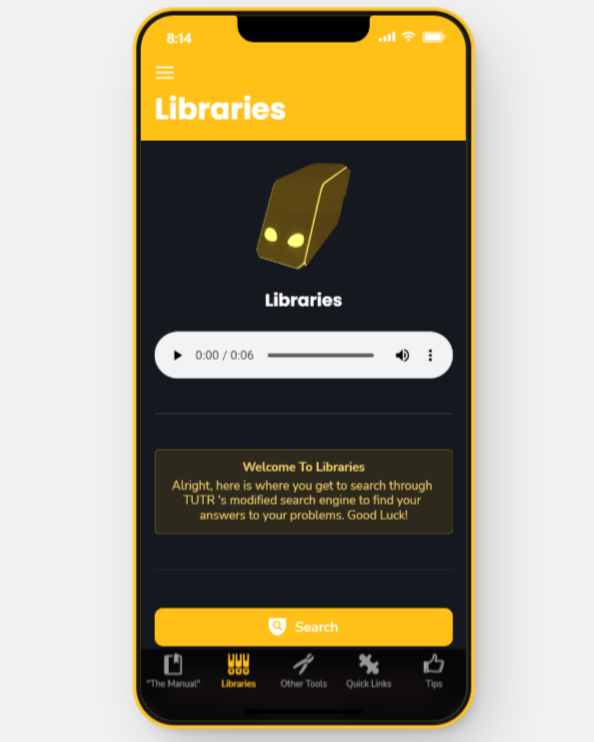
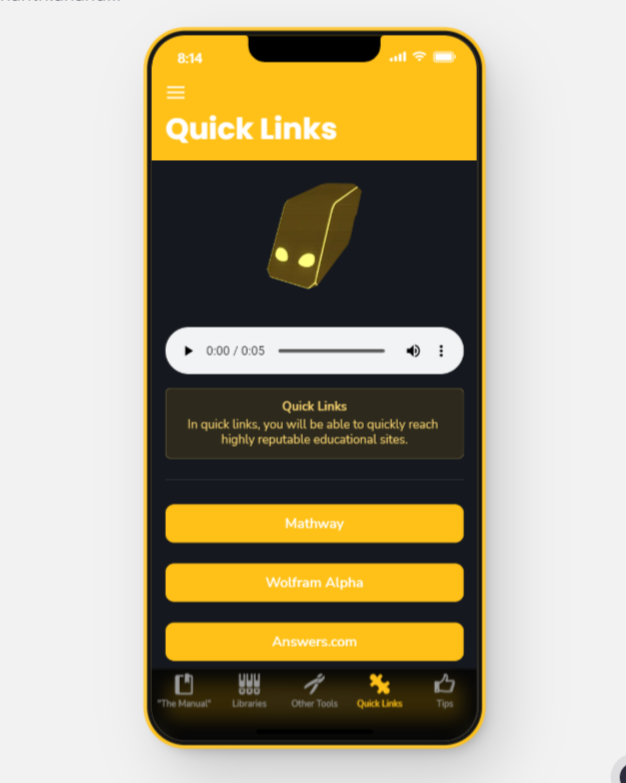
TUTR includes a modified search engine that allows the user to search for their desired content without the extra clutter. It is completely customized and filtered to allow it to achieve this goal. Other than this, TUTR includes many other useful features that are built-in and easy-to-use to achieve maximum efficiency and convenience for the user. For example, TUTR includes a math solver that uses Google’s API in order to correctly and quickly compute most basic equations and expressions. We also included a quick and clutter-free flashcard tool, to allow the user to purely study flashcards, rather than most tools these days which you have to either download, or you have to navigate through various subscription prompts and ads. There is also a Quizzes search engine that allows the users to easily find Quizlets and related content to test their knowledge in a easy (and very good-looking) format. And to top it off, TUTR has a voice assistant that guides you through the entire app, making it very accessible to most audiences, and also very calming to hear.
How we built it
TUTR’s frontend was built with Glide, which allowed us to quickly build the app in the timeframe given. It allowed us to give TUTR beautiful UI, support for the audio prompts, and more. For the backend, there were different tools we used for different aspects of the app. For the math solver, I used an open-source API called mathsteps that was distributed by Google and Socratic, as well as Node.js and HTML. For the flashcards, it was a very simple HTML and vanilla JS design, so it was easy to implement, and both were completely customized via CSS. For the search engines, Google Developers has a tool called Programmable Search Engine, which allowed us to completely customize and filter our search engine, using their editor and HTML.
What we learned
I have done JS, node.JS, HTML and CSS before, but I have never used them in unison with outside APIs. This was a new experience for me since I’ve never really worked with APIs too much before. I gained a lot of real-world experience with Git and CLI in general, which I think are really good tools to have.
What's next for TUTR
We have some plans for TUTR that we brainstormed, but sadly were unable to complete in the restricted time that was given to us. For example, we wanted TUTR to have a time constraint feature that would allow the student to input how long they have before their test/assignement, and TUTR would sort search results based on complexity, length, etc. to help the student achieve their goal, while still staying under the time constraint. We also wanted to give TUTR full virtual assistant capabilities, such as an animated figure, the ability to use the tools and respond to questions and more. If the time permits, we would have found a way to implement these supplementary ideas.
Built With
- css
- glide
- google-mathsteps
- google-programmable-search-engine
- html
- javascript
- ngrok
- node.js
- voicemaker


Log in or sign up for Devpost to join the conversation.