-
-
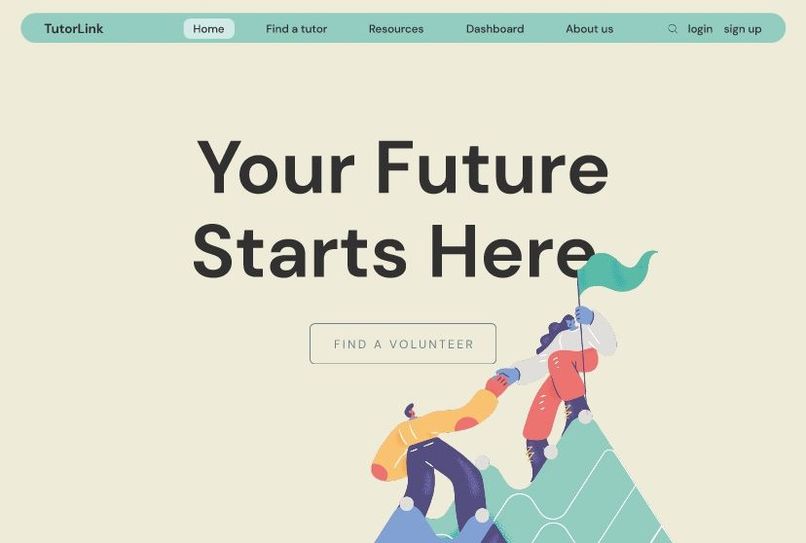
Preview of our site (fully designed)
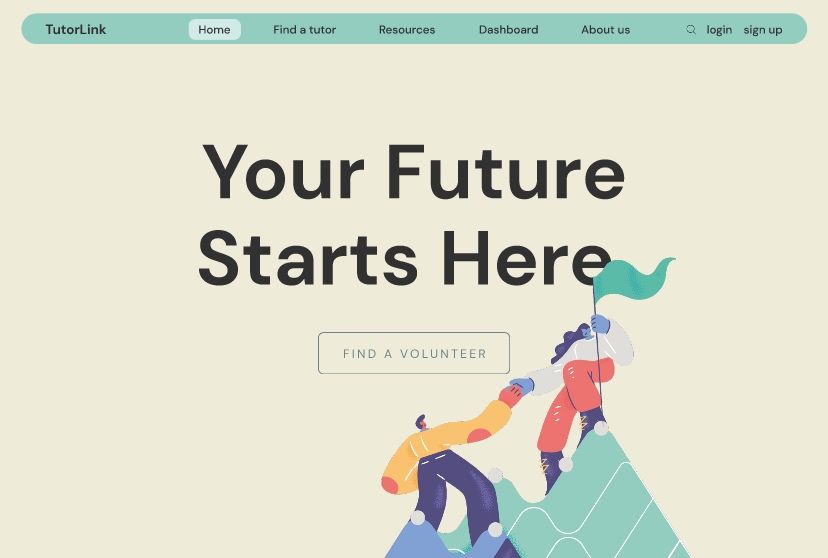
TutorLink: The story
Inspiration
Have you ever experienced the clarity that comes from learning a concept from a peer, in a way that surpasses the insights gained from videos or textbooks? At TutorLink, this peer-to-peer teaching model is at the heart of what we strive to achieve. Our inspiration stems from the belief in the power of collaborative learning and the impact of peer support on personal growth and academic success.
What it Does
TutorLink is a transformative online platform designed to bridge the educational gap for first-generation, low-income (FGLI) students by facilitating access to tutoring and educational resources. Our platform enables volunteers to offer their expertise and create valuable resources, while students—especially those from disadvantaged backgrounds—can connect with these volunteers and benefit from their knowledge.
We address a critical challenge: the lack of access to quality academic support and resources faced by many FGLI students. TutorLink provides a comprehensive solution by allowing users to exchange articles, share posts, and engage in meaningful tutoring relationships. Students can select volunteers who match their needs and initiate connections that lead to personalized learning experiences. Volunteers, in turn, gain opportunities to contribute to their community, earn service hours, and experience the profound satisfaction of making a difference. This self-sustaining model fosters mutual benefit and social impact.
How We Built It
Our journey began with meticulous planning and design using Figma, where we crafted detailed flowcharts to map out user experience journeys. This initial phase provided us with a clear vision of our application’s structure and functionality. With this foundation, we moved on to the design phase, utilizing Figma’s prototyping features to visualize and refine the user interface and navigation.
The design process involved the usage of Figma. This involved designing the UI of the website. Here, pages based on conditional instances were designed based on user roles (volunteer or student). This provides as the backbone for further styling for the front-end portion of the program, Furthermore, prototyping was also done via Figma. This included prototyping the buttons and linking all the pages to ensure smooth user navigation. click here to view our prototype!
The development process involved both backend and frontend components. We employed Django for the backend, leveraging its robust framework to handle user authentication, data management, and API integration. React.js was used for the frontend, allowing us to create a dynamic and responsive user interface. The integration of these powerful frameworks enabled us to build a cohesive and functional application.
Challenges We Ran Into
Designing the user interface for Tutorlink posed several challenges. Firstly, the platform needed to accommodate a diverse user base, including students, tutors, and administrators, each with distinct needs and expectations. Ensuring intuitive navigation for all users required careful consideration of user flows and accessibility features. Additionally, achieving a balance between aesthetic appeal and functional simplicity was crucial, as overly complex designs could deter users, while overly simplistic ones might fail to engage them. Integrating features like real-time communication, scheduling, and personalized dashboards without overwhelming the user required strategic layout and prioritization of elements. Furthermore, ensuring responsive design across various devices and screen sizes added another layer of complexity to the design process.
The development process was not without its hurdles. As relative newcomers to backend programming, we encountered numerous errors and challenges that required persistence and problem-solving skills. One significant challenge was establishing effective connections between users and volunteers, which involved complex logic and extensive debugging. Despite these obstacles, our determination and problem-solving efforts paved the way for the successful development of TutorLink.
Accomplishments We're Proud Of
We take immense pride in having developed a fully functional application within a relatively short timeframe, especially considering our initial level of expertise. The successful integration of Django and React.js, coupled with the creation of a user-friendly platform, stands as a testament to our hard work and dedication.
What We Learned
Our journey through this project has been a profound learning experience. Navigating the complexities of backend development and mastering Django REST framework has significantly enhanced our understanding of web development. The process of debugging and problem-solving has provided us with invaluable insights and skills that will benefit us in future projects.
What's Next for TutorLink
Looking ahead, we are excited about the future of TutorLink and the opportunities for growth and enhancement. Our plans include implementing an in-built messaging system to facilitate seamless communication between users and volunteers. We also aim to expand user customization options, such as profile pictures and personalized settings, to enhance user engagement and satisfaction. Additionally, we envision making our resource features more interactive and accessible, further enriching the learning experience for students. Our ultimate goal is to deploy TutorLink on a larger scale and build a robust network of volunteers committed to our mission of educational equity.
Built With
- django
- figma
- javascript
- python
- react
- restapi
- restframwork


Log in or sign up for Devpost to join the conversation.