-
-
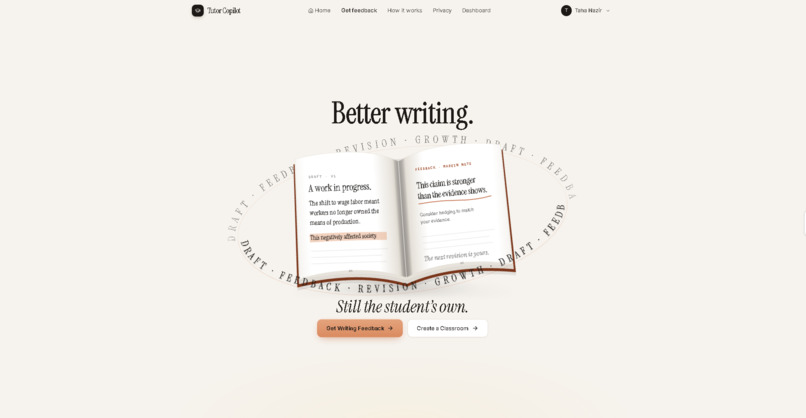
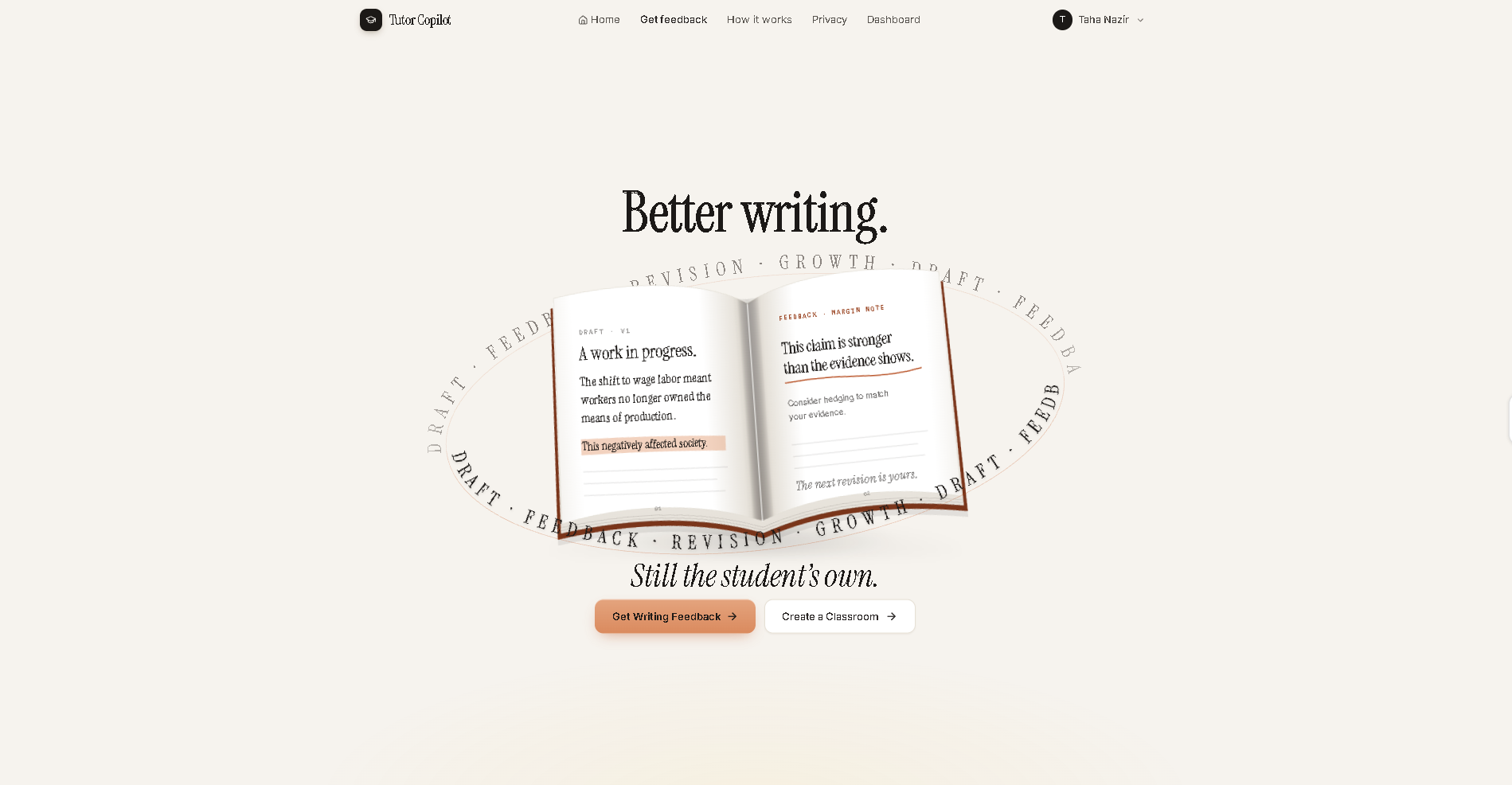
Tutor Copilot’s redesigned homepage highlights rubric-based feedback that helps students revise their writing while keeping it their own.
-
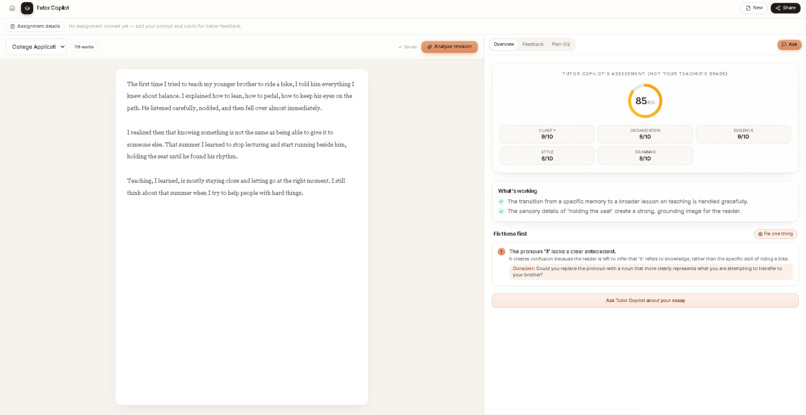
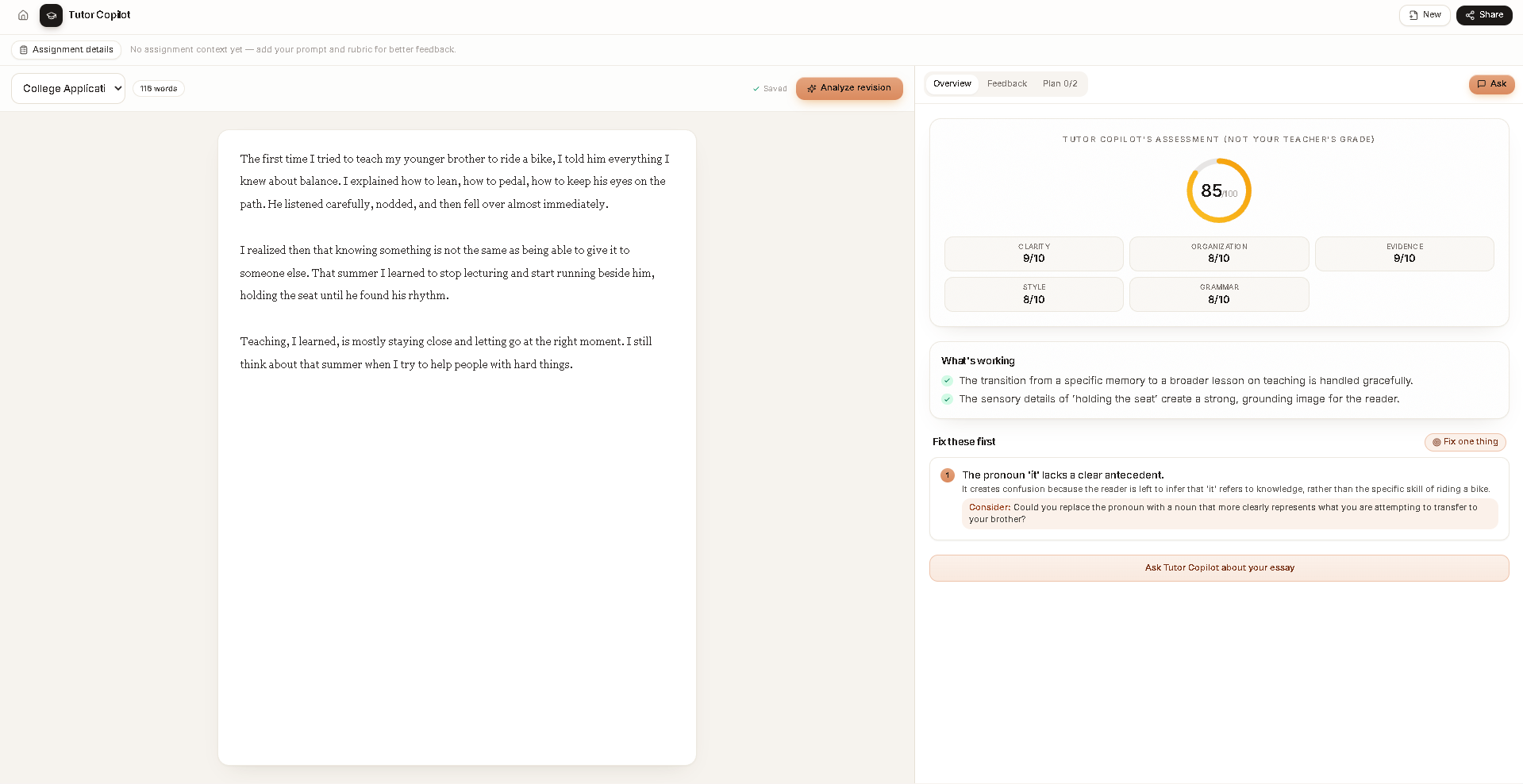
Tutor Copilot’s essay workspace provides rubric-based scores, highlights writing strengths, and offers targeted suggestions for revision.
Inspiration
Writing is one of the most important academic skills students develop, yet many struggle to receive timely, personalized feedback. Teachers often manage dozens of essays at once, making it difficult to provide detailed guidance on every draft. At the same time, many AI writing tools focus on generating essays rather than helping students improve their own writing.
I was inspired to create Tutor Copilot through my volunteer work with SEA Literacy, a nonprofit organization supporting refugee and multilingual students. While tutoring students in reading and writing, I noticed how much individualized feedback could improve their confidence and writing abilities. However, providing that level of attention consistently was difficult, especially when working with multiple students.
I wanted to create a tool that could make meaningful writing feedback more accessible without taking away from the learning process. That idea eventually became Tutor Copilot, a platform designed to help students recognize their strengths, understand their weaknesses, and improve their writing independently.
What it does
Tutor Copilot is an AI-powered writing feedback platform that helps students strengthen their essays through personalized, rubric-based analysis and revision guidance.
Students can write or paste their essays into an interactive workspace and receive feedback across five areas: clarity, organization, evidence, style, and grammar. The platform evaluates each category, identifies what the student is doing well, and provides specific suggestions for improvement.
Instead of rewriting essays, Tutor Copilot encourages students to make their own revisions. Feedback is organized into manageable recommendations, helping students focus on the changes that will have the greatest impact on their writing.
The platform also includes an interactive feedback assistant that allows students to ask questions about their essays and better understand the suggestions they receive. Classroom creation features allow educators to incorporate Tutor Copilot into their instructional environments.
Throughout the process, the goal remains the same: helping students become better writers while preserving their original ideas and voice.
How I built it
Tutor Copilot began as a full-stack web application built with Next.js, React, JavaScript, Python, and FastAPI. The original version used Vercel and Render for deployment, connecting a web-based interface to an AI system that analyzed student writing against structured rubrics.
As more students began using the platform, I realized that the original interface needed significant improvements. I redesigned and rebuilt Tutor Copilot using web development tools, focusing on a more intuitive writing experience, better feedback organization, and additional classroom functionality.
The updated platform features a split-screen writing workspace, visual assessment dashboards, prioritized revision suggestions, and an interactive assistant for understanding feedback. Students can review their writing and make revisions without constantly switching between different pages.
Much of the development process involved testing feedback on different types of essays, adjusting the analysis system, and incorporating suggestions from students and educators.
Challenges I ran into
One of the biggest challenges was developing feedback that students could actually use. In early versions, the AI occasionally generated suggestions that were too general or overwhelming. Simply identifying a weakness was not enough; the feedback needed to explain why something could be improved and help students understand how to approach their revisions.
Another challenge was maintaining academic integrity. Since Tutor Copilot uses AI, I wanted to ensure that students were still responsible for developing their own ideas and writing their own essays. This meant designing the platform around feedback and guided revision rather than automatic essay generation.
I also faced challenges when expanding beyond the initial prototype. As students began using Tutor Copilot in different educational settings, I had to consider differences in writing ability, assignment expectations, feedback quality, and user experience.
These challenges shaped many of the changes made to the platform and helped me better understand what students and educators actually needed.
Accomplishments that I'm proud of
Tutor Copilot has grown considerably since its initial development.
As of fall 2026, the platform has analyzed over 800 student essays, with approximately 94% undergoing revision. Students across 13 school districts have used Tutor Copilot, and the initiative has expanded to five chapters across Wisconsin, California, New Jersey, the United Kingdom, and Vietnam.
One of my most meaningful experiences was introducing Tutor Copilot to students at SEA Literacy, the organization that originally inspired the project. Seeing students interact with the feedback and work to improve their writing reinforced why I started building the platform.
I have also had opportunities to connect with educators and educational organizations, including WIDA and the National Writing Project, to discuss writing instruction, educational standards, and the potential applications of Tutor Copilot.
The project received 2nd Place in AI/Machine Learning and 3rd Place in High School STEM at the 2026 IEOM International Conference. I also authored and presented a peer-reviewed research paper published in the IEOM conference proceedings.
While these accomplishments have been exciting, I am especially proud that Tutor Copilot has grown from a small project into something students are actively using to improve their writing.
What I learned
Building Tutor Copilot taught me much more than how to develop and deploy a web application.
I learned that creating useful educational technology requires understanding the people who will actually use it. A platform can work perfectly from a technical standpoint but still fail to make a meaningful difference if students find it confusing or the feedback difficult to apply.
Working with students helped me recognize problems I would not have noticed through development alone. Their experiences influenced everything from how feedback is presented to how revision suggestions are organized.
I also learned how important it is to continuously improve a product. Tutor Copilot looks very different from its first version, and many of those changes came directly from testing, feedback, and conversations with educators.
Most importantly, this project showed me how technology can help address challenges I had previously encountered through volunteering. What began as an idea inspired by a few tutoring sessions has developed into a much larger educational initiative.
What's next for Tutor Copilot
I plan to continue improving Tutor Copilot and expanding its accessibility to students and educators.
Some of my priorities include developing more advanced classroom management features, improving student progress tracking across multiple drafts, expanding rubric customization, and providing additional support for multilingual learners.
I also hope to continue working with educators and educational organizations to better align Tutor Copilot's feedback with classroom expectations and writing standards.
As the platform grows, I want to reach more schools, tutoring programs, and nonprofit organizations, particularly those serving students who may not have consistent access to individualized writing support.
My long-term goal is to make high-quality writing feedback more accessible while ensuring that students remain responsible for their own learning and development as writers.
Built With
- api
- fastapi
- javascript
- next.js
- openai
- python
- react
- vercel

