-
-
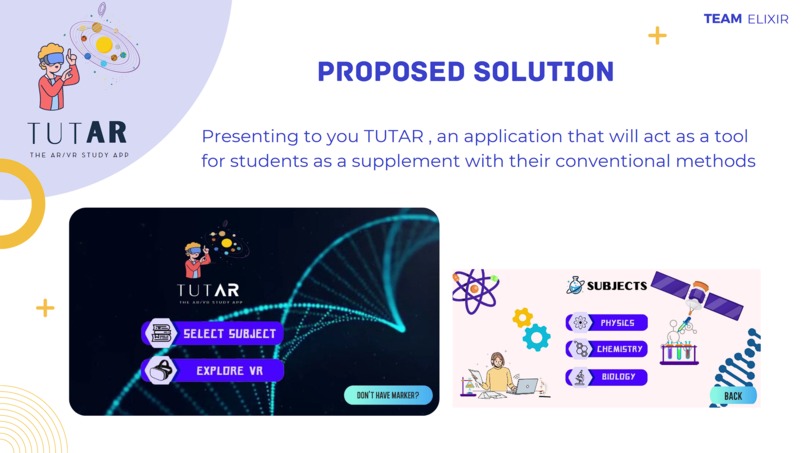
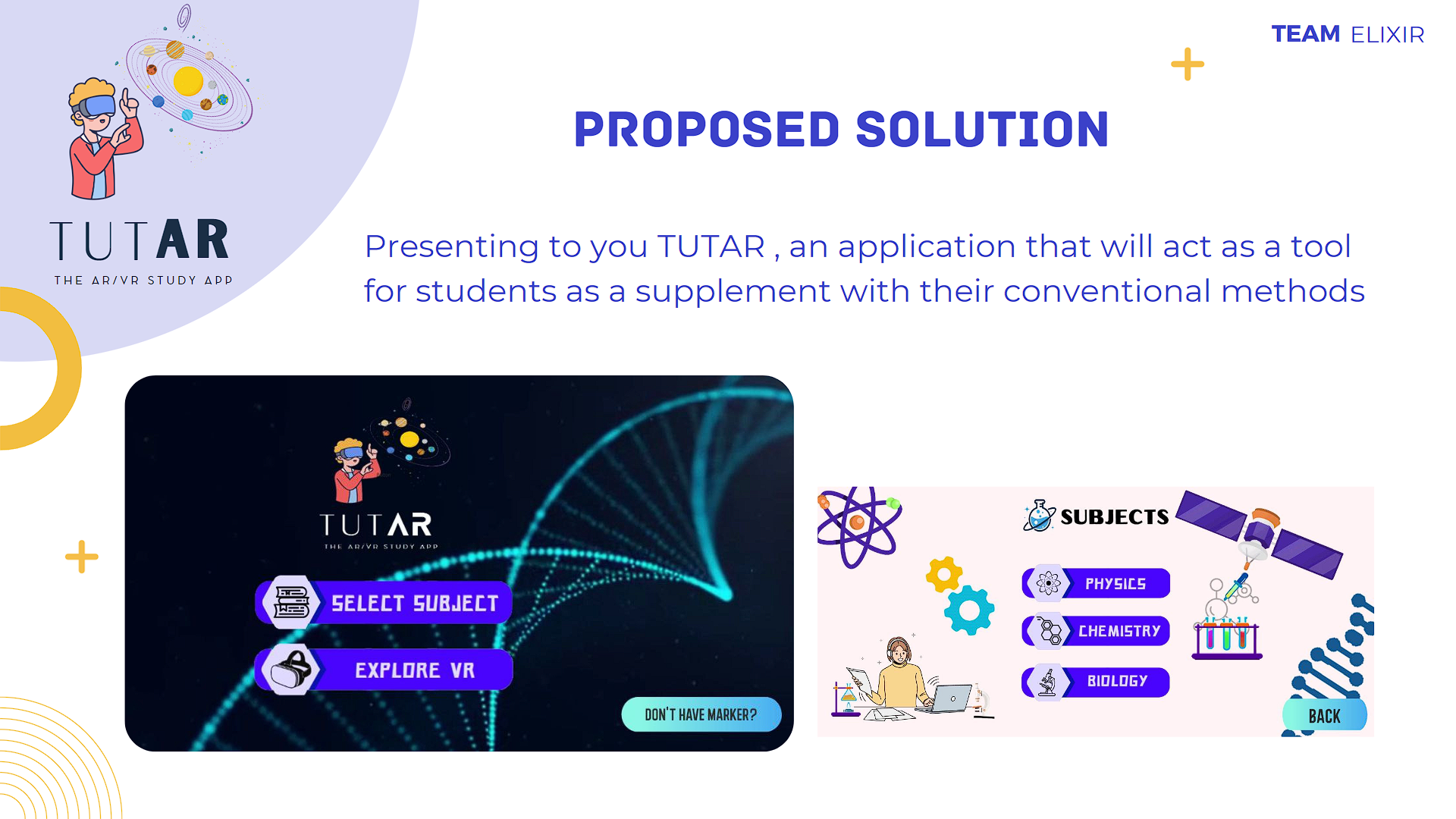
Home Page & UI
-
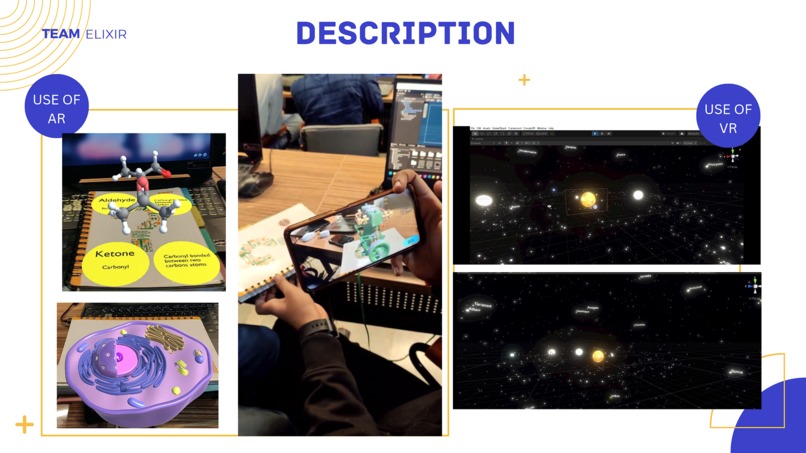
Screenshots and VR
Inspiration
Many students face problems learning the concepts of our academic subjects in classes 12th and 11th and they are not able to visualize the concepts thoroughly through 2D diagrams in the textbook. A similar case happened in our first year of college where we were taught about engines and other things. Their work was very hard to understand. We read about the working of the engines several times but it was very hard to visualize exactly how it was moving the wheels. This is where the idea of creating an app like TUTAR came to our minds. So we decided to contribute towards changing this trend of conventional methods of learning by improvising it with 3D visualization to get better clarity about concepts.
What it does
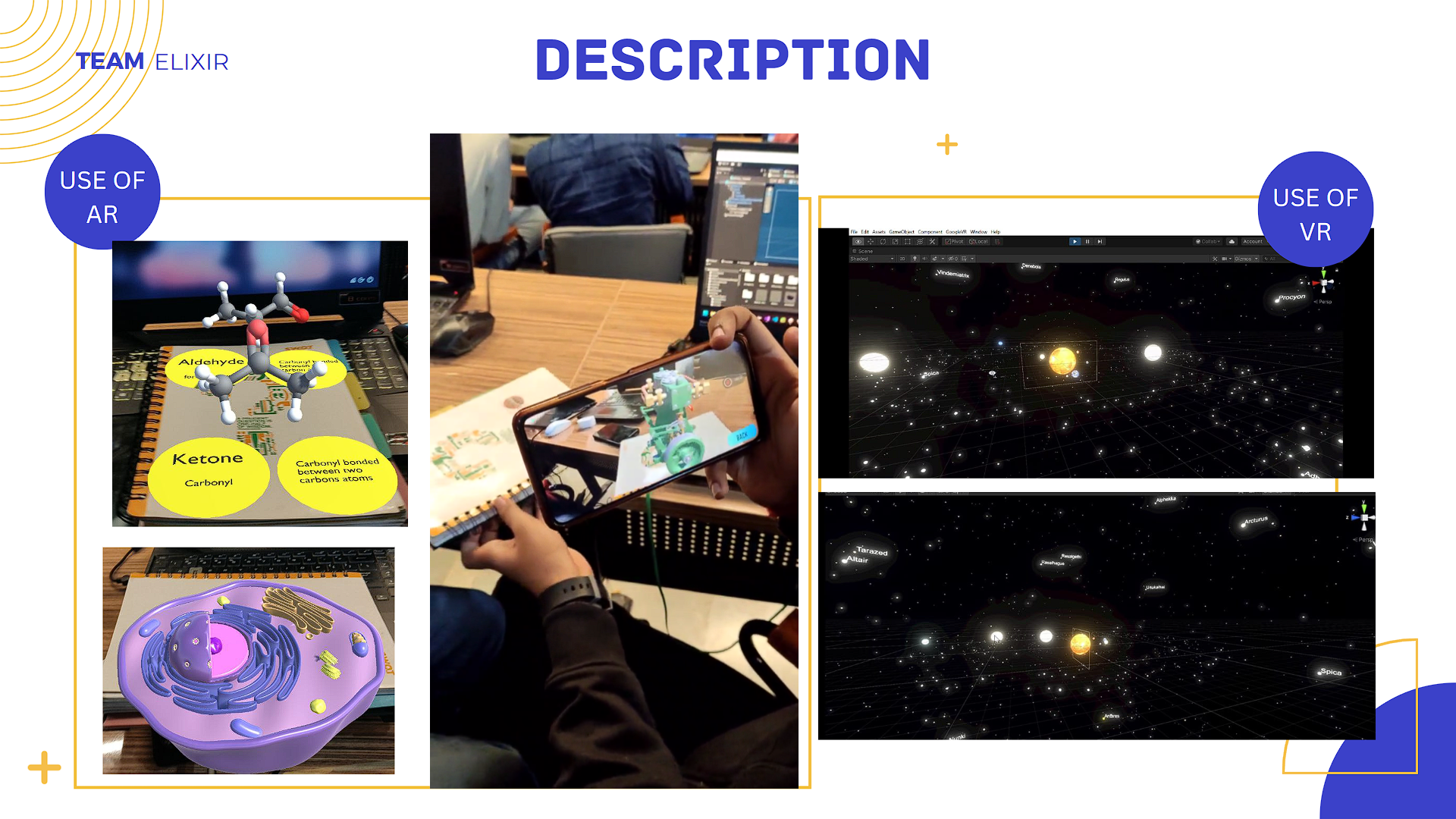
Our app uses AR-based image and plane detection to augment 3D models over an image (that can be a book or any plane image). Here we have used a universal marker to demonstrate the prototype. The same process will be used to view them over our academic textbooks such as NCERTs. It turns the 2D diagrams of textbooks into 3D visualizations and simulations where one can even interact with the diagrams by using touch gestures such as drag, zoom, and rotate according to their convenience. We have tried to make 3D models that are self-explanatory and easy to understand. We have also integrated animations in some 3D models (like engines) to explain their working more accurately. We also have VR support for some topics like the solar system, which will provide an extremely immersive learning experience and increase the interest of the students.
How we built it
We have built the entire app using UNITY, which is a very powerful game engine that also supports AR/VR integrations very well.
Challenges we ran into
We never built a full-fledged Android app using Unity 3D so this was the first time we were able to make it after many trials and errors. Also, while making the VR part the textures of our objects and other visuals were gone and we were in a panic because they were not even glowing like how we intended them to. Another challenge was working with 3D modeling and adding animations to the 3D models, we found this difficult because none of us had any experience in working with 3D animations that well. But we didn't give up and kept on learning and we were able to integrate lots of animations in our 3D models.
Accomplishments that we're proud of
We are very proud of our entire app, especially the VR integration.
We successfully made the whole Android application with clean implementation and found a way to add textures and glow to our visuals. We were able to create an excellent simulation of our solar system and when we first tried it in VR, we were very mesmerized by our own work. 😅
What we learned
We learned a lot from the entire process. We learned to create 3D animations and integrated them into our app. Implementing VR with other packages was a difficult task because sometimes we faced some conflicts while importing them together, but in the end, we were able to resolve them as well.
What's next for TUTAR (An AR/VR-based learning app for students)
Our future plan for TUTAR is to gamify learning by adding several mini-games that would pique the interest of young students. We also plan to add more models and visualizations for topics that are very complex, ex. in civil, electrical, and mechanical engineering, there are several complex 2d diagrams that are hard to understand without a 3D model.


Log in or sign up for Devpost to join the conversation.