-
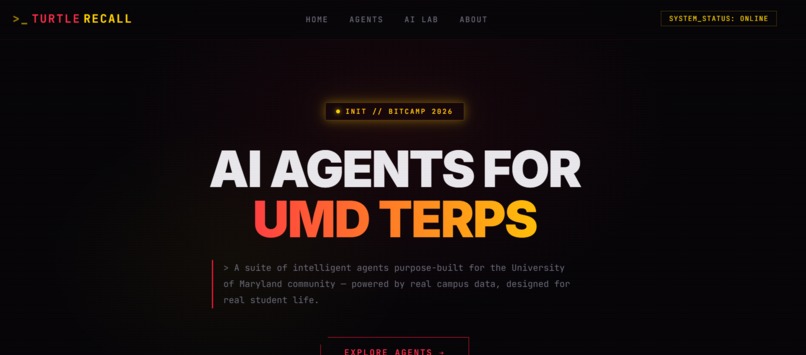
Homepage
-
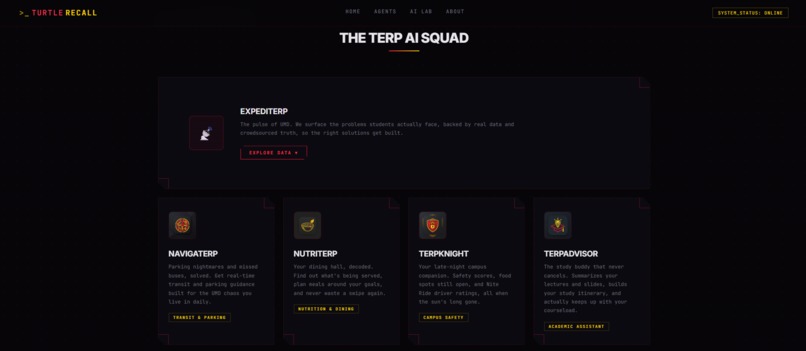
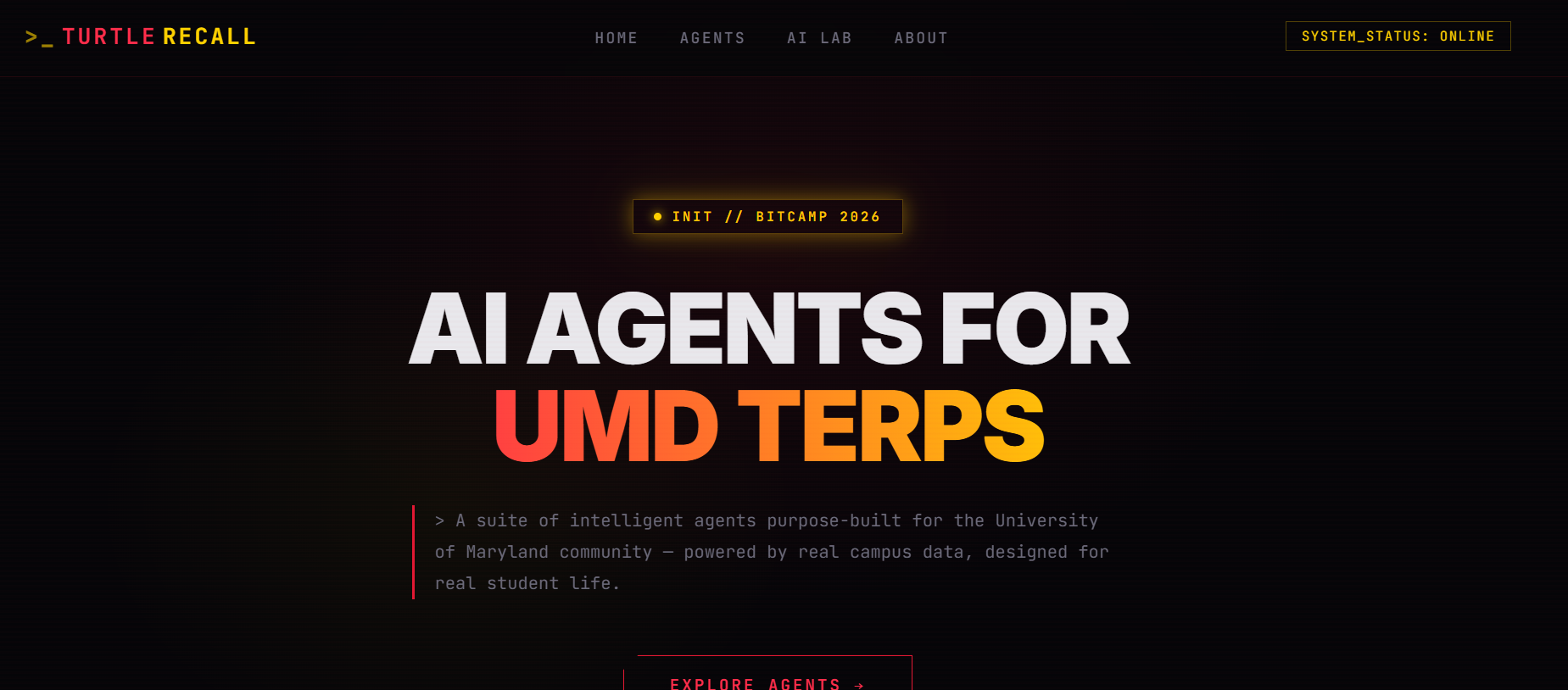
Inspiration
The idea for TurtleRecall came to us before it was set up as a challenge at Bitcamp. It came from our daily conversations about missed buses, a closed dining hall, a 20-minute parking loop before a 7pm lecture. These are day-to-day struggles we talk about with friends and family, almost constantly. The data to solve these problems exists. The technology exists too. Nobody had connected it for us. Bitcamp gave us the push to close that gap.
What It Does
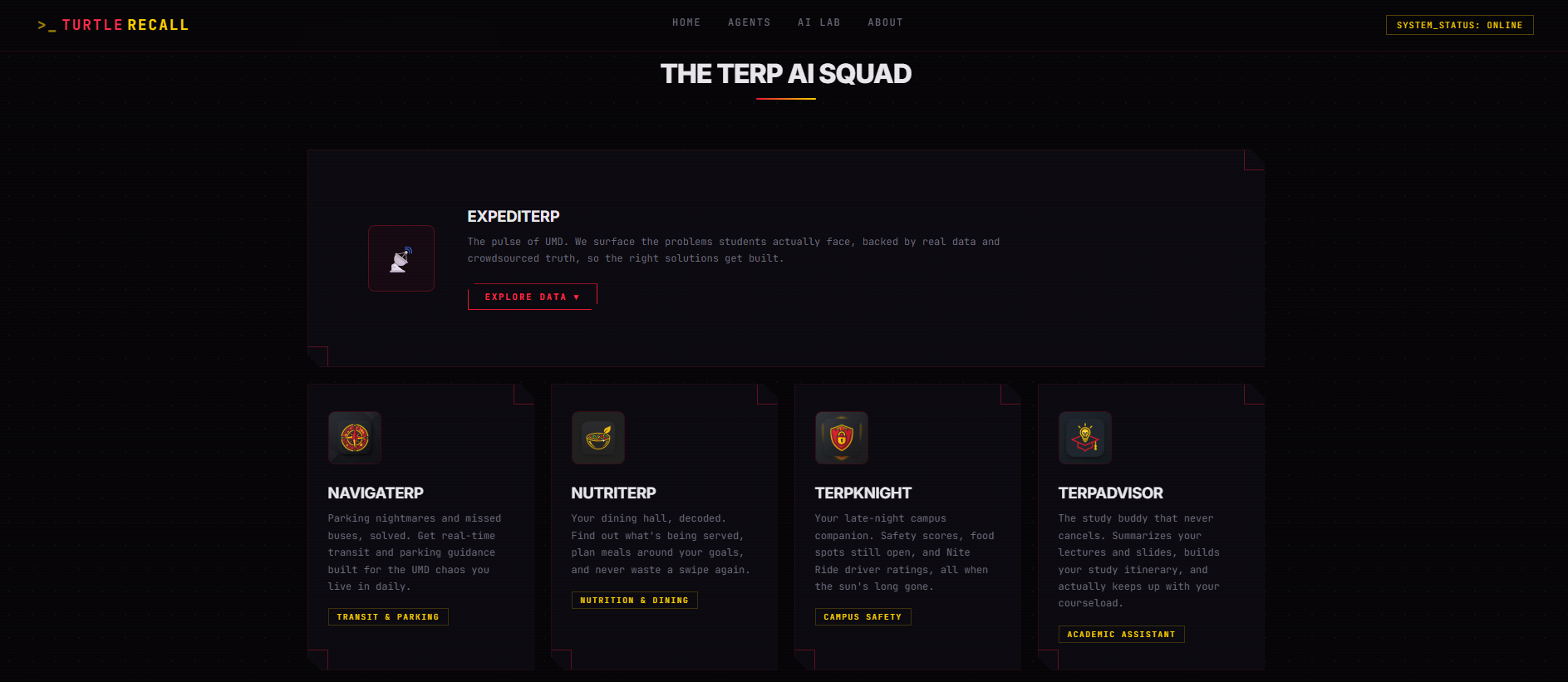
TurtleRecall brings five of the most fragmented parts of student life under one roof.
- ExpediTerp sits underneath all of it — an AI-driven signal layer that reads crowdsourced student input and surfaces, in real time, where the platform needs to go next.
- NavigaTerp gives students real-time parking and transit guidance specific to UMD's campus rhythm.
- NutriTerp makes dining hall menus actually useful — searchable, filtered by dietary needs, and connected to meal planning.
- TerpKnight is a late-night companion that surfaces safety scores, nearby open spots, and Nite Ride ratings so students are never making uninformed decisions after dark.
- TerpAdvisor turns lecture slides and course materials into structured study plans without the student having to lift a finger.
How We Built It
We started where most teams don't — with the problem itself.
Before writing a single line of code, we built ExpediTerp: a data-driven tool equipped with sentiment analysis, designed to accurately identify the biggest stressors in student life using real data and real student testimonies. No assumptions, no gut calls. We let the signal tell us where the friction actually lived.
Once ExpediTerp surfaced the top five problem areas with enough confidence, we had our roadmap. The team split ownership — each member took on one to two problem domains — and we built in parallel from there. Five problems, five agents, one coherent platform.
- NavigaTerp was built to solve the parking and transit chaos that costs students time every single day.
- NutriTerp was built because dining hall information is everywhere and useful nowhere.
- TerpKnight was built for students making decisions after dark with no reliable information to guide them.
- TerpAdvisor was built for the student buried in slides the night before an exam.
- ExpediTerp, the engine that started it all, continued to evolve — reading crowdsourced input in real time and directing where the platform needed to go next.
The build was fast. The foundation was not.
Challenges We Ran Into
Real-world campus data humbles you fast.
Dining hours change without notice. Parking feeds drop without warning. Shuttle timing drifts from what the schedule says. Every data source we touched had gaps we did not anticipate, and we had to build normalization logic for each one on the fly — pulling us away from building features and into fixing foundations.
The harder challenge was cohesion. Five agents, built simultaneously by a small team, will naturally drift apart. Keeping TurtleRecall feeling like one product — not five tools stapled together — required constant realignment that competed directly with build time. Every time we synced, something needed to be reconciled: a design inconsistency, a data format mismatch, an interaction pattern that worked in one agent but broke the feel of another.
We made it work. But it was the hardest part of the build.
Accomplishments We Are Proud Of
That it feels like one product.
Most platforms built at this pace show the seams. TurtleRecall does not. From the shared design system to the unified data architecture, the experience holds together in a way we are genuinely proud of.
We are also proud that nothing in it was invented for the sake of it. Every feature traces back to a real moment of friction — a missed bus, a closed dining hall, a parking loop that made someone late. That grounding kept every decision honest.
What We Learned
Genuine problems make for genuine products.
When you are building something you actually need, the decisions come faster. The tradeoffs are clearer. You have already lived the consequences of getting it wrong, so you stop second-guessing and start building.
We also learned to cut fast. A hackathon is a proof of concept, not a roadmap. The discipline to do five things well — instead of ten things halfway — is what made TurtleRecall feel finished.
What's Next for TurtleRecall
The foundation is solid. What comes next is depth.
Canvas integration for TerpAdvisor. Richer, real-time nutrition data for NutriTerp. A tighter feedback loop for ExpediTerp so the platform learns faster from how students actually use it — not just how we designed it to be used.
The longer vision is bigger. ExpediTerp's architecture was built to be portable. The same signal layer that works at UMD can work at any large campus where student life is fragmented and the data to fix it already exists — but nobody has connected it yet.
$$ \text{TurtleRecall} = \sum_{i=1}^{5} \text{Agent}_i \quad \text{where each Agent}_i \text{ solves a distinct, data-validated student pain point} $$
Built at Bitcamp. Built by Terps. Built for Terps.


Log in or sign up for Devpost to join the conversation.