-
-
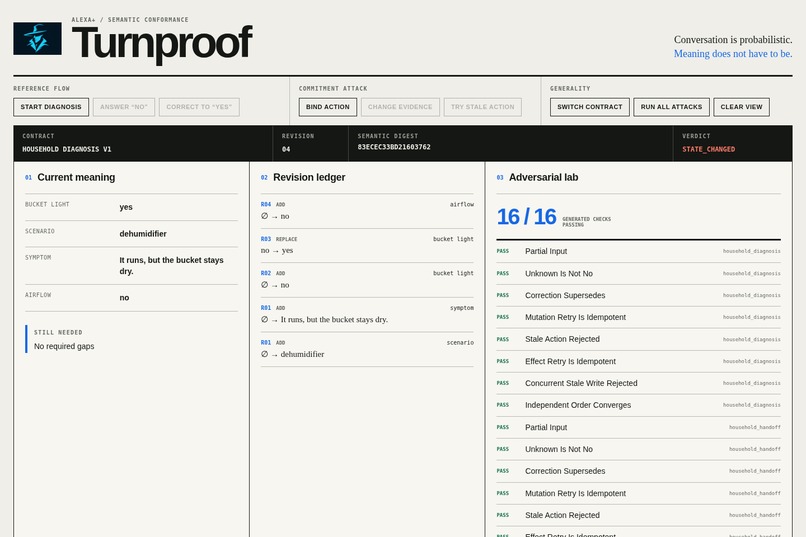
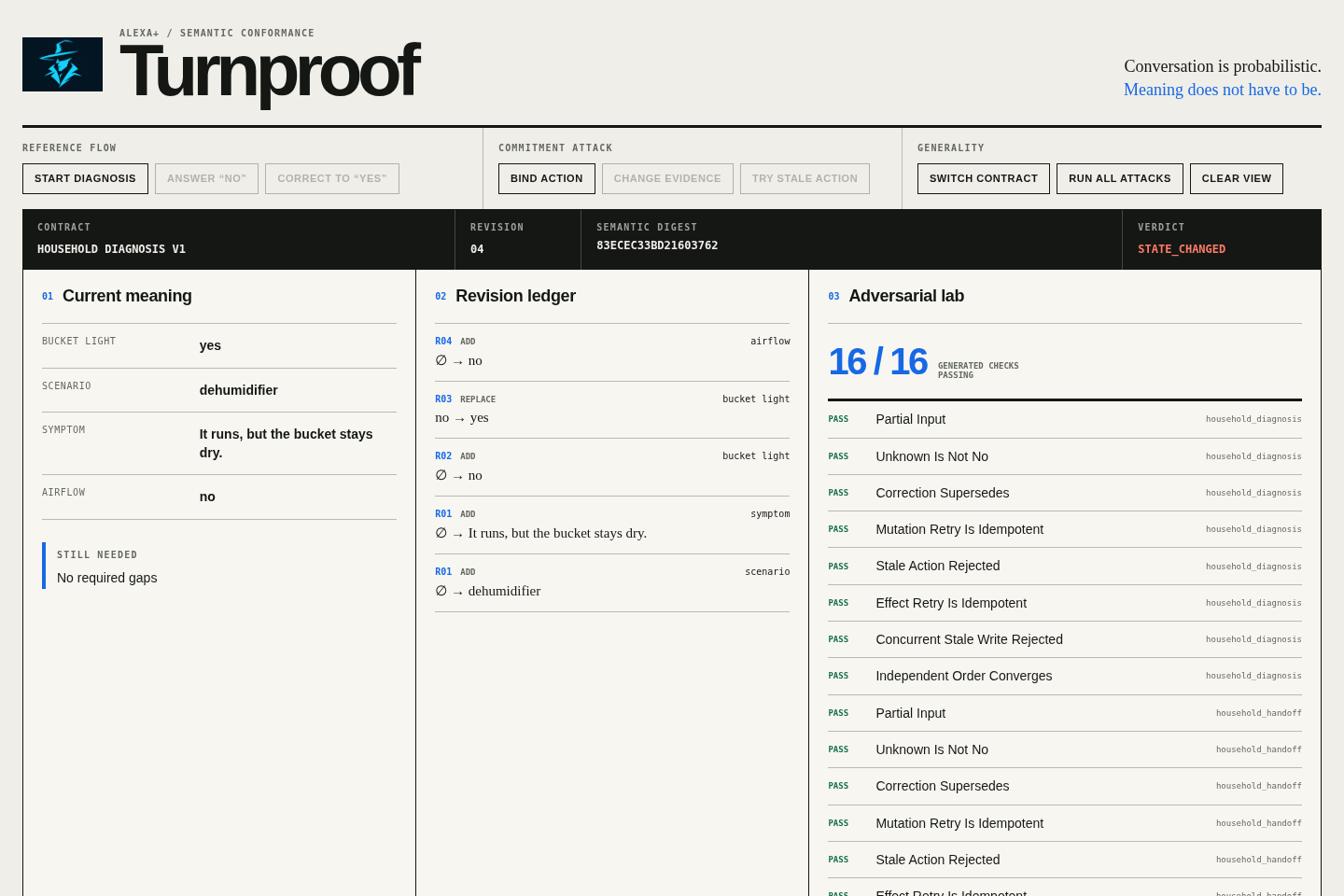
One screen shows current meaning, correction history, a stale-action verdict, and 16 generated attacks passing across two contracts.
Turnproof — Devpost project story
Inspiration
Voice interfaces are easy to demonstrate and difficult to trust. A polished conversation can conceal a damaged state: silence recorded as “no,” a correction that leaves an old answer active, a retry that performs the same action twice, or an approval that remains usable after the underlying facts have changed.
The language model is usually blamed when this happens, but changing prompts or models does not solve the engineering problem. Language interpretation is probabilistic. Durable state, corrections, commitments, and effects need firmer rules.
Turnproof grew from a question: what would conversational software look like if we treated meaning as executable infrastructure? Instead of testing only a few pleasant transcripts, could we declare what a conversation is allowed to mean, generate attacks from that declaration, and preserve a reproducible receipt of the result?
This reflects Armada Ventures' broader modus operandi: use LLMs to augment human judgment and help design better systems, while refusing to make correctness or authority depend on model confidence alone. In the present environment of rapid change and uncertain model behavior, deterministic contracts and reproducible evidence provide safe harbor. We build with LLMs; we do not build critical trust on top of them.
Alexa+ provides a useful boundary for that experiment. Its MCP add-ons connect natural conversation to structured tools. Turnproof protects the point where a model's interpretation becomes persistent state or an application effect.
What it does
Turnproof is a semantic firewall and adversarial laboratory for conversational applications.
A developer defines a conversation contract: its facts, types, dependencies, required information, allowed corrections, actions, and action preconditions. Turnproof compiles that declaration into runtime rules and generated multi-turn checks.
The current proof of concept includes two different contracts:
- A household diagnosis that accepts partial evidence and later corrections.
- A household handoff containing a recipient, task, time window, precondition, and acknowledgement policy.
Both contracts use the same semantic engine. The engine distinguishes an explicit unknown from “no,” records every accepted change as a revision, preserves superseded values, and creates a digest of the current meaning.
Before an action can occur, Turnproof creates a reviewable proposal bound to that exact revision and digest. If any relevant state changes afterward, the old proposal is rejected with STATE_CHANGED. Successful effects return stable idempotent receipts, so a network retry cannot silently perform the same action twice.
The browser observatory makes this visible without pretending to be a chat window. It displays:
- the facts currently understood;
- the revision ledger and corrected values;
- the semantic digest to which an action is bound;
- the runtime verdict when state changes;
- every generated adversarial check and its result.
The guided demonstration records “no,” corrects it to “yes,” binds an action, changes another fact, and then attempts the stale action. The runtime blocks it. The same screen reports the laboratory result: 16 of 16 generated attacks passing across both contracts.
How we built it
Turnproof is a dependency-light Python application built with FastAPI, SQLite, the Model Context Protocol, standard-library unittest, and a plain HTML/CSS/JavaScript observatory.
The semantic engine owns state. Each conversation has a monotonically increasing revision, and each mutation carries an expected revision and an idempotency key. A mutation batch is atomic: either every valid change becomes one revision or none of it does. A reused idempotency key must describe the same operation; it cannot conceal a different mutation.
Corrections are append-only events. The active projection shows the newest meaning, while the ledger preserves what it replaced. This gives the voice and visual layers one source of truth without asking the language model to remember which statement won.
Actions use a two-step boundary:
propose_turnproof_actionvalidates the contract and binds the proposal to the current revision and semantic digest.commit_turnproof_actionverifies that the binding is still current and returns one stable effect receipt.
The adversarial laboratory is generated from the same compiled contracts. It checks partial input, explicit unknowns, correction supersession, mutation retries, effect retries, concurrent stale writes, stale action rejection, and convergence when independent facts arrive in different orders.
We also retained the earlier deterministic diagnosis engine as a reference subsystem. This prevents the pivot to a general semantic layer from erasing its existing safety and evidence tests.
The repository has three levels of evidence:
- 26 direct unit and integration tests for contracts, state, MCP transport, diagnosis behavior, retries, concurrency, and narration assembly;
- 16 generated adversarial checks across two contracts;
- 6 independent conformance gates that run syntax, contract tests, the generated laboratory, the reference engine, MCP transport, and the browser contract.
The gate runner records bounded output, duration, exit status, and a SHA-256 digest of the tested source in a reproducible JSON receipt.
Challenges we ran into
The hardest problem was deciding where determinism belongs. An Alexa+ add-on cannot replace Alexa's speech recognition, global dialogue manager, or choice of words. Claiming otherwise would make the project sound more powerful while making the result less credible.
We placed the boundary at the MCP tool call. The model may interpret language and propose a structured change. Turnproof decides whether that change is valid, whether it conflicts with a newer revision, and whether it may produce an effect.
Corrections exposed another subtle problem. Updating the latest value is not enough; the system must retain which value was superseded and ensure that an action approved under the previous meaning cannot survive the correction. Binding proposals to both a revision and a semantic digest made that property explicit and testable.
Retries also required care. Returning the previous result for every repeated key appears idempotent, but it is unsafe if the caller reuses that key for a different mutation. Turnproof therefore compares the request identity as well as the key and rejects conflicting reuse.
Finally, we wanted tests that did not merely restate the implementation. The most useful checks describe properties: independent fact order should converge, unknown must not become false, stale writes must fail, and a committed effect must have one stable receipt. These properties can survive changes to the code and to the model interpreting the conversation.
Accomplishments that we're proud of
The strongest result is a complete, inspectable failure boundary:
- 26/26 direct tests pass;
- 16/16 generated conversational attacks pass;
- 6/6 conformance gates pass;
- corrections remain visible without leaving obsolete meaning active;
- stale approvals are rejected before the simulated effect;
- retries return stable receipts and conflicting key reuse is blocked;
- two structurally different contracts run through the same engine;
- the evidence receipt is tied to the exact tested source.
We are also proud that the interface shows the proof directly. A judge does not have to accept a completion claim or inspect a wall of logs. The current meaning, revision history, stale-action verdict, and adversarial results share one screen.
What we learned
Conversational correctness is a state-management problem as much as a language problem.
Better prompts can improve interpretation, but they cannot provide atomic updates, optimistic concurrency, idempotent effects, or an authoritative correction ledger. Those properties belong in ordinary inspectable code.
We also learned that the contract is most useful when it drives both runtime behavior and testing. If the runtime rule and the test oracle are maintained as unrelated prose, they can drift apart. A shared declaration lets a new contract inherit the same attack families and makes missing rules easier to see.
The broader lesson is that model drift does not have to become application drift. Models, prompts, and phrasing may change while the deterministic boundary continues to enforce the same meaning and effect rules.
What's next for Turnproof
The next milestone is a production Alexa+ integration using the existing MCP tools, followed by a recorded device or simulator walkthrough. The current browser experience is an explicitly labelled custom simulation backed by the real self-hosted MCP endpoint.
We also plan to:
- load contracts from external declarative files rather than Python fixtures;
- generate narrow JSON Schemas and more attack families from each contract;
- compare two model or prompt versions by the semantic patches they propose;
- add interruption, delayed-call, and transport-reordering scenarios;
- render voice and visual projections from the same revision;
- publish retained receipts in continuous integration;
- wrap existing MCP tools so teams can add a Turnproof boundary without rebuilding their entire application.
The long-term goal is to make consequential conversation testable like any other software interface: declare the contract, attack the boundary, inspect the evidence, and refuse effects that no longer match what the user meant.

Log in or sign up for Devpost to join the conversation.