-
-
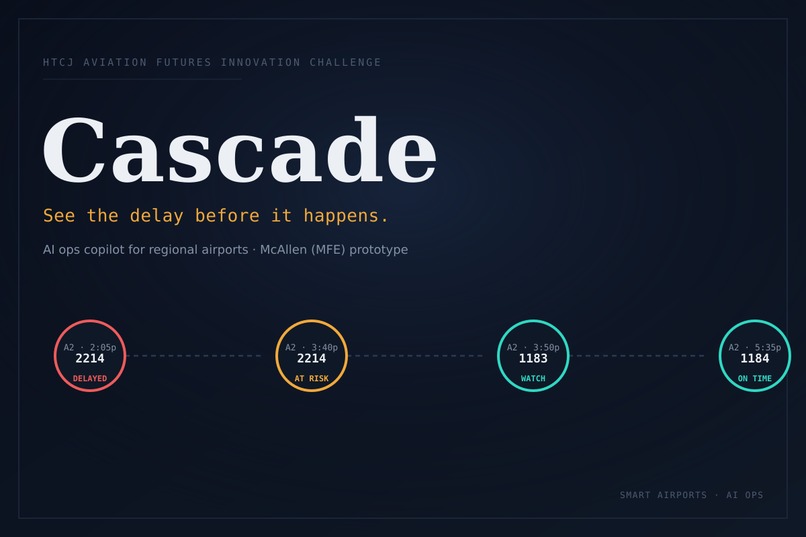
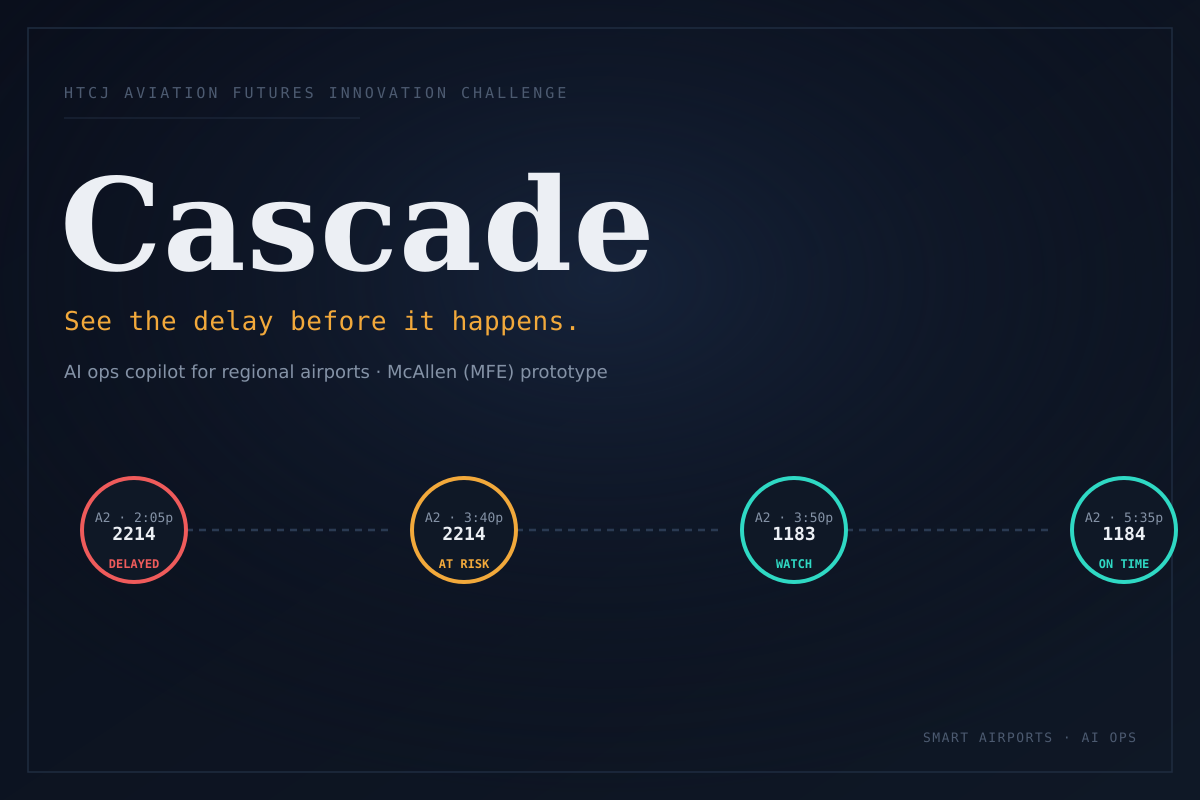
Cascade — an AI ops copilot for regional airports
-
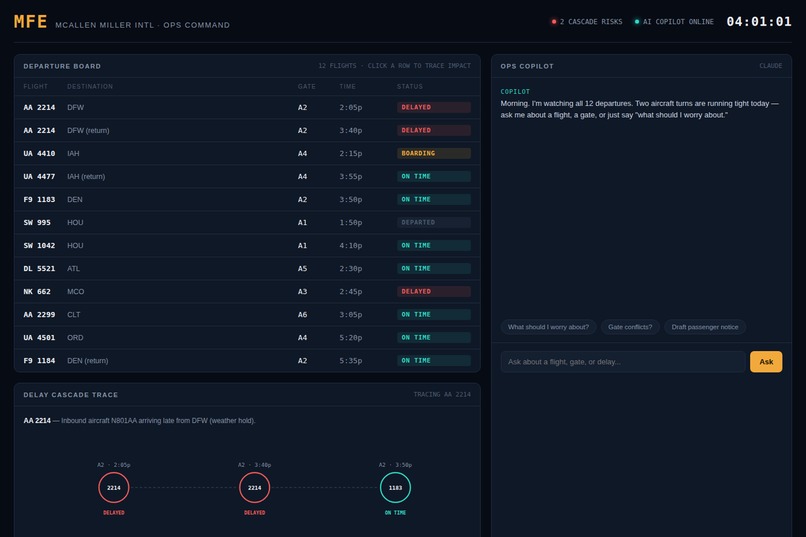
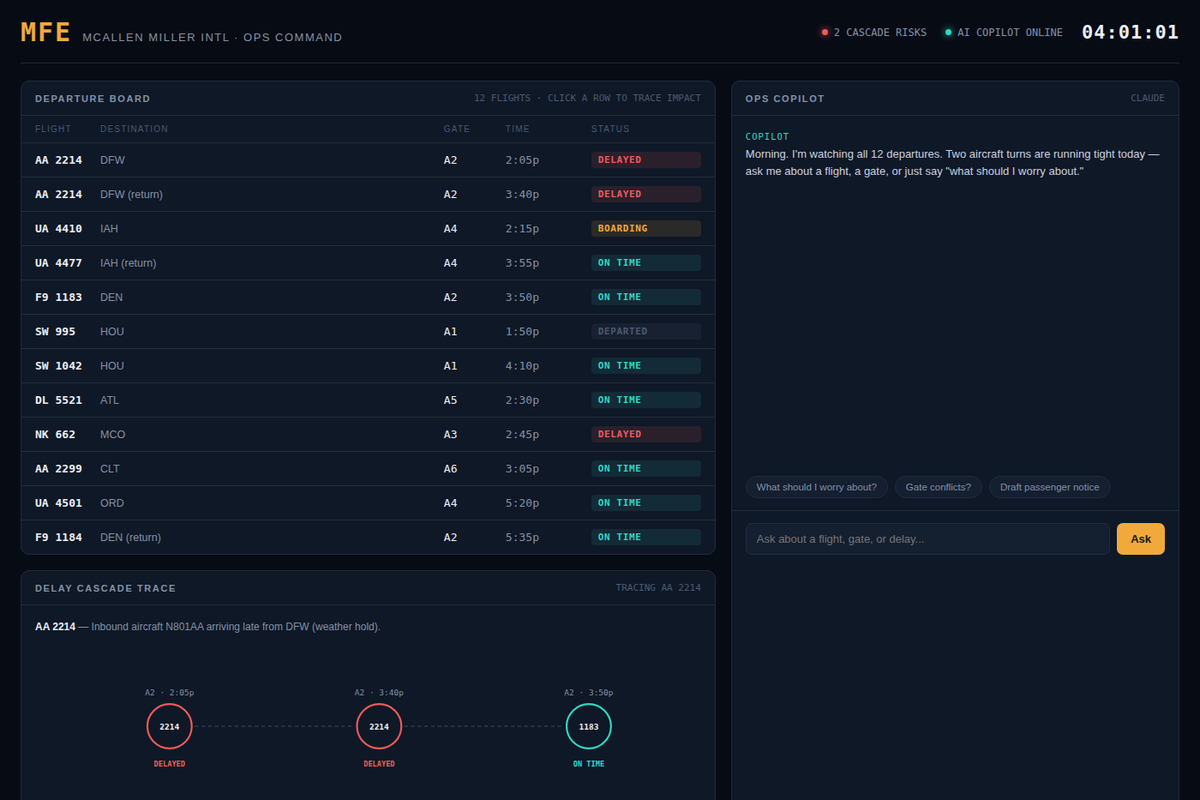
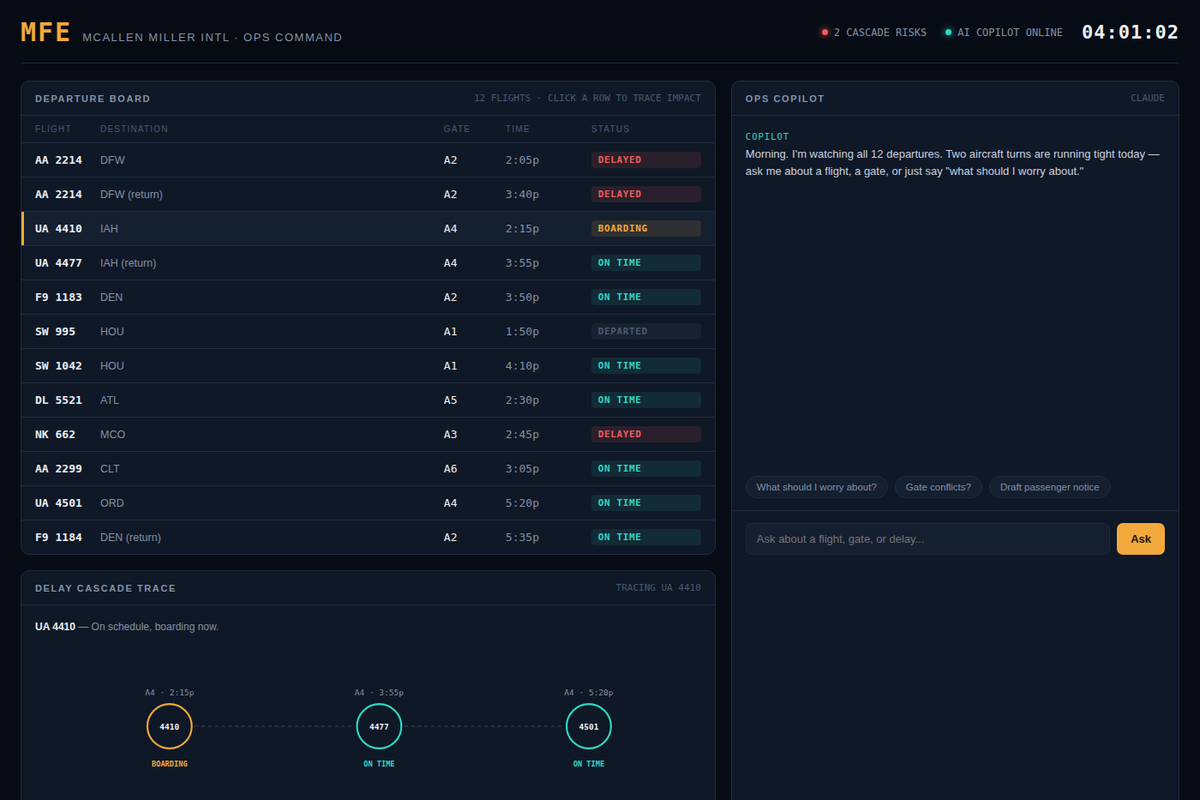
The full ops dashboard: live departure board, delay-cascade trace, and AI copilot in one view
-
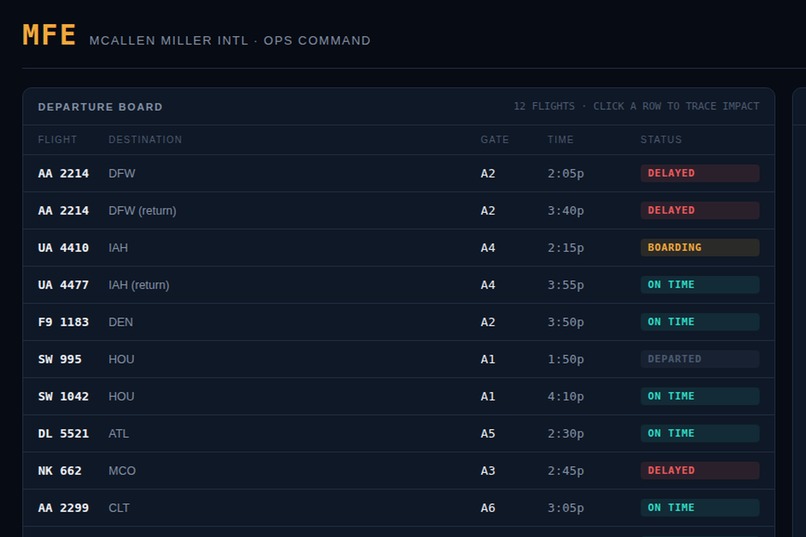
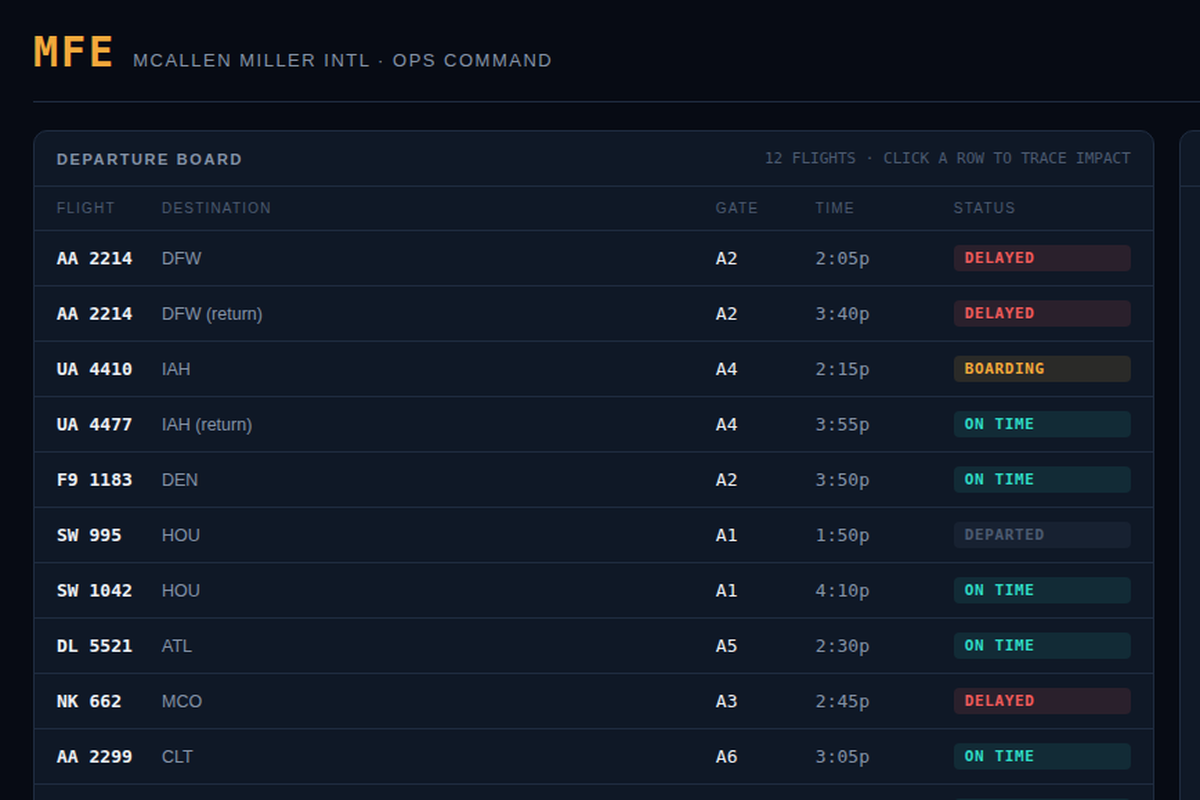
A live departure board styled after real split-flap displays — click any flight to trace its risk
-
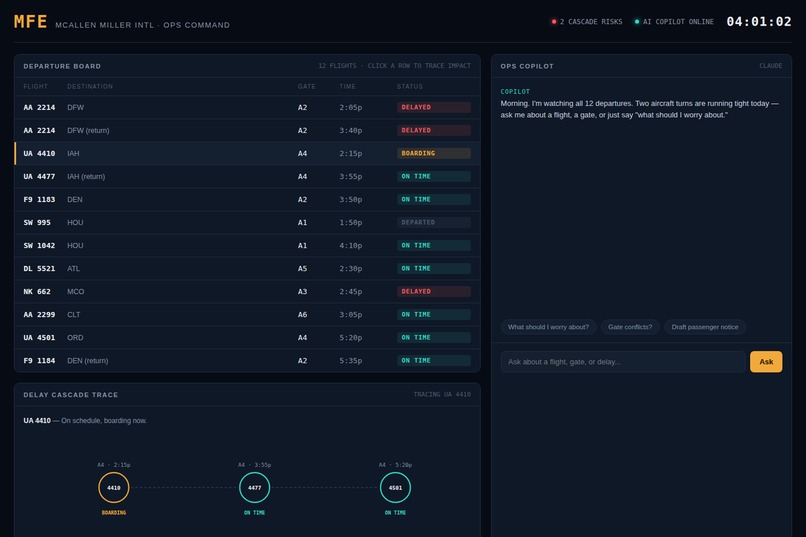
Selecting flight, traces its real dependencies, shared aircraft, shared gate, shared crew, and shows exactly where a delay would ripple next
-
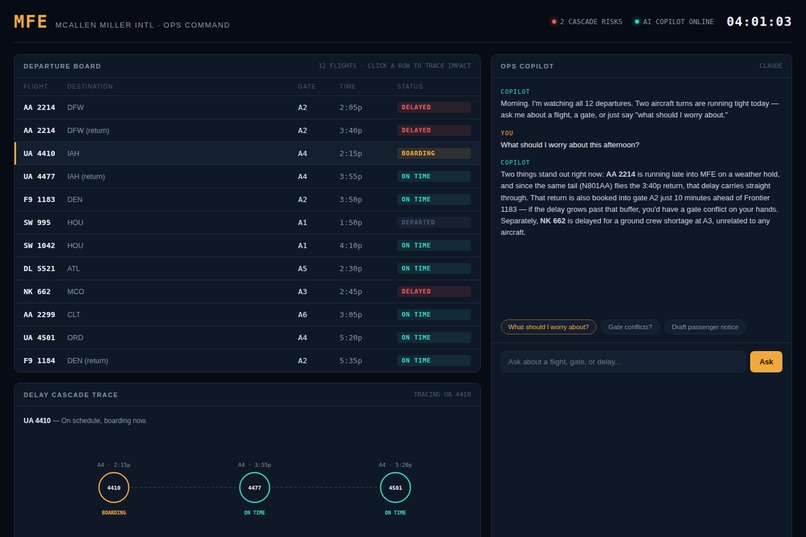
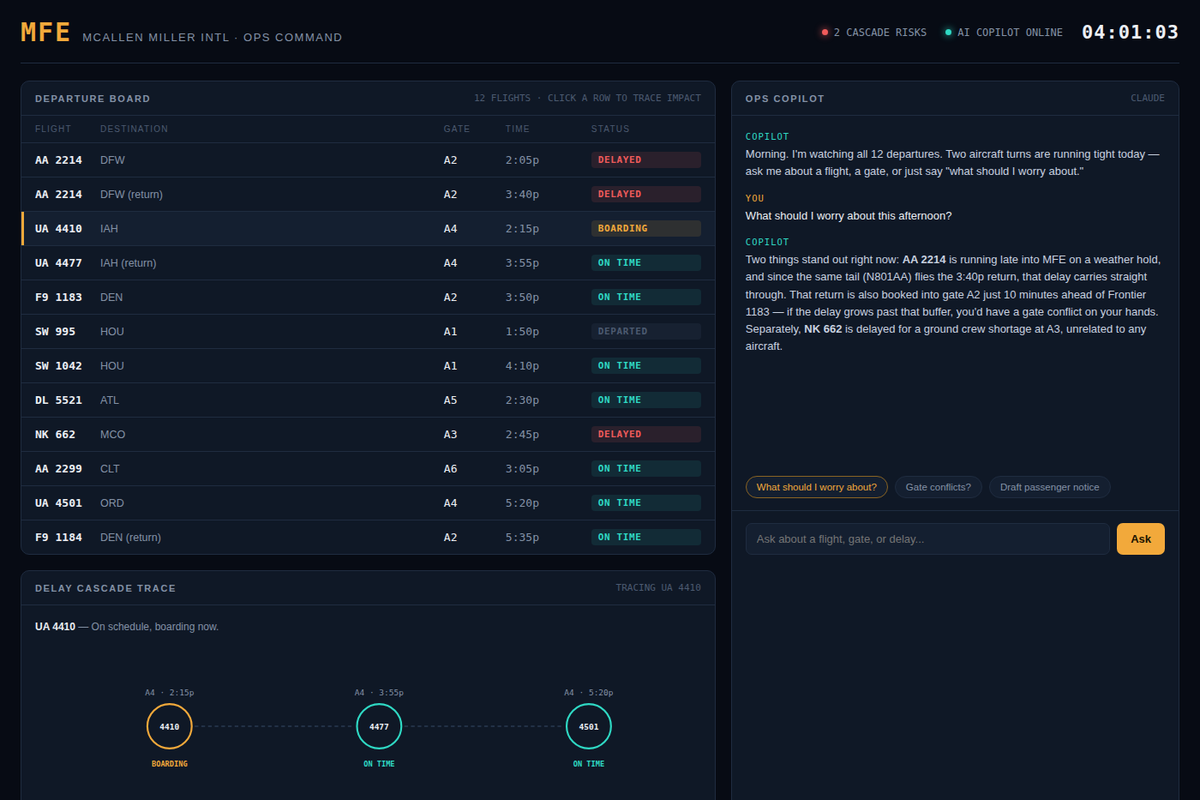
Ask the copilot a plain-language question and get an answer grounded in today's actual board, not a generic response
-
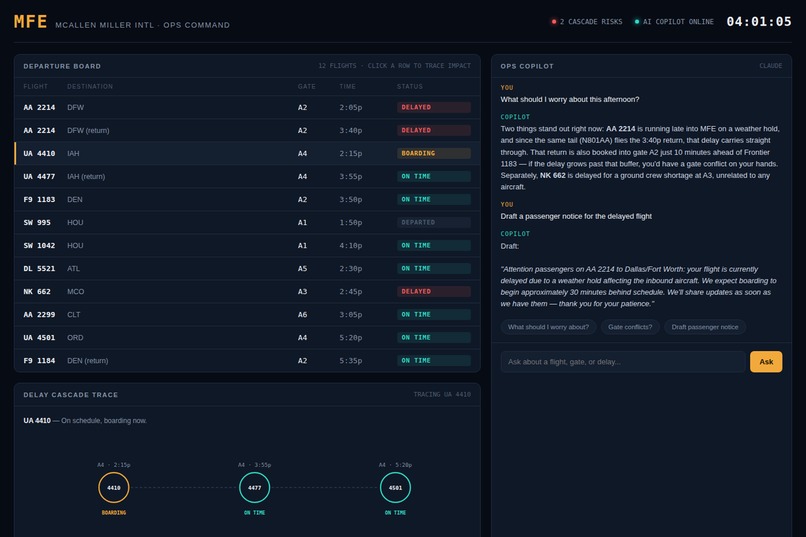
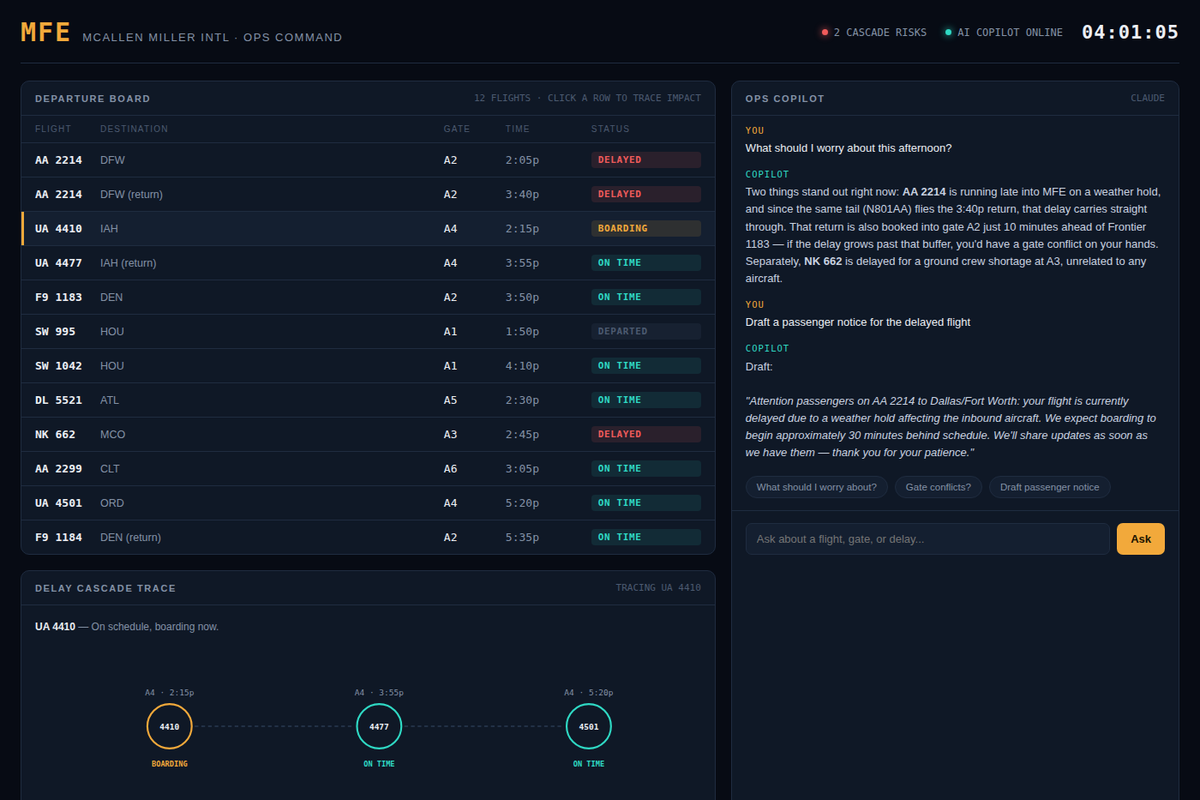
The copilot can also draft passenger notifications on demand, referencing the specific flight and delay reason
Inspiration
Regional airports run on the same complexity as major hubs — shared aircraft, tight gate turns, crews stretched across the day — but none of the predictive tooling. We saw this firsthand through work on a technology proposal for McAllen International Airport, where even basic flight information display infrastructure is a stretch for a mid-size airport's budget. The idea for Cascade came from a simple observation: airport staff usually only find out about a cascading delay after it's already cascaded. We wanted to build something that shows the ripple before it hits.
What it does
Cascade is an AI ops copilot for airport staff. It presents a live departure board, and when you select any flight, it traces the chain it's actually connected to — the same aircraft flying its next leg, a gate booked back-to-back, a crew rotating multiple times in a day. Instead of a wall of static flight data, staff see why a 20-minute delay on one flight might become a gate conflict three flights later. An AI copilot panel sits alongside the board, answering plain-language questions like "what should I worry about this afternoon?" or drafting a passenger notification — grounded in the actual state of the board, not a generic response.
How we built it
We built the board and cascade-tracing visualization as a single self-contained web app, styled after real split-flap departure displays — deliberately avoiding a generic dashboard look so it would feel like something built for an actual airport ops room. The cascade view models three real dependency types we saw discussed in airport operations: shared airframes, shared gates, and shared ground crews. The copilot is powered by Claude, given the live board state as context on every question so its answers stay tied to the specific flights and gates in front of the user rather than generic aviation advice.
Challenges we ran into
The hardest part wasn't the AI integration — it was deciding what to simplify. Real airport operations involve dozens of interlocking systems (crew scheduling, maintenance windows, air traffic control slots) and we had to pick the three dependency types that would tell a clear story in a short demo without pretending to solve the whole problem. Building the cascade visualization to update dynamically based on which flight was selected, while keeping it readable at a glance, took several passes. We also had to work within a tight hackathon timeline, which meant leaning hard on real domain context we already had from prior airport-facing work rather than researching from scratch.
Accomplishments that we're proud of
We're proud that Cascade doesn't just display data — it explains relationships in that data, which is the actual hard problem in airport ops. The copilot's answers are grounded in the live board rather than generic, which is what makes it feel like a real operations tool rather than a chatbot bolted onto a dashboard.
What we learned
We learned how much of "AI for aviation ops" is really an information design problem before it's a machine learning problem — the cascade only becomes useful once it's visible, legible, and tied to a concrete action. We also learned how much untapped opportunity exists for affordable, purpose-built tooling in the regional and mid-size airport space, which major vendors largely ignore.
What's next for Cascade
Next, we want to connect Cascade to real flight data feeds (FAA ASDI/FIDS integrations) instead of simulated data, extend the dependency model to include crew scheduling and maintenance windows, and add mobile alerts for gate agents so the cascade warning reaches the person who can act on it — not just the ops desk. Longer term, we see this as a product regional airports and ground handling companies could adopt directly, priced for airports that current enterprise ops software was never built for.
Built With
- airport-operations
- anthropic
- aviation
- claude
- claude-sonnet-4
- css3
- data-visualization
- generative-ai
- html5
- javascript
- natural-language-processing
- real-time
- svg


Log in or sign up for Devpost to join the conversation.