Inspiration
All the time we see turnovers at companies left and right, this costs a lot of money for HR because they have to do background checks. I wanted to find a solution that could save them money. Another problem in businesses is that a new employee many stays just until their training is over, then leave. This also costs a lot of money and time. The company losses the possibility of having more experienced employees working. I wanted to find a solution for this as well. Lastly, I just wanted to figure out what applicant for a company would be most beneficial for them, and the turnover time seemed like a good metric for this.
What it does
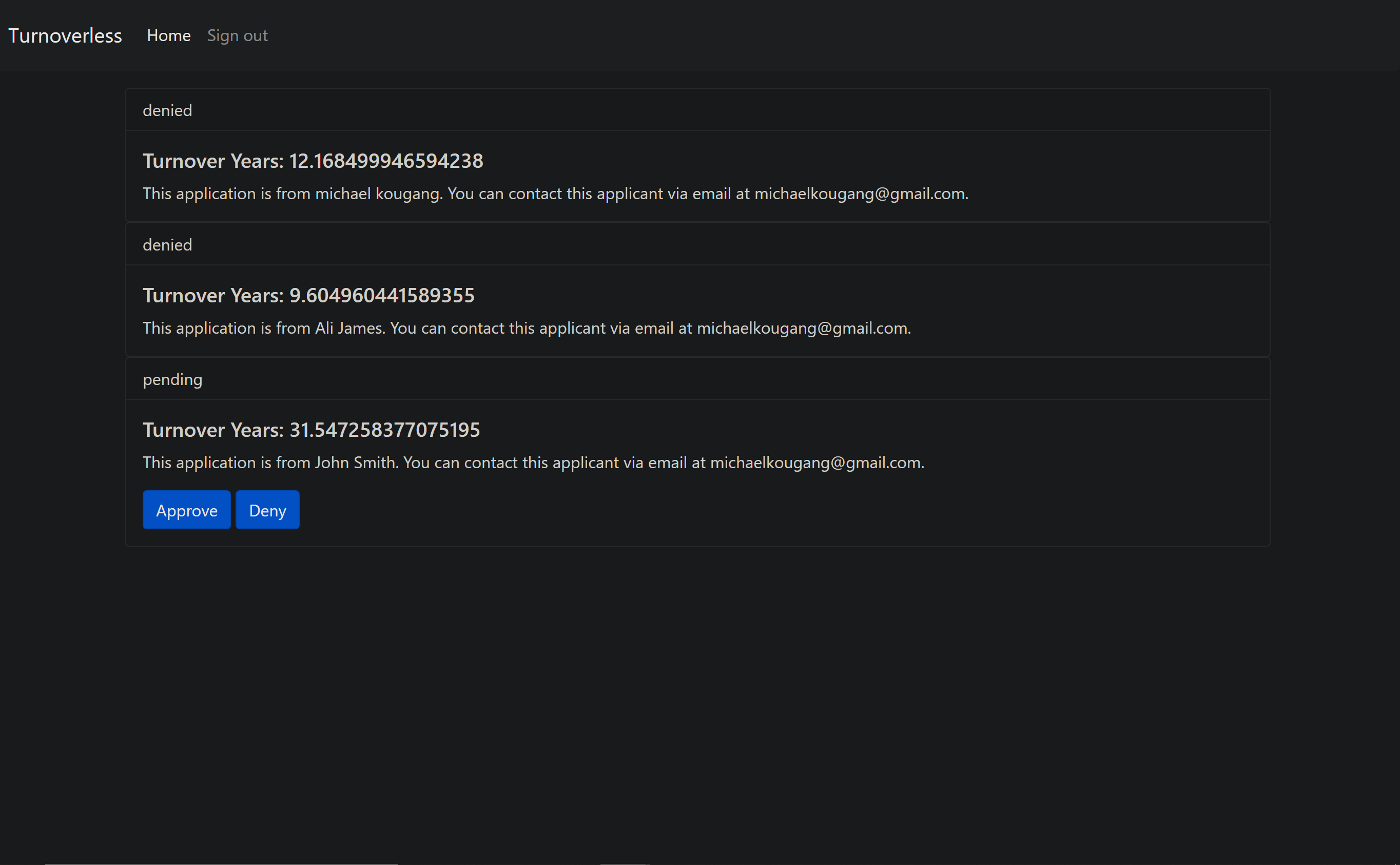
This application allows job applicants to apply to companies, allowing the company to approve or deny them based on the predicted turnover time for the applicant. The applicant applies by providing their email, name, and other information that allows the neural network to predict their turnover time in years.
How we built it
I build this using Python and Flask for the backend to run the API. I then also used TensorFlow, Keras, and Sklearn to preprocess the data, and train my neural network.
Challenges we ran into
One challenge I ran in to at the beginning was how to create the neural network, since I still am beginning with machine learning. I first thought that I could use linear regression, but that ended up to be very inaccurate. Later, when I was training a neural network, I ran in to problems because I didn't exactly know how to create a regression neural network at the time. Another challenge I ran in to was with the tensorflow library because it is too big to actually be deployed on Heroku, I had to use an earlier version of python to allow deploying to Heroku.
Accomplishments that we're proud of
I am proud that I was able to create a neural network model that can predict the turnover time. I am also proud that I was able to save data using MongoDB because this is my first time using that. I am very happy that I got this application to work for the pubic on a deployed webapplication.
What we learned
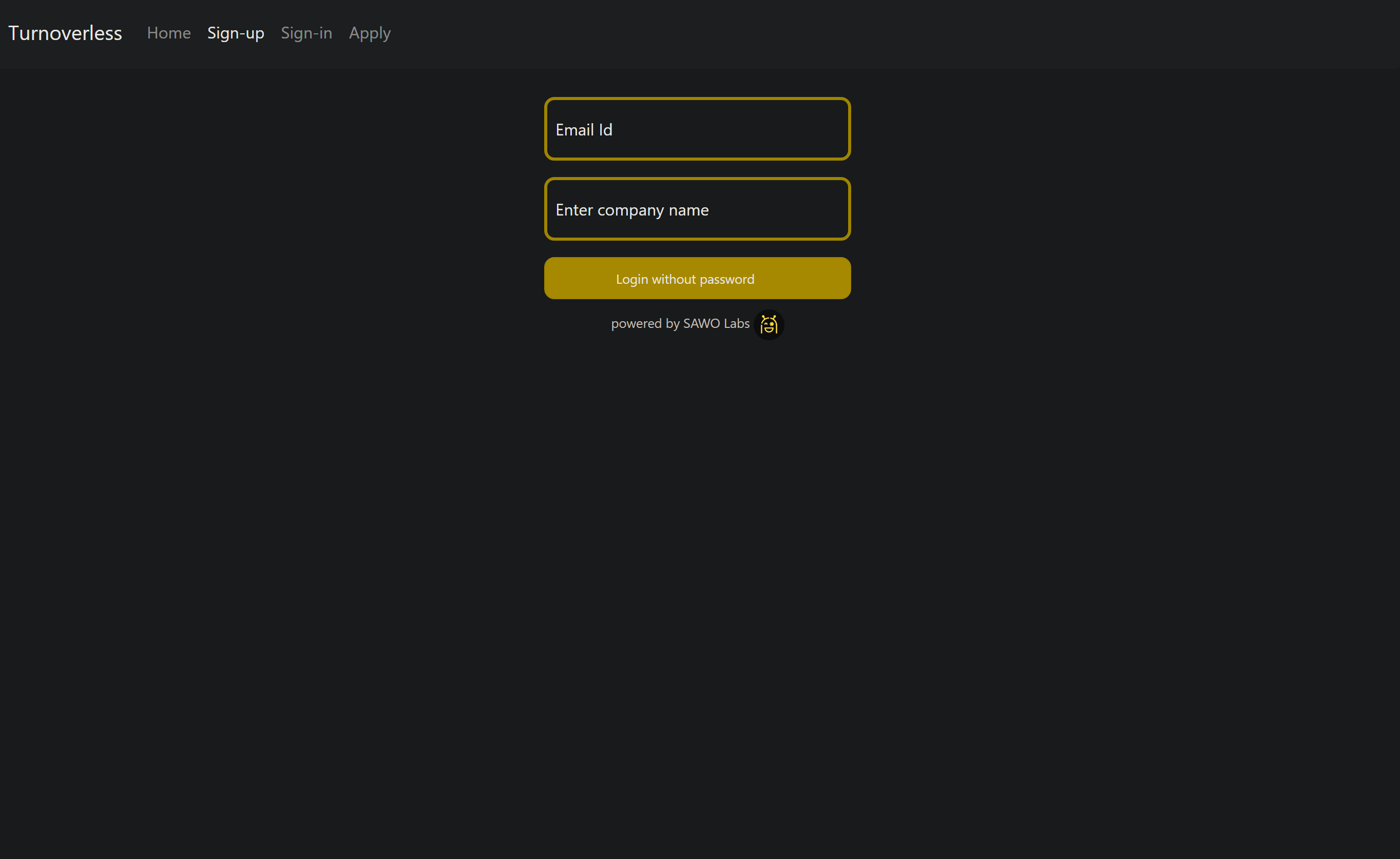
As I mentioned previously, this is my first time using MongoDB, so it was very interesting to learn how to use, as it is not based on SQL. I also learned how to train a regression neural network and predict values based on user input. Also, I learned how to use SAWO API to create forms to enter user data.
What's next for Turnoverless
The next step for Turnoverless is to improve the UI, so it is easier for users to use. Also another step is to attain a larger dataset to more accurately predict the turnover time. It would also be useful if this model could predict other useful information for the company that could bring significant benefit. Lastly, I think it would be helpful if I could create a more defined system to approve and deny applicants by sending emails.

Log in or sign up for Devpost to join the conversation.