-
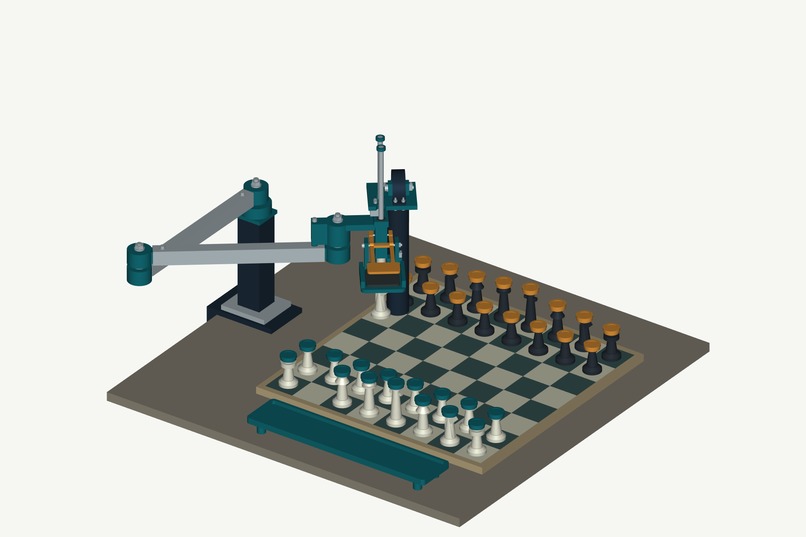
TurnMate CAD assembly showing a knight lifted above c3.
Inspiration
Choosing a chess move and physically making that move are different tasks. TurnMate began with the goal of reducing the finger grip needed to handle pieces while keeping the player in control of the game.
During development, a public family account describing difficulty picking up and putting down game pieces because of arthritis helped sharpen this focus. This was published context, not an interview or a test of TurnMate.
The intended user is a seated chess player with limited finger grip who can comfortably guide a tool using broader shoulder and elbow movements.
What it does
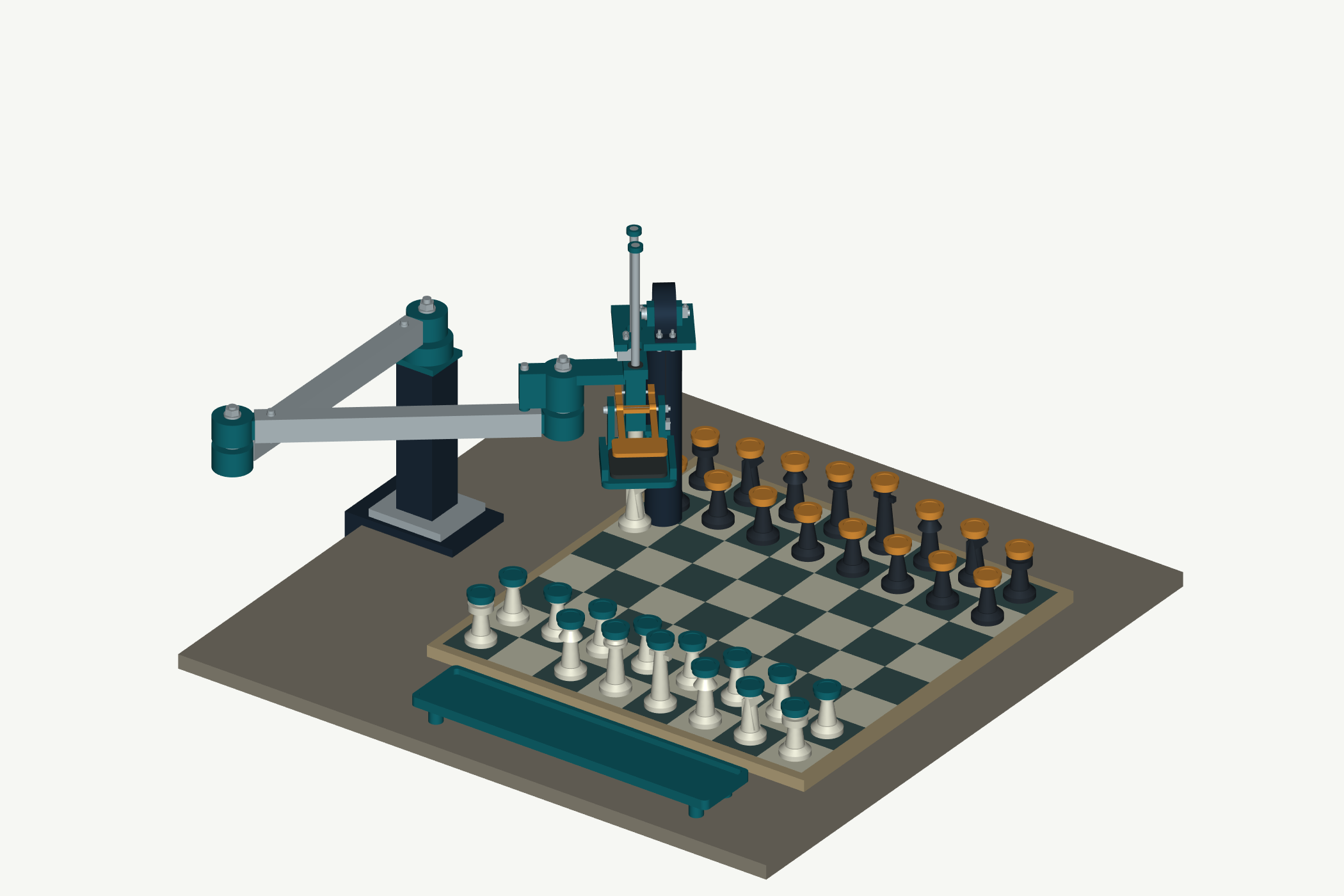
TurnMate is a manual, table-mounted piece-placement arm. Two articulated links position a pickup head over the board, while a counterweighted vertical slide provides lifting motion.
An open palm cradle lets the player guide the head without maintaining a tight finger pinch. A captive magnet connects to a steel target retained in a compatible piece cap. After lowering the piece onto its destination, the player presses a broad release lever, withdrawing the magnet inside a sleeve to release the piece.
The player chooses every move and controls the pace. There are no motors, batteries, or automated move decisions.
The submission includes a matching compact chess set and compatible caps. Compatibility with arbitrary commercial chess pieces has not been established.
How it was built
TurnMate was developed as an AI-assisted CAD concept using CadQuery, Python, Open CASCADE, and FreeCAD.
The assembly includes the table clamp, articulated links, guide shafts, bushings, counterweight enclosure, pickup mechanism, release lever, and compatible chess pieces. Positive travel stops and retained components were incorporated to make the mechanism more complete and reviewable.
The submission contains 77 individual component STEP files, assembled STEP models, a native FreeCAD document, reproducible source files, and technical documentation.
Digital checks confirmed valid component solids and analytical linkage reach to all 64 square centers on a 400 mm chessboard. Collision screening covered the illustrated assembly pose and sampled lift and release positions.
These checks establish aspects of the CAD geometry; they do not establish physical usability or safe performance.
Challenges and lessons
The central challenge was making pickup and release work together within a crowded mechanism. Iterations addressed interference around the release lever, guide hardware, and palm interface, while adding retention features and travel stops.
The design process also highlighted that reaching a square is only one part of accessibility. Setup, lifting effort, release control, neighboring-piece clearance, and the player’s preferred way of participating all matter.
Built With
- cadquery
- cascade
- freecad
- open
- openai
- python
- vtk
