Turning ILI Runs into Actionable Integrity Insights
Inspiration
Pipeline integrity decisions rely on comparing In-Line Inspection (ILI) runs collected years apart.
In practice, these datasets cannot be directly compared due to odometer drift, vendor differences, renamed or missing features, and sensor uncertainty.
Today, integrity engineers manually align these runs — a process that can take weeks, varies analyst to analyst, and can introduce false corrosion growth or missed defects.
We were inspired by a simple but critical question:
How can we turn misaligned ILI data into physically honest, defensible integrity insights—automatically?
This project was motivated by real-world integrity workflows where alignment errors matter as much as corrosion itself, directly impacting safety, compliance, and excavation decisions.
What We Built
We built a physics-aware, engineering-driven system that:
- Aligns multiple ILI runs to a common physical reference frame
- Matches corrosion anomalies across years with explicit confidence scoring
- Calculates annualized corrosion growth rates
- Identifies interaction zones where clustered defects increase failure risk
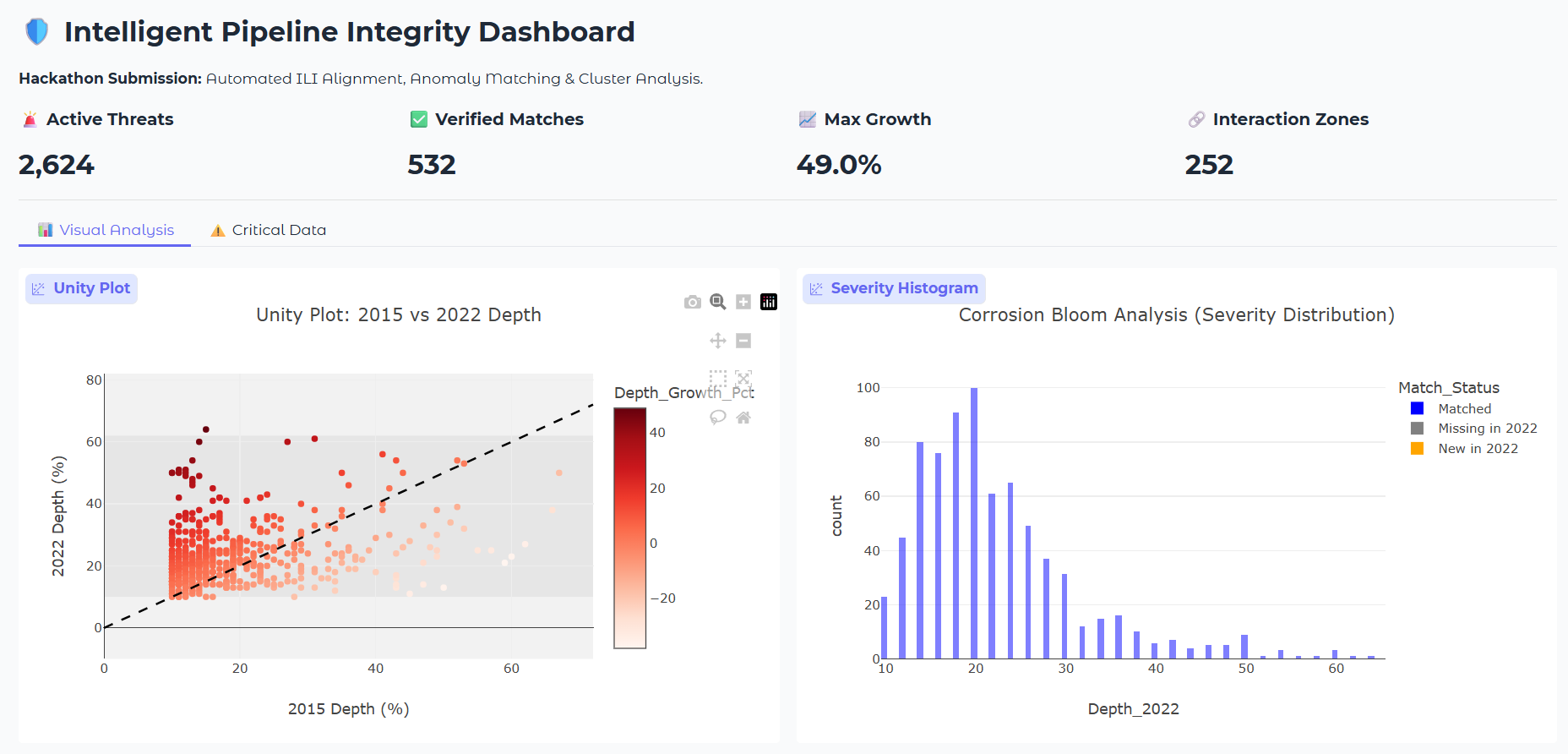
- Converts thousands of anomalies into a small, actionable set of dig locations
The system transforms raw inspection data into clear integrity decisions, not just matched rows.
How We Built It
Our approach was structured into three engineering phases.
Phase 1 — Reference Alignment (“Common Ruler”)
ILI odometer error accumulates gradually, meaning a simple shift correction is incorrect.
We applied a rubber-sheeting alignment, where distance correction scales along the pipeline.
- Used rare, fixed features (valves, tees, taps) as anchors
- Matched anchors using elevation fingerprints, even when names differed
- Interpolated correction between anchors to remove drift
This produced a physically consistent alignment where corrected pipeline lengths converged.
Phase 2 — Anomaly Matching & Growth Engine
We focused only on metal loss features, since growth prediction is meaningful only for corrosion.
Each anomaly was matched using multiple physical constraints:
- Corrected distance (± tolerance)
- Clock position (circular math)
- ID/OD consistency
- Dimensional sanity checks
We introduced confidence scoring, starting from 100% and applying penalties for mismatches, allowing the algorithm to say “I’m not sure” instead of forcing bad matches.
Corrosion growth was computed as annualized depth growth
This normalization prevents misleading conclusions from total growth alone.
Phase 3 — Interaction Zone Analysis
Single pits rarely fail pipelines — clusters do.
We applied DBSCAN clustering to group nearby corrosion features into interaction zones:
- No predefined cluster count
- Noise-resistant
- Aligned with corrosion physics
This reduced thousands of anomalies into a few hundred high-risk dig locations.
Challenges We Faced
- Odometer drift increased non-linearly over long distances
- Feature names and identifiers changed between vendors and runs
- Joint numbers failed due to pipe replacements
- Sensor tolerance produced apparent “negative growth”
- Anomalies split, merged, or disappeared between inspections
Instead of hiding these issues, we designed the system to expose uncertainty explicitly.
What We Learned
- Alignment is the hardest problem in ILI analytics — not growth modeling
- Confidence scoring is more valuable than forced precision
- Average corrosion rates look safe; outliers drive failures
- Growth distributions reveal physics when alignment is correct
- Explainability is essential in safety-critical engineering systems
Most importantly, we learned that integrity analytics must respect physical reality, not just data similarity.
Looking Ahead
This project is a foundation for:
- Circumferential (2D) clustering
- Automated dig-sheet generation
- Bayesian corrosion growth modeling
- Pressure re-rating simulations
- Digital pipeline integrity twins
Our goal is to help pipeline operators move from manual alignment and reactive decisions to predictive, data-driven integrity management — safely and transparently.
Built With
- colab
- gradio
- jupyter
- llm


Log in or sign up for Devpost to join the conversation.