-
-
Poster
Abstract
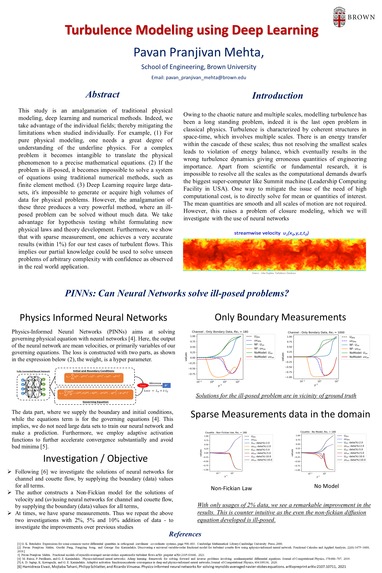
This study is an amalgamation of traditional physical modeling, deep learning and numerical methods. Indeed, we take advantage of the individual fields; thereby mitigating the limitations when studied individually. For example, (1) For pure physical modeling, one needs a great degree of understanding of the underline physics. For a complex problem it becomes intangible to translate the physical phenomenon to a precise mathematical equations. (2) If the problem is ill-posed, it becomes impossible to solve a system of equations using traditional numerical methods, such as finite element method. (3) Deep Learning require large data-sets, it's impossible to generate or acquire high volumes of data for physical problems. However, the amalgamation of these three produces a very powerful method, where an ill-posed problem can be solved without much data. We take advantage for hypothesis testing whilst formulating new physical laws and theory development. Furthermore, we show that with sparse measurement, one achieves a very accurate results (within 1%) for our test cases of turbulent flows. This implies our partial knowledge could be used to solve unseen problems of arbitrary complexity with confidence as observed in the real world application.
Full Report
https://drive.google.com/file/d/1V2Tcm8PI3TPeV6RJJPOCLTkUql3V_Sbf/view?usp=sharing
Built With
- tensorflow


Log in or sign up for Devpost to join the conversation.