-
-
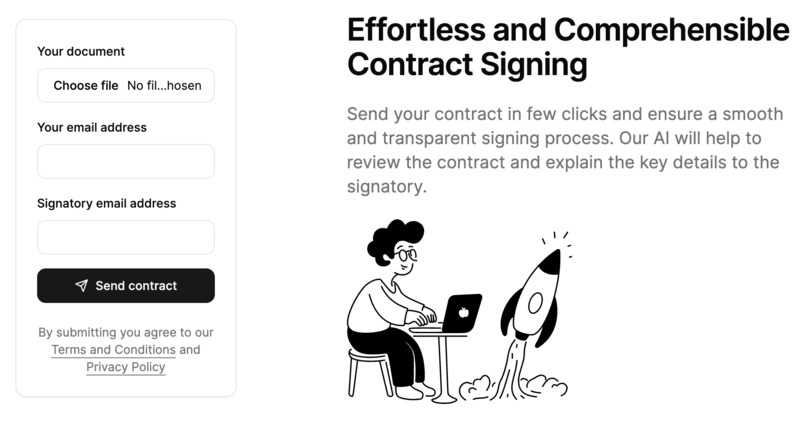
Document sending interface
-
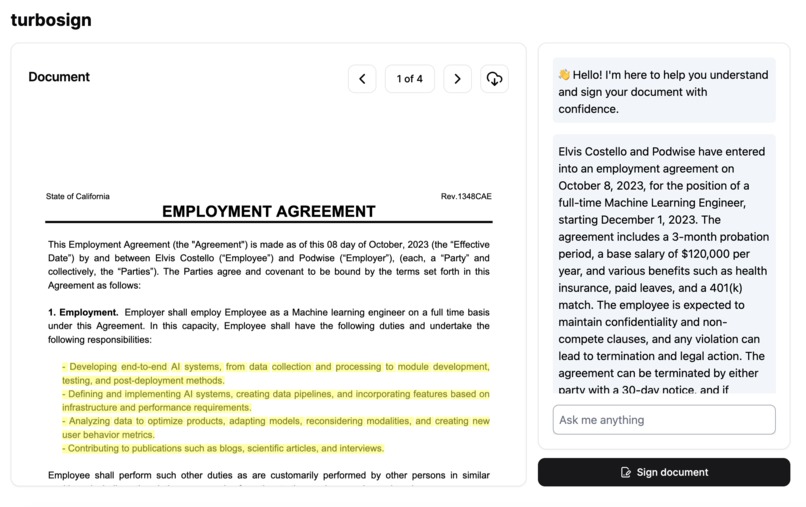
Document signing interface
Inspiration
Our vision for TurboSign was sparked by the simplicity and effectiveness of existing electronic signature platforms such as DocuSign, YouSign, and the seamless file transfer system of WeTransfer. While we admired these platforms, we identified a significant gap in the market. Most solutions, like DocuSign, primarily cater to the issuer, leaving the signatory with limited assistance in understanding the contract details.
This realization inspired us to create TurboSign, an app that not only facilitates electronic signatures but also aids in the comprehensive review and understanding of contract details. By integrating the convenience of electronic signatures with the intelligence of AI, TurboSign offers a balanced, user-friendly solution for both issuers and signatories, making contract signing a more informed and effortless process.
What it does
TurboSign is an application that streamlines the process of sending and signing documents electronically. It allows users to send their contracts for signature in just a few clicks, ensuring a smooth and transparent signing process.
- AI-Powered contract review: TurboSign's AI reviews contracts and presents a summary to the signatory, highlighting key details. This feature aids in understanding the contract, reducing potential disputes.
- Electronic signature: After reviewing the contract, signatories can sign electronically via TurboSign, eliminating the need for physical paperwork.
- Document delivery: Post signing, TurboSign emails the document to all parties, ensuring everyone has a copy of the signed contract.
How we built it
We built TurboSign using Next.js for the front-end development and leveraged LangChain and OpenAI's GPT-4 API for the AI-powered contract review feature. These technologies enabled us to create a robust and efficient electronic signature solution that delivers a seamless user experience.
Challenges we ran into
One of the main challenges we faced during the development of TurboSign was dealing with the 8k token limit of OpenAI's GPT-4. This limit posed a significant challenge when it came to handling lengthy contracts, as it meant we had to find a way to effectively summarize and present these contracts within this constraint.
Initially, we struggled with how to break down large contracts into smaller sections without losing the context or key details. It was a complex task to ensure that the AI could still understand and accurately summarize the contract when it was divided into smaller parts.
Accomplishments that we're proud of
One of the accomplishments we're most proud of is how we managed to successfully organize and share the workload despite all team members having full-time jobs. Balancing the demands of a full-time job with the development of TurboSign was a significant challenge, but we were able to overcome it through effective time management and teamwork.
We established a clear and organized workflow, dividing tasks based on each team member's strengths and availability. Regular meetings and constant communication ensured that everyone was on the same page and that progress was being made consistently.
Despite the time constraints, we were able to deliver a fully functional application that not only meets but exceeds our initial expectations. This experience has not only resulted in a product we're proud of, but also strengthened our teamwork and project management skills.
What we learned
- Dropbox Signing API: We learned how to integrate the Dropbox Signing API for electronic signature functionality in our application. This API facilitated a seamless and user-friendly signing process.
- Large Language Models: Despite the token limit, we effectively utilized Large Language Models to analyze and summarize lengthy contracts. This significant part of our project provided valuable insights into the capabilities and applications of advanced AI models.
What's next for TurboSign
The next steps for TurboSign involve a rigorous phase of user testing to validate our proof of concept. We believe in the importance of user feedback in shaping a product that truly meets the needs of its users.
On the tech side, we have a couple of exciting developments in the pipeline:
We are in the process of fine-tuning and customizing the LLM. We are exploring the use of alternative models and are currently working on a llama2 fine-tuned model variant. This will help us improve the accuracy and efficiency of our system.
We are also planning to add computer vision capabilities to our platform. This will significantly improve document readability, especially for documents with a lot of handwritten information. Currently, we struggle with such documents, but with the integration of computer vision, we aim to overcome this challenge.
These advancements will not only enhance the functionality of TurboSign but also provide a more seamless and user-friendly experience for our users.
Built With
- dropboxsign
- gpt-4
- langchain
- nextjs


Log in or sign up for Devpost to join the conversation.