Inspiration
We’ve all heard the startup mantra: "Move fast and break things." But in the rush to ship, the first thing that usually breaks is security.
We realized that most developers in hackathons and early-stage startups skip security checks not because they don't care, but because the tools get in their way. Traditional SAST tools are slow, expensive, and often require complex CI/CD configurations that break the "flow state" of a hackathon or sprint.
We built Turbo Broccoli to bridge this gap. We wanted a tool that matches the speed of modern development one that runs instantly in the browser, respects data privacy, and turns vulnerability remediation from a chore into a one-click action.
What it does
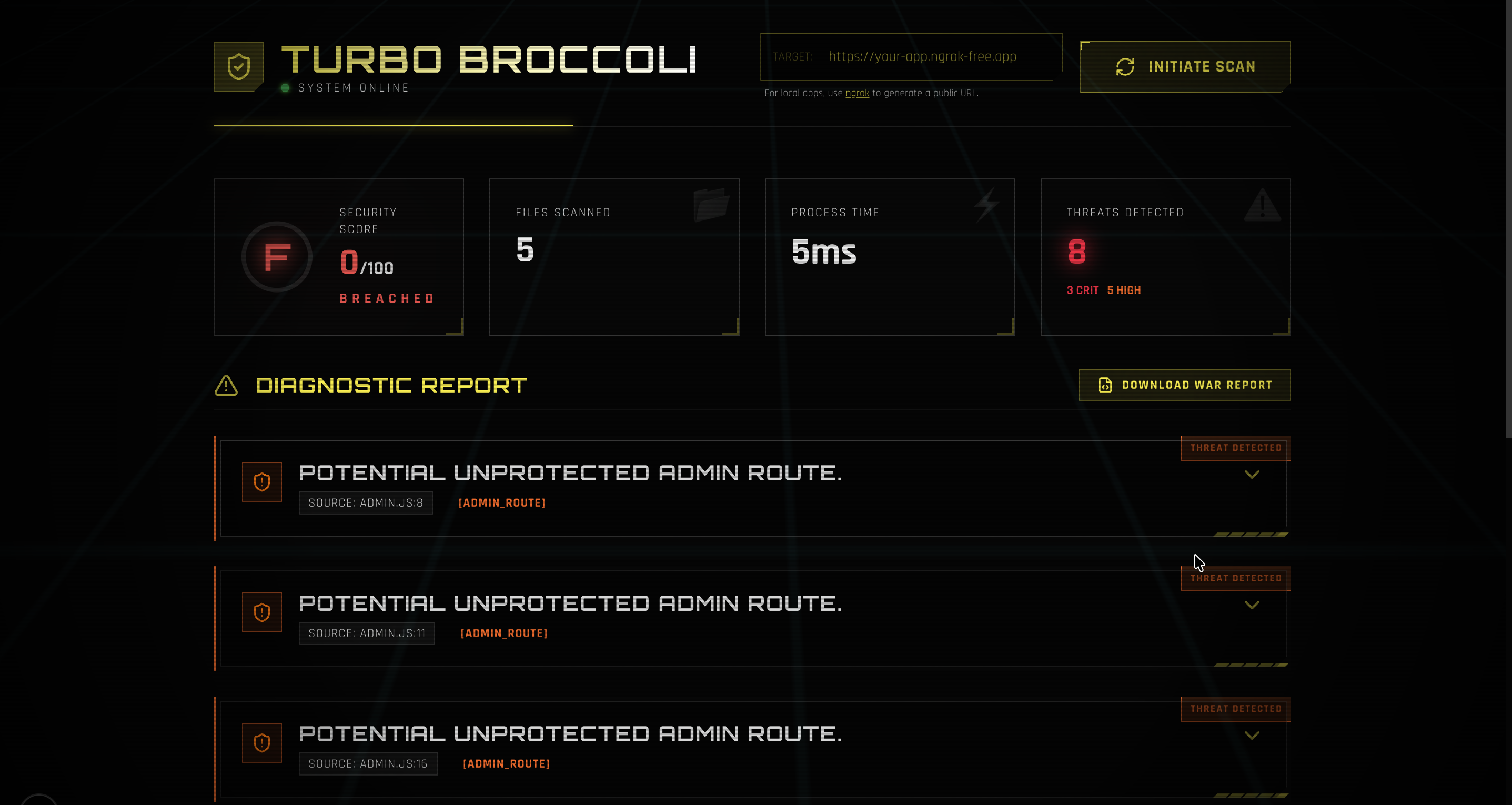
Turbo Broccoli is a hybrid client-side security analysis engine designed to catch vulnerabilities before deployment.
- Local Static Analysis (SAST): It uses the File System Access API to scan your local directory in real-time without uploading your entire codebase to a server. It runs both Regex-based pattern matching (for secrets, API keys) and AST-based analysis (for deeper logic flaws like SQL injection).
- Dynamic Siege (DAST): It actively probes your running application (e.g., ngrok URL) to check for security headers, exposed
.gitdirectories, and public admin routes. - AI Remediation: When a vulnerability is found, it uses Google's *Gemini * model to generate context-aware code fixes, which can be applied to patch the issue instantly.
- War Report Generation: It generates a downloadable Markdown "War Report" summarizing system integrity and detected threats.
How we built it
We built this to look like a hacking terminal but run like a modern SaaS.
- Frontend: Next.js 16 and React 19 drive the "Glitch-Cyber" UI. We used Tailwind CSS for the cryptographic aesthetic.
- The Brain (Static): We built a custom AST (Abstract Syntax Tree) parser using Acorn that runs entirely in the browser. This allows us to "understand" code structure, not just Regex match it.
- The Muscle (Dynamic): We used Next.js API Routes to create a proxy server that performs active "Siege" scans (checking headers, git exposure, admin routes) to bypass CORS restrictions.
- The Medic (AI): We integrated the
@google/generative-aiSDK. We engineered specific prompts to ensure Gemini acts as a "Senior Security Engineer," returning only clean, executable code blocks for fixes.
Challenges we ran into
- The "Browser Jail": Browsers are designed not to let websites read your file system. Implementing the File System Access API recursively while filtering out
node_modules(which killed our memory usage) was a massive hurdle. - Handling AST in Typescript: Writing a parser that can handle both
.jsand.tsxsyntax client-side without crashing was difficult. We had to implement strict error boundaries around our Acorn parser to ensure one bad file didn't crash the whole engine. - The Gemini Rate Limit: We wanted to fix everything, but AI APIs have limits. We had to build a custom in-memory rate limiter to queue our fix requests so we didn't get
429errors from Google.
Accomplishments that we're proud of
- Zero-Knowledge Architecture: We are incredibly proud that the Static Analysis happens 100% in-memory on the client. Your source code is never uploaded to our servers during the scan phase.
- The "War Report": We successfully combined two completely different security paradigms (SAST & DAST) into a unified, actionable report that gives a 360-degree view of application security.
- Gamification: We managed to turn a dry topic like security into an engaging experience with our "Cyberpunk" UI, real-time scoring system, and "Fortress" vs. "Breached" grading scale.
What we learned
- Security is Nuanced: We learned that some bugs (like weak JWT algorithms) are best found statically, while others (like missing CORS headers) can only be truly verified dynamically. A single approach is never enough.
- The Power of ASTs: We gained a deep appreciation for Abstract Syntax Trees. They allow you to treat code as data, unlocking powerful analysis capabilities that simple text search cannot match.
- Browser Capabilities: We pushed the limits of modern browser APIs, realizing that the web platform is now powerful enough to host complex developer tools that previously required a desktop app.
What's next for Turbo Broccoli
- IDE Extensions: Bringing the scanner directly into VS Code so developers see alerts as they type.
- CI/CD Integration: Creating a GitHub Action to block pull requests if the "Security Score" drops below a certain threshold.
- Broader Language Support: Expanding our AST parsers to support Python and Go, making Turbo Broccoli a universal tool for backend security.
Built With
- acorn
- gemini
- next.js
- node.js
- react
- tailwindcss
- typescript
- vercel

Log in or sign up for Devpost to join the conversation.