-
-
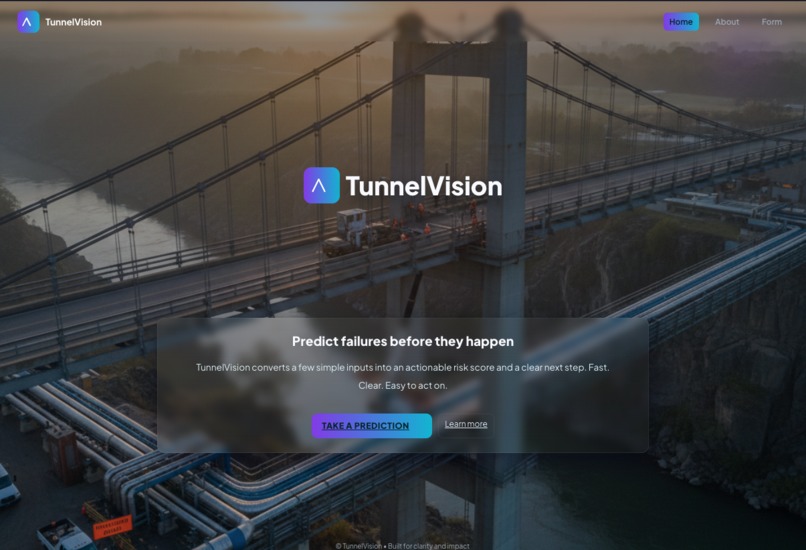
Home page
-
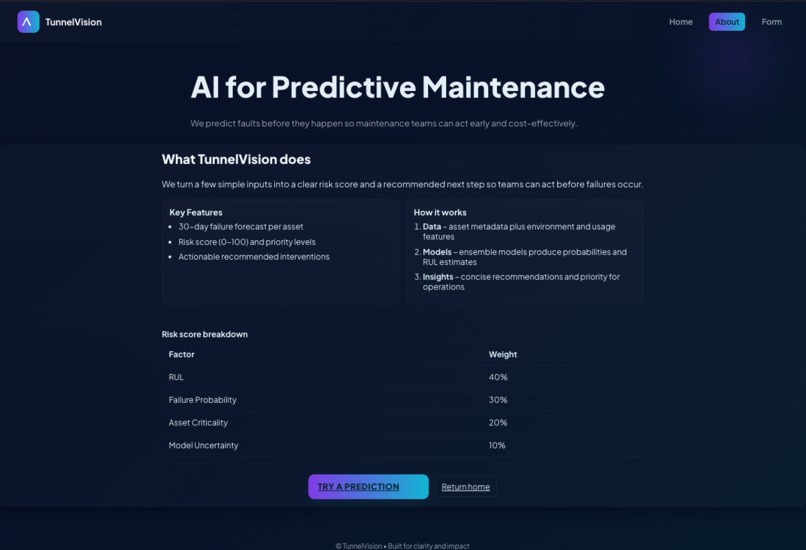
About page
-
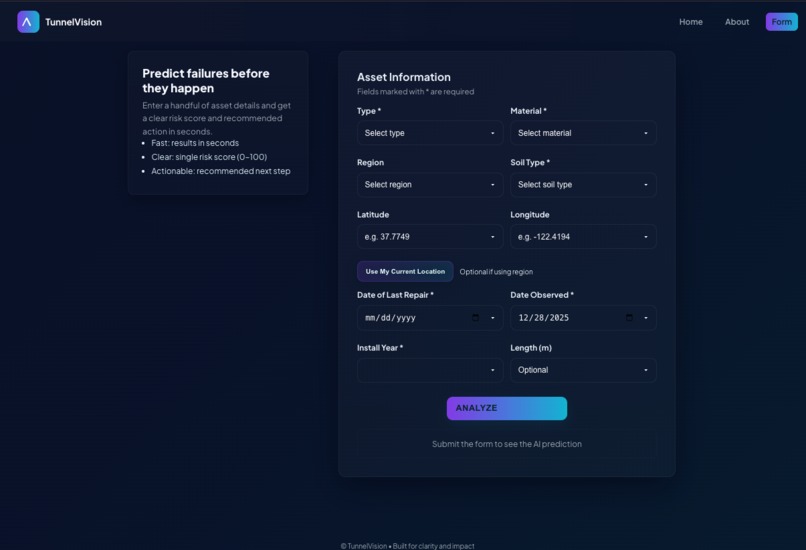
Form page
-

Logo
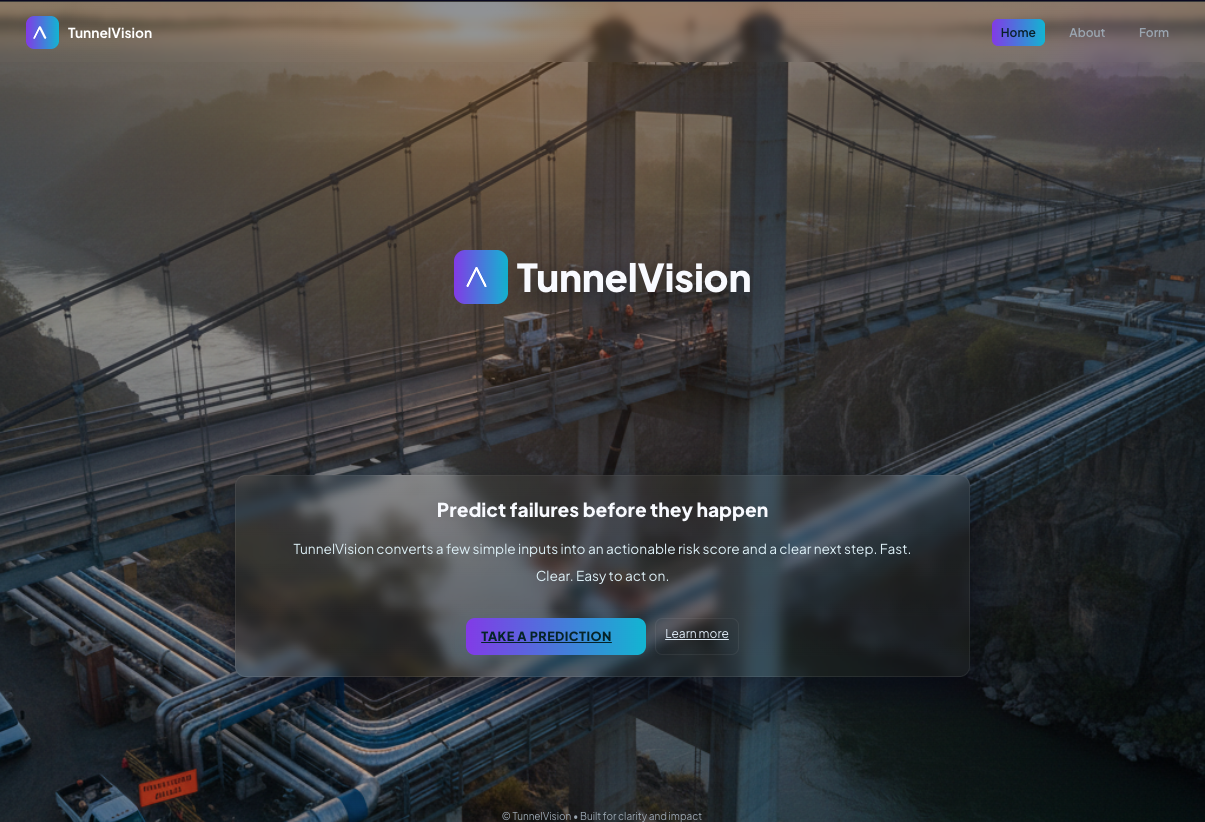

TunnelVision
What if cities could fix infrastructure before it failed?
TunnelVision is a beginner-built AI system that explores how predictive models can help Bay Area communities move from reactive repairs to proactive maintenance—designed and implemented by a team learning AI from scratch.
Inspiration
Communities across the Bay Area depend on aging infrastructure that often fails without warning. Flooded roads, broken pipes, and emergency repairs disrupt daily life, strain city budgets, and pose real safety risks. Yet many maintenance systems are still reactive, responding only after failures occur.
Our team was inspired to explore whether AI could help surface infrastructure risk earlier and support better decision-making for the people responsible for maintaining city systems. TunnelVision grew out of the question: what if cities could see problems coming before they happened?
What it does
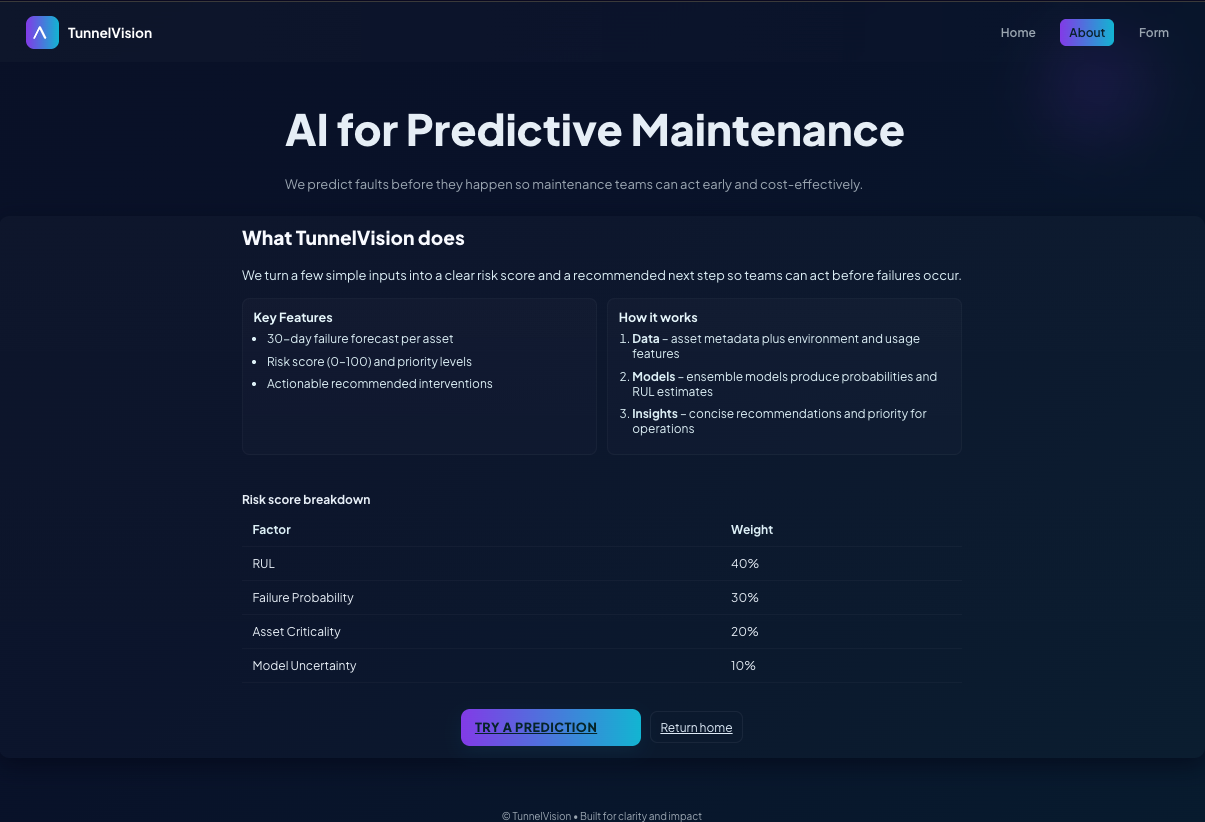
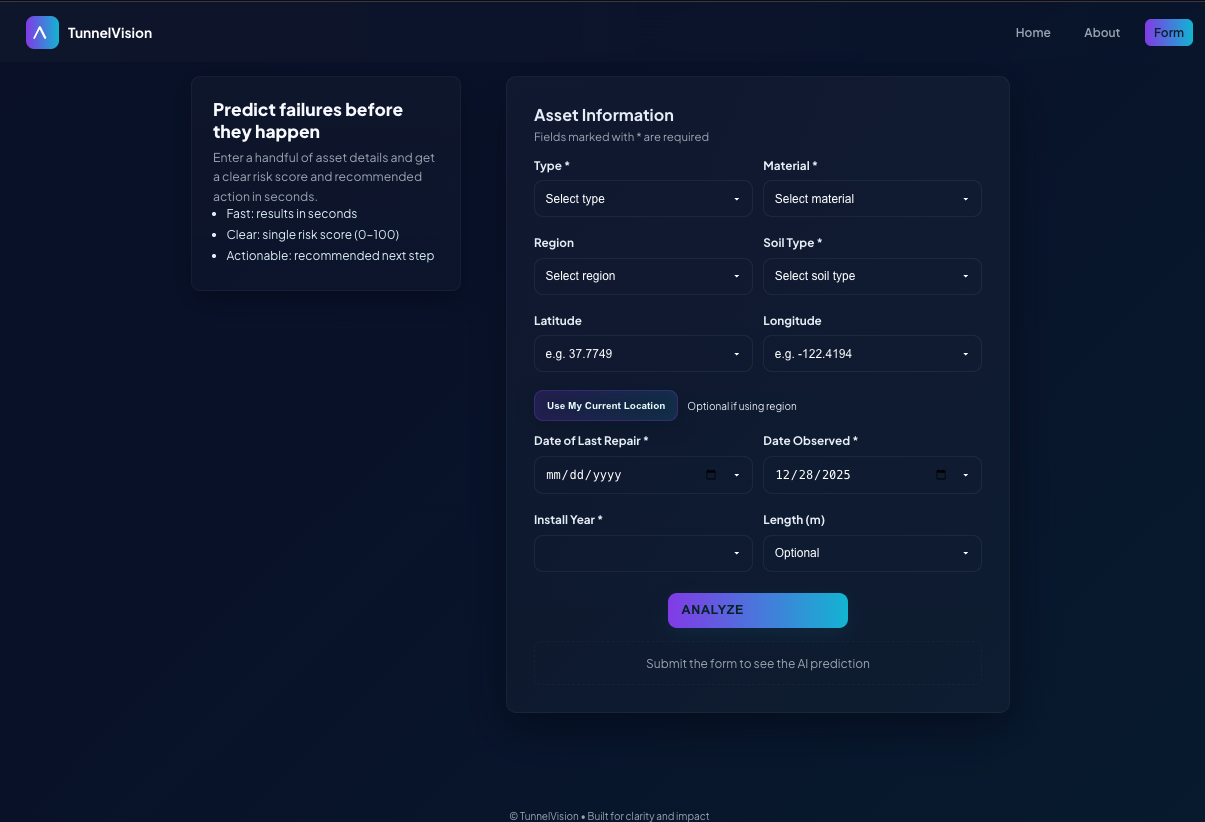
TunnelVision is an AI-powered predictive maintenance system designed to estimate short-term infrastructure failure risk.
For each infrastructure asset, the system:
- Predicts whether a failure is likely within the next 30 days
- Identifies the most probable failure type
- Assigns a risk score from 0–100
- Recommends maintenance actions and priority levels
These outputs are intended to support construction workers, maintenance crews, and city officials, helping them decide what to inspect or repair first and allocate limited resources more effectively.
How we built it
TunnelVision was built as a team project with clear responsibilities across data, modeling, and interface planning. As a beginner team, we focused on understanding the entire pipeline rather than optimizing a single component in isolation.
- Data: Generated realistic synthetic infrastructure data using mostly.ai, including features like environmental conditions, terrain, geographic context, asset characteristics, and maintenance history.
- Model: Trained Random Forest models using scikit-learn to predict short-term failure risk and failure type. Random Forests balanced performance with interpretability, crucial for civic applications.
- Integration: Structured outputs through APIs to connect backend predictions to a potential user-facing interface.
Challenges we ran into
- Steep learning curve: Our team started with almost zero experience in AI or predictive modeling and had to learn data preprocessing, model training, evaluation, and integration from scratch in just 20 days.
- Designing useful outputs: Making predictions actionable for real users required several iterations to ensure clarity and practicality.
- Team coordination: Aligning backend, frontend, and dataset design while learning new concepts in parallel was challenging but ultimately rewarding.
Accomplishments we’re proud of
- Successfully built an end-to-end AI system in the beginner division, covering data generation, model training, evaluation, and integration planning.
- Focused on decision support, translating predictions into maintenance priorities, rather than just raw model outputs.
- Maintained a privacy-conscious approach using synthetic data while modeling realistic infrastructure behavior.
What we learned
- Building AI systems depends heavily on dataset design, preprocessing, and problem framing—not just model selection.
- Transparent evaluation is critical. We learned how metrics reflect real-world usefulness and identified areas for future improvement, like additional features or more granular labels.
- Effective teamwork and communication are as important as technical skills, especially when learning new concepts under time pressure.
What’s next for TunnelVision
- Interactive Dashboard: Visualize assets by risk, filter by region/type/priority, and inspect individual predictions and recommended actions.
- Expanded Asset Coverage: Include bridges, streetlights, and other infrastructure types.
- Model Explainability: Integrate SHAP to show which factors most influenced predictions, improving transparency and trust.
Why this project scores across the rubric
| Criterion | How TunnelVision Addresses It |
|---|---|
| Impact (10 pts) | Directly addresses Bay Area infrastructure problems with actionable predictions. |
| Originality (5 pts) | Combines predictive modeling with decision-support and synthetic data, built by beginners. |
| Dataset & Preprocessing (5 pts) | Synthetic dataset carefully designed to reflect real-world Bay Area conditions. |
| Model (5 pts) | Trained and optimized Random Forest from scratch; not a pretrained black box. |
| Metrics (5 pts) | Evaluated model outputs honestly with future improvement plans. |
| Integration (5 pts) | API-level integration and planned interactive dashboard for usability. |
| Video & Report (5 pts) | Clear, professional presentation documenting the process, challenges, and learning. |
🎉 TunnelVision — Smarter cities in the making!
We strongly encourage you to check out our GitHub repo for more information on how we built TunnelVision and how to run the website. Note: The Render website link will take a while to load, but when it does, it'll be worth it. 😁
Write-Up Link: https://docs.google.com/document/d/19zGzIA-4s3O9Tfbtd0anQ0-j7daGi-T96RCTRp6KpLk/edit?tab=t.0
Built With
- corsmiddleware
- css
- datetime
- fastapi
- gradientboost
- html
- javascript
- joblib
- json
- math
- metrics
- numpy
- os
- pandas
- pydantic
- python
- randomforest
- requests
- scikit-learn
- scipy
- typing
- xgboost

Log in or sign up for Devpost to join the conversation.