-
-
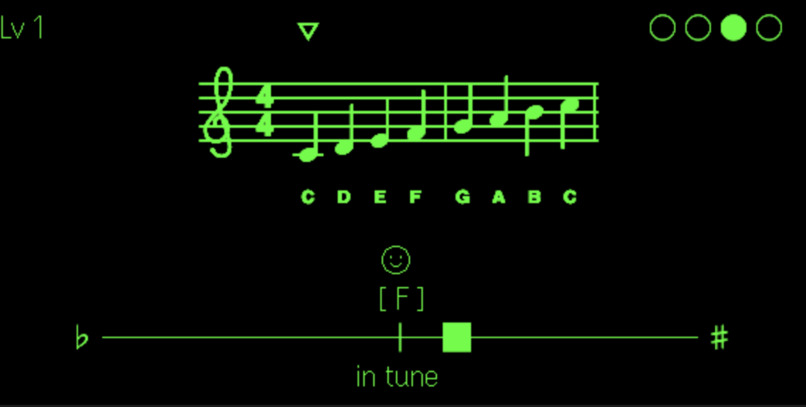
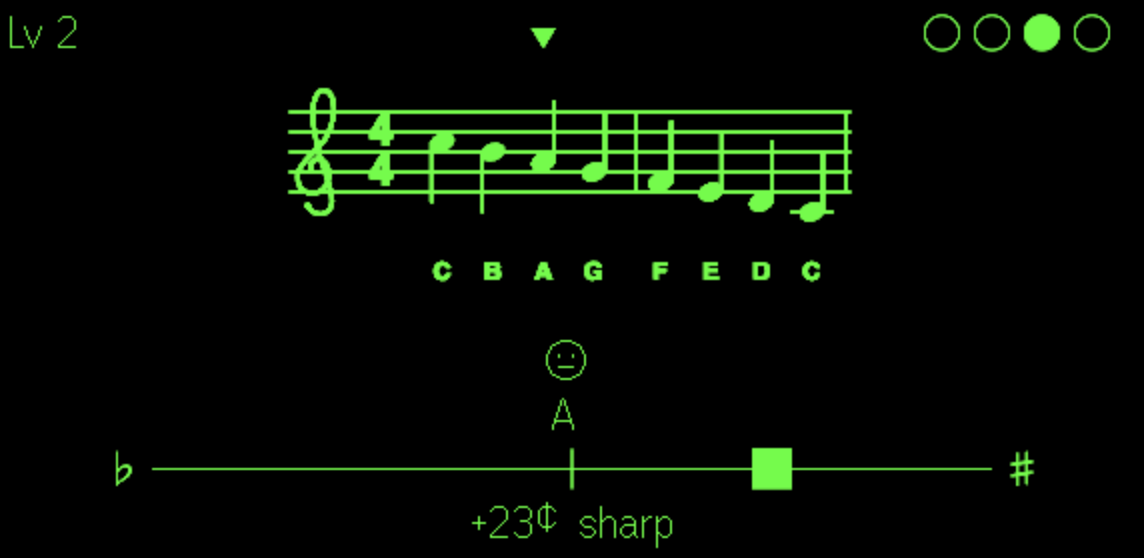
The arrow at the top shows the musician's place in the music piece. The emoji shows that the user is in tune, but playing the wrong note.
-
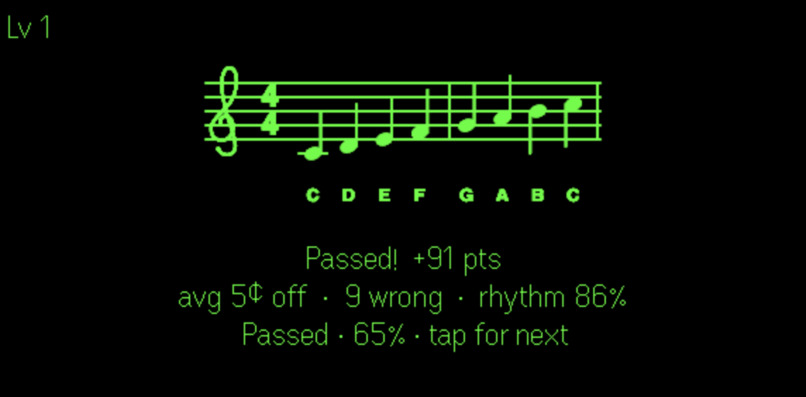
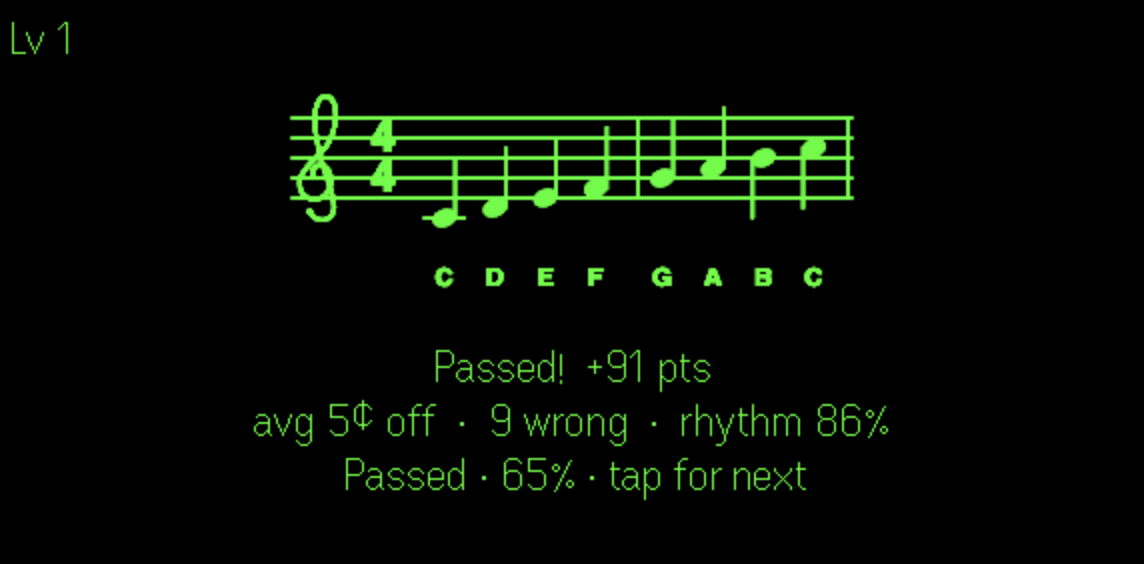
After completing a level, the user receives feedback summarizing their overall performance.
-
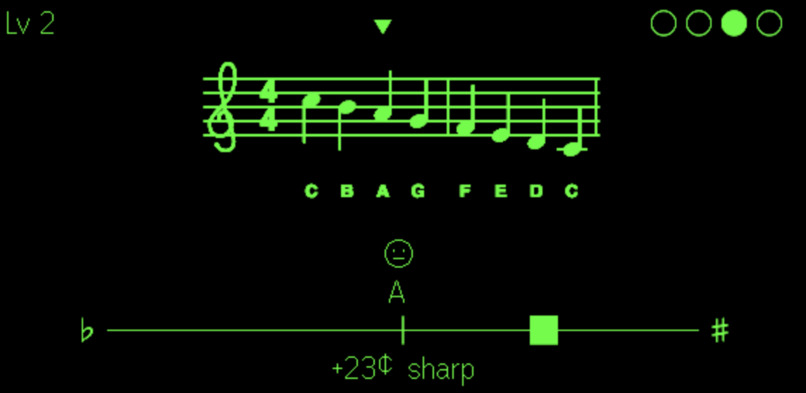
The user is in Level 2, but playing too sharp to be in tune. The four dots in the top right are the metronome to help keep you on beat.
Inspiration
We grew up playing instruments, from clarinet to cello, so we know what practicing alone is really like. You can play the F-sharp in bar 12 incorrectly hundreds of times before your teacher catches it the following week. By then, the mistake has already become a habit.
We wanted to give musicians useful feedback at the moment they need it, without asking them to put down their instrument or look away from the music.
What it does
Playing an instrument requires both hands and both eyes. Tuners, metronomes, tablets, and phones interrupt practice because you have to stop playing or shift your attention to another screen. TuneIn lives on Even G2, directly in the musician’s line of sight.
As you play, TuneIn listens and gives you simple feedback: in tune, sharp, flat, or off the beat. Sheet music appears one line at a time, and the metronome is visual instead of audible. Practice and accuracy are scored separately, so musicians advance by improving rather than repeating easy music for points.
How we built it
TuneIn combines the Even G2 display with real-time musical feedback and two Creao agents.
The Level Architect reviews a musician’s error history, identifies patterns such as playing flat above the top line or rushing through 6/8 passages, and creates the next level’s sheet music to target those weaknesses.
The Score Reader takes a photo of sheet music the musician already owns and converts it into lines designed for the glasses’ display.
Challenges we ran into
Our biggest design challenge was deciding how much information to show on such a small display. Feedback had to be useful without distracting the musician or covering the score. That led us to keep each message short, display only one line of music at a time, and make the metronome visual.
What we learned
We learned that a good wearable experience is not a smaller version of a phone app. It has to respect the user’s attention and fit naturally into what they are already doing. For musicians, that means keeping their hands on the instrument and their eyes on the music.
What's next for TuneIn
Next, we want to make TuneIn useful throughout a musician’s entire learning journey. That means supporting more instruments, improving pitch and rhythm detection in noisy environments, and expanding beyond single-line music. Longer term, TuneIn could support ensemble practice, where musicians receive private feedback without interrupting the group.
Built With
- creao
- photon
- typescript

Log in or sign up for Devpost to join the conversation.