Inspiration
Rohde & Schwarz asked for two things: track a handheld ZED X Mini stereo camera with an IMU as precisely as possible (Task 1), and turn a portable radar plus camera into a business (Task 2). We did both and connected them: a handheld radar image is only sharp if you know where the device was for every shot, to a fraction of a wavelength. Our Task 1 tracking is that missing piece.
What it does
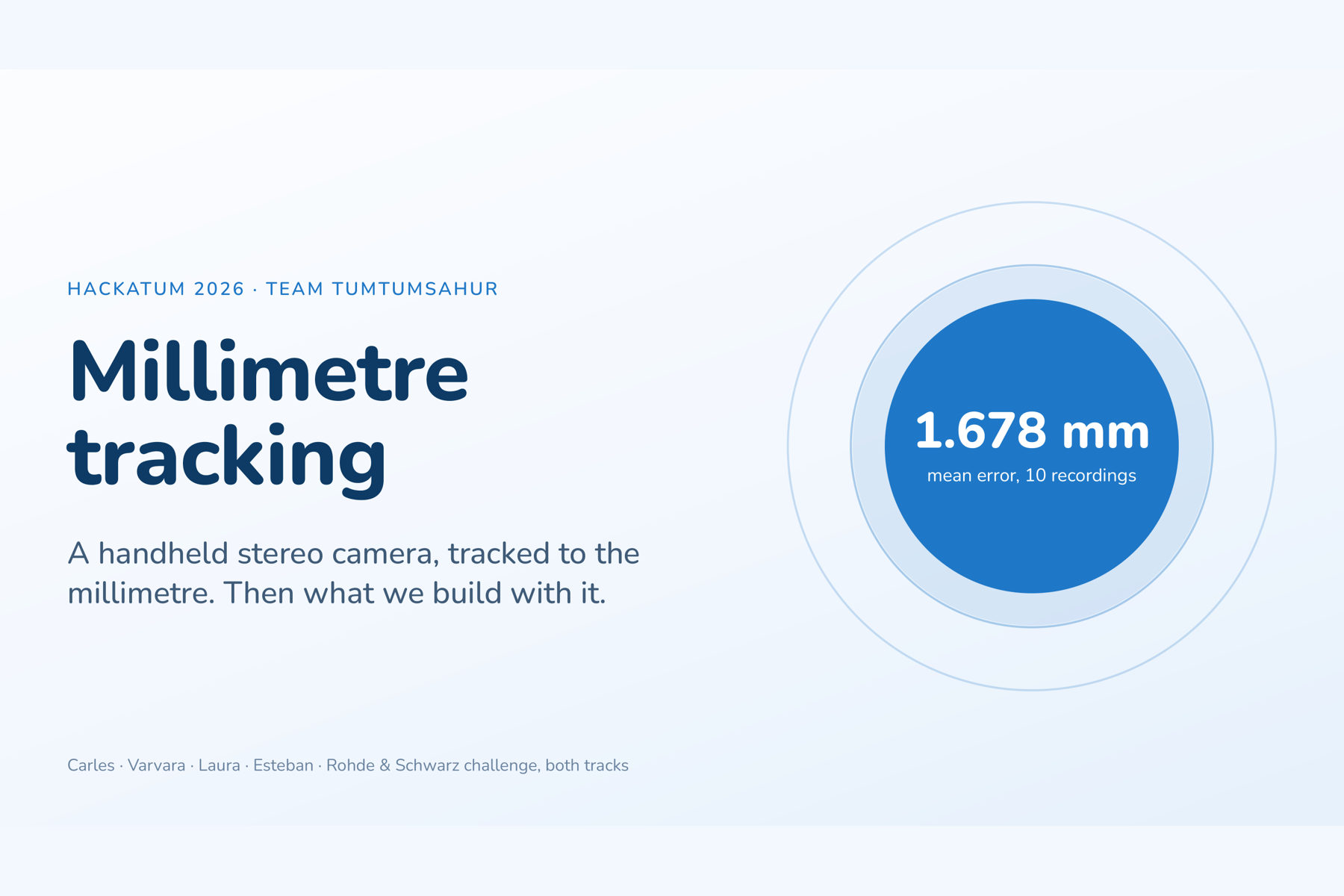
Task 1. Estimates the full 6DoF trajectory of the left camera for every frame. On the 10 training recordings: 1.678 mm mean position error, 0.185° mean orientation error (our replica of the organisers' metric). Trajectories for the 10 test recordings are in our submission.
Task 2: DrySight. A handheld scanner for water damage. The user sweeps a wall by hand, a 3–10 GHz radar looks into the wall, and our tracking places every radar shot where it was taken, so many blurry shots add up to one sharp image: a map of suspected moisture on a photo of the wall, to guide a targeted opening and a dated report. German insurers paid a record €4.9 bn for tap-water damage in 2024 (GDV). The imaging is simulated so far.
How we built it
- Stereo visual odometry (Laura, Esteban): corners tracked frame to frame, stereo matching, a fast-motion mode for blur.
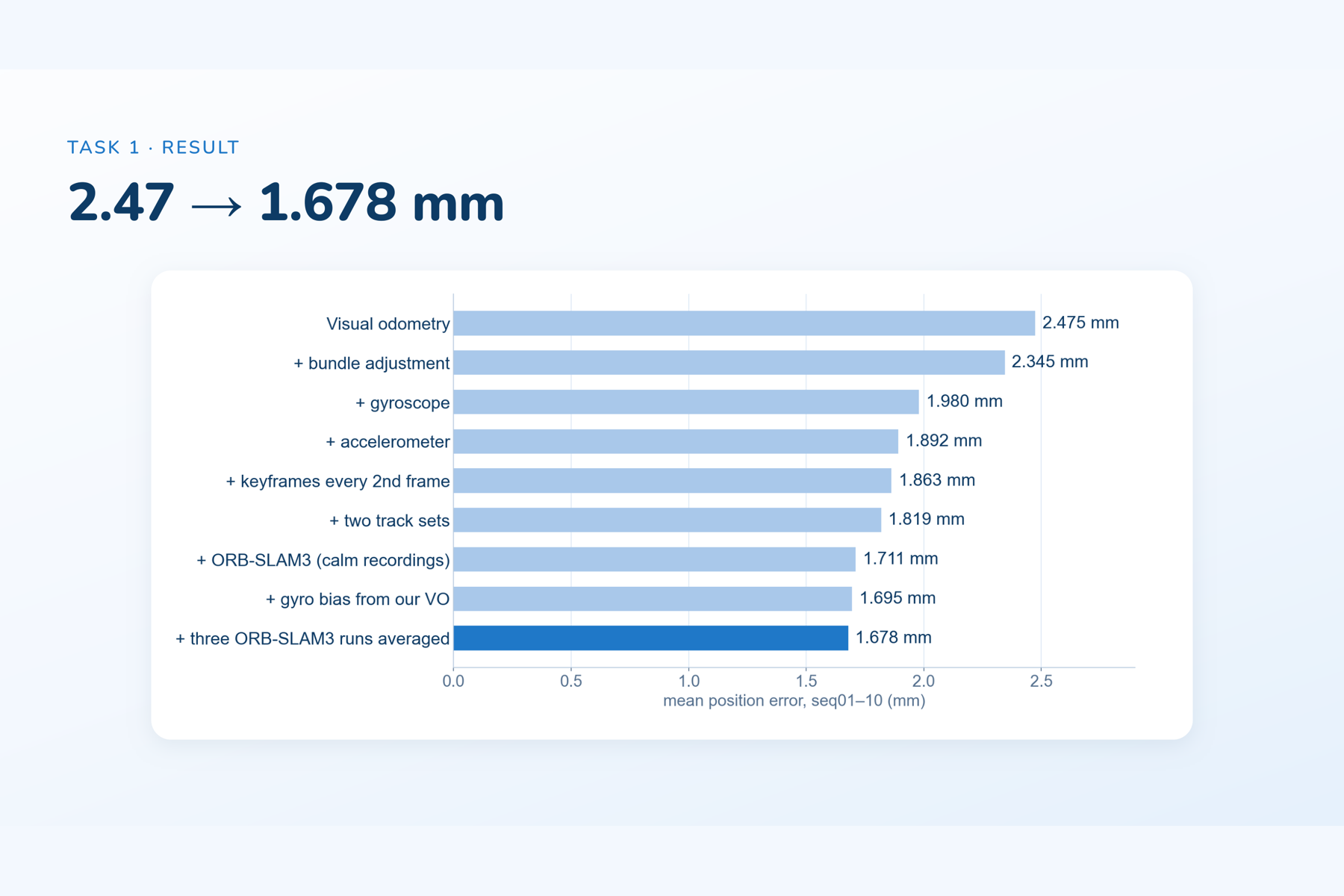
- Global stereo bundle adjustment (Varvara, Carles): Levenberg–Marquardt with Schur elimination and a Huber loss, with the gyroscope and accelerometer (IMU preintegration) inside the same optimisation, keyframes every second frame, and the gyro bias estimated by our own odometry.
- Ensembles: two bundle adjustments on different track sets are averaged; ORB-SLAM3 stereo (three runs, averaged) is added only where it agrees with us within 2 mm.
- Every step lowered the training mean: 2.47 mm (front-end alone) → 1.678 mm.
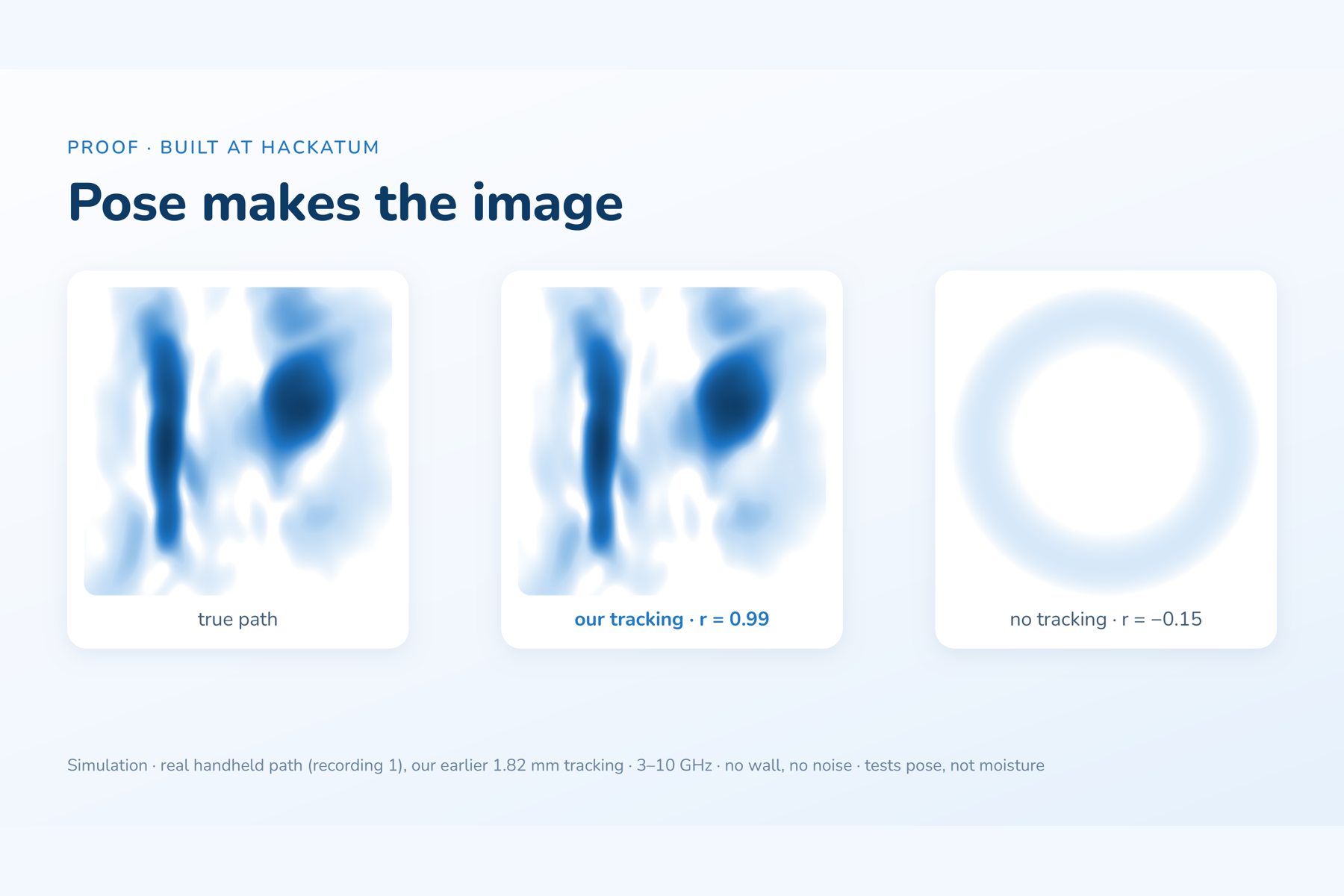
- DrySight proof: a radar simulation on a real handheld path from the data. With our tracking (an earlier 1.82 mm version) the simulated image matches the true-path image (correlation 0.99); without tracking only rings remain. This tests sensitivity to the pose, not moisture detection.
- Business case (Varvara): market, competitors, who pays, pricing and a pilot plan.
Challenges we ran into
- Fast, blurry hand swings (recording seq10): the visual front-end alone had 10.2 mm there; the IMU inside the bundle adjustment brings it to 4.8 mm.
- Building ORB-SLAM3 on a current Ubuntu/GCC needed several patches; its stereo-inertial mode failed to initialise, so we use stereo mode with an agreement gate.
- Avoiding overfitting with only 10 scored recordings: we fixed an adoption rule (lower mean and at least 7 of 10 recordings better), documented the two exceptions we made, and logged every experiment, including the ones we dropped.
Accomplishments that we're proud of
- 1.678 mm / 0.185° with a fully reproducible pipeline (commands in the README).
- A business case built directly on our own technical result.
What we learned
Sensor fusion wins where vision alone fails: the gyroscope inside the optimisation was the biggest single improvement. Careful evaluation matters as much as new ideas.
What's next for TUM TUM Sahur
A handheld DrySight prototype on wet test walls (~3 months), then a pilot with one insurer on real claims (~6 months). Our ask: one insurer for a pilot.
