-
-

Creator index
-

Inspiration
Starting in February 2027, YouTube’s monetization thresholds (YPP) will effectively double (increasing from 4,000 to 8,000 hours of watch time, or from 10 million to 20 million Shorts views). Furthermore, the proliferation of AI-generated summaries in search engines and social media has made it increasingly difficult to build broad awareness simply by providing useful information.
Our independent analysis of 116,268 channels in Japan revealed that 54.4% (63,274 channels) had fewer than 1,000 subscribers. TubeSaku was born from a strong desire to shine a spotlight on this "overlooked majority" of creators and to provide them with the recognition and economic opportunities they deserve.
What it does
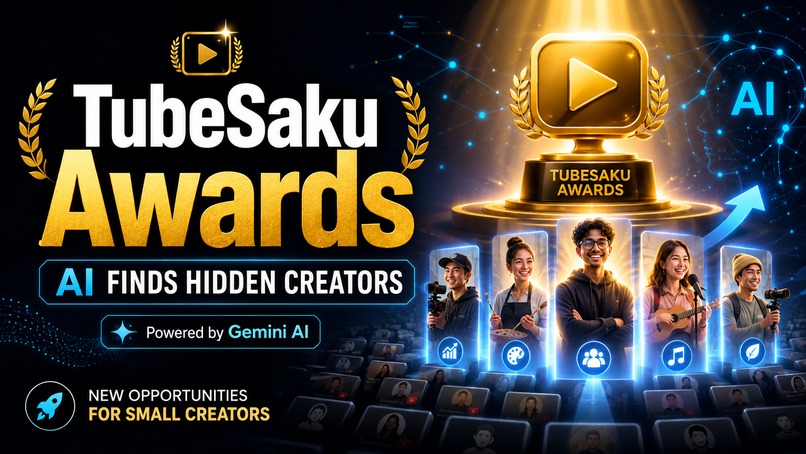
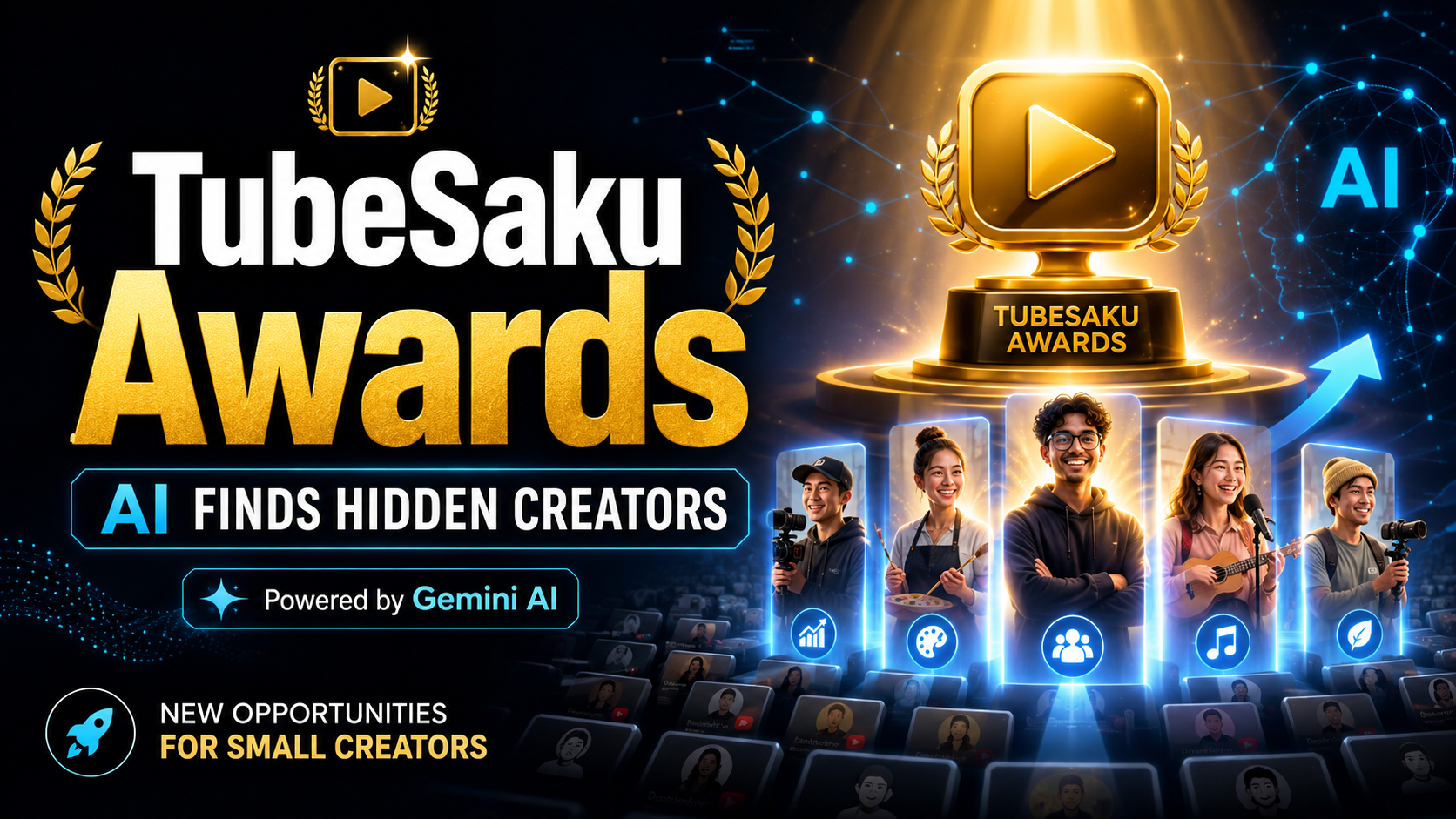
TubeSaku Awards is a platform where AI agents autonomously discover and score passionate, small-scale creators and automatically generate authoritative, public award and benchmarking pages.
AI-native Operations: Powered by Google Gemini 3.1 Flash lite, Gemini 3.7 Flash on GCP, AI agents autonomously execute tasks such as multimodal thumbnail analysis, evaluation of creator channel names and descriptions, and content planning (with humans focusing solely on strategy design).
Business Viability: Pivoted from a standard SaaS subscription model to a "Zero-CAC (Customer Acquisition Cost) profile claiming, listing, and matching model" that leverages AI-driven backlinks and mentions, thereby establishing sustainable unit economics.
Category Impact: By making hidden talent visible and evolving toward a system where creators can stock their own product shelves while delegating customer service to AI managers, the platform creates sustainable monetization opportunities beyond traditional ad revenue and memberships.
How we built it
- AI & LLM: Gemini 3.1 flash lite, 3.7 Flash on GCP (multimodal thumbnail analysis and text generation for evaluation rationale).
- Backend & Agent Pipeline: Python, GCE
- Database & Frontend: MySQL
- Observability: Continuous monitoring of API usage and latency using Google Cloud Operations Suite.
Challenges we ran into
The biggest challenge was the need to pivot multiple times. Initially, we planned to sell reports automatically generated by AI using data. However, we discovered that creators tend to have a craftsman-like mindset and prefer their own intuition over data.
Next, we considered a system to match small-scale creators (such as live streamers and game developers) with one another; however, many game developers believed that a good game would sell without the need for marketing.
We then explored monetizing a standalone diagnostic tool. Although we secured our first paid transaction of 100 yen when offering a thumbnail diagnostic tool (alpha version), we found it difficult to turn a profit—considering CAC (Customer Acquisition Cost) and cloud infrastructure costs—because clicks from organic search were being diverted to AI-generated summaries.
Consequently, we rapidly pivoted from simply selling a tool to building a platform that leverages the fact that our site is cited in AI summaries; this platform automatically discovers and recognizes creators, driving awareness back to them through backlinks and AI search results.
Accomplishments that we're proud of
Operated as a live product, stably executing 1,639 "Gemini thumbnail diagnoses" (with a peak of 105 in a single day) over a 78-day observation period.
Demonstrated a real-world market challenge—specifically that "54.4% of channels are non-monetizing"—based on large-scale data from 116,268 channels.
We launched our own YouTube channel and realized firsthand just how difficult it is for small-scale creators to get noticed.
Direct interviews at an indie game developer exhibition revealed that indie developers focus primarily on "creation," with few feeling the need for marketing.
Built an "AI-native business infrastructure" that goes beyond a simple chatbot to autonomously integrate data collection, analysis, and publication.
Completing and submitting the entry for this competition, despite having to pivot multiple times and nearly giving up.
What we learned
Because creators take great pride and care in their content production, they are often reluctant to simply accept external data or advice. Instead, they prefer to invest in elements that drive work opportunities and fan growth—such as visual appeal, visibility, credibility, and new prospects. A prime example of this is how popular Japanese VTubers invest heavily in their avatars and illustrations. These insights drove the development of an AI-powered awards and certification badge system.
What's next for TubeSaku Awards
・Rollout of premium subscription features (custom designs, custom awards) for verified creators.
・A system enabling fans to place requests with creators; AI managers handle the interactions, so creators do not need to deal with customer service themselves.
・Building a system that makes it easier for indie game developers and small-to-medium-sized businesses to propose live-stream promotional campaigns.


Log in or sign up for Devpost to join the conversation.