-
-

WebMCP
-
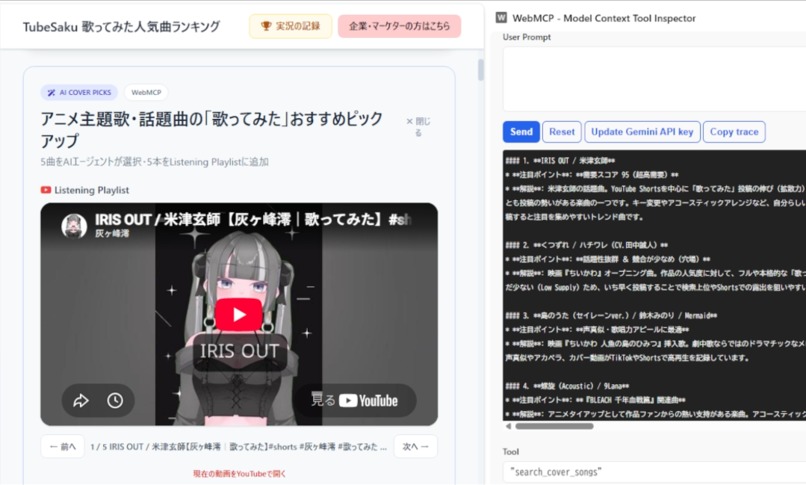
WebMCP - Model Context Tool Inspector
-
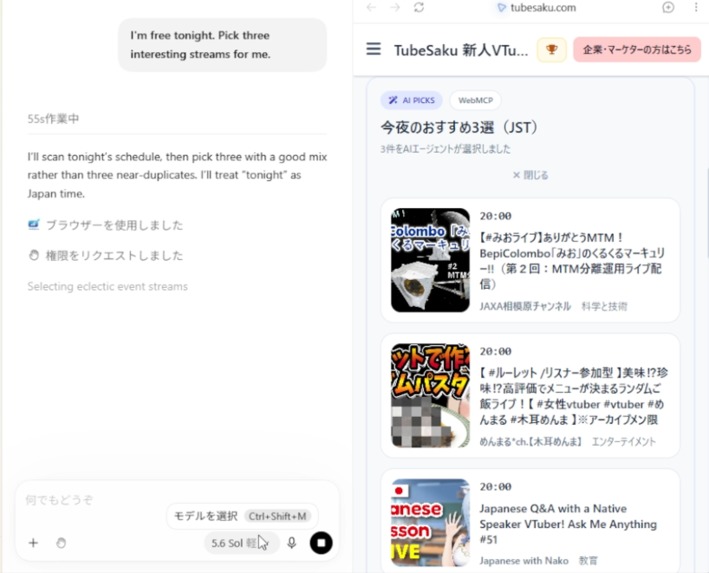
ChatGPT - Codex

Inspiration
YouTube’s recommendation algorithms are highly sophisticated, yet there are still situations where users struggle to find exactly what they want—for example, finding the right upcoming live stream at a specific time, or identifying a song that is popular but not already overcrowded with cover videos.
We operate TubeSaku, a website that collects and organizes Japanese YouTube data for creators and viewers. As the amount of data grew, however, we encountered a new problem: more data did not always make decisions easier. Users could see rankings, schedules, demand signals, and historical observations, but still had to decide where to start.
That led to the first idea behind TubeSaku WebMCP:
Let the website remain the expert on its domain data, while an external AI agent becomes the expert on the individual user.
The agent can understand what the user actually wants, query TubeSaku's structured evidence, compare the candidates, and then return its selections—and the reasons for those selections—back into the TubeSaku interface.
There was also a broader motivation.
AI is changing how people discover information on the web. Independent research from Pew Research Center found that users who encountered an AI-generated search summary clicked traditional search results less often than users who did not, while Google has reported that overall organic click volume remains relatively stable and that the clicks it sends are increasingly high-quality.
The exact aggregate impact is still debated, but the underlying incentive question is important for the open web:
What happens if websites continue producing useful information, but users increasingly consume the answer somewhere else without visiting the source?
For many websites, a visit is not only a click. It is how users discover a new service, understand who created the information, build trust, see related features, subscribe, purchase, or take another action.
TubeSaku WebMCP explores a different relationship between websites and AI agents: instead of treating the website only as raw material for an answer generated elsewhere, the agent can enter the first-party experience, use capabilities explicitly provided by the site, and make that site more useful for the user.
What it does
TubeSaku currently offers two WebMCP workflows.
Live Schedule
The first is designed for viewers.
Agents can search TubeSaku's Japanese YouTube live-stream data using criteria such as:
- date
- time
- keyword
- category
- debut status
For example, a user can ask:
“Find three gaming live streams tomorrow evening that look interesting.”
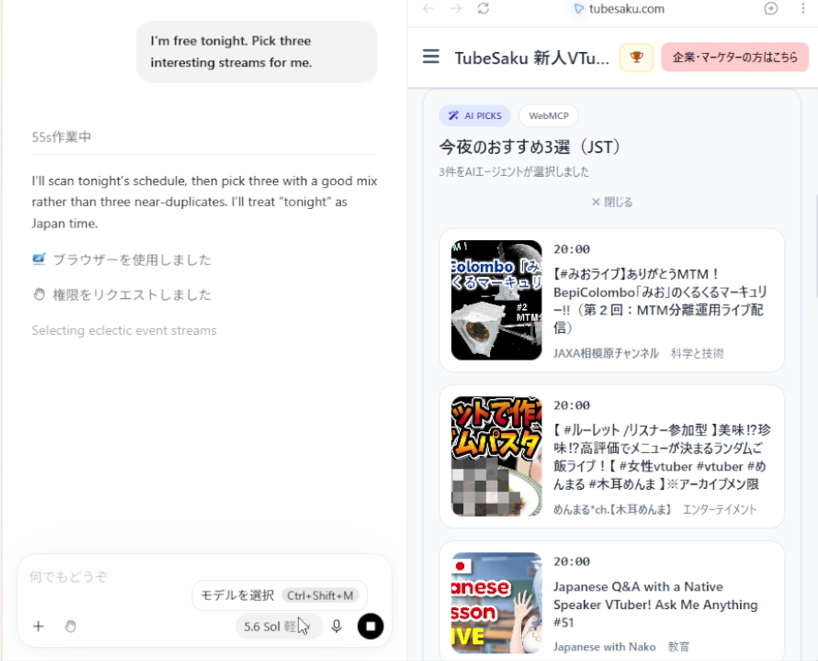
The agent searches TubeSaku, compares the returned candidates against the user's request, and then calls a second WebMCP tool to display its choices directly on the TubeSaku page as AI Picks.
The agent can also provide a short explanation for each selection. Those reasons are rendered inside TubeSaku alongside the underlying stream information.
So the result is not only:
agent → answer in chat
but:
agent → decision → explanation → personalized first-party page
Cover-song Planner
The second workflow is designed for VTubers, YouTubers, vsingers, and singers deciding what song to cover next.
TubeSaku combines several kinds of evidence, including:
- Japanese YouTube Charts
- recent cover-song upload activity
- historical cover availability where observed
- existing cover performance
- early-stage spread signals such as Shorts growth
The agent can answer questions such as:
“Find popular Japanese songs that are not currently overcrowded with new covers.”
TubeSaku does not hard-code one universal recommendation.
Instead, it exposes the evidence. The agent decides how those signals should be weighted for this particular user.
A creator seeking maximum demand might choose differently from a small VTuber looking for a less competitive opportunity.
At the time of submission, the live Cover Planner dataset compared 154 tracked songs against 4,891 recent cover observations from 3,439 YouTube channels.
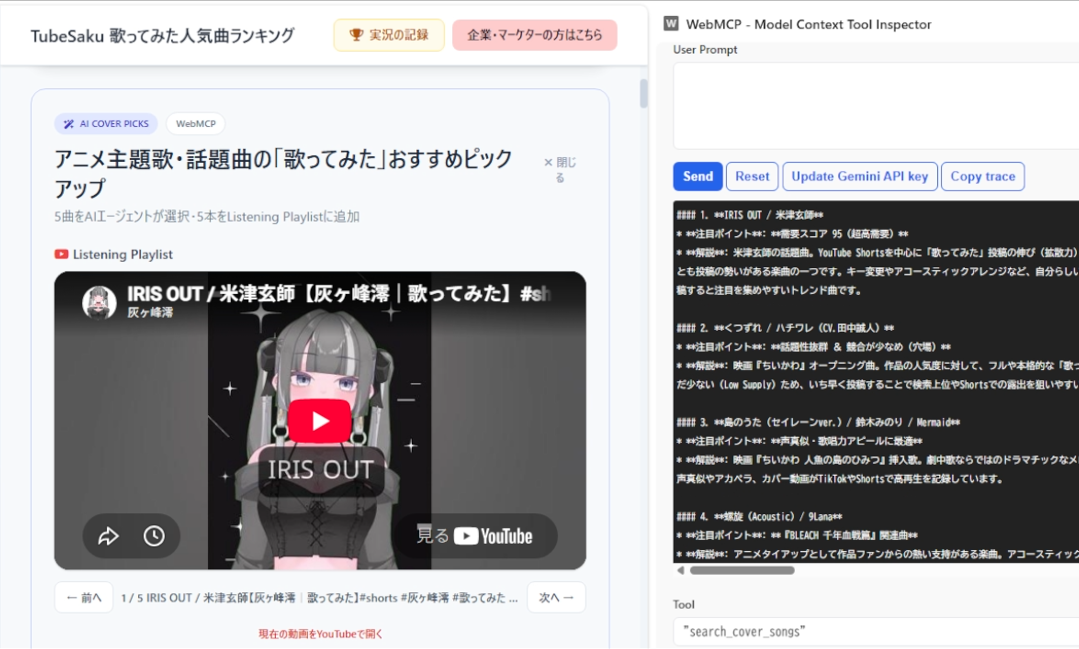
After making its decision, the agent can create AI Cover Picks directly inside TubeSaku, explain why each song was selected, and build an in-page listening playlist from validated existing YouTube cover videos.
This also enables cross-lingual use.
An English-speaking user can ask a question in English, the agent can reason over TubeSaku's Japanese data, explain its recommendation in English, and still preserve the original Japanese song and video titles.
How we built it
Hackathon scope
TubeSaku.com and its YouTube data pipeline existed before this challenge.
During the WebMCP Challenge submission period, we added the WebMCP layer shown in this submission:
- search_live_streams
- show_live_streams
- search_cover_songs
- show_cover_playlist
- first-party AI Picks interfaces
- agent-generated selection explanations
- an in-page cover-song listening playlist
- a standalone runnable demo using sample data
The public repository and dated commit history document the work completed during the challenge period.
A production data pipeline was already in place for TubeSaku. Local collectors and GCP-based jobs gather and clean observational data about YouTube in Japan, including live-stream schedules, YouTube Charts, recently uploaded cover videos, and observations of existing cover-song supply.
The WebMCP Challenge
WebMCP gave us a lightweight way to expose selected capabilities from that system directly to browser agents.
Both workflows use the same pattern:
TubeSaku first-party data
↓
WebMCP search tool
↓
Agent combines evidence with user context
↓
WebMCP show tool
↓
TubeSaku first-party UI
Live Schedule
search_live_streams
→ agent compares candidates
→ show_live_streams
→ AI Picks + selection reasons
Cover-song Planner
search_cover_songs
→ agent compares demand and supply evidence
→ show_cover_playlist
→ AI Cover Picks + reasons + Listening Playlist
We deliberately separate the search and display tools.
The display tools only accept IDs that appeared in the most recent search result. An agent therefore cannot arbitrarily inject unrelated streams or songs into the page.
Selection explanations are also associated with those validated IDs and rendered as text rather than trusted HTML.
For the Cover Planner, URLs exposed to the UI are validated, and listening examples are filtered before being exposed to the agent/player using checks including duration, obvious dance/clip false positives, public availability, and embeddability.
We also made the tool execution wrappers tolerant of browser implementations that invoke a WebMCP tool without an optional execution-context argument, which improved interoperability during testing across agent browsers.
Challenges we ran into
The biggest challenge was data quality.
Searching YouTube for Japanese cover-song terminology can also return:
- dance Shorts
- clips
- tutorials
- instrumental videos
- commentary
- unrelated songs with similar titles
- videos that technically match the query but are useless as listening examples
We therefore added multiple validation layers instead of trusting YouTube search results directly.
We also learned that browser lifecycle and first-party page architecture matter.
TubeSaku serves some pages as generated static HTML, so modifying a template did not necessarily update the deployed page immediately.
Playlist development exposed another set of subtle issues.
YouTube's embed playlist behavior did not match our initial assumptions, and dynamically initializing the IFrame Player API behaved differently inside an agent browser than in our minimal local environment.
We eventually simplified the implementation.
TubeSaku keeps the validated selected video IDs itself and changes a standard YouTube iframe when the user presses Previous or Next.
That solution was both simpler and more reliable.
Browser interoperability also produced a useful lesson: different WebMCP-capable environments do not necessarily supply every optional execution argument in exactly the same way. We adjusted our tools defensively and added regression tests for this case.
Accomplishments that we're proud of
We achieved a complete end-to-end WebMCP interaction on the live TubeSaku website:
natural-language request
→ WebMCP search
→ agent reasoning
→ validated selection
→ WebMCP UI action
→ first-party TubeSaku update
The latest version goes one step further.
The agent does not only return its selections—it can return the reason for each selection, and those explanations become part of the TubeSaku page.
The Cover Planner is especially exciting because the user can immediately inspect and listen to the evidence behind a recommendation while continuing the conversation with the agent.
Instead of returning five links in chat, the agent creates an interactive shortlist inside the service that produced the underlying evidence.
We also kept the WebMCP integration additive.
TubeSaku continues to function as a normal website in an ordinary browser. WebMCP-capable agents simply receive a richer structured interface.
That means adopting agent functionality does not require replacing the existing human-facing product.
What we learned
WebMCP becomes much more interesting when it is not merely a browser-accessible API.
A search-only tool can look very similar to REST or backend MCP.
The experience becomes distinctly WebMCP when the agent can:
understand the current page
→ use first-party capabilities
→ combine them with user context
→ make a decision
→ explain that decision
→ change the current first-party experience
We also learned that separating domain evidence from recommendation logic creates a useful division of responsibility.
TubeSaku knows things the user's general-purpose AI agent may not know:
- Japanese YouTube activity
- current schedules
- observed demand
- observed supply
- creator-specific data signals
The agent knows things TubeSaku should not need to know:
- what the user just asked
- their language
- their immediate constraints
- preferences they have chosen to share with that agent
WebMCP lets those two forms of knowledge meet at the moment of decision.
A possible model for the agentic open web
This also changed how we think about the relationship between AI agents and websites.
One possible future is that websites increasingly become invisible data sources: information is crawled, summarized, and delivered somewhere else.
That is convenient for many user tasks, but it can create a difficult incentive problem for the organizations that continue producing and maintaining high-quality web resources.
WebMCP suggests another possibility.
A website does not have to choose only between blocking AI and being consumed by AI.
It can expose useful, intentional capabilities to agents while keeping the resulting interaction inside its own first-party experience.
In that model:
Website owns domain expertise and capabilities
Agent owns user context and reasoning
Browser connects them
User gets the combined experience
This makes the browser more than a container for pages.
It can become a coordination layer between humans, agents, and first-party web applications.
For us, that is one of the most interesting possibilities of WebMCP.
Instead of shrinking the open web into a corpus behind an answer box, agents can make individual websites more useful.
What's next for TubeSaku WebMCP
The current implementation is the first step toward a personalized streaming and creator-planning environment built jointly by TubeSaku and AI agents.
Next we want to connect more of TubeSaku's existing datasets:
- Live Schedule
- Popular Games
- Streamer Database
- Cover-song Trends
- Creator Profiles
A user could then ask:
“Build my streaming schedule for this weekend.”
“Find smaller Japanese creators playing games I like.”
“Find songs that match my taste but are not overcrowded with covers.”
And instead of receiving only a textual answer, users could save, rearrange, play, compare, and refine those selections directly inside TubeSaku.
Longer term, WebMCP could also work with the user's existing first-party TubeSaku session for features such as:
- favorites
- saved schedules
- saved creator lists
- premium datasets
- personalized actions
This creates a healthier division of responsibilities.
The AI agent does not need to replicate TubeSaku's specialized data infrastructure.
TubeSaku does not need to build its own general-purpose AI assistant or maintain a detailed behavioral profile for every possible user.
Each side contributes what it does best.
Our long-term goal is for TubeSaku to become a high-quality Japanese YouTube data layer and first-party workspace for AI agents—demonstrating one possible future in which AI increases the value of visiting the web rather than removing the website from the interaction.
Built With
- chrome
- codex
- webmcp


Log in or sign up for Devpost to join the conversation.