-
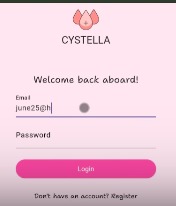
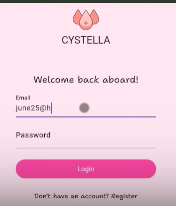
Patient Login
-
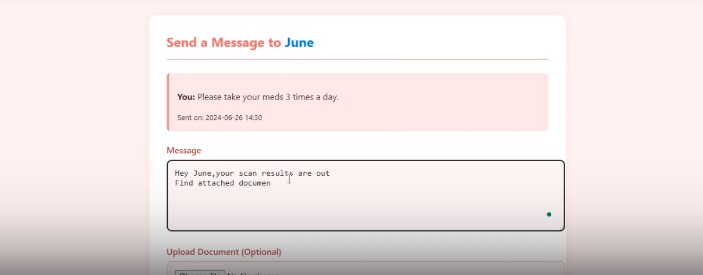
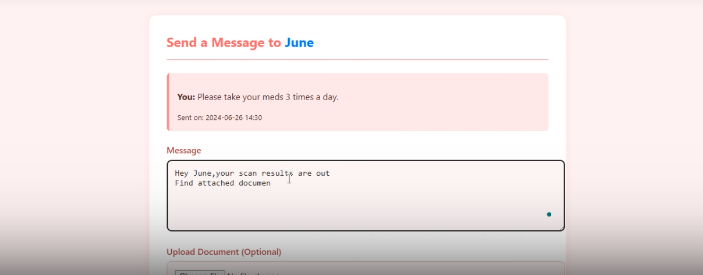
Doctor Message Patient feature
-
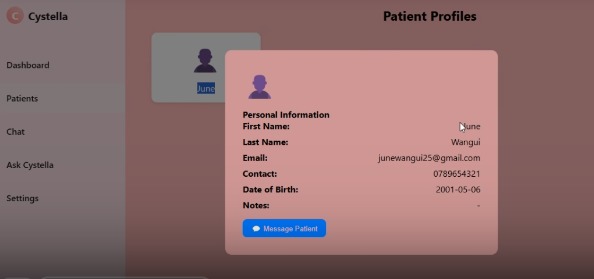
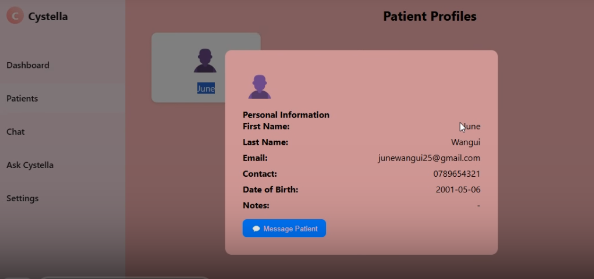
Dashboard,Patient profile on Doctor side
-
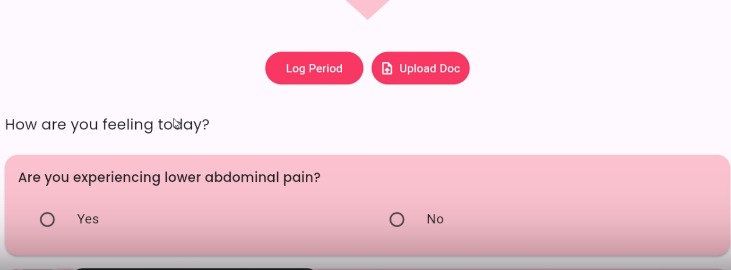
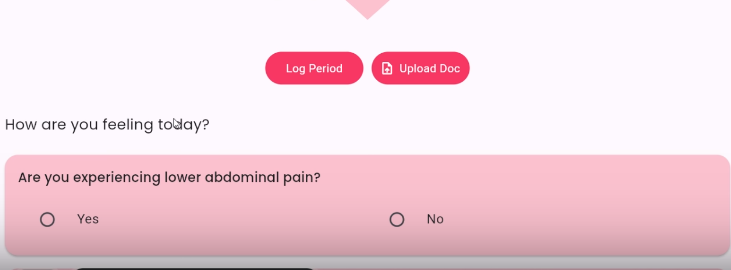
Period tracker
-
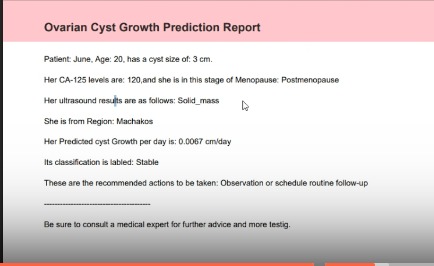
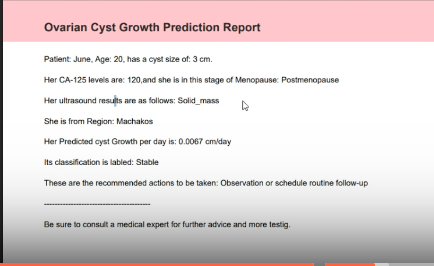
Cyst prediction doc
-
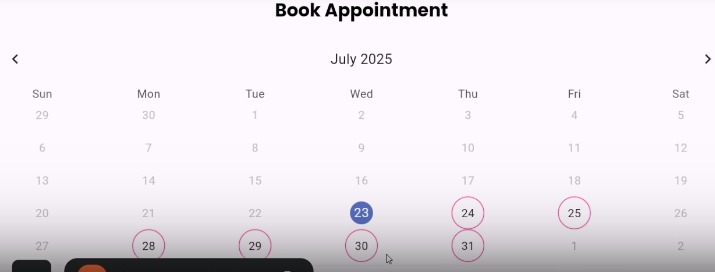
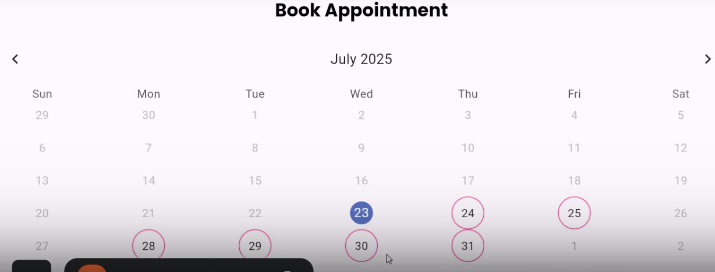
Appointment booking in Patient app
-
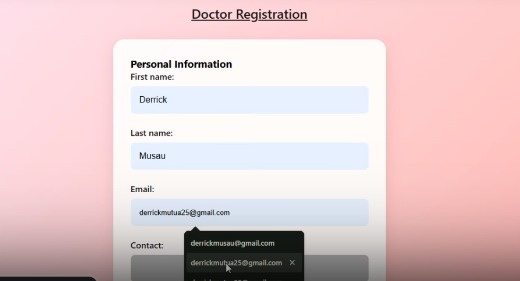
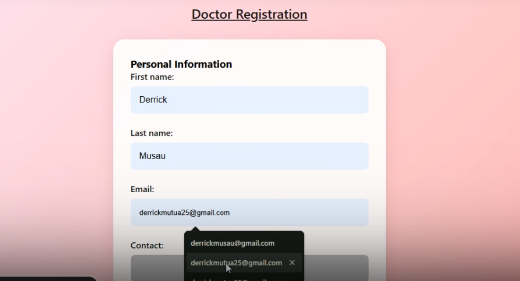
Doctor Registration
-
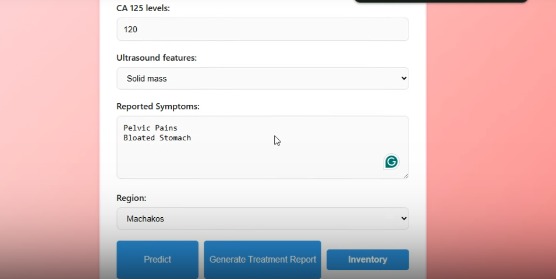
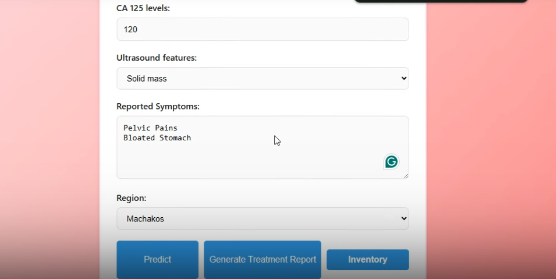
Cyst Prediction,treatment costs feature and Inventory tracking button
-
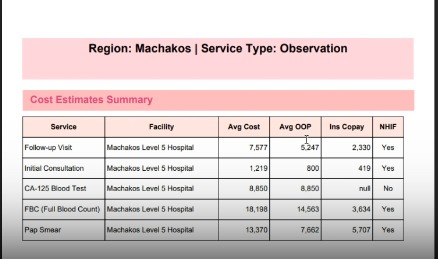
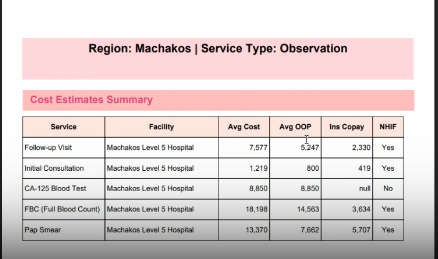
Treatment cost estimates doc
Inspiration
Cystella was born out of a deep concern for the women who suffer silently from ovarian cysts due to delayed diagnosis and limited access to reproductive health support. In many parts of the world, women are misdiagnosed or undiagnosed until complications arise simply because there are no early warning systems in place. The emotional, physical, and financial toll is often immense. We envisioned a world where technology could step in not to replace doctors, but to assist them; not to complicate care, but to simplify it. Cystella aims to give women a voice in their own health journey by leveraging AI to detect potential cyst complications early and offer data-driven insights for timely intervention.
By integrating AI, mobile technology, and a patient-centered design, Cystella creates a space for women to track their health with confidence. More than just an app, it’s a bridge connecting underserved patients to quality care and equipping doctors with the tools to act sooner. With every prediction, report, and shared insight, we are not just monitoring cysts we’re restoring agency, dignity, and hope. Cystella stands for smarter healthcare and a future where no woman is left in the dark about her reproductive health.
What it does
Cystella is an AI-powered ovarian cyst monitoring system designed to support early detection and personalized reproductive healthcare. It functions as both a mobile app for patients and a web-based dashboard for doctors. Users input their menstrual and health data such as symptoms, cycle patterns, or medical scan results into the app. This data is securely analyzed by healthcare providers and fed into a predictive AI model that estimates cyst growth rates and classifies cysts by risk level (e.g., slow-growing or fast-growing). The system then generates personalized reports with visual graphs and clinical insights to help patients understand their reproductive health more clearly. Doctors use the web platform to manage patient data, review AI-generated growth predictions, and track each case over time. Patients, in turn, can download or share their reports directly from their phones, allowing for more informed consultations even remotely. Cystella bridges the communication gap between patients and providers, especially in low-resource settings, by ensuring timely, data-backed decisions. Ultimately, it empowers women with proactive health insights while giving medical professionals the tools they need to intervene earlier, reducing the risks associated with late ovarian cyst diagnosis.
How we built it
Cystella was developed as a full-stack system combining mobile and web technologies with machine learning. The patient-facing side is a mobile application built using Flutter for cross-platform compatibility and an intuitive user experience. It allows users to input menstrual and symptom-related data, access personalized reports, and receive health alerts. On the backend, we used Python with frameworks like FastAPI to create secure APIs that connect the mobile app to the prediction engine and database. MongoDB was used for flexible and scalable data storage to accommodate varying health data from multiple users. The core of Cystella is its AI-powered prediction model. We trained the model using PyCaret with ensemble methods such as LightGBM and CatBoost to forecast ovarian cyst growth rates. The model classifies cysts by risk and generates clinical reports with charts and recommendations. Healthcare providers access these insights through a web-based dashboard built with Django and Bootstrap, which facilitates report review, patient management, and communication. The entire system is designed with user privacy and data security in mind, ensuring sensitive reproductive health data is protected while delivering actionable insights in real time.
Challenges we ran into
- We were working on a big and complex project, so one of the main challenges was figuring out how to realistically approach and integrate all the parts into a working solution. It required a lot of coordination and creative problem-solving. ## Accomplishments that we're proud of
- We are proud of how we managed to bring together a large system and make it work end-to-end. From patient interactions to prediction models and inventory tracking—it felt like building something truly impactful.
What we learned
Collaboration: We’ve seen how important it is to stay respectful, communicate well, and maintain good relationships in a team.
Team dynamics: Working as a team helped us brainstorm more creatively. Two heads—actually three in our case—are definitely better than one! We moved faster and came up with stronger ideas because we supported each other throughout.
What's next for TTW
Looking ahead, the next phase for Cystella focuses on expanding its medical accuracy, accessibility, and offline capabilities. We plan to enhance the AI model using a larger, more diverse dataset including anonymized sonographic and clinical records to improve prediction precision across various cyst types and patient demographics. Additionally, we aim to integrate Natural Language Processing (NLP) to allow doctors and users to interact with the system through voice or typed queries, making the platform more intuitive for non-technical users. We also intend to roll out offline functionality for remote or low-connectivity regions, allowing users to track and store health data without constant internet access. Partnering with gynecologists and healthcare institutions will help validate the system medically and drive adoption. Furthermore, we hope to develop multilingual support and integrate Cystella into existing electronic health record (EHR) systems for broader clinical use. Ultimately, our vision is to make Cystella a trusted, AI-assisted companion in every woman’s reproductive health journey helping catch issues earlier, reducing stigma, and promoting smarter, patient-centered care.
Built With
- and-user-logs-machine-learning-&-prediction-pycaret-?-for-training-and-deploying-the-cost-prediction-model-scikit-learn-?-for-cyst-growth-prediction-pandas
- catboost
- codelabs
- css
- dart
- django
- fastapi
- flutter
- github
- inventories
- javascript
- lightgbm-deployment-platforms:-localhost-(current)
- localip's
- loom
- mongodb
- numpy
- postman
- pycaret
- python
- restfulapis
- sharedpreferences/getstorage
- skicit-learn
- sqlite-(for-prototyping)-?-plan-to-migrate-to-postgresql-ai/ml-tools:-pycaret
- tech-stack-frontend:-html
- vscode


Log in or sign up for Devpost to join the conversation.