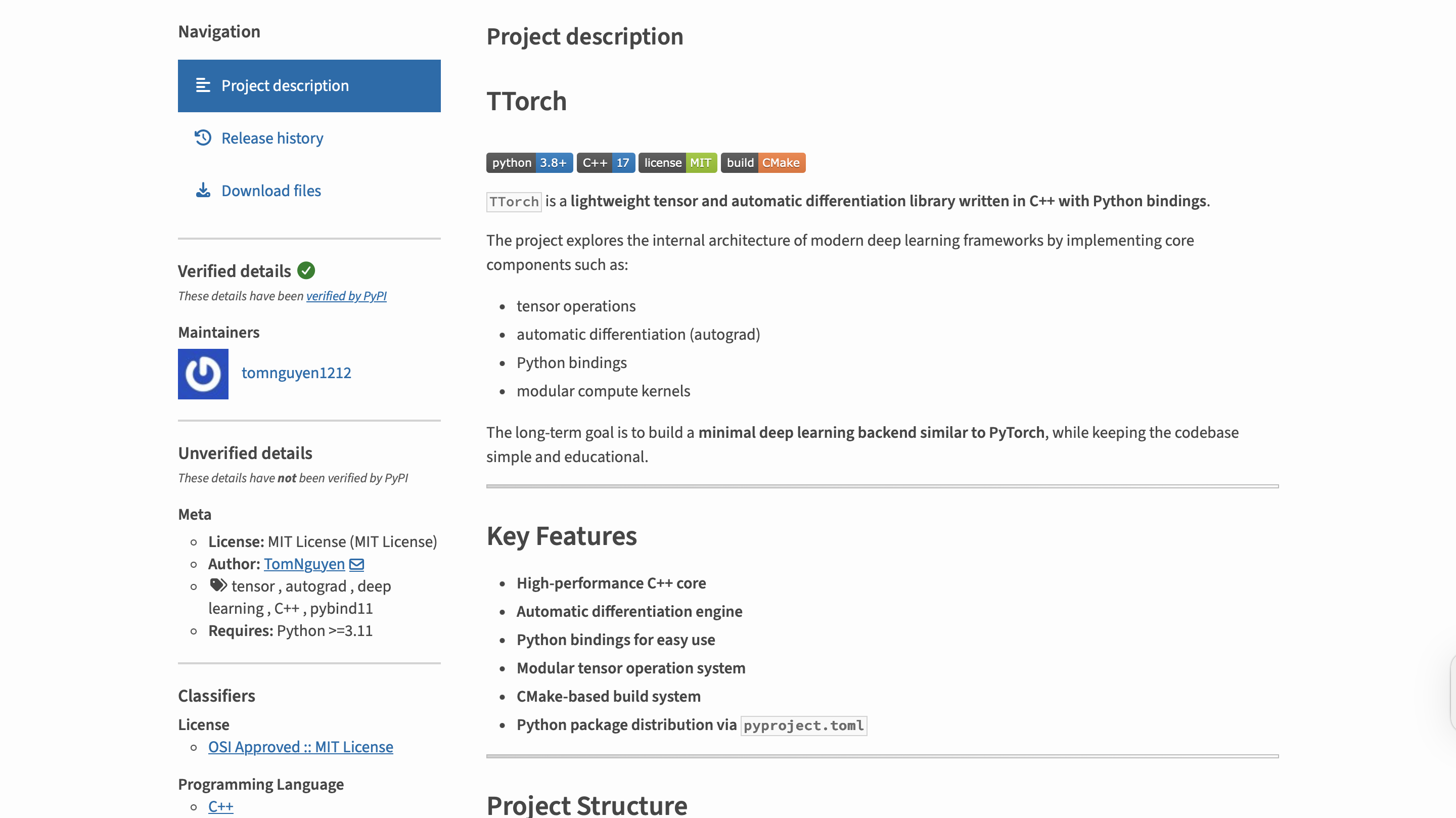
TTorch


TTorch is a lightweight tensor and automatic differentiation library written in C++ with Python bindings.
The project explores the internal architecture of modern deep learning frameworks by implementing core components from scratch: tensor operations, a dynamic computation graph, backpropagation, and Python bindings via pybind11.
Features
- C++17 core — tensors, math ops, shape manipulation
- Dynamic autograd engine — computation graph built during the forward pass, traversed in reverse on
backward() - Activation functions —
relu,sigmoidwith gradient tracking - Python bindings — full API exposed via pybind11
- scikit-build-core build backend —
pip installworks out of the box - CI/CD — wheels built via cibuildwheel and published to PyPI on push to
main
Project Structure
TTorch/
├── pyproject.toml        # Python build config (scikit-build-core + pybind11)
├── CMakeLists.txt        # C++ build config
├── README.md
├── AUTOGRAD.md           # Deep-dive into the autograd design
├── LICENSE
│
├── include/
│   ├── tensor.h          # Tensor class declaration + autograd fields
│   └── autograd.h        # GradFn base class + all GradFn subclasses
│
├── src/
│   ├── tensor.cpp        # Tensor ops + forward graph building
│   ├── autograd.cpp      # Backward engine + gradient rules
│   └── bindings.cpp      # pybind11 Python bindings
│
├── ttorch/
│   └── __init__.py       # Python package entry point
│
└── tests/
    └── test.cpp          # C++ unit tests
Installation
From PyPI (recommended)
pip install ttorch
From Source
git clone https://github.com/DuongAnh1212/TTorch.git
cd TTorch
pip install .
Or build a wheel manually:
pip install build
python -m build
pip install dist/*.whl
Requirements: Python 3.11+, a C++17-capable compiler, CMake.
Quick Start
Python
import ttorch

# Create tensors
a = ttorch.Tensor.form([2, 3], [1, 2, 3, 4, 5, 6])
b = ttorch.Tensor.ones([2, 3])

# Math ops
c = a.add(b)          # element-wise addition
d = a.multiply(b)     # element-wise multiplication
e = a.dot(a.T())      # matrix multiply → shape (2, 2)
s = a.sum(0)          # sum along axis 0 → shape (3,)

# Autograd
a.requires_grad = True
y = ttorch.relu(a)
y.backward()
print(a.grad)         # gradient of a
a.zero_grad()
C++
#include "tensor.h"
#include "autograd.h"

Tensor a = Tensor::form({2, 3}, {1, 2, 3, 4, 5, 6});
a.requires_grad = true;

Tensor y = relu(a);
y.backward();

a.grad->print();  // gradient of a
a.zero_grad();
Tensor API
Factory Methods
| Method | Description |
|---|---|
Tensor::zeros(dims) |
Tensor filled with 0.0 |
Tensor::ones(dims) |
Tensor filled with 1.0 |
Tensor::custom(dims, val) |
Tensor filled with a scalar |
Tensor::form(dims, data) |
Tensor from a vector<double> |
Shape & Access
| Method | Description |
|---|---|
dims() |
Returns shape as vector<int> |
ndim() |
Number of dimensions |
size(dim) |
Size of a given dimension |
at(index) |
Element access by multi-index |
reshape(newshape) |
Returns reshaped tensor |
view(newshape) |
Alias for reshape |
flatten() |
Returns 1D tensor |
Math Operations
| Method | Description |
|---|---|
add(Tensor) |
Element-wise addition |
add_int(double) |
Scalar broadcast addition |
scale_int(double) |
Scalar broadcast multiply |
multiply(Tensor) |
Element-wise multiplication |
dot(Tensor) |
Matrix multiplication (1D and 2D) |
transpose() / T() |
Transpose a 2D tensor |
sum(axis) |
Sum along axis |
mean(axis) |
Mean along axis |
Autograd
| Method | Description |
|---|---|
backward() |
Backpropagate gradients through the computation graph |
zero_grad() |
Reset accumulated gradient to zero |
Autograd API
TTorch implements a dynamic computation graph — the graph is built automatically during the forward pass as a chain of GradFn pointers.
Gradient Functions
| GradFn | Forward op | Backward rule |
|---|---|---|
AddBackward |
add(a, b) |
grad flows to a and b unchanged |
AddScalarBackward |
add_int(a, s) |
grad flows to a unchanged |
MulBackward |
multiply(a, b) |
grad_a = grad * b, grad_b = grad * a |
ScaleBackward |
scale_int(a, s) |
grad_a = grad * s |
DotBackward |
dot(a, b) |
grad_a = grad @ b.T, grad_b = a.T @ grad |
TransposeBackward |
transpose(a) |
grad_a = grad.T |
FlattenBackward |
flatten(a) |
grad_a = grad.reshape(original_shape) |
SumBackward |
sum(a, axis) |
broadcast grad back to original shape |
MeanBackward |
mean(a, axis) |
broadcast grad / n back to original shape |
ReLUBackward |
relu(a) |
grad_a = grad * (a > 0) |
SigmoidBackward |
sigmoid(a) |
grad_a = grad * sigmoid(a) * (1 - sigmoid(a)) |
Activation Functions
| Function | Description |
|---|---|
relu(Tensor& x) |
Element-wise ReLU with gradient tracking |
sigmoid(Tensor& x) |
Element-wise sigmoid with gradient tracking |
Architecture
Python API (ttorch)
      ↓
pybind11 bindings  (src/bindings.cpp)
      ↓
C++ Core
  ├── Tensor + math ops   (include/tensor.h, src/tensor.cpp)
  └── Autograd engine     (include/autograd.h, src/autograd.cpp)
The backward engine uses topological sort to visit nodes in reverse dependency order, accumulating gradients into leaf tensors. See AUTOGRAD.md for a detailed design walkthrough with worked examples.
Build from C++ Only
mkdir build && cd build
cmake ..
make
Roadmap
- [x] Core tensor data structure
- [x] Tensor math operations (add, multiply, dot, transpose, sum, mean)
- [x] Autograd computation graph (GradFn architecture)
- [x] Backpropagation engine (
backward,zero_grad) - [x] Activation functions (relu, sigmoid)
- [x] Python bindings (pybind11 via scikit-build-core)
- [x] PyPI publishing via CI/CD (cibuildwheel + GitHub Actions)
- [ ] Neural network modules (Linear, loss functions)
- [ ] Optimizers (SGD, Adam)
- [ ] GPU backend
Dependencies
| Dependency | Purpose |
|---|---|
| C++17 | Core library |
| CMake | Build system |
| Python 3.11+ | Python interface |
| pybind11 | Python bindings |
| scikit-build-core | Python build backend |
License
MIT — see LICENSE.


Log in or sign up for Devpost to join the conversation.